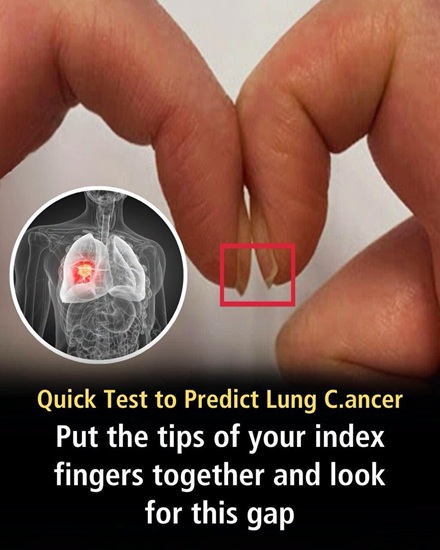
A small change in the appearance of the fingers can sometimes provide useful information about a person’s health, which is why a simple observation known as the Schamroth window test has attracted considerable attention online. The test involves placing corresponding fingernails together and looking for a small diamond-shaped space between them. When that gap is absent, the fingers may show a change known as digital clubbing or finger clubbing. Clubbing can occur in association with several medical conditions, including some diseases affecting the lungs and heart.
Lung cancer is one possible cause, but it is important to understand that the finger test cannot diagnose cancer. Anyone who notices new clubbing should have the change assessed by a healthcare professional rather than attempting to determine the cause at home. Finger clubbing refers to a gradual change in the shape of the fingertips and nails. The ends of the fingers can become broader or more bulbous, while the nails may curve more strongly than usual. The tissue around the nail bed can also appear softer or shinier.
These changes commonly affect both hands, although patterns can vary depending on the cause. Clubbing usually develops over time rather than appearing suddenly in a single day. Cancer Research UK notes that the process can progress more quickly in some conditions, including certain lung infections such as a lung abscess. One of the easiest ways clinicians and patients may notice possible clubbing is by looking at the angle and space between the nails. In a person without clubbing, placing the backs of corresponding fingers together so that the nails touch usually leaves a small diamond-shaped opening between the nail beds.
This space is sometimes called the Schamroth window. When clubbing is present, changes in the shape of the fingertips can cause that window to disappear. The absence of the gap can support suspicion of clubbing, but it does not reveal why the change has occurred. A medical evaluation is still needed to determine whether there is an underlying condition. The test itself is simple. A person can bring the same finger from each hand together, commonly the index fingers, with the nails facing one another. The nails are then positioned so that the nail plates touch. A small opening would normally be visible near the base of the nails. If there is no opening and the nail beds sit directly against one another, possible clubbing may be present. This observation should be treated as a reason to seek medical advice if the change is new, not as a home cancer test.

The distinction is important because social-media posts sometimes describe the Schamroth window test as though it can reveal lung cancer within seconds. That is not what the test does. Lung cancer can cause finger clubbing in some people, but many people with lung cancer do not have clubbing at all. Cancer Research UK notes that finger clubbing is seen particularly in association with some lung and heart conditions and can also occur with diseases that have nothing to do with cancer. A normal finger appearance therefore cannot rule out lung cancer, while an abnormal appearance does not prove that cancer is present.
The NHS lists finger clubbing among the less common possible symptoms of lung cancer. More common symptoms include a persistent cough, a longstanding cough that changes or becomes worse, recurring chest infections, coughing up blood, persistent breathlessness, chest discomfort, unexplained weight loss, reduced appetite, and persistent tiredness. A person should not wait for finger changes before seeking medical advice if other concerning symptoms are present. Similarly, having clubbed fingers without respiratory symptoms still deserves assessment because clubbing may be associated with other medical conditions.
Cancer Research UK also notes that finger clubbing can occur more commonly in some people with non-small-cell lung cancer. In some cases, clubbing may occur as part of a condition called hypertrophic pulmonary osteoarthropathy, or HPOA. HPOA can cause inflammation and pain affecting bones and joints, particularly around the wrists and ankles, in addition to changes in the fingers. The fingertips may become enlarged, the nails can curve downward, and the area around the nail can appear warm or red. HPOA is uncommon and should not be assumed solely from the appearance of one fingernail.

Scientists do not yet have a single complete explanation for why clubbing develops. One proposed mechanism involves large cells called megakaryocytes, which normally participate in platelet production. These cells may become trapped in small blood vessels in the fingertips and release substances that stimulate tissue and blood-vessel growth. This may contribute to the enlargement and softening associated with clubbing. The biology is complex and can differ depending on the underlying disease. That complexity is another reason the external appearance of the fingers cannot tell someone exactly what diagnosis is responsible.
The process of clubbing is often described in stages. Early on, the nail bed may become softer and the skin around the nail can appear more red than usual. The angle between the nail and the surrounding skin can gradually change. The nail itself may begin to curve more noticeably, and the skin around it can look smooth and shiny. Later, the ends of the fingers may appear wider or bulbous. These changes can be subtle at first, which means people may notice them only after comparing their fingers with older photographs or examining them from the side.
Although lung cancer receives considerable attention in discussions of clubbing, it is only one possible explanation. Other lung diseases can also cause the change. Chronic infections, bronchiectasis, lung abscesses, interstitial lung diseases, and certain other pulmonary conditions have been associated with digital clubbing. Some of these disorders interfere with normal lung structure or oxygen exchange, while others involve chronic inflammation or infection. The exact relationship between these diseases and clubbing is not always identical. A doctor therefore considers a person’s complete medical history and symptoms rather than simply examining the fingernails.
Heart disease can also be associated with clubbing. Certain congenital heart conditions are among the classic causes, particularly those that affect normal circulation and oxygen levels. Infective endocarditis, a serious infection involving the inner lining of the heart or heart valves, is another recognized association. These conditions require professional diagnosis and treatment. Someone noticing clubbing should not attempt to decide independently whether the cause is pulmonary or cardiac based solely on appearance.
Diseases outside the heart and lungs can be associated with clubbing as well. Cancer Research UK lists inflammatory bowel conditions such as Crohn’s disease and ulcerative colitis among possible associations. Thyroid disorders and other less common conditions can also be involved. Some people may have clubbing without one of the most frequently discussed causes. This wide range of possibilities demonstrates why describing the sign as “the lung cancer finger test” is unnecessarily misleading.
When a doctor evaluates possible clubbing, the examination generally involves more than performing the Schamroth test. The clinician may examine the nails from several angles, assess the shape of the fingertips, and ask about symptoms such as cough, breathlessness, chest discomfort, fever, weight changes, gastrointestinal problems, or heart symptoms. Medical and smoking histories can also be relevant. Depending on the findings, further investigations may be recommended. Cancer Research UK notes that a chest X-ray is one example of a test that may be considered when investigating unexplained clubbing.
In the United Kingdom, clinical guidance also treats newly developed finger clubbing seriously enough that it can contribute to decisions about further investigation for lung disease. Cancer Research UK explains that, in certain circumstances, a GP may consider an urgent chest X-ray for a person with new thickening and broadening of the fingertips. This does not mean the person has cancer. It means that the symptom may justify checking for potentially important underlying causes. Many symptoms prompting investigation ultimately turn out to have explanations other than cancer.
Nails can provide clues about health in other ways, but they should not be treated as a diagnostic map of the entire body. Changes in nail shape, texture, color, or growth can result from local injury, skin conditions, nutritional deficiencies, systemic illness, medications, or normal variation. Some changes are harmless, while others deserve medical attention. The most useful approach is to notice persistent or unexplained changes and discuss them with a healthcare professional when appropriate. Attempting to diagnose a serious illness based solely on an internet photograph can easily lead to unnecessary anxiety or false reassurance.
One nail change that is often discussed alongside clubbing is koilonychia, commonly called spoon nails. In this condition, the nails become concave rather than maintaining their usual gentle outward curve. Cleveland Clinic explains that spoon nails are frequently associated with iron deficiency, including iron-deficiency anemia. Other possible causes include certain systemic diseases, injuries, hereditary conditions, and exposure to some petroleum-based substances. Koilonychia itself is a physical sign rather than a diagnosis, so identifying the underlying cause is what determines whether treatment is needed.
Iron deficiency is particularly important because it is one of the better-known associations with spoon-shaped nails. However, even this relationship should not be oversimplified. Someone who develops concave nails should not automatically begin taking iron supplements without confirming whether iron deficiency is actually present. Excessive iron can also create health problems, and supplementation should be guided by appropriate assessment when needed. Cleveland Clinic recommends medical evaluation for unexplained koilonychia because testing can help determine the cause.
Another recognizable nail finding is the appearance of horizontal grooves known as Beau’s lines. These lines run across the width of the fingernail or toenail and develop when normal nail growth is temporarily interrupted. Severe illness, infection, injury to the nail matrix, certain chronic conditions, significant nutritional deficiency, and major physical stress can all contribute. Cleveland Clinic lists illnesses including pneumonia, high fever, and heart attack among possible triggers. Beau’s lines themselves are not dangerous, but they can sometimes provide evidence that nail growth was disrupted weeks or months earlier.
The timing of Beau’s lines is particularly interesting because fingernails grow gradually. A groove can therefore represent an interruption that occurred before the line became noticeable farther from the cuticle. Clinicians may sometimes use the position and pattern of the lines as one piece of information when considering a person’s history. However, the appearance is not precise enough for someone to independently calculate the date or severity of a past illness with certainty. Nail growth rates differ between people and can be influenced by age, health, and other factors.
Beau’s lines can affect a single nail or multiple nails. A groove on only one finger may result from local trauma affecting that nail matrix. Similar lines appearing across many nails at approximately the same level may suggest that a systemic illness or significant stress temporarily interrupted nail growth more broadly. Multiple episodes can produce more than one line. Once the underlying issue has resolved, the grooves generally move outward as the nail continues to grow.
Brittle or easily splitting nails are another common concern, but they are often nonspecific. Frequent wetting and drying, exposure to cleaning products, manicures, aging, skin conditions, and other environmental factors can affect nail strength. Medical conditions and nutritional problems can also contribute in some cases. Because brittle nails are common, their presence alone rarely identifies a specific disease. Persistent changes accompanied by other symptoms are more informative than an isolated cosmetic difference.
Nail texture can also change with dermatological conditions. Psoriasis, for example, can affect the nails as well as the skin and may cause pitting, discoloration, thickening, or separation of the nail from the nail bed. Eczema and other inflammatory skin problems can also interfere with nail growth. Local fungal infections may alter nail thickness, shape, and color. These possibilities demonstrate why a nail abnormality should not automatically be interpreted as evidence of disease in an internal organ.
Changes caused by physical injury are equally important to remember. A nail that has been hit, repeatedly rubbed, exposed to tight footwear, or damaged during cosmetic procedures can grow abnormally for months afterward. Because nails grow slowly, an old injury can continue to be visible long after the original event has been forgotten. A clinician examining a nail change may therefore ask about work activities, hobbies, footwear, manicures, chemical exposure, and previous injuries as well as medical symptoms.
This broader context is useful when considering finger clubbing too. Clubbing is more specific than many ordinary nail changes, but it still does not identify a single disease. A person who discovers that the Schamroth window appears absent should first make sure the nails are being compared correctly and then consider whether the fingers have actually changed over time. If the change appears genuine or new, medical evaluation is the appropriate next step. Taking photographs for comparison may sometimes help document changes, but photographs cannot replace an examination.
It is equally important not to panic if someone notices possible clubbing. The association with lung cancer can understandably sound frightening, but an association is not the same thing as a diagnosis. Numerous noncancerous illnesses can produce clubbing, and some people undergoing evaluation will not have a serious condition. The purpose of recognizing the sign is to encourage appropriate medical assessment, not to predict an outcome. Alarmist headlines can distort that distinction and create unnecessary fear.
Conversely, a normal Schamroth window should not be used as reassurance that someone definitely does not have lung cancer. Many people with lung cancer never develop finger clubbing. Symptoms such as a persistent or worsening cough, coughing up blood, recurrent chest infections, unexplained weight loss, persistent breathlessness, or chest pain can warrant medical attention even when the fingers look completely normal. The NHS specifically lists finger clubbing as a less common symptom rather than a universal feature of lung cancer.
Lung cancer risk is also influenced by factors that cannot be evaluated by looking at fingernails. Tobacco smoking remains an important risk factor, while exposure to substances such as radon and certain occupational carcinogens can also contribute. People who have never smoked can still develop lung cancer. Symptoms, exposure history, age, imaging, and other medical investigations are therefore far more important than any single physical sign. Finger clubbing is one clue among many possibilities rather than a screening test.
The most useful role for the Schamroth window test is therefore awareness. It can help people notice a physical change that might otherwise be overlooked. If the typical diamond-shaped space is absent and the fingertips appear increasingly enlarged or the nails increasingly curved, a healthcare professional can evaluate whether true clubbing is present. That professional assessment can then guide further testing if needed. The home observation should end there rather than turning into self-diagnosis.
There is also no established method of preventing finger clubbing itself as an isolated condition because clubbing is usually a consequence of something else. Preventing or treating the underlying disease is the relevant goal. General measures such as avoiding tobacco, maintaining appropriate medical care, following occupational safety guidance, eating a balanced diet, and staying physically active can support overall health. However, it would be inaccurate to promise that these behaviors specifically guarantee that someone will never develop clubbing.
Likewise, treating the underlying cause can sometimes lead to improvement in clubbing, but the outcome depends on the condition and individual circumstances. Some physical changes may improve when the associated disease is successfully treated, while others may persist. A person should not judge whether treatment is working solely by monitoring the shape of the nails. Medical tests and clinical follow-up provide much more reliable information.
The main lesson from nail changes is therefore not that the fingers can secretly diagnose diseases. Nails can sometimes provide external clues that encourage further investigation, but those clues must be interpreted within a much larger medical picture. Finger clubbing may be associated with lung cancer, heart disease, chronic lung conditions, gastrointestinal disease, and other disorders. Spoon nails may be connected with iron deficiency or other causes, while Beau’s lines may follow illness, injury, or systemic stress. None should be interpreted in isolation.
Anyone noticing a new, unexplained change in finger shape or nail appearance can mention it during a medical appointment, especially when other symptoms are present. New clubbing deserves particular attention because it is an unusual physical sign with several potentially important causes. The clinician can determine whether the appearance represents true clubbing and decide what investigations, if any, are appropriate. That approach is safer than relying on online tests to determine whether cancer or another serious disease is present.
Ultimately, the Schamroth window test is remarkably simple but has a limited purpose. Touching the corresponding nails together and looking for the small diamond-shaped gap may help someone notice possible digital clubbing. An absent gap can be a reason to seek professional assessment, particularly if the finger shape has changed. It cannot tell someone whether they have lung cancer, and the presence of a normal gap cannot exclude cancer. Understanding those limitations turns a viral “finger test” into something far more useful: a basic observation that may encourage appropriate medical care without creating unnecessary fear.
