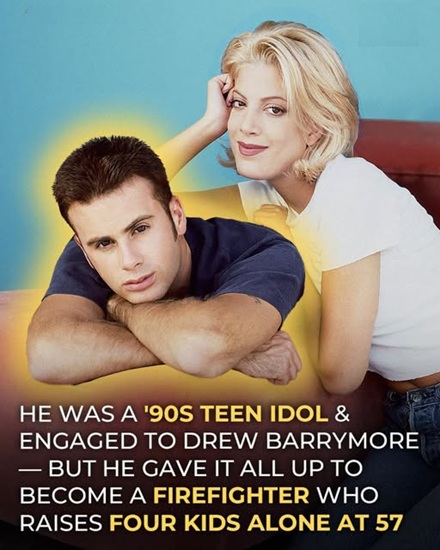
In the early and mid-1990s, Jamie Walters seemed to have the kind of career that many young performers could only imagine. He was acting on television, recording music, appearing in magazines, and becoming recognizable to millions of viewers. His rise was closely connected to two television series that became significant parts of his public identity: The Heights and Beverly Hills, 90210. Yet Walters’ story did not follow the familiar path of a young celebrity spending decades trying to remain in the spotlight.
His career instead took an unusual turn, eventually leading him away from full-time entertainment and toward emergency-service work. Looking back at his life requires separating the real person from the fictional characters audiences once associated with him. It also reveals how dramatically a television storyline can influence the way an actor is perceived by viewers. Walters was born James Leland Walters Jr. on June 13, 1969, in Boston, Massachusetts, and grew up in Marblehead, Massachusetts.
Before his television fame, he pursued acting and music, two interests that would eventually become intertwined in his professional career. One of his major early opportunities arrived with The Heights, a Fox musical drama that premiered in 1992. Walters played Alex O’Brien and provided the lead vocal on the show’s theme song, “How Do You Talk to an Angel.” The series itself was short-lived, but its theme song became considerably more successful than the television program. “How Do You Talk to an Angel” reached No. 1 on the Billboard Hot 100 in November 1992, giving Walters’ voice nationwide exposure even though the recording was credited to The Heights rather than to Walters as a solo artist.

That distinction is important when recounting his career accurately. Walters is sometimes described as having personally scored a No. 1 solo single, but the chart-topping recording belonged to The Heights, the fictional band associated with the television series. Walters subsequently developed a genuine solo recording career and released his self-titled debut album in 1994. Its best-known single, “Hold On,” became a substantial hit in its own right, reaching No. 16 on the Billboard Hot 100 in 1995. His debut album eventually achieved platinum certification in the United States.
For a young performer who was simultaneously pursuing acting and music, Walters appeared to have successfully built a career in two highly competitive industries. Then came the role that would become inseparable from his name. In 1994, Walters joined Beverly Hills, 90210, one of the defining American youth dramas of the decade. He played Ray Pruit, a working-class musician who became romantically involved with Donna Martin, the character played by Tori Spelling.
The role initially made sense for Walters because it allowed the television series to incorporate his musical abilities as well as his acting. Ray could perform songs, and Walters could simultaneously receive exposure for his music. In theory, appearing on one of television’s most recognizable programs should have strengthened both sides of his career. Instead, changes in Ray’s storyline produced consequences Walters could not have anticipated when he accepted the role.

Ray’s relationship with Donna became increasingly unhealthy and eventually abusive. One particularly memorable storyline involved Ray pushing Donna down a staircase. For viewers, it became an important turning point in the relationship. For Walters, however, the consequences extended beyond the fictional world of the series. Years later, he explained that some viewers had difficulty separating him from Ray. Entertainment coverage of Walters’ experience has documented that he received negative reactions from people who associated him personally with his character’s behavior. The irony was striking: successfully convincing viewers that Ray could behave terribly contributed to some viewers believing something negative about the actor portraying him.
Walters later recalled realizing that the storyline could create serious problems for his career. The concern was understandable. Television audiences in the 1990s interacted with celebrities very differently than audiences do today. There were no mainstream social-media profiles where actors could communicate directly with millions of fans and constantly reinforce the distinction between themselves and their characters. For many viewers, the weekly television performance was the dominant image they had of an actor. Walters had spent months appearing in people’s homes as Ray Pruit, and Ray’s increasingly disturbing behavior became part of the public image attached to Walters’ face.
The reaction demonstrated the strange power of television fame. Walters had not mistreated Donna Martin because Donna Martin was fictional. Tori Spelling was his colleague, not the victim of the fictional relationship viewers watched each week. Nevertheless, Walters later described receiving criticism from members of the public over Ray’s actions. He has spoken about people confronting him and about the difficulty of escaping the character’s reputation. The experience became a frequently cited example of an actor suffering professionally because audiences strongly identified him with an unpopular character. Walters himself would later describe his experience with the program as a “double-edged sword”: enormous exposure accompanied by an unwanted public association.

Eventually, the writers faced a narrative problem of their own. Once Ray had been established as an abusive boyfriend, restoring him as an uncomplicated romantic partner for Donna became extremely difficult. Walters later observed that the storyline had effectively put the character into a corner. Ray’s role was reduced, although Walters did make later appearances. The character returned after seeking help for his behavior, and he also appeared again in Season 7. Those appearances gave Ray somewhat more development than the simplest retelling of the story sometimes suggests. Still, the abusive relationship remained the defining memory many viewers retained of the character.
Importantly, Walters has not publicly blamed Tori Spelling for what happened to his career. His later comments about working with her have generally been positive. That distinction matters because the fictional conflict between Ray and Donna sometimes overshadows the actual professional relationship between the performers. Decades later, Spelling herself described Walters as a good person when discussing him with Jennie Garth and Drew Barrymore. Garth similarly spoke positively about him. Their comments provided a striking contrast with the image Walters had once carried because of Ray Pruit. The people who had actually worked alongside him were talking about the actor, while audiences in the 1990s had sometimes reacted to the character.
At roughly the same period that Walters’ professional life was accelerating, his personal life was receiving considerable attention as well. He had become romantically involved with Drew Barrymore, who was already famous from childhood and was rebuilding her career as a young adult. Barrymore and Walters dated in the early 1990s and became engaged. Their relationship attracted attention because both were young entertainers whose careers were being closely followed. Walters later recalled that a shared professional connection helped bring them together. Their relationship became serious enough that they lived together and discussed marriage, although the engagement ultimately ended.
One particularly lasting reminder of the relationship was a tattoo associated with Barrymore that Walters had gotten on his back. Years later, the tattoo became one of those celebrity details repeatedly mentioned whenever their former engagement was discussed. Walters himself acknowledged learning from the experience. Yet the breakup did not evolve into the kind of prolonged public feud that often accompanies celebrity relationships in entertainment coverage. Decades later, both Walters and Barrymore could discuss the relationship without turning it into an ongoing public conflict.
Barrymore unexpectedly brought that chapter of their lives back into public conversation in February 2023. Tori Spelling and Jennie Garth appeared on The Drew Barrymore Show, where the conversation turned to Walters. Barrymore immediately remembered the connection and openly confirmed that she had dated and been engaged to him. The moment was particularly amusing because Spelling had been Walters’ fictional romantic partner on Beverly Hills, 90210, while Barrymore had actually been romantically involved with him away from the cameras. Spelling responded by remembering Walters warmly, calling him a good guy, and Garth added that he still was.
By that point, however, Walters’ life looked very different from the world they were remembering. He had released additional music after his first album, including Ride in 1997 and Believed in 2002. But his entertainment career was no longer developing along the trajectory that had seemed possible during his early fame. Instead of spending the following decades pursuing television roles at any cost, Walters began seriously considering another profession. He wanted greater stability and had an interest in emergency services. Eventually, that interest became a genuine second career.
Becoming a professional firefighter was not simply a matter of exchanging a guitar for a uniform. Walters has described a lengthy selection process involving written testing, medical examinations, background screening, psychological evaluation, and physical-agility requirements. The process took years. For someone accustomed to an entertainment industry in which a single audition, song, or television opportunity could suddenly transform a career, this was a very different system. Progress depended on meeting formal standards and completing successive stages of evaluation rather than public recognition. His previous fame could not substitute for the requirements of the profession.
Walters has explained that his changing priorities were connected in part to family life. Entertainment could be unpredictable even for someone who had already achieved national recognition. Acting jobs ended. Record contracts changed. Musical tastes shifted. Television programs were canceled. A person could be highly visible one year and struggling for the next opportunity shortly afterward. Walters had experienced that instability firsthand. Emergency-service work offered a fundamentally different professional structure and a different sense of purpose. Available biographical accounts identify him as having become a firefighter and paramedic in the early 2000s.
The transition is remarkable precisely because Walters had already experienced a level of fame most people never encounter. His voice had been heard on a Billboard No. 1 recording. His solo album had gone platinum. His own single had entered the Top 20. He had appeared on one of America’s most famous television dramas. His personal relationship with Barrymore had attracted entertainment-media attention. Yet none of those achievements prevented him from deciding that another life might suit him better. Instead of treating his earlier celebrity as something that had to be recovered indefinitely, he was willing to build a new professional identity.
That did not mean music disappeared from his life. Walters continued to have a connection to performing, and his past eventually came back around in an unexpected way. In 2019, Fox launched BH90210, a deliberately self-referential series in which several original Beverly Hills, 90210 stars played heightened, fictionalized versions of themselves. Walters appeared as himself in the episode “Picture’s Up,” which aired on September 4, 2019. His appearance cleverly acknowledged the real history surrounding Ray Pruit and Walters’ post-Hollywood career rather than pretending that the previous decades had never happened.
The storyline turned Walters’ old reputation into a joke about the difficulty of separating actors from characters. Within the meta-series, the cast temporarily suspects Walters of holding a grudge connected to what happened during the original show. The premise intentionally references the fact that the Ray Pruit storyline had negatively affected how some viewers perceived him. But the Walters encountered by the characters is not a bitter former television star plotting revenge. He has moved forward with his life. The cameo allowed Walters to participate in a joke that once would probably have been far less amusing to him.
He also returned to the song that had introduced his voice to millions of listeners. During the appearance, Walters performed “How Do You Talk to an Angel,” connecting his The Heights past with his Beverly Hills, 90210 history and his present-day identity. Entertainment Tonight later noted the return when Spelling and Garth discussed Walters with Barrymore. The moment effectively compressed nearly three decades of his career into a single scene: the musician, the television actor, the former teen idol, and the man who had built another life after Hollywood were all represented at once.
There is also something instructive about how the public’s perception of Walters has changed. In the 1990s, strangers reportedly confronted him because they disliked Ray Pruit. Years later, people discovering what had happened to Walters tended to focus on the unexpected nature of his second career. The conversation had shifted from “Ray hurt Donna” to surprise that a recognizable television actor had chosen emergency-service work. The distance of several decades also made it easier for audiences to recognize the obvious distinction that had once been blurred for some viewers: Jamie Walters was an actor playing Ray Pruit. Ray’s actions belonged to a screenplay.
His experience therefore illustrates a broader phenomenon in popular culture without requiring the story to be exaggerated. Actors who portray villains or abusive characters can become strongly associated with those roles. Walters’ case was particularly consequential because the role coincided with his recording career. Television exposure was helping introduce audiences to his music at exactly the same time that the television character was becoming increasingly disliked. The same platform that could promote his songs could also shape public attitudes toward the person singing them. That contradiction helps explain why Walters later used the image of a double-edged sword when describing the experience.
It would nevertheless be misleading to say that Walters simply vanished after Beverly Hills, 90210. He continued recording music, released subsequent albums, and appeared in later entertainment projects. In 2009, for example, he participated in VH1’s Confessions of a Teen Idol, a reality program built around former young celebrities confronting the complicated aftermath of early fame. Ten years later came his BH90210 appearance. These projects show that Walters never had to reject his entertainment past completely. Instead, entertainment stopped being the only foundation of his professional identity.
It would also be inaccurate to reduce his life to a simple morality tale in which Hollywood was bad and firefighting was good. Walters has spoken about maintaining friendships with people in entertainment and has continued making music. His comments suggest something more ordinary and therefore more interesting: priorities changed. He had experienced success, disappointment, celebrity, public misunderstanding, and the unpredictability of entertainment work. As he considered raising a family and building a sustainable adult life, another career became increasingly appealing.
The Drew Barrymore chapter follows a similar pattern. Their engagement was significant enough to attract media coverage and permanent enough to leave Walters with a famous tattoo story, but it was still a relationship between two very young people that ended decades ago. Barrymore’s affectionate recollection in 2023 showed that an old celebrity romance does not necessarily need a villain. Walters likewise responded positively when he learned that Barrymore and his former 90210 colleagues had spoken kindly about him. There was no need to turn a relationship from the early 1990s into a modern controversy.
That restraint is part of what makes Walters’ later story distinctive. Celebrity culture often rewards people for repeatedly reopening old conflicts. A former television star can spend years discussing former castmates, former partners, canceled projects, and professional disappointments. Walters certainly has stories worth telling, and he has answered questions about them when interviewed. But his public life has not been organized around endlessly relitigating what happened to Ray Pruit or why his relationship with Barrymore ended. His most dramatic decision was practical rather than theatrical: he trained for a demanding profession outside entertainment.
By 2026, Walters is 57 years old, far removed from the young musician viewers first encountered in The Heights. His place in 1990s popular culture remains secure because millions of viewers remember Ray Pruit and because “How Do You Talk to an Angel” remains associated with that era of television music. Yet the decades that followed are arguably more unusual than the period when he was famous. Plenty of actors have played controversial characters. Plenty of musicians have watched commercial momentum fade. Far fewer people have experienced both and then successfully constructed a substantial professional life in an entirely different field.
His story also offers a useful reminder about the way entertainment should be understood. Ray Pruit was written by television writers and portrayed by Jamie Walters. Donna Martin was portrayed by Tori Spelling. The abusive behavior shown between those fictional characters was part of a scripted narrative. Walters’ experience demonstrates what can happen when audiences lose sight of that boundary. An actor can deliver a convincing performance without sharing the morality, personality, or behavior of the person he portrays.
For Walters, the consequences of that confusion were not theoretical. He has discussed receiving negative attention because of Ray and believing that the storyline harmed his career. At the same time, it would be impossible to identify one television storyline as the sole explanation for every subsequent change in record sales, acting opportunities, or career decisions. Entertainment careers are affected by many variables, including changing audiences, label decisions, available roles, personal priorities, and simple timing. The most accurate version of Walters’ story therefore avoids claiming that one scene single-handedly destroyed everything he had built.
What can be said with confidence is already dramatic enough. Walters became nationally known through music and television while still young. He sang lead on a song that reached the top of the Billboard Hot 100. He established a solo recording career and scored a Top 20 single with “Hold On.” He joined one of the defining television dramas of the 1990s and played a character whose abusive behavior generated intense hostility from some viewers. He was engaged to Drew Barrymore during an important period in both of their lives. And after experiencing the unpredictable realities of entertainment, he pursued a career in emergency services.
Years later, the people connected to those earlier chapters could look back without the hostility that had once surrounded his fictional character. Barrymore openly remembered their engagement. Spelling described him positively. Garth agreed. Walters returned to the 90210 universe and participated in a self-aware joke about his own unusual career history. He could sing the old song again without pretending that the intervening decades had not happened.
Perhaps that is the most accurate way to understand Jamie Walters’ story. It is not simply the story of a celebrity whose career was “destroyed,” because his life did not end when his first period of fame faded. It is not simply a story about Drew Barrymore, because a youthful engagement represents only a small part of either person’s life. And it is not simply a Beverly Hills, 90210 story, even though Ray Pruit remains the role most strongly associated with him.
