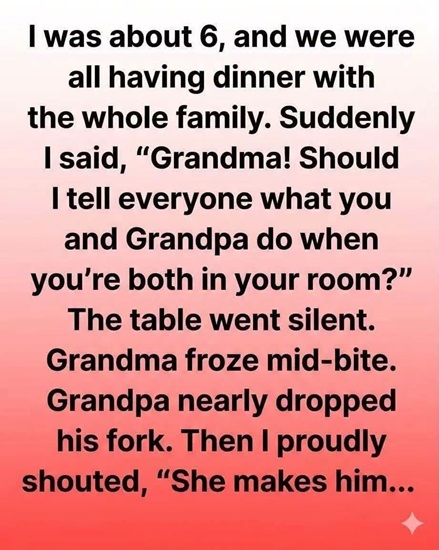
Some family memories survive not because they involve major events, but because one unexpected sentence turns an ordinary gathering into a story nobody forgets. This lighthearted narrative centers on a young child at a large family dinner and a harmless misunderstanding that briefly leaves every adult at the table worried about what might be said next. Because the account is presented as a personal-style humorous story rather than independently documented news, it is best understood as a family anecdote or fictionalized entertainment unless its underlying events can be separately verified.
Its appeal does not depend on presenting it as a confirmed real-world incident. The humor comes from childhood innocence, adult assumptions, and a perfectly ordinary secret involving household chores. The scene begins during a holiday gathering when the narrator is about six years old. A large wooden dining table has been brought into use for the occasion, creating enough room for relatives who have gathered to eat together.
The meal includes roasted chicken and cornbread, while conversation fills the room as different family members exchange stories. For a young child, an occasion like this can feel important because everyone is sitting together and participating in the same conversation. The narrator has recently developed the idea that family dinners are opportunities for people to share things. Wanting to participate like the adults, the child begins searching for something interesting enough to contribute.
The adults have no reason to expect that the next contribution will suddenly command everyone’s attention. Grandpa is in the middle of telling one of his familiar fishing stories when the child decides that the perfect moment has arrived. Sitting upright and speaking with complete confidence, the narrator addresses Grandma and asks whether everyone should be told what Grandma and Grandpa do when they are alone in their room. The wording immediately changes the atmosphere around the table. A conversation that had been filled with overlapping voices and laughter suddenly becomes quiet. The adults hear implications in the question that the six-year-old narrator does not understand.
Grandma pauses in the middle of eating. Grandpa becomes noticeably uncomfortable, while the narrator’s parents realize that an unpredictable childhood observation may be about to become public. Nobody at the table knows exactly what the child has seen or what conclusion has been reached. That uncertainty creates the tension on which the joke depends. Children frequently describe ordinary situations using language that adults interpret very differently. The narrator is not intentionally creating embarrassment or trying to expose anything inappropriate. From the child’s perspective, there is simply an interesting household secret that deserves to be shared.
Grandma carefully asks the obvious follow-up question: what exactly has the child seen? The wording is cautious because nobody yet knows where the conversation is heading. Grandpa appears to prepare himself for whatever answer might follow. Other relatives remain focused on the narrator, waiting for an explanation. For the adults, several uncomfortable possibilities may be running through their minds. For the child, however, there is nothing remotely scandalous about the answer. That difference between the adults’ expectations and the narrator’s innocent understanding is what sets up the punchline.
Without hesitation, the child proudly reveals the supposed secret: Grandma makes Grandpa fold the laundry. The dramatic mystery immediately disappears. What had sounded like the introduction to an embarrassing revelation turns out to involve one of the most ordinary household chores imaginable. The child has interpreted Grandpa helping with laundry as noteworthy information that the rest of the family should know. No private scandal has been uncovered and no serious secret has been exposed. The adults’ concern came entirely from the ambiguous way the original question was phrased.
There is a brief moment in which everyone processes the answer before laughter takes over. The relatives who had been preparing themselves for an uncomfortable revelation suddenly understand how completely they misinterpreted the child’s question. Aunts laugh, cousins join in, and the narrator’s parents can finally relax. Grandma is embarrassed by the attention but also amused by the misunderstanding. Grandpa responds with humor, acknowledging that the child’s description is technically accurate. The tension disappears as quickly as it appeared, leaving the family with a story that is much funnier because everyone had expected something entirely different.
What makes the anecdote effective is not the laundry itself. Folding clothes is an ordinary household responsibility and would hardly be memorable without the setup. The comedy comes from the gap between what the child means and what the adults think the child means. The narrator uses words literally and innocently, while everyone else interprets them through an adult understanding of privacy. Both interpretations make sense from their respective perspectives. When the actual meaning becomes clear, the enormous difference between those interpretations creates the humor.
This type of misunderstanding is common in stories about young children because children are still learning how context changes the meaning of language. A statement can be factually straightforward while sounding completely different depending on how it is phrased. Young children may also classify information as secret for reasons adults would never consider significant. Something as simple as seeing grandparents divide household chores can become fascinating because it happens outside the child’s normal routine. The child therefore shares the information with genuine enthusiasm rather than understanding why the adults initially become uncomfortable.
The family’s reaction is equally important to the tone of the story. Once they understand what the child means, nobody treats the mistake as a serious offense. The relatives laugh at the misunderstanding rather than turning the moment into a conflict. Grandma’s embarrassment is temporary, and Grandpa participates in the joke instead of reacting angrily. That response keeps the anecdote warm and family-friendly. The child is not punished for saying something innocent, and the adults recognize that their own assumptions created most of the tension.
Grandpa’s response provides an especially effective ending to the immediate scene. Instead of denying the child’s claim or trying to change the subject, he acknowledges that the description is correct. The joke works because there is nothing actually wrong with the supposed secret. Helping fold laundry is simply part of everyday household life. By accepting the observation with humor, Grandpa allows the entire family to laugh together. His reaction transforms what could have remained an awkward moment into a shared memory.
The anecdote also demonstrates how easily listeners can fill missing information with assumptions. The child’s first question contains very little actual detail. It says only that Grandma and Grandpa do something when they are alone in their room. Everything that makes the adults nervous comes from possibilities they imagine before hearing the explanation. The final answer reveals how far those assumptions traveled beyond the information that was actually provided. This is a familiar mechanism in comedy because audiences are encouraged to anticipate one conclusion before receiving an unexpectedly harmless alternative.
That does not mean the story needs to carry a heavy lesson. At its core, it is simply an amusing family scenario. Still, the misunderstanding provides a useful reminder that incomplete statements can sound more dramatic than the underlying reality. Waiting for context often changes how information should be interpreted. The relatives at the table initially react to what they think the child is about to reveal rather than what has actually been said. Once the missing context arrives, the situation becomes completely different.
The narrator’s age is central to understanding why the moment feels innocent rather than intentionally provocative. At around six years old, children are still developing awareness of social expectations, conversational boundaries, and the different meanings adults may attach to certain phrases. A child may repeat something observed at home without anticipating how listeners will interpret it. In the story, the narrator believes that sharing the laundry arrangement is a valuable contribution to dinner conversation. There is no attempt to embarrass Grandma or Grandpa. The child simply wants to participate.
Family gatherings provide particularly fertile settings for these moments because several generations may be sharing the same space. Adults tell stories, children listen, relatives exchange jokes, and conversations move quickly from one subject to another. A young person trying to join that environment may imitate the storytelling style of older relatives without fully understanding its social rules. That can produce unexpected statements that become memorable precisely because they are spontaneous. The narrator’s announcement interrupts Grandpa’s fishing story, but it ultimately creates another family story that may be retold far longer.
The holiday atmosphere also helps explain why the memory stands out. Certain sensory details—the large table, familiar food, relatives talking, and a special meal—can become associated with particular childhood experiences. Many people remember family occasions through small moments rather than a complete chronological record of the day. A funny comment, an unusual reaction, or an unexpected burst of laughter can become the detail that survives. In this narrative, the dinner itself provides the setting, but the innocent announcement becomes the defining memory.
The story should nevertheless be presented according to what it actually is. The supplied narrative does not provide independent documentation establishing John, Sarah, or other versions of named characters as real people involved in a verified public event. It therefore should not be expanded by inventing addresses, locations, occupations, exact dates, additional relatives, or supposedly factual dialogue that was never provided. Doing so would transform a harmless anecdote into unsupported reporting. Keeping the account clearly in the category of storytelling allows it to remain entertaining without misleading readers.
There is similarly no reason to connect the anecdote to unrelated public controversies or local issues. Nothing in the story involves politics, government, public policy, or an attempt to influence a community debate. It is a universal family-humor scenario centered on communication and childhood innocence. Maintaining that focus keeps the narrative coherent. The appeal comes from recognizing a type of misunderstanding that could make sense to readers from many different backgrounds without pretending to represent the experiences or opinions of a particular community.
The phrase “family secret” can also sound more serious than what the narrative actually contains. In this case, the so-called secret is deliberately trivial. Grandma apparently asks Grandpa to help fold laundry, and the child believes this private household routine is interesting enough to announce. There is no evidence of wrongdoing, abuse, betrayal, or another harmful situation. Presenting the event as though a genuinely disturbing secret had been exposed would misrepresent the tone and content of the story. The harmlessness of the revelation is exactly what makes the ending work.
After the laughter fades, the moment naturally becomes part of the family’s collection of stories. Relatives often preserve memories like this by repeating them during later gatherings, especially when the person who originally created the moment is older and able to appreciate the humor. What was embarrassing for a few seconds can become affectionate family folklore. The narrator may eventually hear the story told from several perspectives: what Grandma thought was about to happen, what Grandpa expected, or how the parents reacted. Each retelling can preserve the same basic punchline without needing to invent dramatic consequences.
The memory can also become a reminder of how differently children and adults experience the same event. To the adults, the announcement briefly threatens an uncomfortable disclosure. To the child, it is simply exciting information about laundry. Neither group is looking at the moment through the same assumptions. The eventual laughter occurs when everyone finally understands the child’s perspective. That sudden alignment turns anxiety into amusement.
There is also something endearing about the child’s desire to contribute. The narrator has observed that adults share stories during family meals and wants to do the same thing. Rather than remaining a passive listener, the child searches for information that seems worthy of the table. The choice happens to produce an unintentionally dramatic introduction, but the motivation itself is straightforward. The child wants to belong to the conversation. That makes the moment feel warmer than a story based on deliberate embarrassment.
The anecdote therefore succeeds because several simple elements work together: an innocent child, an ambiguous question, worried adults, a harmless revelation, and a humorous response. Removing any one of those elements would change the effect. If the narrator intentionally understood the adult interpretation, the innocence would disappear. If the secret were genuinely serious, the laughter would feel inappropriate. If the family reacted harshly, the story would become uncomfortable. Instead, everything resolves through a shared realization that the situation was never dangerous or scandalous in the first place.
It is worth remembering that family humor works best when it does not humiliate the people involved. In this story, the joke is not that Grandma or Grandpa has done something shameful. The joke is that everyone briefly assumes the child’s statement must mean something far more dramatic than folding laundry. Once that assumption collapses, everyone—including the grandparents—can participate in the laughter. The humor therefore comes from misunderstanding rather than cruelty.
Years later, a story like this can remain meaningful precisely because it captures an ordinary family at an unguarded moment. Nobody planned the punchline, organized the reactions, or expected the conversation to become memorable. The child spoke naturally, the adults reacted instinctively, and the misunderstanding resolved almost immediately. Those spontaneous details are often what make family anecdotes enjoyable to retell. They preserve personalities and relationships through a moment that was small in consequence but large in laughter.
The broader takeaway does not require turning the story into something more serious than it is. Sometimes the funniest moments occur because people react before receiving the complete explanation. Language can create expectations, and context can overturn them in seconds. Children are particularly good at producing these situations because they often speak directly without anticipating the assumptions adults will make. When the misunderstanding is harmless, laughter becomes an easy way for everyone to move forward together.
In the end, the supposedly dramatic family secret contains nothing scandalous at all. Grandma and Grandpa’s mysterious private activity is simply folding laundry, and the young narrator has no idea why everyone expected a different answer. The silence, worried expressions, and sudden explosion of laughter all come from that difference in interpretation. What begins as an uncomfortable few seconds becomes an affectionate story that can be remembered long after the plates have been cleared from the table.
That is what gives this family-dinner anecdote its charm. It does not need an invented controversy, an exaggerated revelation, or unsupported claims to remain entertaining. Its strongest elements are already simple and relatable: childhood innocence, adult assumptions, family humor, and an ordinary chore unexpectedly becoming the center of attention. Whether read as a fictionalized anecdote or a personal-style story, it works best when presented transparently and without claiming details that cannot be verified. Sometimes the most memorable “secret” at a family gathering turns out not to be a secret at all—just a six-year-old proudly telling everyone who folds the laundry.
