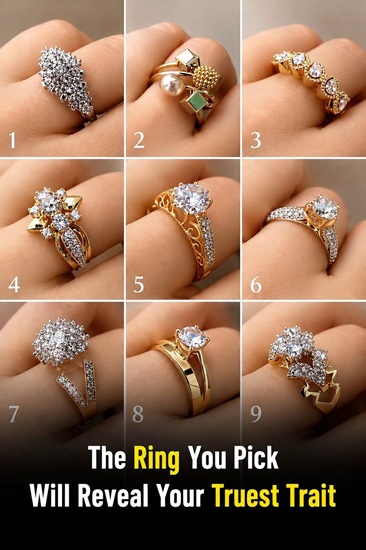
Online personality quizzes have become a familiar part of social media, and one popular version asks people to choose a ring from several different designs. After making a selection, participants are given a description supposedly connected to qualities such as confidence, independence, loyalty, creativity, or sensitivity. These posts can be entertaining because they turn a simple visual preference into an opportunity for self-reflection. However, there is an important distinction to make from the beginning: choosing a particular ring cannot scientifically determine a person’s personality.
There is no validated psychological rule showing that one ring design can reliably reveal someone’s deepest character traits. The appeal of these quizzes is easy to understand. Jewelry has been used for thousands of years as decoration, symbolism, personal expression, and markers of relationships or social traditions. People naturally develop preferences for particular shapes, materials, colors, and styles. Someone might prefer an understated band, while another person may be attracted to an elaborate gemstone surrounded by decorative details.
Those choices can reflect personal taste, but personal taste and a scientifically established personality assessment are not the same thing. A person’s reason for selecting a ring could be as simple as liking its color or imagining that it would look good with a favorite outfit. That does not mean the activity has no value. When treated as entertainment rather than psychological diagnosis, a ring-selection game can provide an enjoyable way to think about personal preferences.
The descriptions below should therefore be understood as playful interpretations inspired by the visual characteristics of different jewelry styles. They are not medical or psychological evaluations, and they cannot establish whether someone actually possesses a particular characteristic. With that distinction clear, choose the ring that immediately attracts your attention and see whether the accompanying description feels familiar.

Ring 1 — Classic and Timeless
If the first ring attracts you most, you may simply appreciate traditional designs, symmetry, and familiar elegance. In the language of a lighthearted personality quiz, this choice is often associated with people who value consistency and simplicity. You might prefer objects that remain stylish for years rather than designs built around temporary trends. A classic ring can also appeal to someone who enjoys understated details rather than highly elaborate decoration. Whether those qualities describe your personality is something only you can decide, but the selection may reveal something genuine about your aesthetic preferences.
Classic jewelry remains popular partly because it can work in many different settings. A person may choose this design because it feels versatile, because it resembles jewelry associated with meaningful memories, or simply because the proportions are visually pleasing. Personal history can strongly influence aesthetic preferences. A ring that resembles something worn by a parent or grandparent, for example, might attract attention because of an emotional association rather than an underlying personality characteristic. This is one reason visual-choice quizzes should never present their interpretations as scientifically proven conclusions.
Ring 2 — Bold and Expressive
The second design may appeal to people who enjoy jewelry that immediately attracts attention. Within the playful framework of the quiz, this selection can represent confidence, enthusiasm, and a willingness to express personal style openly. Large stones, unusual shapes, or decorative settings often function as statement pieces because they become prominent parts of an outfit. Someone choosing such a ring may simply enjoy dramatic fashion. That preference does not automatically mean the person is extroverted or fearless, since quiet and reserved individuals can enjoy bold jewelry just as easily.
Fashion choices are influenced by many factors, including culture, trends, affordability, occasion, and personal experience. A person might wear minimal jewelry at work while preferring highly decorative pieces for celebrations. Someone else might love statement rings while otherwise dressing very simply. Human personality is far too complex to be accurately summarized from one fashion preference. Nevertheless, asking why a particular design appeals to you can be an interesting exercise in understanding your own aesthetic choices.
Ring 3 — Romantic and Detail-Oriented
A ring featuring floral shapes, curved lines, or delicate decorative elements may create a softer and more romantic impression. In an entertainment-oriented personality interpretation, people drawn to this design might identify with qualities such as warmth, attentiveness, or appreciation for meaningful details. Perhaps you enjoy objects that appear carefully crafted rather than strictly minimalist. You might also associate intricate jewelry with celebrations, family traditions, or important moments. Those associations can influence your selection without necessarily revealing anything fixed about your character.
Psychologists distinguish casual personality quizzes from validated personality assessments for good reason. Proper psychological measures are developed and evaluated systematically rather than assigning traits based on one decorative preference. Even established personality questionnaires are designed to evaluate patterns across numerous responses. Consequently, no responsible interpretation should claim that selecting a floral ring proves that someone is romantic, compassionate, or emotionally sensitive. The description is better treated as a conversation starter rather than a factual evaluation.
Ring 4 — Independent and Unconventional
Perhaps the fourth ring immediately caught your attention because its design looks different from the others. Unusual jewelry can appeal to people who enjoy distinctive shapes, unexpected combinations, or objects that feel less conventional. In the spirit of the game, this ring can represent individuality and a preference for making personal choices rather than automatically following popular trends. However, choosing an unconventional ring does not prove that someone behaves independently in every part of life. It simply indicates that, among the options presented, this particular design was most visually appealing.
Preferences can also change considerably over time. The ring someone chooses today might not be the one they would select five years from now—or even tomorrow. Mood, context, fashion trends, and recent experiences can influence what appears attractive. If a person has recently seen a similar ring in a movie or advertisement, familiarity alone may influence the decision. That flexibility is another reason it would be misleading to describe a single visual choice as a permanent window into personality.
Ring 5 — Elegant and Balanced
A balanced ring with clean proportions may appeal to someone who appreciates visual harmony. Playful quizzes often connect this kind of choice with patience, reliability, and an appreciation for stability. The interpretation sounds appealing, but it should remain firmly in the category of entertainment. Symmetry itself can be visually attractive for many reasons, and people commonly prefer balanced compositions in art, architecture, fashion, and design. Choosing a symmetrical ring may therefore tell us considerably more about what looks pleasing to you than about how you behave in relationships or difficult situations.
The same person can also possess characteristics that appear contradictory. Someone can appreciate stability while enjoying spontaneous travel. A highly organized person at work can be relaxed about organization at home. A person who wears traditional jewelry can hold unconventional opinions. Real personalities contain many dimensions and can change depending on circumstances. Reducing that complexity to a single jewelry selection makes for an enjoyable quiz, but not a scientific conclusion.
Ring 6 — Creative and Imaginative
An artistic or unusually arranged ring may attract viewers who appreciate creative design. Within this game, the choice can symbolically represent imagination, curiosity, and openness to new ideas. Perhaps you enjoy visual experimentation or prefer objects that have an interesting story behind them. Maybe the design simply reminds you of something pleasant. All of these explanations are reasonable, and none requires assuming that the ring has uncovered a hidden psychological characteristic.
Creativity itself is also much broader than artistic ability. People can express creativity through cooking, problem-solving, writing, gardening, engineering, music, decorating, business, or countless other activities. A person’s preferred jewelry style cannot measure those abilities. If the description encourages someone to think about the ways they express creativity, however, the quiz can still provide a positive opportunity for reflection without making unsupported scientific claims.
Ring 7 — Minimal and Practical
If you prefer a simpler ring, you may appreciate clean designs that are easy to wear and combine with different styles. A playful interpretation might associate this preference with practicality, organization, or a preference for avoiding unnecessary complication. Yet there are numerous practical reasons for choosing minimalist jewelry that have nothing to do with personality. Comfort, occupation, budget, clothing style, and everyday activities can all affect which rings someone prefers.
A person who works frequently with their hands, for example, might naturally prefer a less elaborate design. Another person might select a simple ring because they consider minimalism elegant rather than practical. Someone else may simply dislike large gemstones. These possibilities demonstrate why context matters whenever we attempt to interpret individual choices. The same decision can have completely different explanations for different people.
Ring 8 — Sentimental and Meaning-Focused
Some jewelry designs create a vintage, symbolic, or heirloom-like impression. If such a ring attracts you, the entertainment interpretation might describe you as someone who values memories, relationships, and meaningful objects. Jewelry can genuinely carry powerful emotional significance. Wedding rings, inherited pieces, graduation gifts, and family jewelry often become important because of the stories attached to them rather than their monetary value.
Still, preferring an heirloom-inspired design does not prove that someone is more sentimental than anyone else. A person may simply enjoy vintage aesthetics. Another may appreciate the craftsmanship associated with older jewelry. The important point is that objects can acquire personal meanings, but those meanings come from individuals and their experiences. They cannot reliably be determined by an online quiz.
Ring 9 — Adventurous and Eye-Catching
The final design may appeal to someone who enjoys unusual combinations, prominent gemstones, or distinctive shapes. In a casual personality game, this selection might be connected with adventure, curiosity, or enthusiasm for trying something different. If that description feels accurate, it can be fun to consider why. If it does not, there is no reason to assume the quiz has discovered something about you that you somehow failed to recognize.
That final point applies to every result in this type of test. People should not feel pressured to accept flattering or negative descriptions merely because an online graphic associates those qualities with a particular choice. Entertainment quizzes are designed to encourage participation and conversation. They are not substitutes for validated psychological assessments, professional advice, or genuine knowledge developed through relationships and experience.
One reason personality quizzes can sometimes feel surprisingly accurate involves the broad nature of many descriptions. Statements such as “you care deeply about people close to you” or “you sometimes need time alone” apply to large numbers of people. Psychology discussions sometimes connect this experience with the Barnum effect, also called the Forer effect, in which people can perceive generalized personality descriptions as uniquely applicable to themselves. This helps explain why an entertaining result may feel personally meaningful even when it was not scientifically derived from the participant’s choice.
There is nothing inherently wrong with enjoying that experience as long as the limitations are understood. A ring quiz can encourage friends or family members to compare preferences and discuss why different designs appeal to them. One person might choose a ring because of its gemstone, another because of its shape, and someone else because it resembles a piece of jewelry connected to a cherished memory. Those explanations can reveal interesting information about personal tastes without requiring unsupported claims about psychology.
The most useful question may therefore not be, “What does this ring prove about my personality?” A better question is, “Why did this particular design attract me?” That invites genuine reflection. Perhaps you value simplicity, love vintage fashion, enjoy bold colors, or associate a certain style with someone important in your life. Those answers come from your own experiences rather than from an algorithm or viral graphic.
Ultimately, the ring you choose can certainly reflect what you like at that moment, but it cannot scientifically reveal your complete personality. Human beings are shaped by countless experiences, relationships, environments, values, habits, and decisions. No single piece of jewelry can capture all of that complexity. So choose your favorite ring, enjoy comparing the results, and treat the descriptions as what they are: a lighthearted exercise in personal preference and self-reflection rather than a psychological diagnosis.
