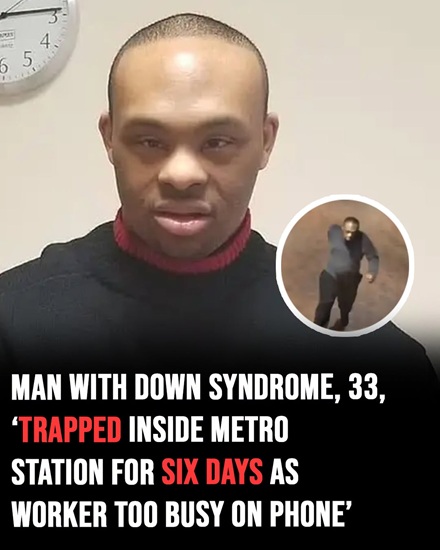
A Maryland family’s lawsuit has raised serious questions about how a nonverbal man with Down syndrome allegedly remained trapped inside an area of the Glenmont Metro station for six days in October 2023. Rashawn Williams was 31 when he disappeared in Montgomery County after becoming separated from a caregiver. His disappearance prompted an extensive search before he was eventually located alive inside the Metro station.
Because litigation over the incident remains ongoing, many details described below are allegations contained in the family’s lawsuit or findings discussed by the federal court, rather than final determinations of liability. Williams disappeared on October 20, 2023, while staying at a hotel through WeAchieve, a nonprofit organization providing services to people with disabilities. According to the lawsuit, Williams indicated at approximately 6:20 p.m. that he needed to use the bathroom.
His caregiver reportedly went to obtain a key, and during that period Williams left through the hotel lobby. He subsequently made his way toward Glenmont Metro Station, part of the Washington Metropolitan Area Transit Authority system.
The situation was particularly alarming because Williams is nonverbal and requires significant supervision and assistance. His family knew that he could have difficulty communicating his identity, explaining where he belonged or asking strangers for help. As hours turned into days, relatives and authorities searched for him. Contemporary reporting from October 2023 confirms that Williams was missing for six days before being found inside a room at Glenmont station.

His father, Jimmy Hall, publicly expressed his concern during the search. Hall emphasized that his son could not easily communicate or defend himself and worried about whether he had access to food and water. The uncertainty became increasingly difficult as the search continued without a confirmed sighting. Family members looked through areas where they feared Williams might have gone, while law enforcement continued efforts to determine his location.
According to later allegations described in the lawsuit, Williams’s movements that first night included an extended period aboard the Metro system. The family’s complaint alleges that he remained on a train for approximately six hours before it arrived at Glenmont after midnight and went out of service. The lawsuit further claims that a Metro employee directed Williams to leave the train but did not ensure that he successfully exited the station.
What allegedly happened afterward has become central to the family’s legal claims against WMATA. According to the complaint, Williams approached a station kiosk and appeared to need assistance. The lawsuit alleges that a station employee was engaged in a personal telephone conversation and failed to respond adequately to Williams. These allegations are important to the case because Williams’s disability and inability to communicate verbally could have made obtaining assistance substantially more difficult than it would have been for many other passengers.

The complaint alleges that Williams waited near the kiosk and eventually displayed frustration after receiving no assistance. He then moved farther into the station and ultimately passed through an emergency door into what court documents describe as an Area of Refuge, or AOR. According to the family’s allegations, the door locked behind him, leaving him unable to return to the main station area.
An Area of Refuge is generally intended as a protected location associated with emergency evacuation procedures, particularly for people who may require assistance. The lawsuit alleges that Williams remained inside such an area at Glenmont for the following six days. During that same period, his family and police were searching elsewhere for him without knowing that he was reportedly inside the transit station.
The case raises another important issue involving inspection procedures. According to the federal court’s discussion of the allegations, Metro personnel did not inspect the area where Williams was trapped on the night he entered it or during the following six days. The family’s lawsuit argues that adherence to established station inspection and monitoring procedures could have resulted in Williams being discovered much sooner. Those claims are among the matters being contested through the legal process.
On October 26, six days after Williams disappeared, police finally located him. Initial police reporting at the time said he had been found safe, and contemporary news coverage reported that he was discovered in a room at Glenmont Metro station. His father said Williams was hungry and thirsty when found. Williams was subsequently taken to a hospital to be evaluated.
Later court descriptions provided substantially more detail about his alleged condition. According to the ruling quoted in subsequent reporting, Williams had allegedly been without food, water, toilet facilities and adequate light while inside the area. Court documents described him as severely dehydrated and undernourished when authorities reached him. Those descriptions form part of the factual allegations underlying the lawsuit and should not be confused with an independently completed trial finding regarding responsibility.
For Williams’s family, finding him alive brought an end to nearly a week of uncertainty. Contemporary reporting described the emotional reunion after his discovery. His father said that Williams reacted enthusiastically when reunited with relatives. At the same time, the family later alleged that the experience had effects extending beyond the immediate physical consequences of being missing for several days.
The lawsuit claims Williams subsequently experienced significant behavioral changes. According to the family’s allegations, these included disrupted sleep, rocking behavior, panic episodes and periods of unexplained screaming. The complaint also reportedly states that darkness became particularly difficult for him and could trigger frightened behavior. These claims concern Williams’s individual experience following the incident and are part of the damages and harm alleged by his family.
The legal dispute eventually focused not only on what happened to Williams but also on the responsibilities of WMATA employees. WMATA sought dismissal of claims against it and raised legal defenses that reportedly included governmental immunity and Williams’s status inside the station after operating hours. One argument described in reporting concerned whether Williams could be treated as a trespasser after entering an area where passengers ordinarily were not permitted to remain.
U.S. District Judge Paula Xinis rejected WMATA’s effort to dispose of the case at that stage, allowing relevant claims to continue. Importantly, denial of a motion to dismiss does not mean that a court has ultimately found a defendant liable. It generally means that the claims have sufficient legal basis to proceed to later stages where evidence can be developed and disputed issues examined more fully.
In discussing the case, Xinis reportedly focused on whether basic assistance could reasonably have prevented what followed. The court considered allegations that Williams displayed obvious confusion and needed help leaving the station. The judge also addressed Metro policies relevant to assisting passengers and inspecting station areas. Those considerations were significant to whether the family’s claims could continue rather than being dismissed before further litigation.
The lawsuit also names WeAchieve, the organization responsible for services Williams was receiving when he initially walked away. According to reporting cited in the original account, WeAchieve previously denied allegations of negligence or intentional misconduct and argued that WMATA was responsible for any injuries Williams allegedly suffered after entering the transit system. These competing positions illustrate why responsibility cannot accurately be assigned as settled fact while the litigation remains unresolved.
The distinction between an allegation and a proven fact is especially important in reporting about civil lawsuits. A complaint presents one party’s factual and legal claims. Defendants are entitled to dispute those claims, introduce evidence and raise legal defenses. A judge allowing a lawsuit to proceed does not necessarily endorse every factual allegation in the complaint. Instead, the case continues so that the contested issues can be addressed through the judicial process.
Some elements of Williams’s disappearance are independently established through contemporaneous reporting. He disappeared in October 2023, was missing for six days and was ultimately discovered inside Glenmont Metro station. Police publicly announced that he had been located, and his father described him as hungry and thirsty after the ordeal. The more detailed allegations about employee conduct, inspection failures, responsibility and long-term harm are matters described in subsequent litigation and should be attributed accordingly.
Beyond the individual dispute, the case illustrates why accessibility procedures can be especially important for passengers who cannot easily communicate. A person who is nonverbal may not be able to explain that they are lost, provide an address or answer routine questions in the manner employees expect. Disability alone does not establish what happened in any particular interaction, but accessible communication and established safety procedures can play an important role in helping people navigate public environments.
The circumstances also demonstrate why routine inspections can matter. Procedures that may appear repetitive during ordinary operations can become critical when something unexpected occurs. The family’s case specifically points to inspection requirements as part of its argument that Williams could have been discovered earlier. Whether particular employees or organizations legally breached their duties remains a matter for the court process rather than something that should be assumed from the allegations alone.
For Williams’s family, however, the legal questions developed only after a much more immediate crisis: their son was missing for almost a week. His eventual discovery alive ended the search that began on October 20, 2023. Contemporary coverage at the time focused primarily on the relief surrounding his return, while the later lawsuit brought additional allegations about what may have happened during the six days he was missing.
The case now places those allegations before the judicial system, where WMATA, WeAchieve and the Williams family can present their respective positions. Until the litigation reaches a final resolution or the parties agree to a settlement, claims concerning negligence and legal responsibility should not be presented as conclusively established. What remains undisputed at the center of the story is that a vulnerable, nonverbal man disappeared, was searched for over six days, and was ultimately found alive inside Glenmont Metro station.
The family’s lawsuit seeks accountability for how Williams allegedly came to remain there for so long and for the harm they say resulted from the experience. The court’s decision permitting claims to move forward allows those questions to receive further examination, but it does not predetermine the final outcome. As the case continues, the most accurate approach is therefore to distinguish documented events from allegations, defenses and judicial findings—while recognizing the very real ordeal Williams and his family experienced during the six-day disappearance.
