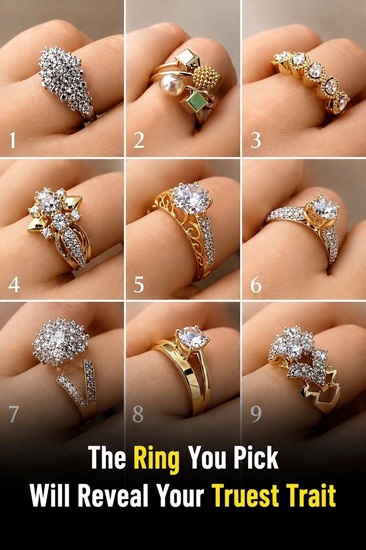
Personality quizzes have attracted attention for years because they offer an easy and entertaining way to reflect on individual preferences. One visual quiz that has circulated online invites people to examine several different ring designs and choose the one that immediately stands out to them. Each selection is then paired with characteristics such as confidence, compassion, creativity, loyalty, or ambition. Although the idea can be entertaining, there is no established scientific evidence showing that a person’s choice of ring can accurately determine their personality.
The activity is therefore better understood as a lighthearted exercise rather than a professional psychological test. Its main appeal comes from seeing whether the description connected to a favorite design feels familiar or relatable. The process is intentionally simple. Participants look at the available rings without spending too much time analyzing every detail and select the design they find most attractive. They can then read the interpretation associated with that number and compare it with their own perception of their personality.
Different styles may attract people for completely ordinary reasons, including shape, color, symmetry, familiarity, fashion preferences, or personal memories. Consequently, choosing one design instead of another should not be considered evidence of a particular psychological characteristic. A person’s personality develops through a complicated combination of experiences, temperament, relationships, environment, and many other influences. The ring descriptions simply provide themes that participants can use for casual reflection.
Ring #1: Confidence and Leadership
The first ring is commonly associated in this type of personality exercise with confidence, determination, independence, and leadership. Someone attracted to this design might relate to being comfortable taking responsibility when difficult decisions need to be made. They may also identify with direct communication and a preference for addressing problems instead of postponing them. In everyday life, leadership can appear in many different forms and does not necessarily mean holding an official position of authority. A person might demonstrate leadership by organizing a project, supporting a group during a challenging situation, or helping others find practical solutions. However, selecting this particular ring cannot scientifically establish whether someone is a natural leader. The interpretation should simply encourage participants to consider whether leadership and independence are qualities they recognize or value.
People who relate strongly to this category may also appreciate reliability and personal responsibility. They might prefer situations in which expectations are clear and decisions can be made after considering the available information. Confidence, however, is not something that remains identical in every part of life. Someone can feel highly confident professionally while being uncertain in an unfamiliar social environment, for example. Similarly, an individual who does not select Ring #1 can still possess exceptional leadership skills. Human behavior changes depending on circumstances, experience, and relationships. For that reason, the ring represents a symbolic theme within the quiz rather than a factual measurement of someone’s abilities.
Ring #2: Kindness and Compassion
The second ring is linked with empathy, kindness, emotional awareness, and an appreciation for meaningful relationships. Participants who select it may recognize themselves as people who enjoy helping friends, relatives, colleagues, or others around them. Compassion can involve listening carefully when someone needs support, considering another person’s perspective, or showing patience during difficult circumstances. These are valuable qualities, but they cannot be accurately measured through a single visual preference. Someone might choose Ring #2 simply because they appreciate its shape or decorative details. Another person who chooses an entirely different ring may be equally compassionate. The interpretation is therefore intended to provide a positive idea for reflection rather than establish a fact about someone’s character.
People who identify with this description may place significant value on trust and emotional connection. They might prefer a few meaningful relationships rather than many superficial ones, although individual social preferences vary widely. Empathy can also be expressed differently from person to person. Some individuals show support through conversation, while others prefer helping through practical actions. Neither approach automatically indicates that one person cares more than another. Personality cannot be reduced to a single behavior or preference, and people frequently respond differently depending on the situation. The ring quiz provides only a playful framework for thinking about these characteristics.
Ring #3: Creativity and Curiosity
Ring #3 is associated with imagination, curiosity, originality, and an interest in exploring new ideas. Participants attracted to distinctive or artistic designs may find this description especially appealing. Creativity is not limited to traditional artistic activities such as painting, writing, photography, or music. It can also appear in problem-solving, technology, cooking, business, crafts, design, communication, and countless everyday situations. Creative thinking often involves looking at familiar circumstances from another perspective or experimenting with alternative approaches. Nevertheless, selecting an unusual ring does not prove that someone is more creative than people who prefer simpler jewelry. Visual taste and psychological characteristics are not interchangeable.
Someone attracted to Ring #3 may simply appreciate details that feel different from conventional designs. That preference can still provide an interesting starting point for discussing personal taste without turning it into a scientific conclusion. Curiosity itself can take many forms as well. One person may enjoy discovering new places, while another might prefer learning about history, science, literature, technology, or practical skills. People can also be highly imaginative while preferring traditional clothing or jewelry. The connection between the ring and creativity exists within the entertainment format of the quiz. It should not be treated as a reliable psychological measurement.
Ring #4: Loyalty and Stability
The fourth ring represents loyalty, dependability, trust, and stability within the quiz’s interpretation. People attracted to a classic or balanced design may find these qualities particularly relatable. Loyalty is often demonstrated over time through actions rather than appearances or preferences. Keeping commitments, respecting other people’s confidence, offering support during challenging periods, and maintaining dependable relationships can all be expressions of loyalty. These behaviors develop through choices and experiences and cannot be determined from someone’s jewelry preference. Selecting Ring #4 therefore does not prove that someone is more trustworthy than a participant who chooses another design. It merely connects the visual choice with a familiar personality theme.
People who relate to this description may appreciate consistency and relationships that develop gradually over time. They might value knowing that friends and family members can depend on one another when circumstances become difficult. Stability can also mean different things to different individuals. For some people it may involve routines, while for others it can mean maintaining dependable relationships while remaining open to new experiences. Personalities rarely fit neatly into one category because individuals often combine apparently different qualities. Someone can value stability while simultaneously enjoying adventure, creativity, or change. That complexity is another reason the ring descriptions should remain entertainment rather than labels.
Ring #5: Ambition and Determination
The fifth ring is commonly connected with ambition, persistence, discipline, and personal achievement. Participants who choose this design might identify with setting goals and working consistently toward them. Ambition can involve professional advancement, education, creative projects, financial objectives, physical skills, family goals, or personal development. Importantly, ambition does not necessarily involve competing with other people. Many individuals measure progress by comparing their current abilities or circumstances with their own previous achievements. Persistence can certainly contribute to reaching goals, but success is influenced by many additional factors. Opportunities, resources, circumstances, education, support, timing, and unexpected events can all affect outcomes.
Choosing Ring #5 cannot predict whether someone will become successful or determine how motivated they are. A participant may simply prefer the appearance of that particular ring. Likewise, someone selecting another design could be extremely disciplined and goal-oriented. The value of this category comes from encouraging participants to think about what achievement means personally to them. Goals also change throughout life as circumstances and priorities evolve. Something that feels extremely important at one stage may become less important later. The ring provides a theme for reflection rather than a prediction of someone’s future.
Why These Personality Quizzes Can Feel Accurate
One reason simple personality quizzes remain popular is that their descriptions frequently contain characteristics many people can recognize in themselves. Psychology describes a phenomenon known as the Barnum effect, sometimes called the Forer effect, in which individuals may perceive broad or generalized personality descriptions as particularly applicable to themselves. Qualities such as wanting to be appreciated, caring about relationships, occasionally experiencing uncertainty, valuing independence, or wanting to accomplish meaningful goals can apply to large numbers of people. When a description contains positive and familiar characteristics, readers may naturally focus on the parts that resemble their own experiences. This helps explain why an entertainment quiz can sometimes appear surprisingly accurate. It does not mean the visual choice has scientifically revealed hidden personality information.
Another important point is that people usually possess characteristics associated with several categories simultaneously. Someone can demonstrate leadership at work while being compassionate with friends and highly creative during personal projects. The same person may value loyalty while also pursuing ambitious long-term goals. Human personality is multidimensional rather than divided into five simple groups. Behavior can also change depending on environment and circumstances. A person may behave differently around close family members than during a professional meeting or while meeting unfamiliar people. A five-ring quiz cannot capture that complexity, but it can still provide an enjoyable starting point for thinking about it.
Entertainment Is Different From Psychological Assessment
Professional personality research involves considerably more than selecting an attractive image. Researchers may use carefully constructed questionnaires, established measurement methods, statistical analysis, validation studies, and data collected from many participants. Psychological assessments are developed for particular purposes and have specific limitations that must be considered when interpreting their results. A casual online ring quiz has not demonstrated the characteristics necessary to function as a professional assessment simply because it assigns personality descriptions to different designs. It should therefore never be presented as a diagnosis or definitive evaluation of someone’s psychological characteristics. Readers should also avoid making important decisions about themselves or other people based on such results.
Recognizing these limitations does not mean people cannot enjoy the activity. Entertainment and scientific evaluation simply serve different purposes. Participants can select their favorite ring, read the accompanying interpretation, and decide whether some of the characteristics feel familiar. They can compare results with friends or family members and discuss why particular designs appealed to them. The conversation itself may be more interesting than the assigned result. One person may discover that they are consistently attracted to minimalist designs, while another may prefer elaborate patterns. These aesthetic differences can be interesting without needing to represent hidden psychological truths.
Visual preferences can also change over time. A ring someone finds attractive today may not be the same design they would have selected several years ago. Fashion trends, personal experiences, changing tastes, memories, and even the context in which an image is presented can influence preferences. This flexibility makes it difficult to argue that a single selection reveals a permanent personality characteristic. Human beings continually learn and adapt throughout their lives. Their priorities, relationships, interests, and goals can evolve considerably. A simple visual quiz captures only one choice made at one moment.
There is also value in approaching online personality content with curiosity while maintaining appropriate skepticism. Readers can ask whether a claim is presented as entertainment or whether it claims scientific authority. When scientific claims are made, reliable evidence should support them. A confident statement on a graphic or website does not automatically make the underlying conclusion scientifically established. Separating interpretation from verified information helps people enjoy online content without misunderstanding what it can actually demonstrate. This principle applies far beyond personality quizzes and is useful whenever people encounter surprising claims online.
The ring exercise can therefore be enjoyed without assigning excessive importance to the outcome. Ring #1 can symbolize leadership, Ring #2 compassion, Ring #3 creativity, Ring #4 loyalty, and Ring #5 ambition within the framework of the game. Participants may strongly identify with their assigned category, partially relate to it, or decide that another description fits them better. All of those reactions are perfectly consistent with an entertainment activity. There is no requirement that the interpretation accurately describe everyone who selects the same design. Individual personalities contain far more variation than these broad categories can represent.
Ultimately, the most meaningful part of the activity may simply be the conversation and reflection it creates. Looking at several rings and choosing a favorite can reveal an aesthetic preference, but it cannot provide a complete explanation of someone’s personality. Qualities such as kindness, creativity, determination, reliability, and leadership become meaningful through patterns of behavior and choices made over time. They cannot be confirmed by one image selection. By keeping that distinction clear, readers can enjoy personality quizzes without confusing entertainment with scientific evidence. Choose the ring that attracts you, consider the description for fun, and remember that no single choice can define the complicated and constantly developing person behind it.
