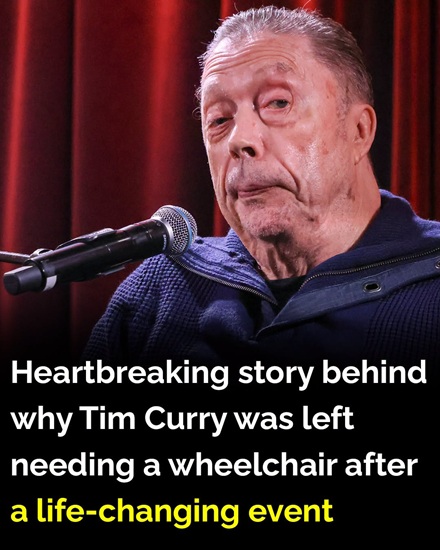
For more than five decades, Tim Curry built a career unlike almost anyone else in entertainment. His unmistakable voice, theatrical confidence and extraordinary ability to transform himself allowed him to move effortlessly between stage productions, Hollywood films, television and animation. To generations of viewers, he was Dr. Frank-N-Furter in The Rocky Horror Picture Show, the terrifying Pennywise in It, Wadsworth in Clue, or Long John Silver in Muppet Treasure Island.
Behind those memorable performances, however, Curry spent the final chapter of his life dealing with the lasting consequences of a devastating stroke. Curry died peacefully at his Los Angeles home on August 25, 2026, at the age of 80. A cause of death was not publicly disclosed. Curry’s health changed dramatically in 2012 when he suffered a major stroke. The event left him with significant physical limitations and ultimately required him to use a wheelchair for mobility.
Details he later shared publicly revealed just how serious the medical emergency had been. According to accounts of his experience, Curry was receiving a massage when the therapist noticed something was wrong and called for emergency medical assistance. Curry himself apparently did not initially understand how serious the situation was. That decision to seek immediate medical help proved enormously important as doctors discovered the severity of what had happened.

The stroke affected the right side of Curry’s brain and caused paralysis on the left side of his body, while also temporarily taking away his ability to speak. His condition required emergency treatment, including a craniectomy, a procedure in which part of the skull is temporarily removed to relieve dangerous pressure on the brain. Curry later described this frightening period in his 2025 memoir, Vagabond. The operation succeeded, but surviving the immediate emergency represented only the beginning of an extraordinarily difficult recovery.
Curry subsequently underwent extensive rehabilitation as he worked to regain abilities that had once been completely natural to him. Learning to communicate again became one of the most challenging parts of that process. Curry underwent speech and physical therapy while adjusting to major changes in his mobility and independence. He later lived with continuing limitations involving movement and short-term memory, although many of his long-term memories remained intact. His stroke was initially kept private and did not become widely known publicly until the following year.

Eventually, Curry became increasingly open about what had happened and about the enormous adjustment required after such a serious neurological event. Rather than disappearing entirely from public life, he adapted his career and continued connecting with audiences in ways his health allowed. Long before those health challenges, Curry had established himself as one of Britain’s most distinctive performers
. Born in Cheshire, England, on April 19, 1946, he studied English and drama at the University of Birmingham and graduated in 1968. His professional career quickly took him to the London stage, including the original West End production of Hair. Theater provided the foundation for the remarkable versatility that would characterize the rest of his career. Curry eventually performed in major productions on both sides of the Atlantic and received three Tony Award nominations, recognizing performances in Amadeus, My Favorite Year and Spamalot.
Everything changed when Curry became Dr. Frank-N-Furter in Richard O’Brien’s The Rocky Horror Show. Curry originated the role on stage in 1973 before bringing the character to cinema in the 1975 film The Rocky Horror Picture Show. The movie was not initially a conventional blockbuster, but it gradually developed an extraordinary cultural life through midnight screenings and audience participation. Curry’s fearless performance became inseparable from the movie’s identity. Decades later, the character remained his most recognizable creation, even though Curry’s career extended far beyond a single role. The film ultimately became one of the defining cult movies of its era.
Curry demonstrated that extraordinary range throughout the following decades. In 1985’s Clue, he played the frantic butler Wadsworth, delivering a performance remembered for its rapid-fire dialogue and physical comedy. That same year, audiences saw a dramatically different Curry beneath elaborate makeup as the Lord of Darkness in Ridley Scott’s Legend. In 1990, he terrified television audiences as Pennywise in the adaptation of Stephen King’s It. Each character looked and behaved so differently that Curry’s ability to disappear into roles became one of the defining qualities of his career.

His filmography continued to expand through comedy, fantasy, family entertainment and television. Curry appeared in productions including Annie, Home Alone 2: Lost in New York, The Three Musketeers and Muppet Treasure Island. His portrayal of Long John Silver in the 1996 Muppet adventure became another particularly beloved performance. Curry also developed an extensive career as a voice actor, where his distinctive baritone proved perfectly suited to animated villains and eccentric characters. His voice credits included projects such as Sonic the Hedgehog, The Mask and Star Wars: The Clone Wars, among many others.
Music represented another part of Curry’s creative life. He released several albums during the late 1970s and early 1980s while continuing to work as an actor. Yet theater remained an especially important part of his professional identity. His performances demonstrated that the flamboyant star audiences associated with Rocky Horror was also a disciplined stage actor capable of handling demanding theatrical material. His three Tony nominations reflected that versatility and helped establish Curry as far more than simply a cult-film personality. He was an entertainer whose work crossed genres, mediums and generations with unusual ease.
The 2012 stroke inevitably changed the type of work Curry could undertake. His physical limitations meant that the highly energetic stage and screen performances of earlier decades were no longer possible in the same way. Nevertheless, he remained professionally and publicly active when circumstances allowed, including voice work and appearances connected with his celebrated career. His continuing presence was especially meaningful to fans who had followed him for decades. In 2025, he published Vagabond: A Memoir, giving readers a personal account of his life, career, memories and health struggles.
Curry also retained the humor for which friends and audiences had long known him. Interviews conducted after his stroke showed a performer willing to acknowledge the seriousness of his condition without allowing it to become the only subject defining him. His reflections on survival were particularly striking because the medical emergency had forced him to confront how suddenly an ordinary day could become life-threatening. He understood that surviving such a severe stroke was itself remarkable. The experience reshaped his daily existence, but it did not erase the personality, wit or creative identity that audiences had known for decades.
When news of Curry’s death emerged in August 2026, attention naturally returned to the enormous range of characters he had created. Reports confirmed that he died at the age of 80 at his home in Los Angeles after having experienced health difficulties for years. His manager announced his death but did not publicly provide a specific cause. That distinction matters: while Curry’s 2012 stroke and its lasting consequences are well documented, it would be inaccurate to claim without evidence that the stroke itself was the direct cause of his death fourteen years later.
His legacy therefore reaches considerably further than the health crisis that transformed his later years. Curry helped create characters that remain immediately recognizable decades after their first appearances. Frank-N-Furter demonstrated his theatrical fearlessness, Pennywise showed how effectively he could create menace, Wadsworth displayed his comic precision, and Long John Silver revealed another side of his charisma. Meanwhile, his theater, television, music and voice work demonstrated a versatility that few performers manage to sustain across such a long career. His performances continue to be discovered by audiences who were not even born when many of them were originally released.
Tim Curry’s final years also became part of that larger story. A catastrophic stroke took away much of his physical independence and forced him to relearn fundamental skills, yet it did not erase the work he had already created or completely silence his creative voice. His memoir allowed him to tell his story on his own terms, while later appearances reminded audiences of the personality behind some of popular culture’s most extravagant characters. Curry’s life ultimately encompassed far more than one movie, one character or one medical crisis. From London’s stages to cult cinema, Broadway, Hollywood and animation, he left behind a body of work remarkable for its range, humor and willingness to take risks — a legacy that continues long after his final performance.
