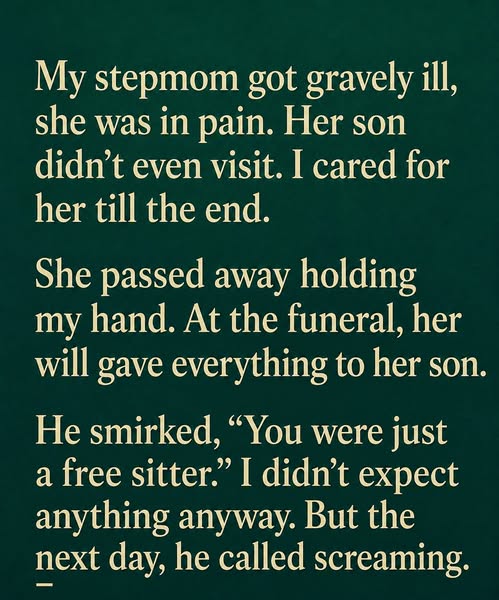
I never expected anything from her affairs, so there was little reason to anticipate surprises. The day after the service, I was still sorting through the weight of grief when the phone rang unexpectedly, startling me. It was her son. His voice trembled with tension, a mix of confusion, frustration, and hurt that spilled out almost immediately. I could sense he had uncovered something in his mother’s possessions that unsettled him deeply. He explained that while going through a box of his mother’s old keepsakes, he had discovered a letter.
Not addressed to him, but to me, and its presence had left him perplexed and unsure of how to react. The letter itself was simple in tone but carried a profound weight. She wrote with a gentleness that immediately stopped me in my tracks, reminding me of her calm presence during her final years. She thanked me for the patience I had shown during her most fragile days. Her words were quiet yet deeply heartfelt, acknowledging the support and steadiness I had offered without fanfare or expectation.
She explained that her estate had been carefully arranged long before, structured to minimize confusion or stress, and that attempting to alter it would have caused more difficulty than she could endure in her final chapter. Still, she wanted me to know that my comfort and presence mattered more than any material inheritance she could have left. It was her way of expressing appreciation that words alone could barely capture.
But that was not what had upset her son. As he continued sorting, he found other items tucked alongside the letter—receipts, handwritten notes, and old photographs quietly revealing thoughts he had never known existed. The papers suggested she had once considered creating a small trust for him, though she never followed through. Her focus had shifted over time to repairing their strained connection instead of planning legal or financial legacies.
He hadn’t understood any of this until he held those documents in his hands, absorbing her unspoken regrets written in a careful, measured script that reflected her consideration and thoughtfulness. His words came in waves, a mixture of confusion and emotion as he tried to reconcile years of misunderstanding and absence. I let him speak, offering space for feelings that had quietly accumulated over a lifetime.
Sometimes, the best support we can give someone is simply allowing them to release what has been quietly building inside, giving their grief or confusion room to breathe without judgment or interruption. When he paused, I spoke softly, explaining the truth as gently as I could. The letter she wrote to me wasn’t a slight, a judgment, or a comparison—it was her gratitude expressed safely and privately.
There was no hidden meaning, no covert message, no intention to cause guilt. It was her heart communicating plainly, the simple articulation of appreciation for the care and attention she had quietly relied upon. What she had hoped for above all else was that her son would understand the fleeting nature of time, the importance of presence, and the value of showing up while the opportunity remains.
Her words were an attempt to reach him in a way she hadn’t managed during the busy, complicated years of life, when distractions and daily obligations often got in the way of clarity and communication. Later, as I returned the letter to its envelope, I realized she had given both of us something far more enduring than money, property, or legal documents—a profound lesson on kindness and presence that persists beyond life.
For her son, discovering these writings became a reflection on the gap between intention and action, highlighting the small ways unspoken appreciation or neglected conversations can shape relationships across decades. Some inheritances arrive not in boxes, envelopes, or legal forms. They arrive in subtle, transformative moments of insight, clarity, and understanding, carrying lessons we were not expecting but desperately needed to internalize.
The discovery prompted long conversations between us, reflecting on the ways her quiet attentiveness had influenced our lives in ways neither of us had fully recognized at the time. He spoke of past arguments and misunderstandings, moments when distance or stubbornness had clouded connection. Reading her words allowed him to view those events with newfound empathy and comprehension.
I shared how her care had shaped my ability to remain patient and attentive, even during her most difficult moments, underscoring the quiet power of consistent support and silent reassurance. Together, we considered the nuances of her decisions: why she had chosen not to create a trust, why she had directed her gratitude privately, and how those choices reflected her priorities and deep understanding of human emotion.
Her letters illustrated a profound awareness of timing, a recognition that life’s most meaningful gestures are often invisible to the casual observer yet enduring for those who truly pay attention. We discussed the challenges she had faced in balancing obligations, health, and family dynamics, which clarified why her son had been shielded from certain decisions until the end, ensuring minimal additional stress.
Through this process, her son began to see her in a new light—not just as a mother who had occasionally seemed distant, but as a deeply intentional, caring individual navigating complex circumstances with love. We spent hours reflecting on the emotional legacy she had left behind, far exceeding any financial or material inheritance. Her thoughtful gestures, even unspoken for years, now spoke volumes about her priorities and values.
In revisiting the letters and notes, we discovered more subtle details: small acknowledgments, expressions of regret, and reflections that demonstrated her enduring awareness of how actions ripple through relationships over time. This prompted further reflection on forgiveness, understanding, and empathy, teaching him that even delayed recognition or expression of gratitude can profoundly impact emotional healing and personal growth.
We also recognized that she had made deliberate choices to protect both of us from unnecessary conflict, showing wisdom in discerning when to speak, when to act, and when to simply allow space. Her words emphasized patience, illustrating that lasting influence is often quiet, consistent, and intentional, manifesting not through dramatic gestures but through small acts repeated over time and remembered long afterward.
The emotional journey following her passing became a lesson in active listening, reflection, and patience, revealing that understanding one another sometimes requires stepping back and considering context, history, and intention. For her son, this process illuminated the importance of expressing care while it is possible, avoiding deferred appreciation that may arrive too late, reinforcing the adage that love is best demonstrated in action, not assumption.
The letters encouraged us to explore not only past grievances but also successes and moments of shared joy, illustrating how acknowledgment and memory intertwine to shape the way we carry relationships forward. We revisited photographs and mementos, discussing their significance, which allowed him to reconnect with his mother’s intentions and revisit memories previously tinged with frustration or miscommunication.
In these conversations, it became clear that her priorities were always rooted in emotional connection rather than material wealth, demonstrating a commitment to fostering relationships over accumulating possessions or formal legacies. The experience underscored a profound truth: some of life’s most valuable inheritances are lessons in patience, compassion, and understanding, quietly imparted over years and revealed only through reflection after a loved one is gone.
We also reflected on the courage it took for her to express gratitude in writing, revealing a vulnerability that few would notice but which carried enormous emotional weight for those attuned to her intentions. Her letters ultimately became a bridge between the past and present, allowing her son to reconcile with choices, missed opportunities, and the realities of complex family dynamics, offering closure in ways previously unimaginable.
Over time, he began to recognize the profound impact her actions had on shaping the adults we had become, revealing that consistent, quiet care often leaves the most lasting mark on character and perspective. The experience reinforced the value of written communication in expressing unspoken emotions, particularly when verbal expression may be limited by circumstance, health, or fear of misunderstanding.
For both of us, this process illuminated the depth of her foresight, her understanding of timing, and her ability to prioritize emotional connection over procedural or legal formalities, offering a masterclass in subtle caregiving. We realized that her letter had functioned not only as gratitude but also as guidance, encouraging reflection on our own relationships, the importance of empathy, and the need to act on feelings of care without delay.
Her carefully chosen words reminded us that intention matters as much as action, and that thoughtful reflection can enhance the meaning of even small gestures, creating a legacy that outlasts any material gift. Ultimately, the experience underscored a vital truth: some inheritances cannot be measured in dollars or possessions. They are measured in clarity, understanding, empathy, and the ability to carry lessons forward into everyday life.
As her son slowly began to process the layered emotions, he recognized that the letter and accompanying documents were not a source of pain, but a map to understanding, healing, and reconciling long-standing questions about her decisions. Her quiet wisdom became evident in the way she anticipated future emotional needs, leaving instructions not just for material affairs but for emotional navigation, highlighting her deep foresight and care for our well-being.
Reading her reflections allowed us both to internalize principles of kindness, patience, and measured expression, demonstrating that intentional acts of emotional care can transcend the limitations of verbal or physical presence. Even after her passing, her guidance continued to shape interactions, offering lessons in how to communicate with empathy, process grief constructively, and recognize the often invisible but enduring influence of thoughtful caregiving.
The letters became a tangible manifestation of her lasting impact, bridging gaps between generations and illustrating how love, patience, and gratitude can create continuity even beyond a lifetime. In the weeks that followed, we revisited the box multiple times, uncovering further insights into her thought processes, her priorities, and the subtle
