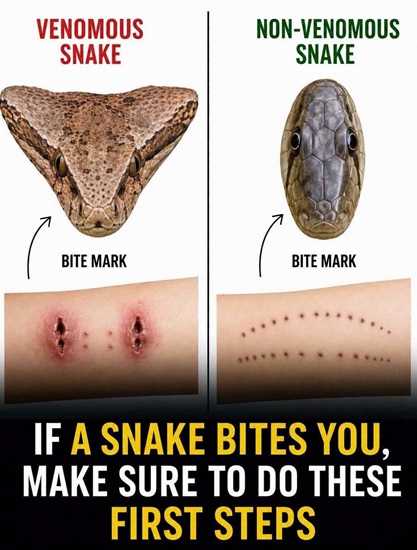
A snake bite should always be taken seriously because it can become a medical emergency even when the initial pain seems mild. Some venomous bites produce obvious symptoms quickly, while others may initially cause relatively little discomfort before more serious effects develop. It is also possible for a frightened person to misidentify a snake or have no opportunity to see it clearly. For those reasons, a person should not attempt to determine whether medical care is necessary based only on pain, fang marks, or the appearance of the wound.
The safest approach after a suspected venomous snake bite is to move away from the snake, reduce unnecessary physical activity, and obtain professional medical evaluation as quickly as possible. The first priority is preventing another bite. The injured person and anyone assisting should move to a safe location away from the snake without attempting to confront it. Snakes generally should not be chased, trapped, captured, or killed for identification.
Trying to handle the animal creates an unnecessary risk of additional bites and can turn one medical emergency into several. Even a snake that appears dead should not be handled because reflex movements can remain possible after death or severe injury. Medical professionals can evaluate a patient using symptoms, clinical findings, and information about the circumstances without requiring someone to bring the snake to the hospital. Once everyone is safely away from the animal, contact emergency medical services or arrange prompt transportation to an appropriate medical facility.
If an ambulance or professional emergency response is available, it is generally preferable because the patient’s condition can change during transportation. Tell the dispatcher that a snake bite has occurred and provide the approximate time of the bite, its location on the body, and any symptoms that have already appeared. Follow the dispatcher’s instructions carefully because recommendations can vary depending on circumstances and location. Do not delay calling while attempting home treatments or searching online for the species.

Keep the bitten person as calm and physically still as circumstances allow. Fear after a snake encounter is completely understandable, but unnecessary walking, running, or other strenuous movement should be minimized. If the person must be moved away from immediate danger, help them do so as safely as possible. Once in a secure location, encourage them to sit or lie down and avoid unnecessary activity while transportation is arranged. If rescuers can carry or otherwise assist the person rather than requiring significant walking, that can reduce exertion.
A bite on an arm or leg requires particular attention because swelling can develop. Keep the affected limb reasonably still and supported in a comfortable, neutral position while following instructions from emergency personnel. Do not repeatedly raise and lower the limb in an attempt to manipulate venom movement. Different medical systems have historically given varying advice about exact limb positioning, so emergency professionals familiar with the circumstances should guide care when available. The important principle is to avoid vigorous movement, massage, or manipulation of the bitten area.
Remove rings, watches, bracelets, anklets, tight shoes, and restrictive clothing from the affected limb as soon as this can be done safely. Swelling can make these objects increasingly difficult to remove and may cause additional pressure on surrounding tissue. Removing them early is much easier than waiting until significant swelling has developed. Do not aggressively pull an object over an already swollen area if doing so could cause injury. Emergency professionals can help if an item cannot be removed safely.
The wound itself should be handled gently. Do not squeeze, vigorously rub, or massage the bite. Depending on local medical guidance and the circumstances, a clean, dry dressing may be used to protect the area, but elaborate wound treatment should never delay transportation. Avoid aggressive scrubbing or attempts to force fluid from the puncture marks. The major medical problem in venomous snakebite is venom already delivered into tissue, not something that can simply be washed or squeezed away from the surface.
One of the most important parts of snake-bite first aid is knowing what not to do. Cutting the bite with a knife or razor is dangerous and does not reliably remove venom. Incisions can cause bleeding, infection, nerve damage, and additional tissue injury. They can also complicate medical evaluation once the patient reaches the hospital. The old practice of cutting across fang marks should therefore not be used.
Attempting to suck venom from the wound is also ineffective and potentially harmful. This includes using the mouth or commercial suction devices marketed for bites. Venom rapidly begins interacting with tissues after injection, and meaningful amounts cannot simply be pulled back through the puncture marks. Oral suction can also introduce bacteria into the wound and potentially expose the helper to biological material. Time spent attempting suction is better used arranging emergency medical care.
Do not apply ice or frozen objects directly to a snake bite. Extreme cold does not neutralize venom and can damage already vulnerable tissue. Similarly, do not immerse the affected limb in ice water. Cooling techniques once promoted as folk treatments can worsen local injury without addressing systemic envenomation. Keep the patient generally comfortable, but do not apply extreme heat or cold directly to the wound.
Electric shock is another dangerous treatment that should never be attempted. There is no reliable evidence that electricity neutralizes venom inside the body. Electrical treatment can instead produce burns, cardiac complications, or additional injuries. The same principle applies to chemicals, herbal mixtures, gasoline, alcohol, or other substances sometimes applied to snake bites as traditional remedies. None should replace evidence-based medical treatment.
A tight arterial tourniquet should not be improvised around a bitten arm or leg unless specifically directed by qualified medical professionals under circumstances where such a device is indicated for another life-threatening injury. Completely restricting blood flow can cause severe tissue damage and may complicate the effects of envenomation. Snake-bite first aid is different from controlling catastrophic bleeding after major trauma. Advice involving pressure immobilization also varies by snake species and geographic region, which is why people should follow local emergency guidance rather than improvising.
Pressure-immobilization bandaging deserves special clarification because recommendations differ internationally. In Australia, for example, pressure immobilization is recommended for bites from several medically important native snakes because many of their venoms can produce systemic neurotoxic or coagulation effects with relatively little local tissue destruction. In the United States, however, this technique is generally not recommended for typical pit-viper bites because significant local tissue injury and swelling may occur. A generic internet article therefore should not tell every snake-bite patient worldwide to apply a pressure bandage. Local emergency services and poison specialists are better positioned to provide region-specific instructions.
Do not attempt to capture the snake for doctors. If the animal remains visible and a photograph can be taken from a genuinely safe distance without delaying medical care, an image may sometimes provide useful information. However, obtaining a photograph is never more important than personal safety. Do not move closer, block the snake’s escape route, or ask another person to approach it. A description of color, markings, approximate size, and location may be helpful, but imperfect identification should not delay treatment.
It is also important to understand that visual identification can be unreliable. Lighting conditions, fear, movement, juvenile coloration, and similarities between species can all lead to mistakes. Fang marks themselves are not a dependable method of identifying whether venom was delivered. Some venomous bites may leave subtle marks, while nonvenomous snakes can produce multiple punctures or scratches. Medical professionals therefore consider the entire clinical picture rather than relying on one feature.
Symptoms after a venomous bite vary according to species, venom composition, location of the bite, amount of venom delivered, and individual patient factors. Local symptoms may include pain, swelling, bruising, tenderness, or tissue changes. Systemic effects can include nausea, weakness, dizziness, abnormal bleeding, neurological symptoms, difficulty breathing, low blood pressure, or other serious problems. Not every patient develops the same pattern, and symptoms can evolve over time.
A person who initially feels relatively well should therefore still be medically evaluated after a suspected venomous snake bite. The absence of immediate severe pain does not prove that the bite was harmless. Some effects can be delayed, and clinical observation may be necessary before healthcare professionals can determine whether significant envenomation occurred. Conversely, not every bite from a venomous snake necessarily delivers a clinically important amount of venom. This is sometimes described as a dry bite, but only medical evaluation should be relied upon to determine whether treatment is necessary.
While waiting for emergency assistance, observe the person’s condition without repeatedly disturbing the wound. Pay attention to breathing, level of alertness, increasing swelling, severe weakness, vomiting, abnormal bleeding, or other changes. If symptoms change, note approximately when the change occurred so that this information can be given to medical professionals. A simple timeline can be valuable because it helps clinicians understand how rapidly the patient’s condition is progressing.
If practical, remember or write down the approximate time the bite occurred. Medical teams may also want to know when swelling or other symptoms first appeared. Some clinicians mark the edge of swelling and record the time to monitor progression, but this should not become a reason to delay transportation or repeatedly manipulate the limb. The priority remains reaching professional care.
If the person becomes unconscious and is not breathing normally, follow emergency-dispatch instructions and begin appropriate resuscitation if trained and if the environment is safe. Standard emergency priorities such as maintaining breathing and circulation take precedence when someone becomes critically unwell. An automated external defibrillator should be used if indicated and available according to normal resuscitation procedures. Continue following emergency-service instructions until professional responders take over.
Avoid giving alcohol after a snake bite. Alcohol does not neutralize venom and may interfere with judgment, hydration, or medical assessment. It is also sensible to avoid unnecessary caffeine or stimulants while awaiting care. The patient should not take medications simply because someone believes they might counteract venom. Antivenom and supportive hospital treatment are fundamentally different from ordinary over-the-counter remedies.
Pain medication requires caution. Some snake venoms can interfere with normal blood clotting, so medicines that affect platelets or bleeding may be inappropriate in certain cases. Aspirin and nonsteroidal anti-inflammatory drugs such as ibuprofen should not be taken casually after a suspected venomous bite unless healthcare professionals specifically advise their use. Medical teams can select pain-control options appropriate to the patient’s condition.
Do not force food or drink on someone who is vomiting, becoming drowsy, having difficulty swallowing, or experiencing neurological symptoms. Such a person may be at risk of choking or aspiration. Emergency personnel can advise whether limited fluids are appropriate while transportation is being arranged. The safest general rule is to prioritize professional instructions rather than attempting to treat the person with food, beverages, or home remedies.
Children require particularly prompt medical attention because the amount of venom delivered may represent a larger dose relative to body size. Older adults and people with significant medical conditions may also have additional risks. However, age alone cannot predict severity. Any person with a suspected medically significant snake bite should receive appropriate evaluation rather than waiting for symptoms to become severe.
Pregnancy does not make emergency treatment less important. A pregnant person who is bitten by a potentially venomous snake needs urgent medical evaluation because serious envenomation can threaten both the patient and pregnancy. Decisions regarding antivenom and other treatment should be made by clinicians who can weigh the risks of untreated envenomation against treatment considerations. Delaying care because of fear about medication can be more dangerous than obtaining professional assessment.
Pets should not be used to approach or investigate the snake either. Dogs and other animals can also be bitten and may require emergency veterinary treatment. Keeping children and pets away from a visible snake protects them and gives the animal an opportunity to leave. Most encounters do not require someone to capture the snake personally.
Once the patient reaches a medical facility, clinicians will evaluate the bite and monitor for evidence of envenomation. This may include repeated physical examinations, vital-sign monitoring, laboratory testing, and observation of swelling or neurological function. Blood tests can be particularly important with venoms that affect clotting. The exact evaluation depends heavily on the region and the species likely to be involved.
Antivenom is one of the major treatments available for clinically significant venomous snake bites. It contains antibodies or antibody fragments designed to bind components of particular venoms. Antivenom does not function like an ordinary pain medicine, and it should not be self-administered outside an appropriate medical setting. Clinicians determine whether it is needed based on the patient’s symptoms, laboratory results, suspected snake type, and progression of envenomation.
Not every person bitten by a venomous snake automatically requires antivenom. Some bites deliver little or no venom, while other cases can be managed through observation and supportive care. In significant envenomation, however, antivenom can be lifesaving and can prevent or reduce serious complications. The decision belongs to trained medical professionals who can evaluate the risks and benefits.
Antivenom can itself cause reactions, which is another reason administration belongs in a healthcare environment. Medical teams are prepared to recognize and treat allergic or other adverse reactions while continuing to manage the underlying envenomation. Fear of a possible antivenom reaction should not persuade someone with a serious bite to avoid emergency care.
Hospital treatment may involve much more than antivenom. Patients can require intravenous fluids, pain control, respiratory support, treatment of blood-pressure abnormalities, repeated laboratory testing, wound management, or other supportive measures. Severe bites may require intensive care. The treatment plan depends on what the venom is doing to the patient’s body rather than simply on how dramatic the bite looks externally.
Antibiotics are not automatically necessary for every snake bite. Clinicians decide whether they are appropriate based on evidence of infection or specific circumstances. Similarly, surgery is not a routine treatment simply because swelling is present. Decisions about wound care and surgical intervention should be made by specialists familiar with snake envenomation because unnecessary procedures can create additional harm.
Recovery time varies widely. Some patients can be observed and discharged relatively quickly after clinicians determine that significant envenomation has not occurred. Others require days of hospitalization and extended follow-up. Local tissue injury can take considerable time to heal, while some neurological or systemic effects require rehabilitation and continued medical monitoring.
Prevention remains far easier than treating a serious bite. People entering areas where snakes may live should wear appropriate footwear and clothing. Sturdy boots and long trousers can provide some physical protection, although no clothing makes someone completely bite-proof. Paying attention to where hands and feet are placed is equally important.
Never reach blindly into holes, rock crevices, woodpiles, dense vegetation, or storage spaces where a snake might be concealed. Use tools rather than bare hands when moving materials that have been sitting undisturbed outdoors. Snakes often rely on camouflage, meaning someone may be surprisingly close before noticing one.
At night, use a flashlight when walking outdoors in places where snakes are present. Many snake encounters occur because a person simply does not see the animal before stepping near it. Proper lighting makes it easier to notice movement and choose another route. Wearing closed footwear is also safer than walking barefoot or in sandals in higher-risk environments.
Keeping areas around homes relatively free of clutter can reduce hiding places for both snakes and the rodents that attract them. Woodpiles should be managed carefully, food sources for rodents should be controlled, and outdoor storage should be inspected cautiously. These steps reduce risk but cannot guarantee that a snake will never appear.
If a snake is discovered near a home, the safest response is usually to maintain distance and allow it an escape route. If removal is necessary, contact an appropriate wildlife professional or local service rather than attempting to capture it personally. Snake-handling experience cannot be acquired safely from a short online tutorial.
Children should be taught a very simple rule: never touch or approach a snake. They do not need to determine whether it is venomous. If they see one, they should move away and tell an adult. Teaching children to admire wildlife from a safe distance is more useful than encouraging them to identify dangerous species at close range.
People who hike, camp, hunt, or work in remote areas should plan for emergencies before leaving. Carry a charged phone, satellite communicator, personal locator beacon, or another suitable communication method where ordinary cellular service is unreliable. Tell someone where you are going and when you expect to return. Know how long it would realistically take emergency responders to reach the area.
A basic first-aid kit is useful for many outdoor injuries, including providing clean materials for covering wounds. However, no ordinary first-aid kit contains a home substitute for hospital treatment of serious snake envenomation. Commercial snake-bite suction kits should not create a false sense of security. Communication and evacuation planning are far more important.
People traveling internationally should also remember that snake species and first-aid recommendations differ considerably between regions. Advice appropriate for an Australian elapid bite may not be appropriate for a North American pit-viper bite. Recommendations can even differ within the same country because medically important species vary geographically. Local public-health authorities, poison centers, and emergency services should therefore take priority over generic social-media advice.
In the United States, the Centers for Disease Control and Prevention advises people bitten by a snake to seek medical attention as soon as possible. The CDC specifically warns against picking up or attempting to trap the snake, applying a tourniquet, cutting the wound, sucking out venom, or applying ice. These recommendations reflect the central principle of modern snake-bite first aid: avoid interventions that cause additional injury while getting the patient to medical professionals.
The World Health Organization considers snakebite envenoming a serious global health problem, particularly in tropical and subtropical regions where access to antivenom and emergency healthcare may be limited. Agricultural workers and people living in rural communities can face especially significant risks in some countries. The worldwide burden is therefore very different from the risk experienced by an occasional recreational hiker in a region with rapid emergency access.
This global variation is another reason articles should avoid presenting one rigid first-aid technique as universally correct. The safest universally applicable principles are comparatively straightforward: get away from the snake, seek urgent medical assistance, reduce unnecessary movement, remove constricting items before major swelling develops, and avoid dangerous folk remedies. More specialized interventions should follow regional professional guidance.
A snake bite can be frightening, but panic and improvised treatment can make the situation more difficult. Staying as calm as possible helps the patient and allows helpers to make better decisions. The objective is not to personally neutralize the venom. It is to prevent additional injury and reach people who have the equipment, medicines, and training required to manage envenomation.
Remember that the appearance of the wound does not reliably predict what will happen next. A small puncture can accompany significant envenomation, while a painful bite may ultimately prove less dangerous. Symptoms can evolve, which is why observation by healthcare professionals matters.
Do not wait for dramatic symptoms such as severe swelling, bleeding, weakness, or breathing difficulty before asking for help. By the time serious systemic effects are obvious, the patient may already require urgent intervention. Earlier medical evaluation gives clinicians more opportunity to monitor changes and respond appropriately.
Likewise, do not assume that feeling normal after several minutes means the danger has passed. The timing of symptoms varies. Only appropriate medical assessment and observation can provide meaningful reassurance after a suspected venomous bite.
The essential first-aid sequence can therefore be remembered without complicated equipment. Move away from the snake and make sure the scene is safe. Contact emergency services. Keep the patient calm and minimize unnecessary movement. Remove rings, watches, and other constricting items. Follow professional instructions and arrange rapid medical evaluation.
Just as important is the list of actions to avoid. Do not cut the wound. Do not suck out venom. Do not apply ice or electric shock. Do not improvise a tight tourniquet. Do not chase or handle the snake. Do not
