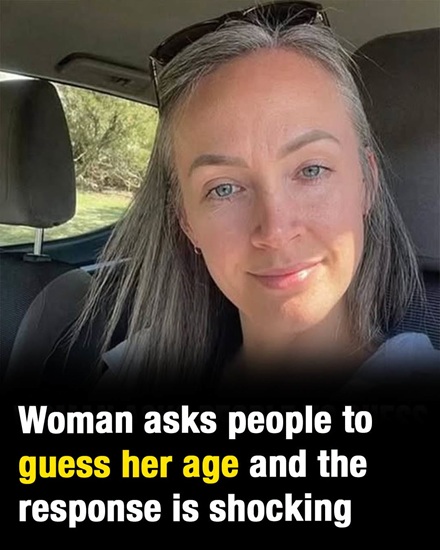
A simple question about age unexpectedly turned into a much larger discussion for content creator Emily Jane. In April 2024, Emily posted a TikTok video asking viewers to guess how old they thought she was. She appeared without makeup or beauty filters and encouraged people to give their genuine estimates. The question was intended partly as a social experiment about how people perceive age, but the responses covered a much wider range than she expected.
Some viewers thought she was in her twenties or thirties, while others estimated that she was in her forties, fifties, or even close to 60. Emily’s video quickly attracted attention because viewers disagreed so dramatically. One person who identified themselves as 56 guessed that Emily was approximately 47. Another viewer, who said they were 42, estimated that Emily was around 51. Someone else placed her at about 42. The estimate that surprised Emily most came from a commenter who guessed that she was 58.
The responses were not universally older estimates, however. Other commenters guessed that she was in her thirties, and some believed she was still in her twenties. The enormous range became part of what made the experiment interesting. Emily responded to the higher estimates in a follow-up video. She wondered aloud whether she genuinely appeared close to 60 and expressed surprise that some viewers believed she was approaching that age. She then revealed the answer: she had just turned 36.
Her real age was therefore more than two decades younger than the highest widely reported guess. Rather than simply dismissing the comments, Emily began considering why different viewers had interpreted her appearance so differently. One characteristic immediately stood out: Emily had naturally grey hair. She explained that she began going grey when she was around 19 years old.
Instead of continuing to cover it permanently, she eventually allowed much of the grey to remain visible. Because grey or white hair is traditionally associated with older adulthood, Emily believed that some viewers may have unconsciously used her hair as an age marker even though other aspects of her appearance suggested a younger woman.
Early greying is not exclusive to older people. Hair can begin losing pigment at very different ages, with genetics playing an important role. For that reason, grey hair alone is not a reliable way of determining someone’s age. Nevertheless, cultural associations between grey hair and aging are strong enough that viewers may use hair color as one of several visual clues when making quick judgments. In Emily’s comment section, several people explicitly said that her hair had influenced their estimate.
Emily had also deliberately presented herself without the visual enhancements that are common on social media. She said she was not wearing makeup and had not used a beauty filter in the original video. She also stated that she had never undergone cosmetic procedures. The appearance viewers were evaluating was therefore much closer to how she normally looked than to a deliberately polished portrait created for social media.
Another temporary factor was visible as well. Emily explained that she had a newborn baby and had been experiencing sleepless nights. She believed the tiredness visible around her eyes may have affected some viewers’ estimates. Sleep deprivation can naturally change how someone looks on a particular day, but Emily’s larger point was that the face shown in the video was not a carefully prepared celebrity-style image. She considered it an ordinary representation of herself at 36.
Instead of treating the comments only as personal criticism, Emily raised a broader question. She wondered whether repeated exposure to edited photographs, beauty filters, carefully selected lighting, and cosmetic procedures has affected how people imagine different ages should look. In her view, people may encounter so many idealized images online that an ordinary unfiltered face sometimes appears older than expected. Importantly, this was Emily’s interpretation of what happened in her comment section rather than something that can be proven from the guesses alone.
Some commenters agreed with her interpretation. They argued that social media often presents highly polished versions of people, which could make natural signs such as under-eye circles, skin texture, or grey hair appear unusual. Others disagreed and offered a much simpler explanation. In their opinion, Emily’s grey hair was doing most of the work. They believed her facial features looked consistent with someone in her thirties but associated her hair color with someone considerably older.
One person essentially told Emily that she looked her real age once the hair was considered separately. Another said her skin looked youthful but that the grey hair made people estimate higher. A different commenter suggested that people were simply unused to seeing a younger person confidently wearing natural grey hair. These reactions demonstrated that there was no single interpretation even among viewers who saw exactly the same video.
That variation itself is worth considering. Estimating someone’s age from appearance is inherently imprecise. People differ in skin texture, hair color, facial structure, lifestyle, genetics, clothing, and countless other features. The person making the estimate also brings their own experiences and expectations. Someone who knows many people who went grey in their twenties may interpret Emily differently from someone whose family members did not grey until their fifties.
Age perception can therefore be influenced by more than the actual biological age of the person being observed. Hairstyles, clothing, facial expressions, lighting, fatigue, makeup, and cultural assumptions can all play a role. Even the age of the viewer may influence what they consider “young” or “old.” Emily herself had originally asked viewers to mention their own ages partly because she wondered whether different age groups perceived her differently.
Her experiment also touched on a broader discussion about the influence of visually focused social media. Research does support the idea that repeated exposure to highly curated appearance-based content can influence body image and beauty standards. A 2024 systematic review covering 25 studies and more than 13,000 participants found associations between appearance-focused social media use, body dissatisfaction, social appearance concerns, and interest in cosmetic procedures. That research does not prove that social media caused people to misjudge Emily specifically, but it supports the broader idea that digital imagery can influence expectations about appearance.
Another systematic review published in 2024 examined the relationship between social media, self-perception, and aesthetic procedures. The researchers reported a meaningful association between social media exposure and interest in cosmetic treatments. Again, this does not mean that everyone using social media develops unrealistic standards or that cosmetic procedures themselves are inherently problematic. It simply suggests that repeated exposure to appearance-focused content can play a role in how people think about beauty and their own appearance.
Research involving young adults has produced similarly nuanced findings. One study involving Instagram users aged 18 to 25 found that people who frequently used filters reported greater acceptance of cosmetic procedures and stronger intentions to consider them. Participants also tended to overestimate how common cosmetic procedures were among other people. These findings offer one example of how digital environments may alter perceptions of what is typical, even when users are aware that images can be edited.
However, the scientific picture is not as simple as saying that every filter creates unrealistic expectations. More recent experimental research comparing filtered and unfiltered TikTok-style content found that the relationship can vary according to context and the outcome being measured. Researchers continue to study exactly how idealized online imagery affects different groups. This uncertainty is another reason Emily’s specific experience should be described as an interesting social-media episode rather than proof of a universal psychological effect.
Emily’s grey hair adds another dimension because women have historically faced different expectations around visible aging than men. Grey hair on men is often accepted or even presented positively, while women have traditionally faced greater pressure to dye or conceal it. Those expectations have been changing, however, as more women choose to keep their natural grey hair rather than treating it as something that automatically needs correction.
Emily appeared comfortable with her decision. Her surprise was not that people noticed the grey hair but that some translated it into such a dramatic difference in estimated age. She had started going grey as a teenager, so for her, grey hair was not evidence of being in her fifties or sixties. It was simply part of her natural appearance.
This difference between personal experience and cultural expectation helped make the comments interesting. To Emily, grey hair had been part of her adult identity for years. To some strangers, however, it functioned almost automatically as a symbol of later life. The same physical characteristic therefore communicated something completely different depending on who was looking at it.
The video also illustrates one of the risks of asking large groups of strangers to judge appearance. Social media removes many of the social restraints that exist in face-to-face conversation. Someone who might hesitate to tell a stranger in person that they look twenty years older may type the same thought into a comment section without much consideration. When hundreds or thousands of people respond, even a few unusually harsh estimates can dominate the experience.
That does not mean everyone commenting intended to insult Emily. She had explicitly asked people to guess. Many viewers were simply participating in the experiment, and age estimates are naturally subjective. The surprising part was not necessarily that some guesses were wrong but how far apart the answers were.
This distinction matters because presenting every inaccurate guess as online cruelty would oversimplify the situation. Some responses may have been insensitive, while others were probably genuine attempts to answer the question she had asked. Emily herself focused less on condemning individuals and more on examining what the collective responses might reveal about expectations around age and appearance.
The result became a discussion rather than simply an embarrassing moment. People debated whether grey hair automatically made someone look older. Others discussed filters, makeup, cosmetic procedures, skin texture, and the visual standards people encounter every day online.
Emily’s decision to show herself without makeup was also important to that conversation. Makeup can alter contrast around the eyes, lips, cheeks, and other facial features. Beauty filters can go further by smoothing skin, changing proportions, brightening eyes, or subtly reshaping a face. When these modifications become common, viewers may not always consciously register how different the edited image is from an ordinary face seen in natural conditions.
Professional photography creates another layer. Magazine covers and promotional images may involve controlled lighting, makeup artists, hairstylists, careful posing, image selection, and digital retouching. Comparing a casual phone video taken after sleepless nights with professionally prepared images therefore tells us little about whether someone is “aging well.”
Emily’s experiment unintentionally highlighted that contrast. She was not standing under studio lighting after professional preparation. She was a 36-year-old mother appearing without makeup or a beauty filter and showing natural grey hair. Some viewers interpreted that appearance accurately, while others estimated considerably older.
There is also no scientifically objective age that a person is supposed to “look.” Two healthy 36-year-olds can appear very different. One may have visible grey hair while another has none. One may have deeper facial lines. Another may have naturally smooth skin. A third may look older in photographs but younger in person because facial movement changes how others perceive them.
For this reason, expressions such as “you look good for your age” can sometimes carry assumptions people do not intend. The statement suggests there is a standard appearance everyone at a particular age should share. Human aging is much more variable.
Emily’s comment section demonstrated that variation from the opposite direction. Viewers could not even agree on which decade she belonged to. Estimates apparently stretched across several decades despite everyone examining the same person.
Hair color seems to have been one of the strongest recurring explanations. Since grey hair is visually obvious, people can use it as a shortcut when estimating age. But shortcuts are imperfect. Someone can begin greying very young, while another person may retain naturally dark hair much later in life.
This is why age estimation from a photograph or short video should never be treated as anything more than a guess. It provides no reliable information about someone’s health, lifestyle, or actual stage of life.
Emily also used her experience to question what authenticity means online. Showing a face without filters can itself feel unusual on platforms where users have access to tools that instantly modify appearance. Yet unfiltered does not mean unattractive, unhealthy, or neglected. It simply means viewers are seeing characteristics that digital tools sometimes remove.
Skin has pores and texture.
People develop lines when they smile.
Eyes can look tired after poor sleep.
Hair can become grey at different ages.
Faces are not perfectly symmetrical.
None of these ordinary features provides a precise measurement of age.
Emily’s video became popular partly because the situation was easy for viewers to understand. Most people have wondered at some point how old strangers think they look. Many have also experienced being guessed older or younger than their actual age.
The difference was scale. Emily asked the internet, where thousands of people could answer independently. That created an unusually broad sample of opinions and produced some estimates she had clearly not anticipated.
Her response also showed that even someone comfortable with their appearance can be surprised by public judgment. She had chosen to wear her grey hair naturally and appeared confident about avoiding filters. Still, being told by strangers that she looked more than twenty years older than she was understandably caught her attention.
Instead of immediately changing her appearance, however, she examined the assumptions behind the comments. That decision shifted the conversation away from whether Emily personally looked “old” and toward why people interpreted specific features the way they did.
Some viewers ultimately concluded that nothing complicated had happened. They simply thought grey hair made her look older.
Others saw the discussion as evidence of broader beauty standards.
Both interpretations appeared in the responses.
The evidence available does not allow anyone to definitively prove which explanation mattered most.
It was probably not identical for every viewer.
One person may have focused on the hair.
Another may have noticed tired eyes.
Another may have unconsciously compared Emily with heavily edited social-media images.
Someone else may simply have been bad at guessing ages.
This diversity is precisely why the wide range of estimates should not be treated as an objective judgment of her appearance.
The original experiment was subjective from the beginning.
What is factual is much simpler.
Emily Jane posted a TikTok asking people to estimate her age.
She appeared without makeup or beauty filters.
The responses ranged widely.
Some viewers guessed much older than her actual age.
One widely reported estimate was 58.
Emily then revealed that she had just turned 36.
She explained that she began going grey at around 19.
She also said she had a newborn and had experienced sleepless nights.
She stated that she had not undergone cosmetic procedures.
And she wondered whether social-media imagery had influenced how people perceived natural aging.
Everything beyond those points is interpretation.
That distinction makes the story more accurate and, in many ways, more interesting.
There does not need to be a dramatic villain.
Emily did not need to be portrayed as humiliated.
Commenters did not all need to be described as cruel.
The episode can simply be understood as an online experiment that exposed how differently people interpret age.
It also created an opportunity to discuss natural grey hair without presenting it as something that requires fixing.
A woman can choose to dye grey hair.
Another can choose not to.
Neither decision determines whether she takes care of herself.
Hair color is a personal characteristic and styling choice, not a measure of someone’s value.
The same applies to makeup.
Some people enjoy using it daily.
Others rarely wear it.
Neither choice provides a reliable measurement of age.
Cosmetic procedures deserve the same nuance.
Adults can choose legal cosmetic treatments for many personal reasons.
Acknowledging that social media may influence beauty standards does not require criticizing everyone who chooses those procedures.
The research simply suggests that appearance-focused digital environments can influence attitudes and expectations.
Emily’s broader question therefore remains interesting even without a definitive answer.
Are people becoming less familiar with ordinary, unedited faces?
Do beauty filters alter expectations about aging?
Does grey hair continue to function as an unusually powerful age cue?
How much do personal experiences influence our guesses?
Researchers continue exploring parts of those questions.
Emily’s TikTok provided one highly visible real-world example of the conversation.
It did not prove that society has forgotten what a 36-year-old woman looks like.
There is no single way a 36-year-old woman should look in the first place.
What the video clearly demonstrated is that strangers can interpret the same face very differently.
For Emily, the unexpected estimates did not appear to change her basic decision to embrace her natural appearance.
She continued discussing her grey hair openly.
And rather than presenting herself as someone who needed to correct the way she looked, she challenged viewers to think about why their expectations differed so dramatically.
That response is ultimately more meaningful than whether someone guessed 32, 42, 51, or 58.
A person’s actual age is a fact.
How old that person “looks” is an opinion.
The internet provided Emily with thousands of those opinions at once.
Some were close.
Others were very far away.
And the gap between them became a reminder of just how subjective our judgments about appearance can be.
