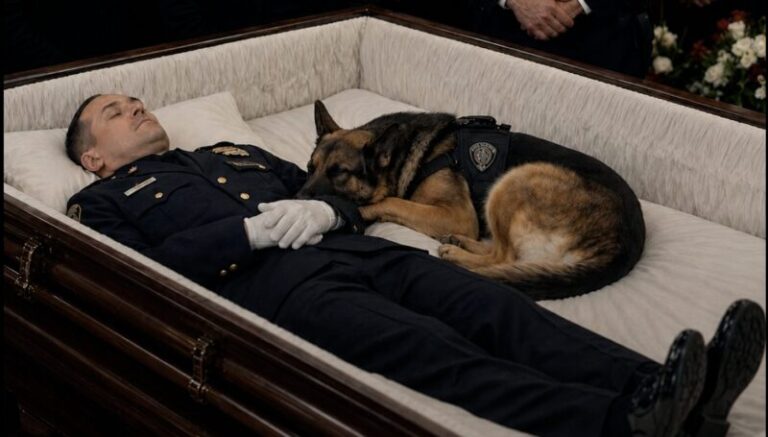
What began as a solemn farewell for Officer Michael Daniels became one of those rare moments in law enforcement circles that people would continue talking about long after the ceremony ended. Daniels had served his community for nearly twenty years, building a reputation as a disciplined, reliable officer who was deeply respected by both colleagues and civilians. His sudden death during what authorities initially described as an operational accident had already left the department shaken.
No one attending the funeral expected anything beyond grief, remembrance, and closure. The service was held in a quiet, dimly lit hall filled with uniformed officers, family members, and close friends. The atmosphere carried a heavy silence, broken only occasionally by soft murmurs or the sound of footsteps. At the front of the room rested Daniels’ coffin, surrounded by folded flags and floral arrangements. Beside it sat Rex, his long-time K9 partner, a German Shepherd who had worked with him for years in field operations.
From the moment Rex entered the room, it was clear he was not behaving like other service animals in similar situations. Instead of pacing or reacting to the crowd, he remained fixed beside the coffin, pressing his body close and refusing to move even when gently guided. His head rested against the wood as if he were waiting for a response that would never come.
Officers familiar with Rex’s training initially assumed his behavior was a normal reaction to loss. K9 units often form strong emotional bonds with their handlers, and moments like this are not uncommon during funerals. However, what made this situation different was the intensity and persistence of Rex’s focus. He did not respond to commands, food, or attempts to redirect him. His attention remained locked on the coffin in a way that unsettled even experienced handlers.
As the ceremony continued, Rex’s behavior became more insistent. He began scratching at a specific part of Daniels’ uniform where the body had been prepared for viewing. At first, those nearby tried to calm him, believing he was reacting out of confusion or grief. But his actions grew more deliberate, as if he was trying to draw attention to something specific rather than acting on emotion alone.
One of the senior officers present eventually suggested that, given the unusual behavior, a second medical review might be necessary. Although Daniels’ death had already been officially classified as the result of an accident linked to an earlier field operation, Rex’s reaction raised questions that could not be ignored. Reluctantly, officials agreed to re-examine the circumstances surrounding the case.
During the additional examination, medical personnel discovered a small mark behind Daniels’ ear that had not been recorded during the initial assessment. It was subtle enough to be overlooked at first, but further analysis revealed traces of a toxic substance. The discovery immediately changed the tone of the investigation, shifting it from a procedural review to a potential criminal case.
Inside the funeral hall, the atmosphere shifted dramatically as whispers spread among attendees. Officers who had worked alongside Daniels for years struggled to process the implication that his death might not have been accidental. The realization introduced a wave of disbelief and confusion, replacing mourning with uncertainty.
While this new information was being discussed, Rex suddenly lifted his head and turned toward the back of the room. His posture changed instantly, becoming rigid and focused. His attention locked onto Officer Carter Mills, another member of Daniels’ unit who had been present at several of their past operations.
Carter had been known as a trusted colleague within the department, someone who had worked closely with Daniels on multiple assignments. Nothing in his public reputation suggested suspicion. However, Rex’s reaction toward him was immediate and intense. The dog growled softly, maintaining unwavering eye contact.
Attempts were made to calm Rex again, but this time his response escalated. He moved forward abruptly, targeting Carter’s jacket and refusing to release his grip. The movement startled those nearby, and officers quickly intervened to separate them. In the process, a small glass vial fell from Carter’s clothing and rolled across the floor.
The room fell completely silent.
The vial was retrieved and examined by the police chief, who immediately recognized the significance of its contents. Early testing confirmed it matched the same toxic substance found in Daniels’ system. The realization changed the situation instantly. Carter was detained on the spot as officers moved in to secure him.
Under questioning, investigators later revealed that Daniels had been conducting internal inquiries into possible corruption linked to unauthorized evidence handling and illicit financial activity. He had reportedly been preparing to escalate his findings to higher authorities shortly before his death.
According to the developing investigation, Carter had allegedly arranged a private meeting with Daniels at an abandoned warehouse days before the incident. What had originally been documented as an operational accident was now being reclassified as a deliberate act connected to an internal cover-up.
The officers present at the funeral struggled to reconcile the information with their memories of Daniels and Carter. Many had served alongside both men and found it difficult to accept that such a betrayal could have occurred within their ranks.
Throughout the unfolding events, Rex remained a central and silent presence. Investigators later suggested that the dog’s heightened response may have been triggered by scent recognition linked to the toxic substance or by behavioral cues only he could detect. Regardless of explanation, his reaction played a significant role in drawing attention to inconsistencies that might otherwise have gone unnoticed.
After Carter was removed from the hall, Rex returned once more to Daniels’ coffin. This time, his behavior changed. The tension that had defined his earlier actions seemed to fade. He lay down beside the coffin, resting his head gently against it, remaining still.
For many who witnessed that moment, it symbolized something beyond procedure or investigation. It represented loyalty that persisted even in the absence of explanation, and a bond between handler and K9 partner that extended beyond duty.
The funeral concluded in silence, but the story did not end there. In the days that followed, the department launched a full investigation into the circumstances surrounding Daniels’ death, while colleagues continued to reflect on the unusual events that unfolded during the service.
What remained most memorable for many was not only the uncovering of a deeper truth, but the role played by a loyal service dog who refused to accept silence when something felt wrong.
In the end, Rex was remembered not just as a grieving partner, but as a silent force that helped push the truth into the light.
