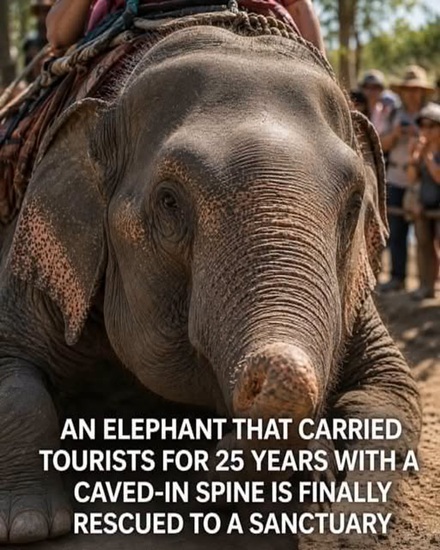
For many travelers, seeing an elephant at close range can feel like an unforgettable experience. Their enormous size, intelligence, and calm appearance have made elephants central to tourist attractions in several parts of Asia for decades. Elephant rides in particular have often been marketed as exciting opportunities to experience these animals from an unusually close perspective. Yet the few minutes experienced by a visitor reveal very little about what the same activity can mean for an elephant repeatedly performing it over many years.
Pai Lin, an Asian elephant who spent decades working for people in Thailand, became one of the most widely discussed examples of that difference. Her visibly deformed back remained with her long after she stopped carrying tourists. Her story ultimately became less about one tourist ride and more about what repeated physical demands can leave behind. Pai Lin spent more than 25 years working in Thailand’s elephant trekking industry, according to Wildlife Friends Foundation Thailand, commonly known as WFFT.
During that period, the organization says she was required to carry a heavy seat, known as a howdah, with as many as six tourists at one time. That workload was not the only difficult chapter in her long life. WFFT has said Pai Lin was also used in the logging industry and as a begging elephant before eventually reaching the sanctuary. By the time she came into the organization’s care, her body carried visible evidence of years of work. Her back was dramatically different from the rounded shape normally associated with an elephant’s spine. The sunken appearance eventually became one of the most recognizable images used by WFFT when discussing elephant welfare.
Photographs released by WFFT showed Pai Lin beside an elephant with a more typical back shape, making the difference particularly noticeable. Instead of rising into the rounded contour normally visible along an elephant’s back, Pai Lin’s spine appeared deeply sunken. WFFT attributed the condition to the difficult working life she had experienced, including years of carrying people and equipment. The organization has also been careful to acknowledge that spinal deformities in elephants can result from several combined factors. These can include injuries sustained during tourism or logging work as well as poor nutrition. That qualification is important because Pai Lin’s condition should not be reduced to the simplistic claim that a single ride created her deformity. What made her case striking was the accumulated history of work that preceded the condition visible later in life.
Elephants are the world’s largest living land animals, and their impressive size often creates an assumption that extraordinary strength must make them resistant to physical strain. Strength, however, does not mean unlimited capacity. An animal can be powerful enough to perform difficult work while still experiencing injuries or chronic health problems associated with that work. The anatomy of an elephant also matters when discussing what its back is asked to support. WFFT has emphasized that constant pressure from heavy tourism loads can contribute to lasting physical problems. Studies of elephants working in Thailand’s tourism industry have separately documented skin lesions associated with saddle equipment, particularly in areas such as the back, neck, and girth. Those findings do not prove that every ridden elephant will develop Pai Lin’s condition, but they demonstrate that working equipment and management practices can have measurable welfare consequences.
One reason those consequences can be overlooked is that tourists normally encounter an animal for only a short period. A visitor may purchase a ride, spend several minutes on an elephant, take photographs, and then continue with the rest of a vacation. The same elephant may have had a much longer working day and may have spent years performing similar activities. The experiences of visitor and animal therefore operate on completely different timescales. What appears to the tourist as one brief activity may form part of a repetitive working routine for the elephant. The visitor generally does not see the animal’s full history, veterinary records, previous injuries, or earlier working conditions. Pai Lin’s body eventually made part of that hidden history visible.
Her case is also a reminder that an animal’s willingness or ability to continue walking does not by itself demonstrate that every aspect of its welfare is satisfactory. Animals used in working environments can continue performing despite physical problems, just as humans sometimes continue working with injuries or chronic discomfort. Assessing welfare requires far more than watching an animal for several minutes. Researchers consider factors including body condition, wounds, foot health, housing, rest, management practices, nutrition, social opportunities, and behavior. Scientific studies of captive elephants in Thailand have emphasized that welfare is complex and cannot responsibly be reduced to a single indicator. That nuance is important when Pai Lin’s story is used in discussions about tourism. Her individual history is powerful, but responsible reporting should not transform it into unsupported claims about every elephant in every setting.
The evidence from Pai Lin’s own history, however, is difficult to ignore. WFFT says she spent approximately 25 years carrying tourists, sometimes with as many as six people in the seat placed on her back. She also endured other forms of labor during a working life that the organization later estimated had lasted around six decades in total. By the time she reached sanctuary care, her spine was already visibly deformed. Photographs of her later years preserved that physical difference even after she no longer performed tourist rides. Her passengers had moved on, but the shape of her back remained. That permanence is one reason her story received international attention years after her rescue.
WFFT’s earliest account of Pai Lin’s arrival also described other health concerns. In a February 2007 update, the organization said she arrived underweight and dehydrated and was suffering from discharge associated with an upper respiratory infection. Veterinary staff examined her and began providing food, fluids, supplements, and ongoing care. The organization also described her deformed back at that time and connected it with the heavy seat she had previously carried. Importantly, the report noted that she did not appear to be experiencing pain from the deformation at the time of that assessment. This is another reason to avoid inventing descriptions of constant agony that the available evidence does not establish. Her physical damage was serious and visible without needing additional dramatic claims.
Accounts differ slightly on whether Pai Lin entered WFFT’s care in late 2006 or was formally described as rescued in 2007. WFFT’s own 2007 article introduced her as a new resident, while later WFFT material referred to her as the organization’s first rescued elephant and dated that rescue to 2007. Some subsequent reporting has cited 2006 as the year she reached the sanctuary. The safest description is therefore that she entered WFFT’s care around 2006–2007. What is not disputed is that the change ended the working life she had previously known. She would spend almost two decades under WFFT’s care. That period became an unusually long retirement after decades of labor.
The environment described by WFFT was very different from her earlier working conditions. The organization said Pai Lin was provided with natural ground, appropriate food, veterinary attention, and opportunities to spend time around other elephants. Earlier sanctuary updates described her walking in forested areas and foraging rather than spending her days on city streets. In later years, she became known as an older elephant who preferred a degree of independence and a quieter routine. WFFT respected those preferences rather than requiring her to entertain visitors. Her activities could happen at her own pace instead of according to a tourist schedule. That difference became central to what retirement meant for her.
Pai Lin also developed routines that staff remembered with affection. WFFT later described her enjoying morning swims in her lake, playing with tire toys, eating vegetation, and sometimes placing straw or grass on her head. In her older years, she reportedly preferred having her own space, which her caretakers allowed her to have. These details offer a more complete picture than the famous photograph of her back alone. The deformity was an important part of her history, but it was not the entirety of her life. She remained an individual animal with preferences, habits, and behaviors that caregivers came to know. Her sanctuary years allowed those aspects of her character to become more visible.
Her damaged back did not simply return to a normal shape after the tourist work stopped. Removing the source of a long-term problem does not necessarily reverse structural changes that have already occurred. That reality is particularly important in animal rescue because rehabilitation and complete physical restoration are not always the same thing. A sanctuary may be unable to erase every injury from an animal’s previous life. What it can potentially do is prevent the same demands from continuing and provide care appropriate to the animal’s condition. In Pai Lin’s case, the visible curve remained through the rest of her life. Her retirement nevertheless meant that she no longer had to continue carrying the tourist loads associated with her earlier years.
This is why rescue should not always be judged by whether an animal eventually looks physically untouched by its past. Sometimes a successful outcome means giving an animal stability even when certain consequences cannot be reversed. Pai Lin’s back continued to show what her body had endured, but the conditions of her daily life changed substantially. She could rest without being prepared for another group of riders. She could move without a passenger platform being placed across her body. She could eat, bathe, explore, or remain alone according to the management and care provided at the sanctuary. Her value was no longer determined by how much work she could perform.
Scientific research provides useful context for understanding why management conditions matter for elephants used in tourism. A study involving 194 elephants at 18 tourism camps in Thailand found a high prevalence of active skin lesions, many occurring in anatomical regions associated with saddle equipment. Researchers examined factors including age, padding material, and working conditions. Other studies of tourist elephants have assessed foot health, body condition, behavior, and husbandry practices. The results demonstrate that welfare cannot be inferred simply from the fact that an elephant is large enough to carry a load. Equipment, working hours, terrain, nutrition, rest, housing, and individual health can all matter. Pai Lin’s story exists within this broader need to evaluate working conditions carefully.
Research has also explored the biomechanics of carrying weight in Asian elephants. One study evaluated eight elephants walking both without additional loads and while carrying a load equal to approximately 15 percent of body mass. The researchers measured changes in joint movement rather than attempting to prove that every form of riding inevitably causes permanent spinal damage. That distinction matters because popular articles sometimes make scientific claims that go farther than the available studies support. Evidence can identify legitimate welfare concerns without requiring exaggeration. Responsible coverage should distinguish documented effects from assumptions. Pai Lin provides one documented individual case, while broader scientific conclusions require evidence from larger groups of animals.
Her story also demonstrates how easily an animal’s workload can disappear behind the visitor experience. Tourism advertising naturally emphasizes what customers will see and remember. A photograph may show an elephant walking peacefully with people sitting above it, but that image captures only a tiny fraction of the animal’s working history. It cannot reveal how many years the animal has worked, whether it has old injuries, how the equipment fits, or what happens between tourist sessions. Those questions require information about management rather than assumptions based on appearance. Pai Lin’s deformity attracted attention precisely because it revealed something ordinary vacation photographs would rarely show.
This does not mean every person who has ever taken an elephant ride consciously intended to harm an animal. Many tourists participate because the activity is openly marketed and because they assume businesses would not offer something harmful. Some may have been told that an elephant’s enormous strength makes carrying people insignificant. Others may simply never have considered the cumulative demands placed on an animal over a long working life. Pai Lin’s story provides information that can help people make future decisions with more context. Awareness is more useful when it explains documented welfare concerns rather than assigning motives to individuals.
The distinction between intention and outcome is important. Someone can participate in an activity without understanding everything occurring behind the scenes. Animal welfare decisions become more informed when visitors know how an attraction operates, how animals are trained and managed, how much rest they receive, and what happens when they become old or injured. Those considerations extend well beyond obtaining a memorable photograph. They focus attention on the life of the animal before and after the tourist arrives. Pai Lin’s decades of work demonstrate why that broader timeframe matters.
Her case also challenges the assumption that a longstanding tradition must therefore be harmless. Humans have used elephants for transportation and labor for centuries in different parts of Asia. Historical familiarity, however, is not the same thing as scientific evidence about welfare. Knowledge about animal health and behavior continues to develop, and tourism practices can be reevaluated as better information becomes available. Modern visitors have access to more evidence than travelers did decades ago. That allows choices to be based on current understanding rather than simply repeating what earlier generations considered normal.
Sanctuary-style tourism has consequently received increasing attention, although the word “sanctuary” alone does not guarantee high welfare standards. Visitors evaluating an elephant facility may need to look beyond its name and examine what interactions are actually offered. An organization that prioritizes observation, appropriate social opportunities, veterinary care, space, and species-relevant behavior may operate very differently from one built primarily around performances or physical contact. Transparency about an elephant’s daily routine can help visitors understand those differences. No single marketing term should substitute for examining actual practices. Pai Lin’s experience illustrates why the details behind an attraction matter.
For Pai Lin herself, the largest change was simple: the rides ended. After decades during which her physical ability had economic value to people, she was allowed to age without continuing the same work. WFFT described her later years as increasingly peaceful. She could spend long periods eating, bathing, walking when she wanted to, and resting. Her body still carried scars and deformation from her earlier life, but those features no longer determined whether she had to perform. She was cared for as an elephant rather than maintained primarily as a means of transporting visitors.
Her advanced age made that retirement especially significant. Pai Lin eventually became the oldest elephant living at WFFT and remained there for almost two decades. The organization described her as gentle and independent, particularly as she grew older. Staff learned when she preferred company and when she wanted space. Those accommodations may sound simple, but allowing individual choice is an important aspect of managing animals with different personalities and histories. Instead of forcing a uniform schedule on her, caretakers described adapting to what she seemed comfortable doing.
The story took its final turn in December 2025. Wildlife Friends Foundation Thailand announced that Pai Lin had died suddenly at almost 80 years old. Her death came after nearly two decades in the organization’s care and approximately six decades of earlier exploitation across logging, begging, and tourism work, according to WFFT. The organization held a Buddhist ceremony following her death and remembered her for more than the injuries that made her famous. Staff recalled her playful behavior, morning swims, tire toys, and the amusing habit of balancing grass or straw on her head. Her later years therefore became part of her legacy alongside the difficult working history that preceded them.
That update is important because older versions of Pai Lin’s story often describe her as though she is still living at the sanctuary. Those accounts were accurate when originally published but became outdated after December 15, 2025. Today, her story should be told in the past tense while recognizing the years of retirement she received. Doing so preserves the factual timeline instead of recycling an earlier article without updating its conclusion. It also provides an opportunity to remember her as an individual rather than simply as a photograph used to illustrate an issue. Pai Lin lived a remarkably long life despite the difficult circumstances described by her caregivers.
Her spine remains one of the most memorable visual records of that history. A tourist riding an elephant decades earlier could never see what Pai Lin’s back would look like years later. The immediate activity and the potential long-term consequences were separated by time. That gap is precisely why cumulative welfare problems can be difficult for visitors to recognize. A person may leave an attraction believing nothing harmful happened because no obvious injury appeared during the brief encounter. Long-term physical effects, however, are not always visible while they are developing.
Pai Lin’s story should nevertheless be presented carefully rather than used to make every possible claim about elephant riding. WFFT specifically notes that elephant spinal deformities can involve multiple contributing factors, including malnutrition and injuries sustained in tourism or logging work. Pai Lin experienced several forms of demanding labor during her lifetime, not tourism alone. Her 25 years carrying tourists were a major part of that history, but responsible reporting should preserve the full context. Doing so strengthens rather than weakens the welfare discussion. A factual story has greater value than an exaggerated one.
The broader lesson concerns how humans evaluate interactions with wild animals. An activity can be entertaining for a visitor while imposing very different demands on the animal providing that entertainment. Understanding the animal’s perspective requires looking beyond the duration of one ticketed experience. Questions about workload, equipment, training, rest, health, retirement, and living conditions all matter. The answers may differ considerably between facilities and individual animals. Making those questions part of travel decisions encourages greater transparency.
Pai Lin could not explain her working history to each person who saw her. Her physical condition eventually communicated part of that history in a way photographs made difficult to overlook. The deep curve in her back became a visible reminder that even an animal of extraordinary size and strength has biological limits. Her later life then demonstrated another important point: permanent damage does not make rescue meaningless. Ending harmful or excessively demanding conditions can still profoundly change an animal’s future even when its past cannot be erased.
For almost two decades after leaving her earlier working life, Pai Lin was able to experience a different routine. There were no groups of tourists sitting in a heavy howdah on her back. She had access to food, veterinary attention, natural ground, water, and the environment provided by WFFT. She became known by caregivers for behaviors that had nothing to do with transporting people. Those years could not restore the body she had before decades of work, but they gave her something equally important: a life no longer centered on performing that work.
Her experience therefore offers a more thoughtful message than simply telling people to feel guilty about past vacations. It encourages travelers to ask better questions before participating in future animal encounters. What does the activity require the animal to do? How often is that behavior repeated? What equipment is used? What happens when the animal is old or injured? Does the facility prioritize opportunities for the elephant to engage in appropriate natural behaviors rather than requiring constant entertainment?
Those questions allow people to evaluate animal tourism without pretending that every facility, elephant, or working condition is identical. They also encourage choices based on evidence instead of assumptions about strength or obedience. An elephant walking calmly does not provide enough information by itself to determine overall welfare. A complete assessment requires understanding much more about the animal’s health and environment. Pai Lin’s case demonstrates why looking beyond appearances matters.
Researchers studying elephant welfare have likewise emphasized the need for objective, science-based assessment rather than relying entirely on either promotional claims or emotionally charged assumptions. Health indicators, behavior, management practices, and individual circumstances all need consideration. This approach does not minimize documented suffering. Instead, it helps distinguish genuine welfare problems from claims that have not been adequately demonstrated. Pai Lin’s documented injuries and history provide enough reason for concern without adding unsupported details.
Her long life finally ended far differently from the way much of it had been spent. Rather than dying while carrying tourists, logging, or begging on city streets, she spent her final years under sanctuary care. WFFT’s farewell emphasized the peaceful and playful moments its team had experienced with her. For people who first encountered Pai Lin through a photograph of her damaged spine, that part of the story is worth remembering as well. She was more than the injury that made international headlines. She was an elephant who survived an exceptionally long and complicated life.
The curved shape of Pai Lin’s back will nevertheless remain an important part of how her story is remembered. It demonstrates that physical strength should never be confused with immunity from injury. It shows why repeated work needs to be considered across years rather than judged only one ride at a time. It reminds tourists that an animal attraction continues existing after each individual customer has gone home. And it demonstrates why retirement and appropriate care matter even when previous damage cannot be reversed.
Pai Lin’s life cannot be changed retrospectively. The decades of logging, begging, and tourist work described by WFFT are already part of her history. Neither can the deformation visible in photographs of her later years be erased. What changed was the final chapter. She spent almost two decades free from the tourist loads that had once been part of her daily life, eventually reaching an age of nearly 80 before her death in December 2025.
That may be the most important way to remember her story. Pai Lin was not simply evidence in an argument about tourism, and she was not merely an unusual photograph of an elephant with a damaged back. She was a living animal whose circumstances changed dramatically over the course of a very long life. Her history demonstrates both the lasting nature of some physical injuries and the value of ending demanding conditions even when complete recovery is impossible.
For future travelers, her experience provides useful context when deciding how to interact with wildlife. Observing elephants moving, feeding, socializing, bathing on their own terms, or simply resting can offer an opportunity to appreciate them without requiring them to carry or perform for visitors. People can research facilities, examine their welfare practices, and make choices based on what the animals themselves are required to do. Those decisions do not require pretending to know everything about an elephant’s feelings. They require paying attention to documented conditions and credible welfare information.
Pai Lin’s visibly sunken back attracted international attention because it made an otherwise hidden history difficult to overlook. Yet the most complete version of her story includes both what happened before rescue and what came afterward. She worked for decades, arrived at WFFT in poor condition, spent almost twenty years in a markedly different environment, and ultimately died at nearly 80 years old in December 2025. Her body carried permanent evidence of her earlier life, but her final years were no longer defined by carrying tourists.
Her legacy is therefore both difficult and hopeful. It shows that consequences from years of labor can remain long after the work stops, while also demonstrating that an animal’s future can still improve even when some damage is permanent. Pai Lin could not recover an undamaged spine, but she could be spared further tourist loads. She could have food, care, space, quiet, and the opportunity to live according to a much less demanding routine. For an elephant whose strength had been used by people for decades, being allowed to carry nothing at all became one of the clearest symbols of what retirement meant.
