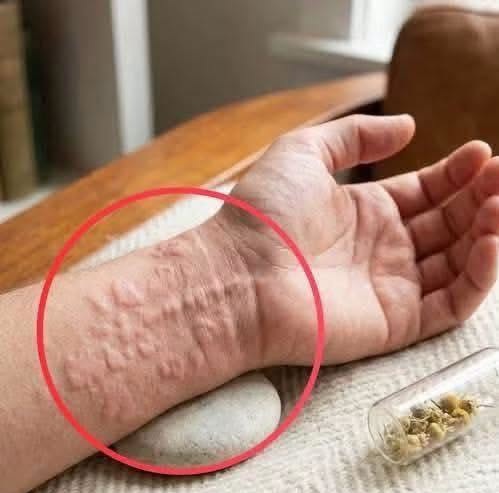
When Itchy Raised Patches Keep Appearing: What Urticaria Really Means
It can begin with a single itchy patch.
Then another appears.
Within minutes, raised areas may spread across the arms, chest, legs or face.
Some look round.
Others form rings or merge into larger irregular shapes.
And just as suddenly as they appeared, individual marks may disappear.
Then new ones show up somewhere else.
This pattern is characteristic of urticaria, commonly known as hives.
Urticaria is a skin reaction caused largely by activation of mast cells in the skin. These cells release histamine and other inflammatory substances, leading small blood vessels to widen and leak fluid into surrounding tissue.
The result is a raised, often intensely itchy swelling called a weal or wheal.
But not every episode of hives behaves the same way.
And duration is one of the most important clues.

A Typical Hive Usually Does Not Stay in One Place for Long
Individual urticaria lesions are temporary.
A typical wheal usually fades within 24 hours without leaving a permanent mark.
That does not mean the entire condition disappears within a day.
One patch may vanish while another develops somewhere else.
The cycle can continue for hours, days or much longer.
Urticaria can affect almost any part of the skin.
The lesions may be small or several centimeters across.
They can be pale, pink or red depending on skin tone and the individual reaction.
And scratching can sometimes make the pattern look even more dramatic.
But another kind of swelling may appear at the same time.
When the Swelling Goes Deeper
Some people with urticaria also experience angioedema.
Unlike ordinary hives, which involve more superficial layers of skin, angioedema affects deeper tissue.
It commonly appears around the eyelids or lips.
It can also affect other areas, including the hands, feet and genital region.
Angioedema often feels more painful, tight or uncomfortable than itchy.
It can also last longer than an individual hive.
Most cases are manageable.
But there is one situation that changes everything.
Swelling Around the Airway Is an Emergency
Hives alone are often uncomfortable rather than dangerous.

However, difficulty breathing is different.
If hives or swelling are accompanied by trouble breathing, throat or tongue swelling, wheezing, faintness, severe dizziness or other signs of a serious allergic reaction, emergency medical attention is needed.
These symptoms may indicate anaphylaxis, which can become life-threatening.
This is not a situation to monitor casually at home.
The airway can become affected rapidly.
And that is why knowing the difference between ordinary hives and a systemic allergic emergency matters.
Acute Urticaria Usually Lasts Less Than Six Weeks
Urticaria is commonly classified by how long the problem persists.
Acute urticaria lasts less than six weeks.
Often, it resolves in hours or days.
Possible triggers include infections, medications, foods, insect stings and other exposures.
But contrary to a common misconception, the exact cause cannot always be identified.
In children especially, viral infections are a frequent association with acute episodes.
Food allergy can cause hives too, particularly when symptoms occur soon after eating and are accompanied by other allergic symptoms.
Medications can also be responsible.
Certain antibiotics and nonsteroidal anti-inflammatory drugs can provoke or worsen urticaria in susceptible people.
Yet sometimes no definite trigger is found.
And if the hives continue beyond six weeks, doctors begin thinking about a different category.
Chronic Urticaria Is Defined by Time
When wheals, angioedema or both keep returning for at least six weeks, the condition is considered chronic urticaria.
The outbreaks may occur every day.
Or they may come and go.
Individual hives still tend to disappear within 24 hours.
The frustrating part is that new ones continue appearing.
Chronic urticaria is divided into two broad forms.
One happens spontaneously.
The other has identifiable triggers.
And that distinction can change how the condition is investigated.
Chronic Spontaneous Urticaria Often Has No Simple External Trigger
In chronic spontaneous urticaria, hives repeatedly appear without an obvious external stimulus such as cold, pressure or scratching.
Many cases are believed to involve autoimmune mechanisms in which mast cells are activated inappropriately.
That does not mean the person is allergic to dozens of foods or products.
In fact, repeatedly changing diets without evidence of a true allergy may not identify the cause.
Doctors usually base the diagnosis on the history, pattern of lesions and clinical examination.
Extensive testing is not automatically necessary for every person.
The goal is to look for clues suggesting another condition rather than ordering every possible test.
And there is another form where triggers are much clearer.
Some Hives Can Be Reproduced by Specific Stimuli
This group is called chronic inducible urticaria.
The hives appear after specific physical or environmental triggers.
Examples include scratching, cold, heat, pressure, sunlight or increased body temperature.
Different types can also occur together.
That means one person may have spontaneous hives and inducible hives at the same time.
The trigger pattern can provide an important clue.
Sometimes the skin itself seems to “write” the answer.
Dermographism Can Make Scratches Turn Into Raised Lines
Dermographism is one of the most common forms of inducible urticaria.
A firm scratch, stroke or pressure on the skin can produce raised itchy lines within minutes.
The name essentially refers to “writing on the skin.”
Someone may scratch an itchy area and then notice a raised outline following exactly where the fingernail passed.
Tight clothing or friction can trigger similar reactions in symptomatic cases.
The appearance can be dramatic.
But it is the reproducible response to pressure or scratching that provides the clue.
Cold Can Trigger More Than a Local Rash
Cold urticaria occurs when exposure to cold air, cold objects or cold water triggers hives.
For many people, the reaction is localized.
But large cold exposures can be more dangerous.
Swimming in cold water, for example, exposes a large area of skin at once.
In susceptible people, that can provoke a widespread reaction and potentially serious symptoms.
Because of that risk, people with suspected cold urticaria should receive appropriate medical evaluation rather than testing themselves by jumping into cold water.
And heat can cause a different pattern entirely.
Exercise, Heat and Stress Can Trigger Cholinergic Urticaria
Cholinergic urticaria typically causes small, short-lived wheals after something raises body temperature and induces sweating.
Exercise is a common trigger.
Hot showers can do it.
Spicy foods may trigger episodes in some people.
Emotional stress can contribute as well.
The lesions are often small and may be accompanied by redness or intense itching.
Most episodes settle relatively quickly.
But severe reactions can occasionally involve breathing symptoms or anaphylaxis.
Pressure Can Cause a Reaction Hours Later
Delayed pressure urticaria is particularly deceptive.
The reaction does not always appear immediately.
Pressure from tight clothing, a strap, prolonged standing or sitting on a hard surface may be followed by swelling several hours later.
The lesions can feel deep and painful.
And unlike many ordinary hives, they may last much longer than a few minutes.
DermNet notes that delayed pressure reactions commonly appear four to six hours after the provoking pressure and may persist for many hours.
That delay can make the trigger difficult to recognize.
Sunlight Can Also Be a Trigger
Solar urticaria is a much less common form in which exposure to certain wavelengths of sunlight triggers wheals.
Symptoms generally develop rapidly on exposed skin.
Because sunlight is such a routine part of daily life, this form can significantly affect quality of life.
Diagnosis may involve specialist testing to determine which wavelengths trigger the reaction.
It should not be confused with ordinary sunburn.
They are different processes.
Treatment Usually Starts With Antihistamines
For many forms of urticaria, modern second-generation H1 antihistamines are the first-line medication.
These drugs block the effects of histamine and can reduce itching and wheals.
For chronic disease, doctors may recommend daily treatment rather than waiting until symptoms appear.
In some patients whose symptoms remain uncontrolled, specialist guidelines allow antihistamine doses to be increased under medical supervision.
If chronic spontaneous urticaria remains uncontrolled despite antihistamines, treatments such as omalizumab, a monoclonal antibody targeting IgE-related pathways, may be considered.
More advanced therapies are generally handled by specialists.
The exact plan depends on severity and response.
Steroids Are Not Usually the Long-Term Solution
Corticosteroids can sometimes be used briefly for particularly severe acute episodes.
But repeated or long-term steroid treatment carries significant risks.
For chronic urticaria, the goal is usually to control mast-cell activity with safer long-term approaches.
That is another reason persistent hives deserve proper evaluation.
The best treatment for a two-day allergic outbreak may not be the best treatment for six months of recurring symptoms.
Duration changes the approach.
A Symptom Diary Can Reveal Patterns
When the trigger is unclear, recording episodes can help.
Useful details may include the time the hives appeared.
Foods eaten shortly beforehand.
Medications taken.
Exercise.
Hot showers.
Cold exposure.
Pressure from clothing or straps.
Illness.
Stress.
Photographs can also be useful because the lesions may disappear before a medical appointment.
The goal is not to obsess over every daily detail.
It is to identify consistent patterns.
Sometimes that pattern reveals something that memory alone misses.
Avoiding Confirmed Triggers Can Help
Someone with dermographism may benefit from reducing skin friction and avoiding very tight clothing.
A person with cold urticaria needs to be careful around significant cold exposure.
Someone with cholinergic urticaria may learn which heat- or sweat-producing activities consistently provoke symptoms.
Cool compresses can soothe itchy areas.
Gentle skin care and comfortable clothing may also reduce irritation.
But avoiding hundreds of foods or products without evidence is not necessarily helpful.
The trigger should ideally be based on a consistent history or medical evaluation.
Angioedema Without Hives Deserves a Different Look
Repeated angioedema without any wheals can sometimes have causes different from ordinary urticaria.
One important example is hereditary angioedema, a rare genetic disorder involving the complement system.
This condition is not simply a more severe version of histamine-related hives.
Its diagnosis and treatment are different.
That is why recurrent unexplained swelling, especially without itching or hives, deserves medical assessment.
The pattern can point doctors in a very different direction.
Chronic Urticaria Can Affect More Than Skin
Repeated itching can disturb sleep.
Unpredictable flares can interfere with work, exercise and social activities.
Some people become anxious because they never know when the next outbreak will appear.
Others worry that every meal or product is responsible.
That uncertainty can become exhausting.
Fortunately, chronic urticaria can often be controlled even when the exact underlying trigger is not identified.
The goal is not always to discover one hidden allergen.
Sometimes the real goal is simply to calm inappropriate mast-cell activation.
The Final Clue Is Often the Pattern Over Time
Hives can look alarming.
But the appearance alone does not tell the entire story.
How long each lesion lasts matters.
How many weeks the outbreaks continue matters.
Whether pressure, cold, heat or exercise reproduces them matters.
Whether angioedema occurs matters.
And breathing symptoms matter most of all.
An isolated patch that fades in hours is very different from daily hives lasting months.
And both are very different from throat swelling with breathing difficulty.
That is why urticaria is not one single experience.
It is a group of related patterns with different triggers, timelines and levels of urgency.
Most importantly, recurring hives do not always mean a hidden food allergy.
They do not always require extensive testing.
And chronic urticaria can often be managed effectively with the right medical approach.
The skin may be where the reaction becomes visible.
Understanding the pattern is what reveals what to do next.
