It started as an ordinary evening that carried no indication of anything unusual. My girlfriend had just returned from a walk with our dog, unaware that the moment would quickly turn unsettling and confusing. She stepped through the door quietly at first, then paused suddenly, her expression shifting. Her face looked pale, and her hands trembled slightly as she signaled me toward the hallway with visible concern.
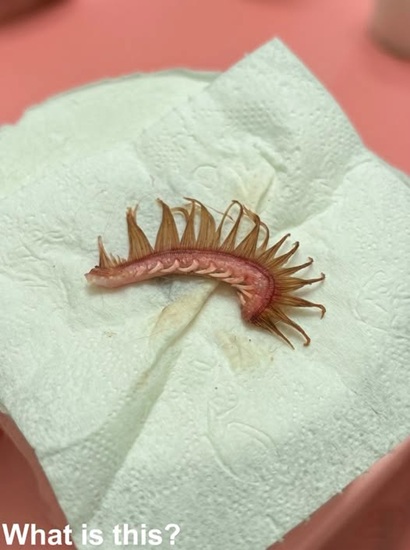
Our dog stood beside her, calm but slightly restless after the walk. However, something on his fur immediately caught her attention, creating a sense of discomfort that neither of us could immediately understand. Attached to the golden strands of his coat was a strange, translucent object. It had irregular edges, a spiked appearance, and a texture that reflected light in a way that felt unnatural and unsettling.
At first glance, it seemed almost alive. Its shape and slight movement created an illusion of something biological, as if it were a tiny organism clinging tightly to our dog’s fur. My first reaction was immediate confusion followed by concern. My heart rate increased as I tried to understand what I was looking at, unable to place it into any familiar category or explanation.
My girlfriend stepped back instinctively, clearly unsettled. She avoided touching it directly, instead suggesting we observe it carefully first, as her imagination quickly filled the unknown with worst-case scenarios. In those first moments, logic struggled to keep up with fear. We both stared at the object, trying to determine whether it was debris, an insect, or something potentially harmful to our dog.

The uncertainty created a growing sense of anxiety. The more we looked at it, the more it seemed unfamiliar, and the less confident we became in identifying what we were actually seeing. We began to imagine possibilities that escalated quickly in severity. Thoughts of parasites, infections, or hidden insects began to take hold, even though there was no evidence supporting those assumptions.
Our concern shifted from curiosity to urgency. We started mentally preparing for a potential emergency veterinary visit, considering costs, timing, and the possibility that our dog might need immediate treatment. The room felt quieter as tension built. The only sound was our dog’s soft panting, which contrasted sharply with the fear and confusion that had taken over our thoughts in that moment.
We used flashlights to inspect the area more closely. The light revealed more details, but instead of clarity, it only intensified our uncertainty and made the object appear even more unusual. Every angle seemed to distort perception further. What should have been a simple observation turned into a mental loop of speculation, where fear repeatedly filled in gaps of missing information.
At that point, fear was guiding interpretation more than reason. The unknown object stopped being neutral and instead became something threatening in our minds, even without any confirmation of danger. After several minutes of hesitation, I decided to approach it more carefully. I retrieved a pair of tweezers and a damp cloth, preparing to remove it without causing harm or sudden movement.
My hands were slightly unsteady as I leaned closer. The anticipation of what it might be created a brief moment of hesitation before I finally made contact with the strange material. The object resisted lightly for a second, tangled within the dog’s fur, before slowly releasing its grip. It detached without resistance or damage, immediately losing its mysterious appearance once separated.
I lifted it closer to the light, expecting something alarming or biological, still influenced by the tension and assumptions built during the earlier moments of uncertainty and fear. At that exact moment, realization replaced anxiety instantly. What we had interpreted as something organic or dangerous was something entirely ordinary and harmless in nature.
It turned out to be a pair of warped, damp fake eyelashes that had likely been carried by wind and accidentally caught onto our dog during the walk outside. The transformation in perception was immediate and overwhelming. The tension that had filled the room disappeared within seconds, replaced by disbelief and sudden relief that felt almost physically light. We both paused, looking at each other, then at the object in my hand, and finally at our dog, who remained completely unaware of the entire emotional escalation he had caused.
The situation shifted rapidly from fear to laughter. The emotional contrast was so strong that it took a moment before either of us could fully process the absurdity of what had happened. What had seemed like a potential emergency moments earlier was now revealed to be nothing more than harmless debris, highlighting how easily perception can be influenced by fear and uncertainty. That experience stayed with us as a reminder of how quickly the mind can escalate ordinary situations into imagined threats. Fear often fills gaps when information is unclear or incomplete.
In the end, the moment became less about the object itself and more about our reaction to it, showing how perspective shapes emotional response far more than reality often does. Our dog, still calm and unaware, simply continued resting as if nothing unusual had occurred. Meanwhile, we were left reflecting on how quickly imagination can transform everyday moments into crisis.
The entire experience ended with relief and humor, turning what initially felt alarming into a story we would later retell with laughter rather than concern or fear. It served as a quiet reminder that not every strange sight hides danger, and sometimes the most unsettling moments are simply misunderstood fragments of ordinary life.
