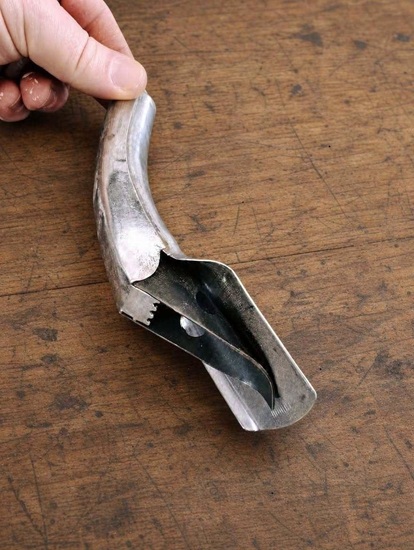
For years, an unfamiliar metal object can sit unnoticed in a drawer, toolbox, garage, or inherited collection without anyone remembering what it was originally designed to do. That is the situation at the center of this story, in which a man kept an unusual tool that had belonged to his father. Its combination of metal edges, a handle-like section, and what appeared to be a channel or pouring surface made its original purpose difficult to recognize without the equipment it had once accompanied.
The father reportedly never provided a detailed explanation, leaving the object to become a small family mystery. What seemed complicated to a younger generation may once have been completely ordinary to mechanics, service-station attendants, farmers, and motorists. The description closely matches a type of reusable self-piercing oil-can spout that was once used with traditional one-quart motor-oil cans. The important point is that objects often become mysterious when the larger system around them disappears.
A tool is rarely designed in isolation, because its size and shape normally correspond to another object, material, machine, or routine. Remove that original context and even a simple piece of equipment can become surprisingly difficult to identify. Someone who has never handled an old-style motor-oil can may look at a piercing spout without understanding why it contains sharp edges or an oddly shaped channel. To a person who used such containers regularly, however, those features had an obvious practical purpose. The difference is not intelligence or mechanical ability but simply familiarity with an older technology.
Historical museum collections confirm that reusable oil-can spouts were once ordinary automotive tools. Lambton County Museums describes an oil-can spout designed to open a one-quart oil can and then remain attached so the oil could be poured conveniently. Rather than requiring a separate opener followed by a separate pouring device, the spout combined those tasks into one practical tool. A pointed or cutting section punctured the container while the remaining structure created a path through which the lubricant could flow. After one can was emptied, the spout could be removed and used again on another container. This simple design made sense in an era when motor oil was packaged very differently from the screw-top plastic bottles familiar to modern motorists.

Motor oil passed through several major packaging styles during the twentieth century. It was sold in glass containers, all-metal cans, and later in composite cans that combined a paper or cardboard body with metal ends. Historical artifact guidance from the U.S. Bureau of Land Management notes the introduction of quart motor-oil cans in the 1930s and the later spread of paper-bodied cans with metal tops and bottoms. These containers did not have the convenient threaded caps found on modern bottles. A customer or service-station worker therefore needed a way to puncture the sealed top before the oil could be poured. A reusable piercing spout was a practical answer to that problem.
The sharp portion of the device was therefore not decorative or unnecessarily complicated. It needed to penetrate a container strongly enough to create an opening without requiring a separate cutting tool. Once positioned correctly, the body of the device provided a controlled route for the oil leaving the can. This helped a mechanic direct lubricant toward an engine opening instead of attempting to pour from an irregular hole in the top of a container. The exact shape varied among manufacturers and designs, so surviving examples do not all look identical. Some were relatively short and simple, while others incorporated longer spouts or features intended to make pouring easier.
This kind of device was especially useful when engine oil was commonly sold in individual one-quart containers. A service-station attendant checking a vehicle might discover that the engine needed additional oil and then reach for a fresh can. The reusable spout allowed the worker to puncture that container and pour its contents with relatively little preparation. Lambton County Museums notes that service-station attendants historically performed a range of tasks, including checking engine oil while customers stopped for fuel. If additional oil was required, the attendant could open a can and add it to the engine. The spout was therefore part of a wider service routine rather than a specialized mystery tool.
That historical setting explains why an older mechanic might recognize such an object immediately. Someone who worked around automobiles during the period when canned motor oil remained common could have handled similar tools repeatedly. The appearance of the device would have been linked in memory to the shape of the can, the movement required to pierce it, and the way the oil flowed afterward. A younger person who grew up around plastic bottles would lack those associations. Presented without an old oil can beside it, the metal device might look like a clamp, cutter, specialized wrench, or component from a larger machine. Once its original companion object is shown, however, its design becomes much easier to understand.
The change in packaging is one of the main reasons these tools disappeared from everyday use. By the 1980s, motor-oil companies were increasingly moving toward plastic containers with screw caps and necks designed for direct pouring. A 1985 Los Angeles Times report about Quaker State’s transition from cardboard cans to plastic bottles explained that oil cans required a spout or another tool to open them, and sometimes an additional funnel was needed for pouring. Plastic bottles offered a screw-top closure and a longer neck, allowing consumers to pour more directly into an engine. They could also be closed again if only part of the oil had been used. As that packaging became standard, the old piercing spout lost much of its practical purpose.
The change did not happen because the old tool was badly designed. In fact, it had been designed quite efficiently for the packaging available at the time. Its decline came because manufacturers redesigned the container itself, eliminating the problem that the tool had been created to solve. This pattern appears throughout technological history. A highly useful accessory can become obsolete almost overnight when another product changes its shape or operating method. The tool may remain perfectly functional even though there is almost nothing left for it to work with.
Motor-oil packaging provides a particularly clear example of that process. Design News describes the progression from early metal cans to cardboard containers with metal tops and bottoms and eventually to plastic packaging. As these containers evolved, the accessories needed to open and pour from them changed as well. A modern bottle puts the opening mechanism directly into the package through a removable cap. Its molded neck also performs much of the directing function once provided by a reusable metal spout. A separate puncturing device therefore became unnecessary for most ordinary automotive consumers.
This is how a once-familiar tool can quietly become an antique. When people stop using an object professionally, manufacturers stop producing large numbers of replacements and new workers stop learning its purpose. Existing examples are pushed toward the backs of tool drawers or stored in garages and sheds. Years later, they may be inherited by family members who recognize the object as old but have no idea how it was used. The original owner’s knowledge may disappear before anyone thinks to ask for a detailed explanation. What remains is a piece of metal whose shape preserves evidence of a vanished routine.
That makes inherited tools particularly interesting historical objects. Their value does not depend entirely on rarity or monetary worth. A relatively inexpensive item can document the everyday working practices of an earlier period more effectively than a luxurious collectible. A reusable oil-can spout tells us that lubricants once came in containers that had to be physically pierced before use. It also shows that manufacturers and mechanics developed small tools specifically to make that repeated task quicker and cleaner. In that sense, the object records a tiny chapter in the history of automobiles, packaging, and routine maintenance.
Old service stations were especially dependent on tools designed for repetitive tasks. During the era of full-service fueling, attendants might pump gasoline, inspect fluid levels, clean windows, or perform other basic checks. Motor oil sold by the quart was part of that environment. A worker opening several cans during a busy period needed equipment that was durable and reusable rather than something complicated to assemble each time. A simple metal opener-and-spout could remain near the service area and be reused whenever another sealed can needed to be emptied. Its ordinary nature at the time helps explain why owners may not have considered it worth explaining or preserving as something special.
The surviving object’s construction can also provide clues about its purpose, although identifying an individual example ideally requires examining it directly. A piercing point suggests that the tool was meant to penetrate a relatively thin material. A hollow section or defined channel suggests that liquid was intended to pass through or along the object. A handle or leverage point can reveal how pressure was applied. Wear near the cutting surface can show repeated contact with metal container tops. Oil residue may provide an additional clue, although residue alone should never be treated as definitive identification.
Markings can be even more useful when they survive. Manufacturer names, patent numbers, brand logos, stamped locations, model numbers, or even partial lettering can sometimes lead to catalogs and advertisements showing how a tool was originally sold. Searching those markings is normally more reliable than identifying an object only by resemblance. Old automotive catalogs, museum collections, patent drawings, service manuals, and period advertisements can all help connect an unknown tool to documented examples. Multiple matching features are stronger evidence than one similar-looking photograph online. This is particularly important because many unrelated industrial tools can share basic metal shapes.
The Smithsonian’s National Museum of American History contains examples demonstrating how much effort was historically devoted to controlled oil pouring. One documented prototype from the late 1920s used a one-quart oil can together with a flexible metal hose. According to the museum, its purpose was to make it easier to direct lubricant into automobile crankcases that were difficult to reach. That particular invention is not necessarily identical to the reusable piercing spout described here, but it illustrates the same practical challenge. Motorists and mechanics needed reliable ways to move oil from its retail container into an engine without creating unnecessary spills. Designers approached that challenge through different combinations of containers, spouts, funnels, and hoses.
The story also demonstrates why older relatives sometimes react with amusement when younger family members cannot identify an object. What looks bizarre today may have been as familiar to a previous generation as a bottle opener or screwdriver. An older person does not need unusual technical expertise to recognize something encountered repeatedly in everyday life. Likewise, a younger person is not uninformed simply because the surrounding technology disappeared before they were born. Knowledge often depends on the objects and routines people experience directly. As those routines disappear, ordinary knowledge can disappear with them.
The father’s reported smile can therefore be understood without inventing a dramatic hidden story. Perhaps he simply remembered using or seeing equipment that his son regarded as mysterious. Perhaps he enjoyed the contrast between the object’s former familiarity and its new status as a puzzle. Without direct testimony, no one can know exactly what he intended by that reaction. It would therefore be inappropriate to claim that the smile carried a particular secret meaning. What can be said more safely is that inherited objects often acquire emotional importance precisely because they remain connected to people who are no longer available to explain them.
Preserving such a tool can be worthwhile even after its practical purpose disappears. Cleaning should normally begin conservatively rather than with aggressive polishing, especially if an owner wants to retain historical markings or surface evidence. Heavy abrasion can remove stamped lettering, plating, paint, manufacturer marks, and the natural wear that helps tell the object’s story. Loose dirt can often be removed carefully while leaving the underlying surface substantially intact. Any old petroleum residue should also be handled with ordinary care rather than deliberately touched, tasted, smelled closely, or heated. Preservation is generally about stabilizing an object, not forcing it to look newly manufactured.
Documentation can be just as valuable as physical restoration. If a tool came from a parent or grandparent, writing down that connection prevents another piece of its history from disappearing. Even a short note identifying the previous owner, approximate period of use, occupation, location of storage, and known purpose can help future family members. Photographs of the object from several angles can accompany that note. If markings are visible, close-up images can make later research easier. A future owner then inherits both the physical object and at least some of the knowledge surrounding it.
Collectors and museums often depend on this kind of contextual information. A tool with a documented history can reveal more than an identical object whose background is completely unknown. Provenance does not need to involve a famous individual to be meaningful. Knowing that a particular spout belonged to someone who maintained farm machinery, worked in a service station, or repaired family vehicles can connect the object to a real pattern of use. Even when those details are unavailable, accurately identifying the tool’s general function restores some of the context lost over time. The object begins to make sense again.
It is also useful to distinguish between historical importance and financial value. Many vintage automotive tools were produced in substantial numbers because they were designed for ordinary work. Surviving examples can therefore be inexpensive even though they are historically interesting. Online asking prices are not reliable evidence of an object’s true market value, particularly when condition, manufacturer, age, rarity, and completeness vary widely. A family connection may make the object personally valuable regardless of what a collector might pay for it. Its strongest value may simply be the story it preserves.
The transition from cans to plastic bottles changed more than the appearance of store shelves. It changed the actions required to perform routine maintenance. A motorist once had to retrieve a separate tool, puncture the container, position the spout, and then pour. With a modern bottle, the user generally removes a cap and pours through the bottle’s molded neck. A sequence that once required specialized knowledge and equipment became almost invisible because the necessary functions were incorporated into the package itself. This is one reason older tools can appear more complicated than their modern replacements.
Modern convenience often hides the work previously performed by separate objects. Screw caps, molded handles, flexible plastics, built-in pouring necks, pull tabs, and disposable packaging have eliminated countless small household and workshop tools. When those tools survive, later generations may interpret them as specialized machinery because their simple original task is no longer obvious. The vintage oil-can spout is a perfect illustration. Its unusual shape was not the result of unnecessary complexity. Every major part existed because the container itself lacked features now taken for granted.
Recognizing the tool also changes the way a person sees it. Before identification, a pointed section may resemble a blade with no obvious reason for being there. After its purpose is understood, the point becomes the component that pierced the can. A curved or hollow section becomes a path for oil rather than a decorative piece of metal. The handle becomes a source of leverage rather than an unexplained extension. The entire object changes from a collection of strange shapes into a coherent solution to one practical problem.
That moment of recognition is what makes unidentified-tool stories so compelling. The mystery usually disappears not because someone discovers an exotic technology, but because the missing historical context is restored. A simple object suddenly reconnects with the container, machine, or work routine for which it was designed. The answer can seem obvious afterward even though it was almost impossible to guess beforehand. This is an example of how material history works on a small scale. Objects carry information, but people need context in order to read it.
Stories like this can also encourage valuable conversations between generations. An older person may remember how an object sounded, felt, or moved during actual use, while a younger person may have easier access to digital catalogs, museum databases, or archived patent records. Combining those forms of knowledge can reconstruct a much fuller picture. The older generation contributes lived experience while the younger generation can locate documentary evidence. Neither perspective needs to compete with the other. Together they can recover knowledge that might otherwise disappear.
It is worth emphasizing that the specific family anecdote cannot be independently verified merely from a written description. Without seeing the original object, its markings, dimensions, and construction, it would be too strong to declare with absolute certainty that this particular inherited tool was an oil-can spout. What can be verified is that reusable self-piercing oil-can spouts matching the described general function genuinely existed and were used to open and pour from one-quart oil cans. Museum records and historical reporting document both their purpose and the packaging system that made them necessary. That distinction keeps the story interesting without presenting an inference as an established fact.
The decline of the device is equally well documented through the history of motor-oil packaging. Metal cans gave way to composite containers, and plastic bottles eventually offered consumers an easier opening and pouring system. When Quaker State moved away from cardboard cans in the mid-1980s, contemporary reporting specifically noted that canned oil required an opening spout or other tool, while plastic bottles could be opened with a screw cap and poured through their necks. Packaging had effectively absorbed the function once performed by the separate metal accessory. A useful workshop tool became redundant because another object evolved.
That transformation explains how practical technology becomes family memorabilia. The tool may have entered the father’s collection because he actually used it, because he worked around people who did, or simply because useful hardware was often kept rather than discarded. Years later, its original job was no longer visible. Instead of opening oil cans, it opened a conversation about how people once maintained vehicles and how quickly common knowledge can disappear. The object’s usefulness changed, but its ability to tell a story remained. In many families, that may ultimately be the more enduring function.
The mystery therefore has a satisfying answer without requiring exaggeration. The unusual metal shape corresponds closely to a genuine class of reusable automotive tools designed for opening and pouring from older motor-oil cans. These devices belonged to a period when packaging demanded a separate puncturing mechanism and a controlled pouring path. Once manufacturers adopted plastic bottles with removable caps and convenient necks, the old tool largely lost its everyday role. Examples survived in garages, workshops, collections, and inherited boxes long after their original context vanished. That is how a perfectly ordinary piece of equipment can become almost unrecognizable within only a few generations.
More broadly, the object reminds us that technological progress does not simply create new things. It also removes familiar actions, skills, and accessories from everyday life. Few motorists today have any reason to learn how to attach a piercing spout to a sealed quart can of motor oil because the package no longer requires it. Future generations may be equally puzzled by objects that seem completely ordinary today. Understanding old tools therefore means understanding the systems that surrounded them. Once that context returns, the mystery often disappears and an apparently strange device becomes what it always was: a practical solution designed for the everyday world of its time.
