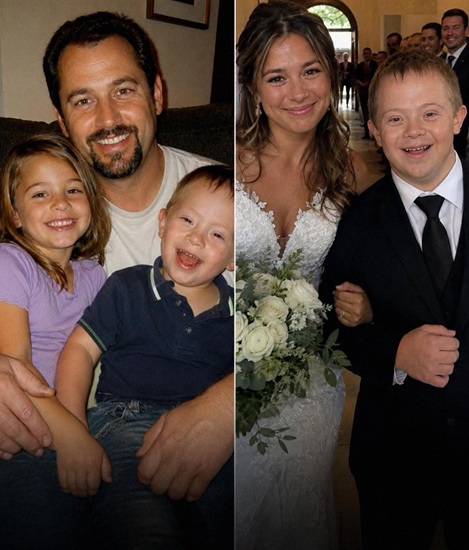
We had been sitting together in the kitchen for nearly an hour when he finally found the courage to say it. Nathan had started several sentences and abandoned every one of them halfway through. Whenever something mattered deeply to him, he did that. He would stare at the table, rub his thumb along the side of his coffee mug, quietly say, “So…” and then decide that maybe the rest of the sentence could wait. That evening, however, whatever was on his mind clearly wasn’t going away.
“Can I do Dad’s job at the wedding?” he finally asked. At first, I misunderstood him. I thought he might be talking about handing out programs, helping people find their seats, or doing one of the small tasks we still hadn’t assigned. There were dozens of details left to organize, and Nathan had already offered to help with almost all of them. But when I asked him what he meant, he looked at me with the expression he always used when he thought I was making something unnecessarily complicated.
“I mean walking you,” he said. “Down the middle part.”
“The aisle?”
“Yes. The aisle.”
For several seconds, I couldn’t answer him.
Our father had died eleven months earlier. Nathan was thirty-one and had Down syndrome, and he and Dad had shared a bond that was difficult to describe without making it sound simpler than it really was. They weren’t merely father and son. They were companions, coworkers on unnecessary weekend projects, and enthusiastic participants in jokes that nobody else understood. Saturday mornings usually meant the garage, old tools, coffee, and some project Dad had invented mostly because he wanted an excuse to spend the day with Nathan.
Dad taught Nathan practical things. He showed him how to change the oil in a car, sharpen garden tools, organize a toolbox, make grilled cheese without burning it, and recognize when something around the house needed repairing. Nathan taught Dad something different. He taught him how to laugh when plans went wrong. He reminded him that not every mistake required frustration and not every day needed to be productive. When Dad died, our family lost more than one person seemed capable of replacing.
For almost a year, I had avoided thinking seriously about who would walk beside me at my wedding.
There were reasonable possibilities. My uncle Patrick could have done it. Mom could have walked with me. I could have walked alone. Nobody would have considered any of those choices strange. But every time I pictured the church doors opening, I imagined the empty space where Dad should have been. Every alternative seemed to begin by reminding me that the person I actually wanted there was gone.
Then Nathan asked.
I covered my mouth with my hand because I suddenly couldn’t speak.
Nathan waited patiently.
“Sarah?”
I nodded.
“Yes?”
I nodded again and finally managed to say it aloud.
“Yes, Nathan. I would love that.”
His entire expression changed. He stood so quickly that the chair scraped loudly against the kitchen floor, and before I could say anything else, he wrapped his arms around me. He hugged me with enough enthusiasm that I almost lost my balance. Then, while I was still trying not to cry, he immediately began discussing the practical problem he had apparently been worrying about.
“I won’t go too fast,” he promised.
I laughed against his shoulder.
“That would be good.”
Then he said something I wasn’t expecting.
“I practiced with Dad before.”
I pulled away and stared at him.
“You practiced what?”
“Walking for your wedding.”
I had never heard this story.
Nathan explained that years earlier, Dad had joked about my future wedding and told him that when the day finally arrived, Nathan would have to make sure Dad didn’t trip over his feet. Somewhere along the way, the two of them had apparently practiced walking together. To Nathan, this wasn’t simply a new responsibility. It was something connected to a conversation he had shared with our father years before.
I started crying.
Nathan immediately became concerned.
“Did I say it wrong?”
“No.”
“Then why are you crying?”
“Because apparently brides cry about everything.”
That explanation satisfied him.
Within days, Nathan began practicing seriously. My uncle later told me that he had found Nathan walking repeatedly through the upstairs hallway with one arm extended as though someone were holding it. He counted his steps, stopped, turned around, returned to the beginning, and tried again. He wasn’t treating the ceremony as a symbolic gesture that everyone would find sweet regardless of what happened. He had been given a responsibility, and he intended to perform it properly.
Soon, practicing at home wasn’t enough.
Without telling any of us, Nathan called the church and asked to speak with Father Michael. He wanted precise instructions about what he was supposed to do when we reached the front. Father Michael called me afterward, amused and impressed by how seriously my brother was approaching the ceremony.
Nathan wanted to know where he should stop, when he should let go of my arm, whether he needed to bow, whether he should shake Daniel’s hand, and exactly when he was supposed to sit down.
Eventually, they developed a sequence.
Nathan would walk beside me until we reached Daniel. He would release my arm, shake Daniel’s hand, hug me, and then take his seat beside Mom. Nathan wrote everything down. Then he practiced the sequence.
Whenever somebody expressed concern, Nathan gave exactly the same answer.
“I practiced.”
Mom wondered whether seeing so many people inside the church might make him nervous.
“I practiced.”
Uncle Patrick wondered whether the music might affect his timing.
“I practiced.”
Daniel offered to have somebody nearby in case Nathan forgot where he needed to go.
Nathan frowned.
“I practiced.”
Soon nobody was questioning him anymore.
Mom loved the idea. Daniel loved it too. To both of us, it felt less like replacing Dad and more like allowing another person who loved him to carry part of his presence into the ceremony. Nathan wasn’t pretending to be our father. Nobody could do that. He was simply doing something Dad would have understood immediately.
For a while, the plan seemed settled.
Then, three weeks before the wedding, Daniel’s mother brought up the processional during dinner.
Margaret and I had known each other for several years. We weren’t particularly close, but we had always been civil. She cared enormously about appearances and details. Her table settings were carefully coordinated. Family photographs were planned rather than spontaneous. Holiday decorations appeared according to an unofficial schedule that everybody in her family somehow understood.
That evening, she put down her fork and asked whether Nathan was still going to walk me down the aisle.
“Yes,” I said.
She paused before responding.
Then she began talking about the wedding photographs.
She wondered whether we had considered how prominent Nathan would be in the pictures of the processional and suggested that perhaps he could attend the wedding without having such a visible ceremonial role. As she continued explaining her concerns, it became painfully clear that she was uncomfortable with the idea of photographs prominently featuring my brother.
I was stunned.
For several seconds, I couldn’t decide which part of her argument to answer first.
Nathan was my brother. My father was dead. Nathan had asked to honor him by standing beside me during one of the most emotional moments of my life. He had practiced for weeks because he cared about getting it right. The idea that somebody might evaluate that moment according to how a future photograph would look felt impossible for me to understand.
Daniel reached beneath the table and squeezed my hand.
“We’ll figure something out,” he said.
For half a second, I misunderstood him.
I turned toward him, wondering whether he was suggesting that we reconsider Nathan’s role. But Daniel’s expression told me something completely different. He wasn’t agreeing with his mother. He was trying to prevent an argument from exploding at the dinner table.
So I didn’t argue.
Dinner ended shortly afterward.
Once Daniel and I were alone in the car, however, I demanded an explanation.
He gave it immediately.
“Nathan is walking you down the aisle,” he said. “There was never another option.”
That was all I needed to hear.
We agreed on one thing that mattered more than winning an argument: Nathan would never hear about the conversation.
He had spent almost a year grieving our father. He had worked hard to prepare for the wedding. There was absolutely no reason for him to learn that somebody had questioned whether he belonged in such an important part of the ceremony.
That night, I couldn’t sleep.
By the early hours of the morning, I had made a decision.
I wasn’t going to reduce Nathan’s role.
I was going to document more of it.
The next morning, I called Lena, our photographer, and asked whether we could arrange additional coverage specifically focused on Nathan. I wanted photographs of him before the ceremony, waiting at the back of the church, offering me his arm, walking beside me, reaching the altar, greeting Daniel, and sitting beside Mom.
I wanted his hands.
I wanted his expression.
I wanted every step.
Most importantly, I wanted a separate album dedicated to that part of the wedding.
The additional photography required adjusting our budget, so I reduced some of the floral arrangements at the reception. It seemed like an easy decision. Flowers would last for a day. Those photographs could remain with us for the rest of our lives.
Nathan knew nothing about the change.
He simply kept practicing.
On the morning of the wedding, Mom brought Dad’s cufflinks for him to wear. Seeing them nearly undid me. Nathan got ready with Daniel and the groomsmen, and Daniel eventually sent me a photograph of him in his suit.
His hair was carefully combed. Dad’s cufflinks were visible. His expression was unusually serious.
Daniel added a message saying Nathan had already asked what time it was eleven times.
When the ceremony was about to begin, I waited in a small room at the back of the church.
Then Nathan walked in.
He stopped when he saw me.
For a moment, neither of us spoke.
Finally, he smiled.
“You look like Mom’s wedding picture.”
It was such a Nathan compliment that I almost started crying again.
“You look like Dad,” I told him.
He touched one of the cufflinks.
“I know.”
Then the music began.
Nathan straightened his jacket and offered me his arm.
“Ready?”
“No.”
His eyebrows pulled together.
“That’s not right.”
I laughed.
“Okay. I’m ready.”
The church doors opened.
The guests stood.
Daniel waited at the front. Mom was already crying in the first pew. There were relatives and friends everywhere, but after the first few seconds, I barely noticed anyone.
I noticed Nathan.
He began counting quietly.
“One.”
We stepped forward.
“Two.”
Another step.
“Three.”
I squeezed his arm.
He looked toward me.
“Too fast?”
“No.”
He nodded.
“I practiced.”
“I know.”
And he had.
He walked carefully and steadily, never rushing and never forgetting what he was supposed to do. Halfway down the aisle, his expression changed. For a moment, I thought he might cry.
Then he leaned slightly toward me.
“Dad would’ve liked your dress.”
That nearly broke my composure completely.
When we reached the front, Nathan stopped exactly where he had been instructed. He released my arm and offered Daniel his hand. Daniel shook it and then pulled him into a hug.
I thought Nathan would take his seat.
Instead, he reached inside his jacket.
He removed a folded piece of paper.
I had no idea what was happening.
Neither did Daniel.
Father Michael, however, was smiling.
Nathan unfolded the paper carefully and explained that he had written something.
His hands trembled at first.
Then he began.
He spoke about being my older brother. He spoke about Dad. He explained that Dad had always tried to be beside me when I was frightened and that because Dad couldn’t walk with me that day, Nathan had done it instead.
Then he explained that Dad had always told him that being a big brother meant taking care of his little sister.
“So that is what I am doing,” he finished.
By then, I was crying.
Mom was crying.
Daniel had one hand against my back.
Nathan carefully folded his paper again.
Then, with complete seriousness, he asked, “Do I sit now?”
The tension broke into laughter.
“Yes,” I managed to tell him.
Nathan sat beside Mom, and the ceremony continued.
Weeks later, our wedding photographs arrived.
The standard album was beautiful, but the separate collection centered on Nathan became one of my most treasured possessions.
There were photographs of Dad’s cufflinks on his wrists. Photographs of him checking the time. Photographs of him waiting near the church doors. Photographs of his arm extended toward me.
Then came the walk.
His concentrated expression.
My hand holding his arm.
His lips moving while he counted.
The moment he checked whether he was walking too quickly.
The hug between him and Daniel.
And finally, the photographs of his unexpected speech.
One image showed Nathan standing at the altar holding the paper in both hands. I was crying beside him, and Daniel stood behind us. The guests in the background were slightly out of focus.
That photograph captured something I had been unable to explain in words.
Several weeks later, we had family over for dinner, including Daniel’s parents, Mom, and Nathan.
I left the album on the coffee table without making an announcement about it.
Eventually, Margaret picked it up.
When I returned from the kitchen, she was sitting quietly with the album open across her knees.
She slowly turned the pages.
Eventually, she stopped at a photograph of Nathan waiting at the church doors with his arm extended.
“He practiced this?” she asked.
“Every day for three weeks,” I said.
She continued looking.
Then she reached the photographs of his speech.
She stayed on those pages for a long time.
Finally, she closed the album and rested both hands on the cover.
Then she asked whether she could have a copy of the photograph of Nathan speaking at the altar.
“Yes,” I said.
There was no argument.
No dramatic confrontation.
No attempt to make the moment into something bigger than it was.
Later, Daniel sent me a photograph from his parents’ house. The wedding picture Margaret had requested was hanging there in a carefully chosen frame.
It showed Nathan at the altar.
Dad’s cufflinks were on his wrists.
The paper was in his hands.
And the photograph that had once been feared as something that might not belong in a family display had become part of one.
I never told Nathan about the disagreement before the wedding.
I never told him why I arranged additional photography.
There was nothing useful he could have gained from knowing it.
As far as Nathan was concerned, the story was much simpler.
Our father couldn’t walk beside me on my wedding day.
Nathan asked whether he could do Dad’s job.
His family said yes.
So he practiced.
He counted the steps.
He wore Dad’s cufflinks.
He offered me his arm.
He walked beside me all the way to the altar.
And when the moment finally arrived, my big brother did exactly what he had promised to do.
