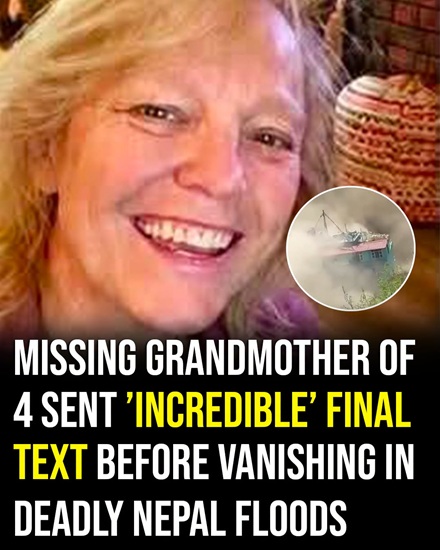
A Georgia family is waiting for answers after 60-year-old Mary Sorensen disappeared during the catastrophic flooding that struck the Nepal-Tibet border region on August 26, 2026. Sorensen, a mother and grandmother of four from Canton, north of Atlanta, had traveled to the Himalayas for a spiritual pilgrimage to Mount Kailash. She had spent years hoping to make the journey and had successfully completed it before beginning the trip home. Then communication stopped, leaving her husband, children and extended family facing an agonizing period of uncertainty.
Sorensen traveled with a group connected to the Isha Foundation, an organization she practiced yoga and meditation with, according to her son Riley Wildeman. Mount Kailash, located in Tibet, is considered sacred by several religious traditions and draws pilgrims from around the world. For Sorensen, the journey was deeply personal. Her family described her as spiritual, adventurous and determined to experience the mountain she had dreamed about visiting for years.
Her son said that Sorensen had successfully reached the mountain and completed the pilgrimage before the disaster occurred. She had experienced the scenery, hiking and spiritual reflection that had motivated her to travel such a long distance. Wildeman described his mother as someone who followed her own path, looked for goodness in people and tried to appreciate the moments life offered her. Those qualities have become particularly meaningful to her family as they wait for information about what happened after she began returning from the region.
One of the most emotional details of the story is the final message Sorensen sent to her family. Before disappearing, she told them that she was grateful they were her family. Her son later explained that the message had become a source of comfort despite the uncertainty surrounding her disappearance. The family has not described it as a deliberate farewell, because Sorensen was expecting to continue her journey home. Instead, it was a loving message that took on a much deeper significance only after disaster struck.
According to her family, Sorensen had been looking forward to the long journey home because she wanted time to process everything she had experienced. She wanted to think about how she could describe the pilgrimage and its meaning to the people she loved. She had no reason to believe that her travel plans would suddenly be interrupted by one of the most destructive natural disasters to hit the region in years.
Sorensen had been expected to travel back through the border region before eventually reaching Kathmandu and beginning her return trip to the United States. Her family said she had additional plans waiting once she reached home. She was expected to spend a short period in Georgia before traveling to Maine to reunite with her husband Brian and spend time with family, including her granddaughters. Instead, her movements became impossible to confirm after she reached the border area.
The disaster unfolded on August 26 when a massive glacial collapse triggered destructive flooding and mudslides along the Nepal-Tibet border region. Water, rock, mud and debris swept through Himalayan valleys, destroying buildings, roads and other infrastructure. Authorities have described an enormous search-and-rescue operation complicated by damaged transportation routes, unstable terrain, heavy mud and continuing weather risks.
The scale of the disaster has continued to grow as officials reach previously inaccessible areas. By September 2, Nepali authorities reported more than 1,100 confirmed deaths in Nepal, while Chinese authorities had reported additional fatalities in Tibet. Thousands of people remained listed as missing across the affected region, although totals have changed as officials reconcile reports and establish contact with survivors.
Foreign travelers were among those caught in the disaster because the affected border corridor is used by pilgrims traveling to and from Mount Kailash. U.S. officials said in late August that approximately 85 American citizens were unaccounted for. Nine Americans had been evacuated safely at that stage, and the State Department said it was not aware at the time of any confirmed U.S. citizen deaths.
Those figures should be treated as evolving rather than permanent. On September 1, Nepali officials told CBS News that contact had been established with one U.S. national who had previously been considered missing. Authorities were still working to clarify that person’s identity, location and condition when the report was published. The development offered some hope that disrupted communications could explain at least a portion of the missing-person cases.
For families such as Sorensen’s, however, the lack of definite information remains extremely difficult. There has been no publicly confirmed report establishing that Sorensen was the American who was contacted, and she continued to be reported as missing in recent coverage. It would therefore be inaccurate either to declare her safe or to presume that she died. Until authorities or her family receive confirmed information, her status remains unresolved.
Sorensen’s husband Brian has spoken about trying to maintain hope despite understanding the seriousness of the disaster. Families separated by catastrophes often face long periods in which communication networks, transportation routes and official records are disrupted. In remote mountainous terrain, confirming whether someone has reached safety can take considerably longer than it would in an area with functioning roads and communications infrastructure.
The family believes records indicated that Sorensen reached an immigration facility near the Nepal-Tibet border shortly before the flooding. Brian has said that the timing appeared frighteningly close to the arrival of the floodwaters. That timeline comes from the family’s interpretation of the information available to them, and authorities have not publicly established every detail of Sorensen’s movements immediately before the disaster.
The immigration and border facilities in the affected corridor were especially vulnerable because they were located near waterways carrying enormous quantities of floodwater and debris. Reports from the region describe buildings being destroyed or buried and transportation links being cut. Those conditions have made it difficult for rescue teams to locate people who may have escaped into surrounding terrain or become separated from travel groups.
Many of the missing foreigners had traveled to the region specifically for pilgrimage. Mount Kailash has enormous religious importance for Hindus, Buddhists, Jains and followers of the Bon tradition. The journey commonly requires travelers to pass through remote, high-altitude areas where communications and emergency access are already difficult even under normal conditions.
Sorensen’s family has emphasized that the journey suited her personality. She was not described as someone who traveled simply to collect photographs or complete a conventional vacation. Her relatives have portrayed her as a person strongly motivated by spirituality, reflection and a desire to connect with experiences she considered meaningful.
Her son Riley described her as someone capable of seeing good even in difficult circumstances. He said she tended to approach people and experiences with optimism rather than suspicion. That outlook has become part of how her family is coping with the uncertainty surrounding her disappearance.
The final text she sent has consequently taken on a role her family could never have anticipated. Sorensen was not sending a message that she believed would be her last. She was apparently reflecting on the significance of her journey and telling her family how much they meant to her.
For Riley, that difference is important. The message offers comfort not because the family has accepted that Sorensen will not return, but because it captured exactly how she felt about them before communication was lost. They remain hopeful that she may still be found alive.
The family has continued working through official channels in the search for information. They have contacted the U.S. State Department as well as authorities and agencies connected with Nepal and China. The State Department has said U.S. diplomatic personnel in Kathmandu and Beijing have been working with local authorities to account for American citizens affected by the disaster.
The United States also announced humanitarian assistance for the disaster response. U.S. officials said the aid was intended to support emergency food and other needs in communities devastated by the floods. International assistance has joined rescue efforts led by Nepali authorities and other governments as the scope of the destruction has become clearer.
Search teams face considerable obstacles. Floodwaters carried large quantities of mud, rocks and debris into valleys and settlements, while roads and bridges were damaged or destroyed. Some areas were buried under deep layers of sediment, complicating efforts to determine what happened to people who were present when the water arrived.
Authorities have also been searching for workers connected with hydropower facilities in the disaster zone. Some may have been inside tunnels or working in difficult-to-reach locations when the flooding occurred. These simultaneous rescue operations demonstrate why establishing an accurate number of missing people has taken time.
Lists of the missing can also contain duplicates or people who later make contact. Someone may initially be listed independently by relatives, travel companies and local authorities, for example. Conversely, travelers may be missing for hours or days before officials learn that they were present in the region at all.
That is why numbers reported during large disasters can change significantly. Early estimates are useful for understanding the seriousness of the situation, but they should not be treated as final totals while search operations remain active.
In Sorensen’s case, her family has tried to balance realism with hope. They understand what happened to the border area and know how severe the destruction was. At the same time, reports that some survivors have been found or contacted after initially being listed as missing provide reasons not to make assumptions before reliable evidence becomes available.
Brian has also spoken about his wife’s spiritual beliefs when describing how he is coping. His comments reflect his own beliefs and personal way of understanding the situation rather than established facts about what happened to Sorensen. Responsible reporting should preserve that distinction.
The couple had been married for decades and had built a blended family together. Sorensen’s relatives describe her as a devoted mother and grandmother whose relationships with her children and grandchildren were central to her life.
Her four granddaughters were among the people she expected to see after returning from the pilgrimage. The plans she had made before leaving underscore why her disappearance was so sudden. She had completed the goal she had traveled for and believed she was beginning an ordinary journey home.
Her decision to travel to Mount Kailash was also consistent with a broader interest in spirituality and yoga. According to her son, she traveled with a group associated with Isha, with whom she practiced yoga, prayer and meditation.
The Isha Foundation confirmed that members of its pilgrimage groups were among those affected by the flooding. Other travel organizations have also reported missing pilgrims from several countries. The concentration of travelers in the border area explains why the disaster has affected families far beyond Nepal and Tibet.
Americans reported missing have come from several states and different backgrounds. Some had been preparing for the pilgrimage for months or years. Several families have described relatives who viewed Mount Kailash as one of the most meaningful spiritual destinations they could visit.
That shared context does not diminish the individuality of each missing person. Behind the large statistics are families waiting for information about parents, spouses, children and friends. Sorensen is one of those individuals, and her family has emphasized the life and personality behind her name.
For Riley, his mother’s adventurousness remains one reason he holds onto hope. People who knew her describe someone comfortable following an unconventional path and willing to face challenges in pursuit of meaningful experiences.
That does not establish what happened during the flood, but it explains the family’s determination to continue seeking answers. Hope, in this context, is not presented as proof that she survived. It is simply their decision not to assume the worst while the search remains unresolved.
This distinction is important when covering disasters involving missing people. Declaring someone dead without official confirmation can cause additional harm to families and spread misinformation. At the same time, suggesting that survival is certain would also be irresponsible.
The most accurate description is that Mary Sorensen remains among those reported missing following the Nepal-Tibet floods, and her family continues to await verified information about her whereabouts.
The broader disaster remains an evolving humanitarian emergency. The confirmed death toll has risen substantially since the first reports, while thousands of missing-person cases are still being investigated. Rescue and recovery work continues across difficult mountainous terrain.
Officials are also attempting to restore roads, communications and essential services in affected communities. Flooding of this magnitude can leave consequences lasting far beyond the immediate rescue period, including displacement, damaged homes and disruption to food supplies, healthcare and transportation.
For relatives outside the region, those infrastructure problems can make waiting particularly painful. A lack of communication does not necessarily provide clear information about whether a person is injured, stranded, evacuated or still missing.
The report that one American previously listed as missing had been contacted demonstrates the uncertainty inherent in the early stages of disaster response. It does not establish anything specific about Sorensen, but it illustrates why families continue hoping that communication failures may account for some cases.
Sorensen’s final message therefore remains especially meaningful to her children. Its importance does not depend on whether it ultimately proves to have been her final communication forever. Even if she is found safe, the message still expresses the gratitude she felt after completing an important spiritual journey.
If the outcome is different, her family has said the words would remain an extraordinary expression of love. That is why Riley has spoken about finding a degree of peace in them while simultaneously insisting that he has not given up hope.
For now, uncertainty remains the central reality of the family’s situation. They continue reaching out to officials, following developments from the disaster zone and waiting for information that could explain what happened after Sorensen reached the border region.
The story is therefore not one with a confirmed ending. Mary Sorensen completed the pilgrimage she had dreamed about, began making her way home and sent her family a message expressing how grateful she was for them.
Hours later, catastrophic flooding transformed the region and left thousands of families searching for loved ones.
Sorensen’s relatives remain among those families. They are grieving the uncertainty without claiming to know an outcome that has not been established.
As rescue and identification efforts continue, any future update about Sorensen should be based on information confirmed by her family or appropriate authorities rather than speculation circulating online.
Until that happens, the most responsible description remains simple: Mary Sorensen is missing, her family is searching for answers, and they are continuing to hope that she may still come home.
