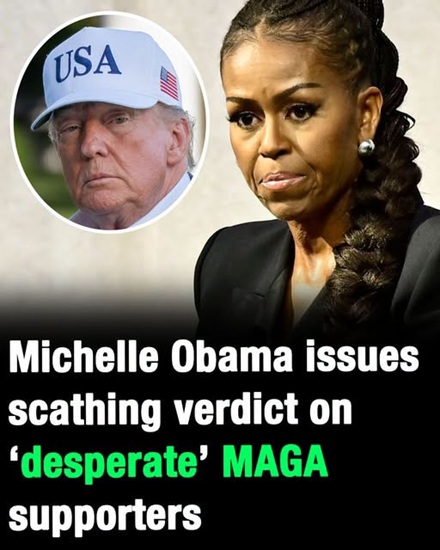
In recent years, American political discourse has become increasingly polarized, with public figures often being interpreted through highly charged media narratives rather than precise factual statements or verified transcripts. Within this environment, Michelle Obama is frequently referenced in discussions about unity, civic responsibility, and the emotional divisions shaping modern American society across political and cultural lines.
Her public speeches, particularly those delivered during national events and campaign-related appearances, have often emphasized themes of empathy, resilience, and the importance of democratic participation in a divided nation. Many analysts and commentators interpret her messaging as an appeal to mutual understanding, encouraging citizens to look beyond partisan identity and consider the lived experiences of others within society.
This interpretive framework has sometimes been extended into broader discussions about voter behavior, particularly in relation to working-class communities experiencing economic and social change. Political observers often argue that these communities may feel disconnected from traditional institutions, leading to frustration that can manifest in support for outsider political movements or non-establishment candidates.
In this context, discussions surrounding the MAGA movement are frequently analyzed through the lens of economic anxiety, cultural identity, and shifting political alignments across the United States. Commentary on these dynamics tends to emphasize that political support is rarely driven by a single factor, but rather a combination of personal experience, community influence, and broader structural conditions.
Some analysts suggest that dismissing large groups of voters as motivated purely by hostility or prejudice can deepen political divisions rather than contribute to meaningful dialogue or understanding. Instead, they argue that democratic stability depends on acknowledging complexity in voter motivation while still critically evaluating harmful rhetoric and divisive political messaging.
Michelle Obama’s widely known public philosophy, as expressed in her speeches and writing, often aligns with encouraging civic engagement and discouraging the dehumanization of political opponents in public discourse. Her messaging is frequently interpreted as advocating for the idea that democracy requires participation from all citizens, regardless of political affiliation or background.
In broader commentary about American society, she is often associated with calls for restoring trust in institutions and reinforcing the importance of shared civic values. These themes become particularly relevant when discussing periods of heightened political tension, where emotional narratives can sometimes overshadow policy-focused debate.
Observers of American politics note that such tensions are not new, but have been amplified by digital media, rapid information cycles, and increasing ideological segmentation. In this environment, public figures are often placed at the center of symbolic interpretations that extend beyond their direct statements or verified positions.
As a result, discussions about unity and division are frequently shaped by broader cultural anxieties rather than specific documented remarks by any single individual. Commentators who analyze voter psychology often highlight that economic uncertainty, wage stagnation, and regional disparities can significantly influence political alignment over time.
These structural factors are commonly discussed in academic and journalistic studies of electoral behavior, particularly in relation to industrial regions and rural communities. At the same time, concerns about political rhetoric remain central to debates about how public trust in democratic institutions is maintained or eroded.
Many civic leaders and scholars argue that respectful engagement across political differences is essential for reducing polarization and preventing long-term democratic fragmentation. This perspective does not eliminate ideological disagreement, but instead emphasizes the importance of maintaining shared norms of communication and accountability.
Within this broader analytical framework, Michelle Obama is often cited as a cultural figure whose public messaging resonates with themes of civility, emotional intelligence, and collective responsibility. Her influence in public discourse is therefore frequently interpreted through the lens of encouragement rather than confrontation, focusing on bridging divides rather than deepening them.
However, it is important to distinguish between interpretation and direct quotation, especially in politically sensitive contexts where misinformation can easily spread. Responsible analysis requires separating verified statements from commentary, ensuring that public figures are not inaccurately represented or attributed claims they have not made.
This approach helps maintain credibility in reporting while also preserving the integrity of public discussion about complex social and political issues. In summary, discussions that reference Michelle Obama in relation to political polarization often reflect broader societal concerns rather than specific, verifiable declarations. These conversations tend to focus on themes such as civic unity, democratic participation, and the challenges of understanding opposing political perspectives in a divided nation.
Ultimately, the underlying issue remains the same across most analyses of modern politics, which is how to balance disagreement with mutual recognition of shared citizenship. As political divisions continue to shape public life, many commentators argue that long-term stability depends on rebuilding trust, encouraging dialogue, and addressing underlying economic and social pressures. This ongoing conversation remains central to understanding the evolving nature of democracy in the United States and the ways citizens engage with one another in times of tension.
