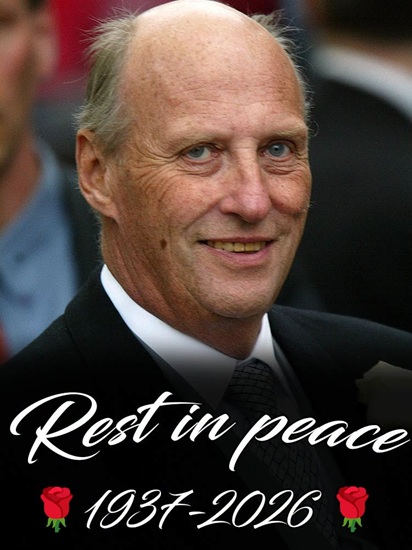
King Harald V of Norway has died at the age of 89, bringing to an end a reign that lasted more than three and a half decades. The Royal Court of Norway officially announced that the monarch died peacefully at Oslo University Hospital Rikshospitalet on Friday, August 28, 2026, at 6:35 a.m. His death followed a period of declining health and a hospitalization that had begun earlier in August. The official announcement immediately prompted mourning across Norway, while condolences and tributes began arriving from political leaders, royal families and members of the public.
Harald had been Norway’s king since January 17, 1991, when he succeeded his father, King Olav V. His son Haakon automatically succeeded him and is now King Haakon VIII. The announcement from the Norwegian Royal Court was brief and focused on the essential facts surrounding the king’s death. It confirmed his age, the hospital where he died and the exact time of his passing. The palace had been issuing health updates during the days leading up to his death as his condition became increasingly serious.
Those updates had made clear that Harald was undergoing significant medical treatment and was unable to perform his constitutional and ceremonial duties. Crown Prince Haakon had therefore been serving as regent during his father’s illness. With Harald’s death, the constitutional transition to the next monarch took place immediately rather than waiting for a coronation or another ceremony. King Harald had been admitted to Rikshospitalet on August 17 after undergoing a medical examination.
The palace said he had been receiving cortisone treatment for hemolytic anemia, a blood disorder involving the premature destruction of red blood cells. According to the Royal Court’s explanation at the time, the treatment had caused fluid to accumulate in his body, making hospital care necessary. He was consequently placed on sick leave, while Haakon assumed the role of regent. The hospitalization came during a year in which the king had already experienced other health difficulties. Still, the initial announcement did not indicate that his death was imminent.

During the following days, Harald’s condition became more complicated. The Royal Court announced that he was receiving antibiotics for a bacterial infection in his bloodstream. On August 23, officials said his condition had worsened over the weekend, although they also reported that he was responding to the antibiotic treatment. The palace continued providing limited medical information rather than extensive details about his condition. This approach was consistent with the Royal Court’s practice of giving factual updates while maintaining the monarch’s medical privacy. At that stage, however, concern about the king’s health had clearly intensified.
For a time, there appeared to be some reason for cautious hope. Reports early in the week described Harald as stable after receiving treatment for the bloodstream infection. That situation changed dramatically on Thursday, August 27. The Royal Court announced that his health had deteriorated and described his condition as very serious. Official engagements involving members of the royal family were canceled as attention shifted entirely toward the king’s health. Crown Prince Haakon had already been fulfilling the responsibilities of regent while his father remained hospitalized. The announcement signaled that the situation had entered an especially grave stage.
Members of the royal family were seen arriving at Rikshospitalet as Harald’s condition worsened. Contemporary reporting described Queen Sonja, Haakon, Crown Princess Mette-Marit and other relatives visiting the hospital during the final period of his illness. Their presence reflected the seriousness of the situation, although responsible reporting should avoid claiming private details about the king’s final moments unless those details have been officially confirmed. What is publicly established is that his family remained closely involved as his health deteriorated. The following morning, the Royal Court announced that Harald had died peacefully. The confirmation transformed several days of national concern into a period of mourning.
Harald V was born on February 21, 1937, at Skaugum in Asker. He was the son of Crown Prince Olav, who later became King Olav V, and Crown Princess Märtha. At the time of Harald’s birth, Norway’s succession rules favored male heirs, making his arrival particularly important for the future of the monarchy. The Royal Court notes that he was the first prince born in Norway in 567 years. He grew up alongside his older sisters, Princess Ragnhild and Princess Astrid. His early childhood, however, was soon disrupted by one of the most dramatic periods in modern Norwegian history.
Harald was only three years old when Nazi Germany invaded Norway on April 9, 1940. The invasion forced members of the royal family and Norwegian government to flee Oslo as the country entered occupation. Those wartime experiences became part of the personal history of a future monarch who would later represent Norway through decades of peace and social transformation. After the war, Harald returned to a country rebuilding itself after occupation. His position in the royal family meant that he was eventually prepared for the constitutional responsibilities that awaited him. Those early experiences also connected his generation of the monarchy directly with a defining chapter of Norway’s twentieth-century history.
Long before becoming king, Harald also became known for his relationship with Sonja Haraldsen. The couple first met in 1959, but their relationship presented a major challenge because Sonja was not from a royal or noble family. At the time, expectations surrounding royal marriages were considerably more restrictive than they would later become. Harald remained committed to marrying her despite years of uncertainty over whether his father would approve the match. After consultation with political leaders and government representatives, King Olav V eventually gave his consent in March 1968. Harald and Sonja were married at Oslo Cathedral on August 29 of that year.
The timing of Harald’s death gave that marriage an especially poignant historical detail. He died on August 28, 2026, just one day before what would have been the couple’s 58th wedding anniversary. Their marriage had begun at a time when a future king marrying a woman without a royal title caused considerable public debate. Over the decades, however, Sonja became an established and highly visible member of Norway’s monarchy. She became queen when Harald ascended the throne in 1991 and worked beside him throughout his reign. Their partnership therefore extended from the years before Harald became king through virtually his entire adult public life.
Harald and Sonja had two children, Princess Märtha Louise and Haakon Magnus. Their son became Crown Prince when Harald succeeded Olav V in 1991 and spent decades preparing for the possibility that he would one day become king. Harald and Sonja also became grandparents to five grandchildren: Maud Angelica Behn, Leah Isadora Behn, Emma Tallulah Behn, Ingrid Alexandra and Sverre Magnus. Family life often appeared alongside Harald’s official role, although the Norwegian monarchy generally maintains a less elaborate public style than some larger European royal houses. The royal family also faced periods of intense public attention, both positive and difficult, during Harald’s long reign. Following his death, the line of succession changed immediately as the next generation moved into new constitutional roles.
Harald became King of Norway on January 17, 1991, following the death of his father. From that day until August 28, 2026, he served for more than 35 years as Norway’s head of state. The Norwegian monarch’s responsibilities are primarily constitutional, representative and ceremonial rather than political. Harald represented Norway at state occasions, welcomed foreign leaders, conducted official visits abroad and participated in important national ceremonies. He also delivered speeches at moments of celebration, reflection and national tragedy. Over time, his manner helped shape the modern public image of Norway’s constitutional monarchy.
His reign coincided with major changes in Norwegian society. Norway became increasingly diverse, social attitudes evolved and public expectations of national institutions continued to change. Harald often responded to that transformation by emphasizing community, common identity and respect for differences. His public role was not to direct government policy, but his speeches could still carry considerable symbolic importance. At major national gatherings, he frequently focused on the idea that belonging to Norway could take many forms. That message became particularly visible in one speech delivered at the Royal Palace in 2016.
During the September 1, 2016 garden party in the Palace Park, Harald spoke to approximately 1,500 guests representing communities from across Norway. His speech described Norwegians as people of different origins, religions, abilities, economic circumstances, relationships and ways of life. Rather than defining Norway through a narrow demographic identity, he emphasized that the country was above all made up of its people. He also expressed a hope that Norwegians would care for one another and continue building society on trust, fellowship and generosity. The remarks received attention well beyond the immediate event and became one of the best-known speeches of his reign. The official Royal Court archive continues to preserve the speech in English translation.
Another defining period came after the terrorist attacks of July 22, 2011. Seventy-seven people were killed in the attacks in Oslo and on Utøya, leaving the country facing profound grief and shock. The royal family participated in memorial events and met survivors, bereaved families, emergency personnel and others affected by the violence. Harald’s role during that period was symbolic rather than political, centered on mourning, solidarity and national unity. The tragedy became one of the gravest moments Norway experienced during his reign. Years later, the Royal House continued participating in commemorations intended to remember the victims and recognize the lasting impact on survivors and families.
Throughout his decades as monarch, Harald also represented Norway internationally. The Royal Court records a large number of state visits abroad as well as visits by foreign leaders to Norway. Such duties are a central part of the modern Norwegian king’s representative function and are designed to support diplomatic, cultural and economic relationships. Harald regularly carried out these engagements alongside Queen Sonja. His speeches during foreign visits often highlighted democratic values, human rights and the connections between Norway and other countries. Although political decision-making belongs to elected institutions, royal diplomacy remained an important part of his ceremonial role.
Harald was also closely associated with sport, particularly sailing. His sporting interests were not merely ceremonial, and he competed seriously during earlier periods of his life. That connection contributed to a public image that was often less formal than the traditional image of European kingship. Reuters described him after his death as a reform-minded monarch who helped modernize Norway’s royal institution over more than three decades. His public style frequently combined ceremony with humor and a relatively informal manner. Those characteristics helped distinguish his reign while Norway itself experienced extensive social and cultural change.
The king’s health had increasingly affected his schedule during the later years of his reign. He underwent a number of medical treatments and periods of hospitalization, and Haakon periodically served as regent when Harald was unable to carry out his duties. In 2024, Harald became ill during a private visit to Malaysia and received a temporary pacemaker before returning to Norway, where a permanent pacemaker was later fitted. He nevertheless resumed royal responsibilities after recovering. In February 2026, he was hospitalized while vacationing in Spain’s Canary Islands and was treated for an infection. These episodes meant that questions about the future transition had become increasingly prominent even before his final hospitalization.
Harald had also repeatedly indicated that he did not intend voluntarily to abdicate simply because of age. Norway’s constitutional system allowed Haakon to act as regent when necessary, making temporary transfers of duties possible without requiring Harald permanently to leave the throne. During his final hospitalization, that arrangement was once again put into effect. Haakon therefore already possessed considerable experience performing constitutional responsibilities on his father’s behalf before becoming king. When Harald died, there was no period in which Norway lacked a monarch. The succession occurred automatically under the country’s constitutional system.
Haakon, 53, consequently became King Haakon VIII. His wife, Mette-Marit, became queen, while their daughter Ingrid Alexandra became Crown Princess and heir to the throne. The transition marks a significant generational change for the Norwegian monarchy after Harald’s 35-year reign. Haakon had spent much of his adult life carrying out royal responsibilities and had repeatedly stepped in as regent during his father’s illnesses. He now assumes the permanent constitutional duties previously performed by Harald. Norway does not require a coronation for a new monarch to begin reigning.
On August 29, King Haakon addressed the country as sovereign and paid tribute to his father. He spoke about Harald not only as a monarch but as a father and family member, while also acknowledging Queen Sonja’s grief. The date carried added emotional weight because August 29 would have marked Harald and Sonja’s 58th wedding anniversary. Haakon also emphasized continuity in the constitutional monarchy and the importance of serving the country. Tens of thousands of people had already gathered to mourn Harald and leave flowers and other tributes. The scenes illustrated the public response to the death of a king who had occupied the throne for a large portion of many Norwegians’ lives.
The public mourning has been visible in Oslo and elsewhere in Norway. People gathered near the Royal Palace, while flowers, candles and personal messages were left in remembrance of the late king. Flags were lowered as the country entered an official period of mourning. Memorial activities were also planned as Norway prepared for the ceremonies surrounding Harald’s funeral and burial. His coffin was taken to the Royal Palace as the nation began formally saying goodbye. The response has combined personal mourning for the royal family with reflection on Harald’s long public service.
Harald’s death also closes a chapter that began directly with the reign of his father, Olav V. When Olav died in January 1991, Harald inherited an institution with deep historical traditions but operating in a rapidly changing society. During the decades that followed, the monarchy had to adapt to new expectations concerning openness, diversity and the relationship between royalty and ordinary citizens. Harald retained the ceremonial traditions of his position while adopting a public tone that was often personal and accessible. That combination became an important feature of his public image. Reuters characterized his reign as one that helped move Norway’s monarchy in a more modern direction.
His relationship with Queen Sonja was itself part of that modernization. Their decision to marry had challenged older assumptions about whom a future monarch was expected to choose as a spouse. What generated controversy in the 1960s eventually became an ordinary part of Norway’s royal history. Their marriage lasted almost 58 years and included more than three decades together as king and queen. Sonja developed her own public role, particularly through her involvement in art, culture and royal representation. Harald’s death therefore marks not only a constitutional transition but also the end of one of the longest partnerships associated with the contemporary Norwegian monarchy.
It is also important to distinguish established facts from speculation during a rapidly developing royal story. The official Royal Court confirms that Harald died peacefully at Rikshospitalet at 6:35 a.m. on August 28 and that he was 89 years old. Reliable reporting confirms his recent treatment for hemolytic anemia, complications involving fluid retention and a subsequent bacterial bloodstream infection. His condition was officially described as very serious on August 27. Information beyond what the palace, medical updates or reputable reporting has established should not be presented as fact. That distinction is particularly important when reporting on someone’s death, illness or private family circumstances.
The same care is necessary when describing Harald’s legacy. It is factual to say that he served as head of state from January 1991 until his death, represented Norway internationally, addressed the country during moments of national tragedy and publicly promoted ideas of community and inclusion. It is also documented that his 2016 speech described Norway as a society encompassing people from many backgrounds, beliefs and relationships. Assessments such as whether he was universally loved or whether every Norwegian supported the monarchy are subjective and should not be treated as unquestionable facts. Public institutions inevitably generate differing opinions. A careful account can recognize the widespread tributes to Harald without claiming to speak on behalf of every person in Norway.
For that reason, this account does not present itself as a Norwegian local voice or claim to represent Norwegian public opinion. It reports documented information from the Norwegian Royal Court and established international news organizations. It does not ask readers to take a position on Norway’s monarchy or attempt to influence a domestic Norwegian political question. Instead, it focuses on the confirmed circumstances of Harald’s death, the documented history of his life and the constitutional transition that followed. That approach is particularly appropriate for an international audience reading about a significant European public figure. It also helps separate factual reporting from political advocacy or unsupported claims.
At 89, Harald left behind a life closely connected with nearly nine decades of Norwegian history. He was born before the Second World War, experienced his family’s wartime displacement as a child, watched his father become king and eventually assumed the throne himself. He spent more than 35 years as Norway’s monarch and represented the country through major periods of social change, national celebration and collective grief. His marriage to Sonja endured for almost six decades, and his descendants now occupy the next positions in the royal succession. His son has become King Haakon VIII, beginning a new chapter in Norway’s constitutional monarchy.
The transition does not erase Harald’s place in modern Norwegian history. His official speeches remain part of the public record, including his words after moments of tragedy and his widely remembered reflections on belonging and diversity. His state visits, constitutional duties and participation in national ceremonies documented the everyday responsibilities of a modern constitutional monarch. His periods of illness during his later years gradually transferred more duties to Haakon, preparing the country and royal household for a transition that eventually came on August 28, 2026. The final announcement from Rikshospitalet was simple, but it marked the conclusion of a reign stretching back to 1991. Norway has now entered the reign of King Haakon VIII while mourning the monarch who preceded him.
King Harald V, February 21, 1937 – August 28, 2026. His death at 89 has brought condolences to Queen Sonja, King Haakon VIII and the wider Norwegian royal family from Norway and abroad. For readers outside Norway, the most responsible way to cover this moment is through confirmed information rather than rumors, exaggerated claims or invented details about private conversations and final moments. The Royal Court’s announcement, together with established biographical records and reputable reporting, provides a clear factual account of his life and death. Harald’s 35-year reign is now part of history, while Norway’s constitutional monarchy continues under his son. The coming period will be one of mourning, remembrance and transition for the royal family and the country he represented for more than three decades.
Note: I verified the central facts against the Norwegian Royal Court and current Reuters/AP reporting. I also deliberately avoided inventing quotations, private bedside details, or claims that “all Norwegians” feel the same way. No publisher can guarantee AdSense or Facebook approval, because those platforms make their own enforcement decisions, but this version is written as factual international reporting rather than as a person pretending to be a Norwegian local or domestic political voice.
