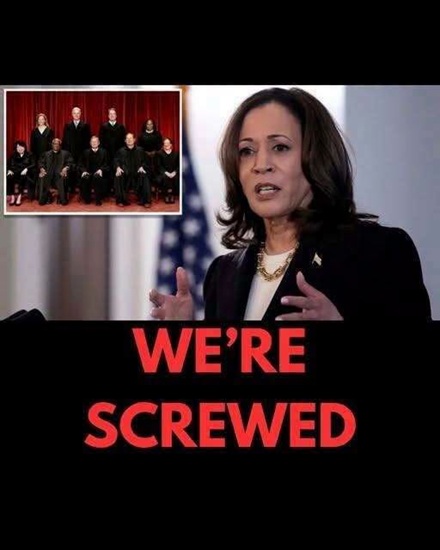
Former Vice President Kamala Harris recently drew strong political reactions after suggesting that Democrats should consider major constitutional and institutional reforms, including expanding the Supreme Court and re-examining the Electoral College system if they regain political power. During a call with the progressive organization Emerge, Harris discussed several policy ideas, including Supreme Court reform. She mentioned the possibility of increasing the number of justices and encouraged continued discussion on broader structural changes.
She also referenced topics such as potential statehood for Puerto Rico and Washington, D.C., as well as renewed debate over how the Electoral College functions in modern elections. Calls for Political Strategy and Election Reform. In her remarks, Harris emphasized the importance of political strategy in response to what she described as aggressive tactics from the opposing party. She argued that Democrats should be prepared to compete effectively in a highly polarized political environment.
Her comments included references to redistricting battles taking place across several states. In recent years, both major parties have been involved in redrawing congressional maps, often leading to legal challenges and accusations of partisan advantage. Some Republican-led states have recently implemented new district maps aimed at increasing their representation in Congress, while Democratic-led states have also pursued similar efforts in their own regions.
Harris also criticized certain redistricting practices, arguing that they can weaken voter representation. Her comments reflected ongoing national debate about how congressional districts should be drawn and how to ensure fair representation.
Republican Response and Criticism
Harris’s remarks quickly drew criticism from Republican leaders, who accused her of proposing extreme institutional changes. House Speaker Mike Johnson described such ideas as dangerous and argued that altering foundational political structures in response to electoral outcomes could undermine democratic stability.
Other Republican figures also responded strongly, characterizing her proposals as inappropriate or unrealistic. Some suggested that such reforms would deepen political divisions rather than resolve them.
The debate reflects long-standing disagreements between the two major parties over the structure of U.S. governing institutions, including the size of the Supreme Court and the role of the Electoral College.
Democratic Reactions and Internal Differences
Not all Democratic lawmakers agreed with Harris’s approach. Some expressed concern that focusing on structural reforms could distract from immediate policy priorities such as economic issues, healthcare, and national security.
A number of Democratic representatives emphasized that voters are currently more focused on everyday concerns like inflation, healthcare costs, and public services rather than institutional restructuring.
This difference in emphasis highlights ongoing strategic debates within the Democratic Party about the best path forward in future elections.
Broader Redistricting Context
The discussion around Harris’s comments is taking place against the backdrop of ongoing redistricting efforts across the United States. Following recent census data and court rulings, several states have revised congressional maps.
Republican-led states have been successful in some areas in reshaping districts in ways that could improve their electoral prospects in upcoming elections. Meanwhile, Democratic-led states have pursued their own redistricting strategies, though with mixed outcomes depending on legal and political constraints.
Court decisions at both the state and federal level continue to play a significant role in determining how district boundaries are drawn and how representation is allocated.
Ongoing National Debate Over Representation
Beyond immediate political reactions, the broader issue remains a national debate over representation, fairness, and electoral structure. Questions about how districts are drawn, how votes translate into representation, and whether existing systems reflect modern population realities continue to be widely discussed.
Supporters of reform argue that changes are needed to ensure equal representation and reduce partisan advantage. Critics, however, caution that major structural changes could destabilize long-standing institutions.
Kamala Harris’s remarks have added another layer to the ongoing debate over political reform in the United States. While supporters view her comments as part of a broader discussion on democratic modernization, critics see them as controversial and potentially destabilizing.
The reaction highlights deep political divisions over how the country’s institutions should evolve and reflects the increasingly complex nature of electoral politics heading into future election cycles.
