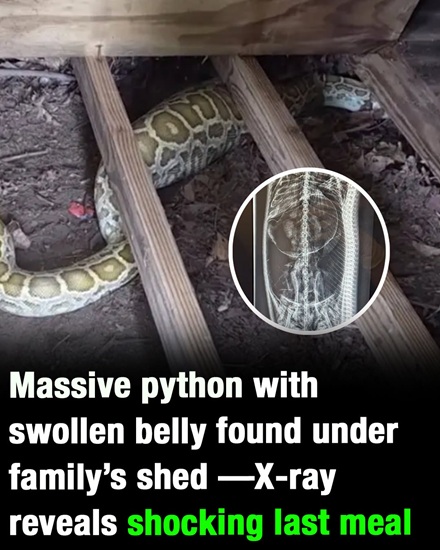
A family in Freehold, New Jersey, encountered an extraordinary situation after discovering a very large snake hiding beneath a shed in their backyard. What initially appeared to be an unexpected wildlife encounter quickly became even more unusual when rescuers noticed that the reptile had a dramatically swollen section around the middle of its body. The animal was eventually identified as an approximately eight-foot-long Burmese python, a species that is not native to New Jersey.
Because handling a snake of that size requires experience and caution, animal-control professionals were contacted rather than the residents attempting to remove the reptile themselves. According to the account provided by resident Ed Daley, his wife, Leslie Daley, first noticed the snake while she was outside watering flowers. Discovering such a large python in a residential backyard would be surprising almost anywhere in the northeastern United States, and the family contacted the Monmouth County SPCA for assistance.
The snake had positioned itself underneath the floor of a shed, making a straightforward removal difficult. Accessing the reptile therefore required more than simply approaching it in the yard, and a local contractor reportedly assisted rescuers by helping remove boards from the structure so that animal-control personnel could reach the python safely. Once access was available, trained personnel began the careful process of freeing the snake.

Video associated with the rescue showed animal-control officers working around the large reptile and gradually removing it from beneath the structure. The python’s considerable size was immediately noticeable, but another feature attracted particular attention: there was a pronounced bulge in its body. That appearance strongly suggested that the snake had recently consumed a substantial meal, although determining exactly what was inside required further examination rather than speculation based only on its appearance.
The Monmouth County SPCA subsequently explained that its trained animal-control officer carefully unwound the python during the rescue. The organization emphasized the importance of avoiding injury both to the animal and to the people handling it. Large constrictors are powerful reptiles, and attempting to pull or manipulate one improperly can create unnecessary risks. The python was eventually freed and transported to the Monmouth County SPCA, where it could be kept securely and evaluated away from the residential property.
The mystery surrounding the animal’s swollen abdomen was eventually answered with medical imaging. According to the SPCA’s account, X-rays revealed that the python had swallowed a large opossum. The finding explained the prominent bulge that rescuers and residents had noticed when the animal was discovered. Snakes swallow prey whole, and a sufficiently large meal can remain visibly apparent inside the body while digestion takes place. In this case, the X-ray allowed rescuers to determine what the python had consumed without relying simply on assumptions about the shape visible from the outside.

After its rescue, the python was cleaned and placed inside a secure enclosure. The Monmouth County SPCA also contacted people with appropriate reptile experience to help determine suitable placement for the animal. The organization said it reached out to Fins & Feathers in Red Bank for assistance. According to the SPCA, arrangements were made for the python to be housed by an experienced person with the appropriate reptile permits while officials dealt with the situation and waited to see whether a properly permitted owner would come forward.
The discovery also raised an obvious question: how did a Burmese python end up beneath a backyard shed in New Jersey? Burmese pythons are native to parts of Southeast Asia and are not naturally occurring wildlife in New Jersey. Their presence in the northeastern United States is therefore very different from encountering one in an area where the species naturally lives. Reports concerning the Freehold discovery noted that exotic snakes can be privately kept in New Jersey when applicable legal and permitting requirements are satisfied, meaning the rescued animal may have originated in captivity rather than from an established wild population.
There was no reason in the information released about the incident to conclude that Burmese pythons had suddenly established a breeding population in the Freehold area. The confirmed event concerned an individual animal discovered on residential property. That distinction matters because Burmese pythons are famously established as an invasive species in parts of southern Florida, but the ecological conditions and circumstances there are very different. The Freehold incident should therefore be described as an unusual discovery involving one python rather than evidence of a broader python population in New Jersey.
The Monmouth County SPCA used the incident to remind people about responsible exotic-pet ownership. Exotic animals can require specialized housing, temperature control, food, veterinary care and secure enclosures. Some species can also become considerably larger and more demanding than inexperienced owners anticipate when obtaining a young animal. For that reason, animal-welfare organizations routinely encourage prospective owners to research an exotic species carefully and understand its adult size and long-term needs before bringing one home.
The organization specifically warned against releasing exotic pets into the environment. Such releases can create problems for native wildlife while also putting the released animal itself at risk. An animal adapted to a different climate may struggle to survive, while certain non-native species can create ecological problems if they become established. The MCSPCA’s message was straightforward: people who can no longer properly care for a reptile should contact qualified rescues, shelters or other appropriate professionals rather than simply abandoning the animal outdoors.
That advice is particularly relevant with a species capable of reaching the size of a Burmese python. These snakes can grow to substantial lengths and require secure, appropriately designed housing. An enclosure suitable for a small juvenile will not necessarily remain suitable as the animal matures. Responsible ownership therefore requires planning for the animal’s eventual adult size rather than only its condition when first acquired. Secure containment is also essential, both for the reptile’s welfare and to prevent unexpected encounters involving neighbors, pets or local wildlife.
The opossum found inside the python illustrates another concern associated with a large non-native predator roaming freely. Opossums are naturally occurring mammals in New Jersey, and the Monmouth County SPCA itself provides wildlife guidance concerning local opossums and other native animals. In this case, the X-ray evidence indicated that the python had already successfully captured and consumed one. The incident therefore provided a concrete example of why authorities discourage releasing exotic animals into environments where they do not naturally belong.
The response also demonstrated why residents are generally better served by contacting trained professionals when encountering an unfamiliar large reptile. Even when a snake does not behave aggressively, attempting to capture an eight-foot constrictor without appropriate knowledge can result in injury to the person or animal. Professional animal-control officers have equipment and handling techniques intended to reduce those risks. The MCSPCA has an Animal Control Division and provides resources addressing wildlife encounters, including circumstances in which professional intervention may be appropriate.
The python’s future depended partly on whether an eligible owner could be identified. According to the information released about the rescue, the animal was to remain with a qualified reptile expert with appropriate permits while that question was addressed. If no properly permitted owner came forward, officials indicated that the snake would need a suitable permanent placement. The priority was ensuring that the python remained in a secure environment under the supervision of people capable of meeting the needs of such a large exotic reptile.
Despite the dramatic appearance of the python and its swollen abdomen, the rescue itself ended without the kind of confrontation people might associate with sensational portrayals of giant snakes. The available account instead describes a methodical animal-control operation: residents recognized an unusual animal, contacted professionals, access to the hiding place was created, trained personnel carefully removed the python, and the reptile was transported to an appropriate facility. Medical imaging then resolved the mystery surrounding its conspicuous bulge.
The episode is also a useful reminder that unusual wildlife photographs can sometimes encourage exaggerated claims online. The verified details are already remarkable without embellishment: an approximately eight-foot Burmese python was discovered beneath a shed on a residential property in Freehold; trained personnel were called to remove it; the snake had a noticeable bulge; and an X-ray showed that it had consumed a large opossum. There is no need to invent additional danger, attacks or dramatic confrontations to make the story noteworthy.
For the family involved, what began as an ordinary moment outdoors turned into a memorable encounter with an animal they would never reasonably expect to find beneath their shed. For the rescuers, the situation required patience and specialized handling. And for the python, professional intervention meant that it was removed without being intentionally harmed and transferred to a controlled environment where qualified people could determine what should happen next.
The Monmouth County SPCA’s broader message following the unusual discovery is perhaps the most important part of the story. Exotic animals depend entirely on responsible human care when they are kept as pets, and abandoning them outdoors can put both the animals and the surrounding ecosystem at risk. Anyone who becomes unable to care for an exotic reptile should seek assistance from a qualified organization rather than releasing it. In this Freehold case, a surprising backyard discovery ultimately ended with the python safely contained—and an X-ray finally answering the question everyone had been asking about its unusually large meal.
