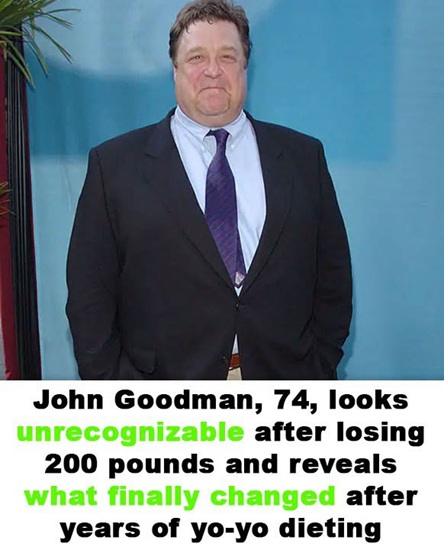
John Goodman has spent decades as one of Hollywood’s most recognizable performers, known for memorable roles in Roseanne, The Big Lebowski, Monsters, Inc., The Conners and The Righteous Gemstones. In August 2026, the 74-year-old actor attracted renewed attention after appearing considerably slimmer in a candid photograph with actor David DeLuise. But Goodman’s transformation is not recent or the result of a sudden diet. He has publicly discussed a health and weight-management journey stretching back many years.
Goodman’s size was once closely associated with his public image, particularly during the height of Roseanne. He has previously said that at his heaviest he was approaching 400 pounds. In older interviews, Goodman described a frustrating cycle in which he could lose substantial amounts of weight before eventually returning to his previous habits and regaining what he had lost. That cycle is an important part of understanding his eventual transformation.
Goodman was not someone who simply discovered a particular diet and immediately lost 200 pounds. Instead, he had already experienced repeated attempts at losing weight. He recalled losing roughly 60 pounds during breaks from Roseanne, only to regain the weight and sometimes more afterward.
Eventually, his approach changed from temporary dieting toward longer-term lifestyle changes. One of the most significant developments occurred in 2007, when Goodman stopped drinking alcohol. His struggles with alcohol had previously affected his life and career, and sobriety became part of the larger transformation he would continue over the following years.
Goodman also worked with health and fitness coach Mackie Shilstone. Instead of focusing exclusively on rapidly reducing the number on a scale, the approach involved changes that could be repeated consistently. Shilstone has emphasized that Goodman’s progress did not happen overnight and described it as an ongoing process requiring planning and commitment.

Food was naturally an important component. Reports about Goodman’s program have described a Mediterranean-style eating plan emphasizing foods such as vegetables, fruit, fish, nuts and olive oil. He also reduced sugar and became more conscious of portion sizes and his previous tendency to continually eat throughout the day.
The Mediterranean-style approach is worth distinguishing from a highly restrictive celebrity crash diet. Goodman has not publicly promoted his transformation as the result of eliminating nearly every food group or following a short-term challenge. His publicly described strategy instead involved improving eating habits while simultaneously increasing physical activity and maintaining sobriety.
Exercise became another major part of his routine. During periods of his transformation, Shilstone said Goodman exercised regularly and aimed for roughly 10,000 to 12,000 steps per day. Reports have also described treadmill and elliptical workouts as part of his activity.
Goodman has experimented with other forms of exercise as well. In later years, he discussed activities such as walking his dogs and boxing. His relationship with exercise has not always been perfectly consistent—something he has acknowledged rather than presenting himself as following an effortless routine every single day.
That honesty is important because maintaining a major lifestyle change over many years rarely happens in a perfectly straight line. Goodman has spoken about setbacks, including periods when his exercise habits became less consistent. His story is therefore better understood as a long-term process than as a dramatic before-and-after transformation with a single starting and ending point.
By 2023, Goodman said he had lost approximately 200 pounds. The number attracted headlines because of its scale, but it represented years of change rather than an unusually rapid drop. At his previously reported weight of nearly 400 pounds, that meant Goodman had lost a very substantial portion of his former body weight.
His appearance continued drawing attention afterward. At the July 2025 Los Angeles premiere of Smurfs, Goodman appeared on the red carpet displaying the transformation he had maintained. Reports again noted that his overall weight loss had reached approximately 200 pounds.
Then, in August 2026, a casual photograph brought another wave of attention. David DeLuise encountered Goodman at a supermarket and shared a photograph of the two actors together. Some fans said they initially struggled to recognize the dramatically slimmer Goodman, while others pointed out that his weight loss had actually been visible publicly for years.
The photograph therefore did not reveal a sudden new transformation.
It showed the result of a transformation Goodman has largely maintained.
That distinction matters because headlines describing celebrities as suddenly “unrecognizable” can create the impression that an extreme change happened recently. In Goodman’s case, the major weight loss developed gradually over a long period.
His motivation has also been more personal than professional. Goodman previously described becoming unhappy with the way he was living and uncomfortable with his reflection. He has spoken about reaching a point where continuing the same patterns felt increasingly dangerous as he became older.
Energy became another consideration.
Acting can involve long days, repeated takes, travel and physically demanding schedules. Goodman has said that remaining active helped provide energy for his work and that reaching an older age made inactivity increasingly difficult to accept.
His simplest explanation may also be the most revealing.
Goodman said he wanted to “live life better.”
That statement places the transformation in a healthier context than simply celebrating thinness. Goodman has not suggested that losing weight made him more talented or more worthy of respect. His performances had already earned him acclaim long before the transformation.
Indeed, his body size had become intertwined with some of his most recognizable characters.
As Dan Conner on Roseanne, Goodman became one of television’s best-known fathers. The character’s physical presence was part of the visual identity audiences associated with the series, but Goodman’s performance depended on considerably more than appearance.
His portrayal of Walter Sobchak in the Coen brothers’ The Big Lebowski provided another unforgettable role. Loud, intense and endlessly quotable, Walter became one of Goodman’s defining film performances.
Younger audiences may know his voice just as readily as his face.
Goodman voiced James P. “Sulley” Sullivan in Pixar’s Monsters, Inc., turning the enormous blue monster into one of the studio’s most recognizable characters.
More recently, he continued appearing as Dan Conner in The Conners and played Eli Gemstone in HBO’s The Righteous Gemstones. His evolving appearance was therefore visible on television long before the latest photograph generated headlines.
There is another important point when discussing celebrity weight loss: Goodman’s experience should not be turned into universal medical advice.
What worked for one person may not be appropriate for someone else.
Body weight is influenced by numerous factors, and people considering major weight changes—particularly those with medical conditions—can benefit from individualized guidance from qualified healthcare professionals.
There has also been considerable public speculation in recent years about whether celebrities who lose substantial weight have used GLP-1 medications. Goodman has not publicly confirmed using drugs such as Ozempic, Wegovy or similar medications as the explanation for his transformation. Attributing his weight loss to such treatment without evidence would therefore be speculation.
The methods Goodman has publicly discussed include sobriety, dietary changes, portion awareness, increased physical activity and working with a professional coach.
His transformation also predates the current explosion in public awareness surrounding modern weight-loss medications.
The long timeline is perhaps the most important element of the story.
Goodman began making significant changes many years ago.
He lost weight.
He worked to maintain it.
He experienced periods when maintaining his exercise habits became more difficult.
Then he returned to those habits rather than treating one setback as the end of the process.
That differs substantially from the familiar cycle he described from earlier in his career, when dramatic short-term losses were followed by returning to old routines.
His experience does not prove that everyone can or should lose 200 pounds through the same approach.
What it demonstrates is considerably narrower and more accurate: Goodman found a combination of lifestyle changes that he has publicly credited with helping him substantially reduce his weight and maintain much of that transformation over an extended period.
At 74, he remains professionally active.
His recent appearance has surprised some fans, but his career remains the more significant story.
Goodman has spent decades moving between sitcoms, independent films, major studio productions, voice acting and dramatic television.
His body has changed dramatically during those years.
His ability to command attention on screen has remained.
That may be why the latest photograph resonated so strongly with longtime viewers. Many people remember Goodman from the earliest years of Roseanne and have effectively watched him age across several decades.
The difference is therefore visually striking.
But the transformation is not a mysterious overnight event.
It represents years of decisions Goodman has discussed openly: stopping alcohol, changing his relationship with food, becoming more physically active and moving away from the cycle of temporary dieting followed by regaining weight.
For Goodman himself, the goal was never simply to become the subject of dramatic comparison photographs.
He wanted a different quality of life.
And after losing around 200 pounds and maintaining his transformation for years, his story is perhaps most accurately understood not as a celebrity “quick fix,” but as a long-running effort to change habits that he knew were no longer working for him.
