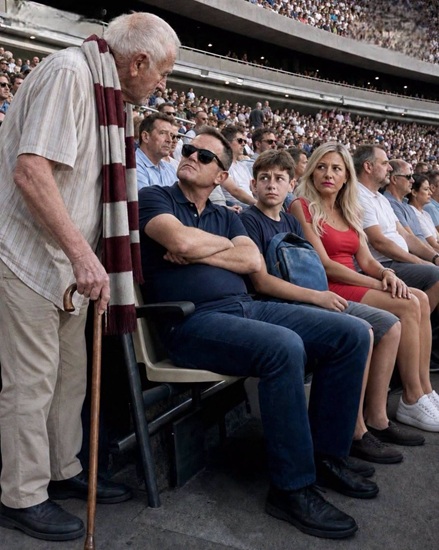
For my ninety-two-year-old grandfather Jeremy, football had never been just a game. Some of my earliest memories involved sitting beside him while he explained players, traditions and rules I was still too young to understand. Even after my grandmother June died twelve years earlier, he continued wearing the faded blue scarf she had once bought him. Every match carried a little piece of their life together, and he never watched an important game without keeping an old photograph of June nearby.
As Grandpa became older, leaving home became increasingly difficult. His movements were slower, his cane was always within reach, and long outings required careful planning. When we began talking about the biggest match of the season, however, his face immediately changed. He had dreamed for years of seeing the stadium filled for an important game one more time. I decided we were going. I saved enough money to purchase two premium accessible seats where Grandpa could sit comfortably without struggling with stairs.
When I showed him the confirmation, he stared at the screen for several seconds before tears appeared in his eyes. “You didn’t have to do this,” he whispered. “I wanted to.” On match day, Grandpa wore his blue scarf and tucked June’s photograph carefully into his wallet. The stadium was already alive when we arrived. Supporters filled the walkways, music echoed through the stands, and scarves waved everywhere. When we finally reached our section, Grandpa stood near the railing and looked across the field.
Then he removed June’s photograph.
“We finally made it,” he whispered.
I pretended not to notice the tears in his eyes.
For several minutes, everything was perfect.
Then another family approached.
A sharply dressed man looked at our seats and insisted that his family should be sitting there. I showed him our tickets, which clearly listed the accessible places I had purchased.
Instead of apologizing, he became argumentative.
He claimed there had been some misunderstanding and suggested that Grandpa could simply move elsewhere.
I explained that these particular seats mattered because of my grandfather’s mobility.
The man’s response stunned me.
He looked at Grandpa and made a dismissive remark suggesting that someone his age probably wouldn’t remember the match for long anyway.
Grandpa heard every word.
His smile disappeared.
I immediately began arguing, but Grandpa gently touched my arm.
“Don’t ruin your day fighting,” he whispered.
Then he slowly reached for his cane.
That hurt more than the stranger’s words.
Grandpa had waited years for this moment, yet he was prepared to walk away simply because he did not want me involved in a confrontation.
We had barely turned toward the aisle when someone spoke behind us.
“Dad, stop.”
It was the man’s teenage son.
In this fictional story, his name was Brandon.
The boy looked embarrassed by what had happened. His father told him to stay out of the disagreement, but Brandon ignored him.
Instead, he opened his backpack.
Inside was an old captain’s armband.
Brandon explained that it had belonged to his grandfather, a passionate supporter who had taught him that being a fan meant respecting the people sitting beside you.
He held the armband for several seconds.
Then he looked directly at his father.
“Grandpa would hate what you’re doing.”
The man’s expression changed.
Brandon walked toward Jeremy.
“My grandfather told me this was supposed to go to someone who understood what leadership meant,” he said. “Right now, I don’t think Dad should have it.”
He offered the armband to Grandpa.
Grandpa looked completely overwhelmed.
“No, son,” he said softly. “That belongs to your family.”
Brandon shook his head.
“So did the lesson.”
People nearby had begun noticing the disagreement.
A stadium steward soon arrived and asked to see everyone’s tickets.
Once the tickets were checked, the situation became straightforward.
The seats belonged to us.
There was no need for a shouting match or public revenge.
The steward simply enforced the seating assignments and helped Grandpa return safely to his place.
Several nearby supporters offered to help as well.
One handed Grandpa a pair of binoculars.
Another offered him a match program.
A woman sitting nearby moved slightly so he had more room for his cane.
Within minutes, the unpleasant encounter had transformed into something completely different.
Brandon remained nearby.
His father was visibly embarrassed.
During halftime, the man eventually approached Grandpa.
His voice was considerably quieter.
He apologized.
Grandpa listened.
Then the man asked Brandon whether he could have his grandfather’s armband back.
Brandon hesitated.
“You can have it back when you remember what he taught you.”
His father did not argue.
Grandpa smiled slightly.
“That sounds fair.”
The second half became one of those matches supporters remember for years.
The score remained close until the final minutes.
Then our team scored.
Grandpa forgot his cane for several seconds and tried to stand with everyone else.
I caught his arm while he laughed.
Around us, thousands of supporters were shouting.
Grandpa raised June’s photograph toward the field.
“You saw that one,” he whispered.
I knew he wasn’t talking to me.
After the final whistle, supporters slowly began moving toward the exits.
Brandon came over to say goodbye.
Grandpa still had the old captain’s armband.
He looked at it carefully before placing it around Brandon’s arm.
“You were wrong about one thing,” Grandpa said.
Brandon looked confused.
“This doesn’t belong to me.”
Grandpa adjusted the strap.
“It belongs to someone who understands what it’s supposed to mean.”
Brandon looked toward his father.
The man lowered his head.
Grandpa continued.
“Leadership isn’t getting the best seat in the stadium. Sometimes it’s making sure someone else isn’t pushed out of theirs.”
Brandon smiled.
Before leaving, his father approached us again.
This time, he offered his hand.
Grandpa accepted it.
There was no dramatic punishment.
No cheering crowd demanded that the man be humiliated.
He had behaved badly, his son had challenged him, and he had been given an opportunity to recognize it.
Sometimes that is a better ending.
As we walked toward the exit, Grandpa noticed an empty paper cup beside the aisle.
He stopped.
Slowly, despite my protests, he bent enough to pick it up and place it in a nearby bin.
“Grandpa, you’re ninety-two,” I laughed. “Someone else can clean that.”
He looked at me as though I had completely missed the point.
“You leave your place better than you found it.”
On the journey home, Grandpa kept talking about the winning goal.
He remembered the noise.
He remembered Brandon.
He remembered the armband.
And he remembered exactly what the stranger had said about him.
The irony made him laugh.
Perhaps one day his memory really would fade.
None of us knows what age will eventually take from us.
But that possibility does not make an experience less valuable today.
Grandpa had spent decades loving the game.
That afternoon, he finally attended the match he had dreamed about.
And what he remembered most wasn’t the expensive seat or even the winning goal.
It was a teenager who saw an adult behaving badly and decided that respect mattered more than staying silent.
As Grandpa told me before falling asleep that evening:
“A good seat gives you a better view of the game. Good character gives you a better view of everything else.”
