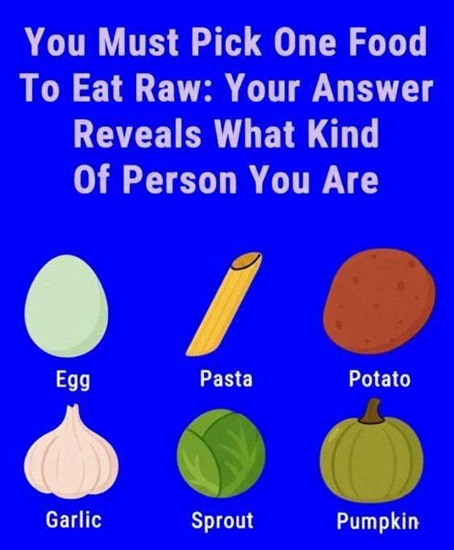
Imagine being given six foods and told that you must choose one to eat exactly as it is. No boiling, baking, frying, roasting, or asking someone else to prepare it for you. The choices are an egg, pasta, a potato, garlic, sprouts, and pumpkin. At first, the question sounds like nothing more than a strange social-media puzzle. But once people begin comparing the choices, the challenge becomes surprisingly complicated. Each option raises a different question involving taste, texture, practicality, and food safety.
The first reaction is often laughter because the choices appear intentionally awkward. Most people are accustomed to seeing eggs cooked, pasta boiled, potatoes roasted or fried, and pumpkin prepared before eating. Garlic and some types of sprouts are more commonly consumed raw, although that does not automatically make them risk-free. The challenge therefore forces people to consider not only what they can physically eat but what they would actually be willing to consume. That distinction is what makes the discussion interesting.
It is important, however, not to treat this as a real-world eating recommendation. Several foods in the challenge can carry safety concerns when eaten raw or improperly handled. Fresh shell eggs can contain Salmonella, which is why the FDA and USDA recommend proper handling and cooking. Raw or lightly cooked sprouts also have a documented history of foodborne-illness outbreaks, and federal guidance warns that the warm, humid conditions used to grow sprouts can also allow harmful bacteria to multiply.
That immediately changes the way the puzzle should be understood. The most familiar-looking raw option is not necessarily the safest one. Likewise, the food that seems easiest to swallow is not necessarily the smartest choice. The challenge works best as a hypothetical conversation rather than a test people should physically attempt. It can reveal how different people reason about uncomfortable options without requiring anyone to take unnecessary food-safety risks.

Consider the egg first. A raw egg may seem attractive because it can be consumed quickly compared with chewing a raw potato or hard pasta. Someone focused almost entirely on speed might therefore choose it immediately. But raw eggs can contain Salmonella, even when the shell appears clean and unbroken. The USDA specifically advises against eating raw or undercooked shell eggs because of that possibility.
That makes the egg an interesting example of how convenience and safety can point in different directions. The physical task might be completed quickly, but the potential health concern gives cautious participants a strong reason to reject it. Someone who refuses the egg is not necessarily timid. They may simply be prioritizing a documented food-safety risk over convenience.
Choosing the egg therefore cannot reliably reveal a permanent personality trait. At most, it shows what factor dominates that particular decision. One person may think, “I want this over as quickly as possible.” Another may immediately think, “Raw eggs can contain harmful bacteria.” Their different answers reflect different priorities in that moment, not a scientific measurement of bravery or intelligence.
Sprouts initially appear to be the obvious loophole. People regularly encounter raw sprouts in salads, sandwiches, and other foods, so they may seem like the most normal choice. Compared with uncooked pasta or a raw shell egg, they also require very little physical preparation. That can make them feel like the practical answer.
Food-safety guidance complicates that assumption. The FDA has repeatedly expressed concern about illnesses associated with raw and lightly cooked sprouts. The sprouting process requires warm and humid conditions, which can also allow bacteria such as Salmonella, E. coli, and Listeria to grow if contamination is present.
The CDC similarly advises that cooking sprouts thoroughly reduces the risk of illness. It specifically notes that older adults, pregnant people, young children, and people with weakened immune systems are at greater risk from raw sprouts. FDA consumer guidance likewise advises people at higher risk of serious foodborne illness to avoid raw or lightly cooked sprouts.
That means calling sprouts “the safest answer” would be inaccurate. They may be one of the easiest foods in the list to eat without cooking, but ease and microbiological safety are different questions. This distinction is a useful reminder that familiarity can influence risk perception. Something commonly served raw may still require proper handling and may not be appropriate for everyone.
Garlic produces a very different reaction. Raw garlic is commonly consumed in small amounts, whether chopped into dressings, sauces, or other dishes. The problem in this challenge is not necessarily whether a person recognizes garlic as food. It is whether they want to consume enough raw garlic to satisfy an unspecified requirement.
Raw garlic has an extremely strong flavor and aroma. Someone might confidently choose a single clove and then discover that the intensity is much greater than expected. The sharp sensation and lingering taste can make the experience unpleasant even though garlic is familiar in cooking.
A person choosing garlic might therefore be reasoning that a strong but familiar flavor is preferable to a raw egg or a hard piece of pasta. They may believe they can tolerate temporary discomfort if the food itself feels recognizable. That is a legitimate strategy within the hypothetical puzzle.
But the choice still does not provide a psychological diagnosis. It would be playful to say that the garlic chooser is “bold,” “determined,” or willing to accept an intense short-term challenge. Those descriptions should remain entertainment rather than claims about the person’s actual character.
Pumpkin presents another type of problem. Pumpkin flesh can be used in raw preparations, but most people are much more familiar with it after cooking. Raw pumpkin has a firmer texture than cooked pumpkin and would require substantially more chewing depending on the piece selected.
The wording of the challenge also becomes important here. Does “choose pumpkin” mean eating one small piece of pumpkin, or an entire pumpkin? Does the food have to remain completely untouched, including skin and seeds? Most viral puzzles never define those details.
That ambiguity changes the answer dramatically. A small properly cleaned piece of raw pumpkin is a very different challenge from being handed a whole pumpkin and told to finish it. The same problem applies to garlic, potatoes, and sprouts. Without defining quantity, the challenge is more about imaginative reasoning than an objective contest.
Someone selecting pumpkin might be thinking strategically. They may prefer a firm vegetable they can chew slowly rather than something with an intense flavor or obvious contamination concern. That approach emphasizes patience over speed.
The potato also looks ordinary enough to feel reassuring. Potatoes are among the most familiar staple foods in many kitchens, and their solid appearance can make them seem predictable. Yet most people normally cook potatoes before eating them because cooking improves their texture and flavor substantially.
A raw potato is firm, starchy, and considerably less pleasant to chew than a cooked one. Consuming a large amount raw would therefore turn the challenge into an endurance exercise rather than a normal eating experience. Someone who chooses it may simply be thinking that a recognizable vegetable feels more manageable than an unfamiliar risk.
Potatoes also illustrate why appearance alone is not enough to judge food suitability. Green or sprouting potatoes can contain elevated levels of naturally occurring glycoalkaloids and should not simply be treated as equivalent to a normal, sound potato. For a hypothetical puzzle intended to avoid misinformation, it is better not to frame raw potatoes as universally harmless.
The person choosing a potato may still have a clear strategy. They know exactly what the food is. They can see its condition. They can chew gradually. The unpleasant texture may seem more controllable than the uncertainty of swallowing an uncooked egg.
Dry pasta creates one of the strangest choices. Most packaged pasta is designed to be cooked in water before eating. In its dry form, it is hard and brittle. Large pieces can be difficult to chew comfortably.
Someone choosing dry pasta may be relying on familiarity. Pasta feels safe psychologically because it is an ordinary pantry product. The brain may focus on the fact that it is a common food while paying less attention to the fact that it is normally consumed only after cooking.
Texture becomes the biggest immediate challenge. Biting very hard dry foods can be uncomfortable, particularly for someone with sensitive or damaged teeth. Large hard pieces may also be more difficult to chew safely than softer foods.
That means a person who chooses pasta is not necessarily making a more rational or irrational choice than everyone else. They may simply be prioritizing something different: familiarity. Their reasoning might be, “I know exactly what pasta is, so I would rather deal with the texture than worry about a raw animal product.”
This is one of the most interesting features of the puzzle. Different people define “risk” differently. For one person, risk means foodborne illness. For another, it means choking or dental discomfort. For someone else, the strongest concern is simply whether the flavor will be unbearable.
The six choices therefore create several competing categories. The egg is quick but raises an established raw-egg safety concern. Sprouts are routinely eaten raw by many people but also have a documented history of bacterial outbreaks. Garlic is familiar raw but intensely flavored. Pumpkin and potato are solid and recognizable but much more commonly cooked. Dry pasta is familiar but physically hard.
Once those differences become clear, there is no perfect universal answer. Personal circumstances also matter. Age, pregnancy, immune status, dental condition, allergies, digestive issues, and the exact condition of the food could all change what is appropriate for a real person. That is another reason the puzzle should remain hypothetical.
The FDA specifically warns that certain groups face greater risk from foodborne illness. These include people whose health or life stage makes severe illness more likely. A playful question should therefore never be converted into advice telling everyone that a particular raw food is universally safe.
The thought experiment becomes more interesting when safety is separated from personality. Instead of asking, “What does your choice prove about you?” ask, “Why did that concern become your priority?” The second question invites reasoning without pretending to perform psychology.
Someone may choose sprouts because they have eaten them raw many times before. Their reasoning is based on experience and familiarity. After learning about the food-safety concerns associated with sprouts, they might change their answer.
Another person may choose garlic because it avoids the specific risks they associate with raw eggs. They may acknowledge the powerful flavor but view discomfort as temporary and predictable.
Someone else may pick pumpkin because they prefer a food they can approach slowly. Their decision reflects a desire for control rather than speed.
A dry-pasta chooser may decide that difficulty chewing is preferable to something wet, strong-smelling, or biologically risky. Their reasoning centers on emotional comfort with a familiar pantry item.
A person selecting the potato might make a similar argument. They may consider it unpleasant but straightforward. The challenge becomes a matter of persistence.
And the egg chooser may argue that speed matters most. They may accept a risk others reject because they imagine completing the task in seconds.
These different strategies make the conversation entertaining because people rarely agree on which disadvantage matters most. One participant might be shocked that anyone would consider a raw egg. Another might be equally surprised that someone would choose to chew hard pasta.
Neither disagreement needs a winner.
The discussion itself is the purpose.
That is also why strict personality labels should be avoided. There is no validated psychological evidence showing that selecting garlic rather than pumpkin demonstrates leadership, loyalty, confidence, emotional intelligence, or any other stable personality characteristic.
At most, playful interpretations can be clearly labeled as entertainment.
For example, one might jokingly describe the sprout chooser as someone who looks for the obvious loophole. The garlic chooser could be described as willing to accept a strong immediate consequence. The pumpkin chooser may seem patient.
The pasta chooser might appear drawn toward familiar options. The potato chooser could be framed as someone willing to grind through an uncomfortable task. The egg chooser might be described as favoring speed.
These can be amusing conversation starters.
They should not be treated as facts.
Someone choosing the egg today might choose sprouts tomorrow after thinking for another minute. A change that easy clearly cannot reveal a fixed personality structure.
The puzzle also demonstrates how framing changes decisions. If people are told they have only three seconds to choose, they are more likely to rely on instinct. Give them several minutes and they begin analyzing safety, portion size, and loopholes.
Add the phrase “you must eat the entire item,” and answers change again.
Specify that the sprouts are commercially packaged and refrigerated, and some people may reconsider them.
Say that the egg is pasteurized, and the discussion changes once more because pasteurization alters the food-safety question.
This shows why incomplete information influences judgment. People fill in missing details automatically. One participant imagines a single garlic clove. Another imagines an entire bulb.
One person pictures a spoonful of sprouts.
Another imagines a large container.
Someone imagines a small piece of pumpkin.
Another imagines carrying a whole pumpkin to the table.
Those people are technically answering different questions.
A well-designed version of the puzzle would therefore specify portion size and condition. It would also make clear that the challenge is hypothetical and not intended as a real eating contest.
That framing removes unnecessary risk while preserving the discussion.
It also prevents participants from believing that the food selected by the most people must automatically be medically safest.
Popularity and safety are not the same thing.
Raw sprouts are a useful example. Because people frequently encounter them in restaurants and supermarkets, they may assume they are risk-free. Yet federal agencies have repeatedly documented foodborne-illness concerns associated with them.
Raw eggs provide the opposite example. Many people already associate them with Salmonella, and that concern is supported by official food-safety guidance.
The lesson is not that people should be afraid of food.
It is that preparation and handling matter.
Cooking is one of the methods used to reduce risks from certain foods. When a challenge deliberately removes cooking, it also removes an important safety step for some options.
That makes the imaginary rule more consequential than it first appears.
Food-safety decisions should normally follow established preparation guidance rather than social-media challenges.
If someone actually wants to eat dishes containing egg that will not be cooked, USDA guidance notes that pasteurized egg products can be used for preparations traditionally containing raw egg.
Likewise, people at higher risk of foodborne illness are specifically advised to avoid raw or lightly cooked sprouts.
Those real-world recommendations are far more useful than trying to identify a single “winner” in the six-food puzzle.
The challenge remains valuable as entertainment because it creates conversation without requiring a definitive answer.
It asks people to explain priorities.
Do you choose the quickest option?
The one you have eaten raw before?
The food with the mildest expected flavor?
The item that feels easiest to control?
The one that looks most familiar?
Those questions reveal reasoning in a very limited situation.
They do not reveal destiny.
They do not predict relationships.
They do not diagnose courage.
They do not determine intelligence.
They simply expose how people approach one unusual hypothetical decision.
That modest interpretation is also more interesting because it encourages conversation rather than judgment.
Friends can compare answers and discover that they interpreted the rules differently.
One person may immediately identify a loophole.
Another focuses on health.
Another thinks about texture.
Another thinks about finishing as quickly as possible.
The discussion becomes a miniature exercise in decision-making.
It also illustrates how risk perception works in everyday thinking.
People often give greater weight to risks that are vivid or familiar.
Someone who has heard many warnings about raw eggs may reject them instantly.
A person who has never heard about sprout-related outbreaks may assume sprouts are automatically the safest choice.
Once new information appears, their ranking may change.
That is not inconsistency.
It is rational updating.
Good judgment allows an answer to change when better information becomes available.
The same principle is useful beyond puzzles.
Confidence should not prevent reconsideration when relevant facts appear.
In this challenge, someone might begin with sprouts because they are commonly eaten raw. After learning that raw sprouts have repeatedly been associated with foodborne illness, they may reconsider.
Someone else might initially choose the egg for speed and then reject it after considering Salmonella.
The thought experiment becomes more meaningful when participants are allowed to revise their reasoning.
That also removes the pressure to produce a dramatic answer.
There is no prize for selecting the most unpleasant option.
There is no evidence that choosing garlic makes someone tougher.
There is no evidence that choosing pumpkin makes someone more patient in every aspect of life.
A choice can be interesting without carrying a hidden psychological message.
That is an important distinction because viral quizzes frequently make enormous claims from tiny decisions.
“Choose one food and discover your true personality” may attract clicks.
It is not a scientifically reliable way to assess personality.
Validated personality assessment requires much more information and carefully developed methods.
This six-food question is better described as a conversation game.
It gives participants a strange set of constraints and asks them to reason through them.
The fun lies in explaining the choice.
One person might say, “I picked garlic because I would rather tolerate a strong taste than risk a raw egg.”
Another might answer, “I chose pumpkin because I can eat it slowly.”
A third may say, “I thought sprouts were obvious because I have eaten them raw before.”
Then someone can point out that sprouts still require food-safety consideration.
That exchange creates learning without turning the puzzle into medical advice.
The challenge can also lead to a discussion about how foods change through preparation.
Cooking does more than improve flavor.
It can soften textures.
It can make some foods easier to chew.
In certain cases, appropriate cooking also reduces microbial risks.
Removing cooking from the puzzle therefore changes each option differently.
Dry pasta loses the preparation that normally makes it soft.
Potatoes lose the preparation that transforms their texture.
Pumpkin remains much firmer.
Eggs lose an important food-safety control.
Sprouts retain a risk that thorough cooking can reduce.
Garlic remains closer to a form in which many people already consume it.
That does not make garlic the official answer.
It merely demonstrates why the options cannot be compared using one simple rule.
Flavor matters.
Texture matters.
Microbial safety matters.
Portion size matters.
Personal health matters.
Even the condition of the individual item matters.
The most responsible conclusion is therefore that this challenge has no universal medically endorsed winner.
It should stay hypothetical.
If played socially, participants can explain what they would choose without actually consuming an unsafe or uncomfortable raw food.
That keeps the entertaining part while removing the unnecessary risk.
The question remains surprisingly effective.
Put six ordinary foods in front of people and remove the ability to cook them, and those foods suddenly seem much less ordinary.
An egg becomes a food-safety calculation.
Sprouts become a reminder that foods commonly eaten raw are not automatically risk-free.
Garlic becomes a test of tolerance for intense flavor.
Pumpkin becomes a problem of texture and patience.
Dry pasta becomes a chewing challenge.
A potato becomes an exercise in dealing with something familiar in an unfamiliar form.
Everyone sees the same six options.
Yet everyone may prioritize something different.
That difference is what makes the puzzle worth discussing.
Not because the answer reveals a hidden personality.
Not because one food proves courage.
And certainly not because people should attempt the challenge physically.
It is memorable because it turns an ordinary decision—choosing food—into a small problem involving uncertainty.
The best answer may therefore be less interesting than the reasoning behind it.
Ask someone what they would choose.
Then ask why.
Their explanation may reveal whether they first considered safety, speed, familiarity, texture, or taste.
That is enough for a good conversation.
There is no need to claim anything more.
And when real eating replaces hypothetical discussion, ordinary food-safety guidance should take priority over the rules of a viral challenge.
