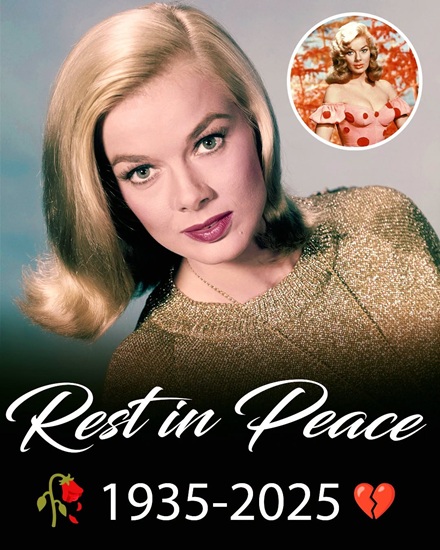
Leslie Parrish, the actress remembered for appearances in some of the most recognizable films and television series of the 1950s, 1960s and 1970s, died at the age of 90 in Washington state. Her death occurred in late 2025, but the news did not become widely public until August 2026, when Erica Berdan, a daughter of Parrish’s second husband, author Richard Bach, confirmed it to The Hollywood Reporter. Parrish had lived largely outside the Hollywood spotlight for many years by then, making the delayed announcement consistent with the private life she embraced after leaving acting.
Her career nevertheless remained familiar to generations through films including Li’l Abner and The Manchurian Candidate and television appearances on Batman, Star Trek, Perry Mason, and numerous other programs. Her story also extended well beyond entertainment into antiwar activism, civic involvement, and land conservation. Parrish was born Marjorie Hellen on March 18, 1935, in Melrose, Massachusetts. Her early childhood was very different from the glamorous Hollywood existence she would later experience.
She eventually spent important formative years in Upper Black Eddy, Pennsylvania, in rural Bucks County. Parrish later recalled that the mountainous geography around the community contributed to an unusually isolated upbringing compared with children growing up closer to major cities. Philadelphia was not especially far away geographically, yet modern entertainment and communication did not always feel close at hand. Those circumstances helped make music one of the most important interests of her youth.
Before acting became part of her future, Parrish seriously considered becoming a concert pianist. She demonstrated enough ability as a young musician to study piano and composition and became associated with the Philadelphia Conservatory of Music during her teenage years. Music required not only talent but money, however, and formal training could be difficult to sustain. Parrish worked while young and tried to support her education, but financial limitations eventually interrupted those ambitions. Even after professional piano study became more difficult to continue, music remained part of her life, and accounts of her early years describe her giving piano lessons as well.

Her route from music to modeling was not something that appears to have been carefully planned from childhood. Friends and people who encountered her while she was working encouraged Parrish to consider modeling. She eventually traveled to New York and began finding work in that field. The move proved consequential because modeling exposed her to people working in the entertainment industry at a time when major studios still operated extensive talent systems. A young woman who had originally envisioned a future centered on piano suddenly found herself entering a completely different profession.
Parrish was discovered and entered the Hollywood studio system during the 1950s. She began appearing in motion pictures in 1955 and accumulated several credits that year alone. Early work included appearances in A Man Called Peter and the Fred Astaire and Leslie Caron musical Daddy Long Legs. These were not yet the defining roles that would make her widely remembered decades later, but they placed her inside major productions at a time when the American film industry was undergoing significant change. Television was becoming increasingly important, and actors who could move between movies and the rapidly expanding television industry had growing opportunities.
She initially worked professionally under her birth name, Marjorie Hellen, before eventually becoming known as Leslie Parrish. The name change occurred during the period when studios and performers frequently adopted screen names designed to be memorable to audiences. By 1959, Leslie Parrish had become the professional identity under which she would be known for the remainder of her career. The new name coincided with one of the roles that helped broaden her recognition beyond smaller screen appearances.

That role was Daisy Mae in the 1959 musical comedy Li’l Abner, adapted from Al Capp’s long-running comic strip and the Broadway musical inspired by it. Parrish’s performance placed her in one of the most visible roles of her early film career. The character of Daisy Mae was already familiar to audiences, and appearing in a major studio musical gave Parrish an opportunity to demonstrate a different type of screen presence from some of her earlier work. The film became one of the titles most frequently mentioned in later retrospectives about her career.
Parrish continued moving between movies and television throughout the 1960s. Her film credits eventually included Portrait of a Mobster, For Love or Money, Sex and the Single Girl, Three on a Couch, and other productions. Her work placed her alongside major performers from the period and allowed her to appear in comedy, drama, thriller, science-fiction and crime projects. That flexibility became especially important as television increasingly dominated popular entertainment.
Among all her movie roles, one of the most enduring was Jocelyn Jordan in John Frankenheimer’s 1962 political thriller The Manchurian Candidate. Parrish played the daughter of a powerful political figure and the fiancée of Raymond Shaw, portrayed by Laurence Harvey. The movie starred Frank Sinatra, Laurence Harvey, Janet Leigh and Angela Lansbury and became one of the most discussed political thrillers of its era. Parrish’s character was closely connected to the personal and political tragedy driving the film’s later scenes.

The Manchurian Candidate developed a reputation far beyond its original theatrical release. Its combination of Cold War anxiety, political manipulation, assassination, and psychological conditioning helped establish it as a distinctive American thriller. Later generations continued discovering the film through television, home video and retrospectives, which meant Parrish’s role remained visible long after she retired from acting. For many movie enthusiasts, Jocelyn Jordan became one of the roles most strongly associated with Parrish’s name.
Her television career was even broader. During an era when network television produced a huge number of westerns, crime programs, dramas, comedies and adventure shows, Parrish became one of those performers whose face could appear across many different series. Her credits included Perry Mason, Bat Masterson, The Man From U.N.C.L.E., The Wild Wild West, Adam-12, McCloud, Police Story, Logan’s Run and many others. The diversity of those programs shows how frequently working actors of the period moved from one genre to another.
Parrish’s connection with Batman became particularly memorable because of the series’ continuing popularity. The colorful Adam West version of Batman became a major television phenomenon during the 1960s and later developed a strong nostalgic following. Parrish appeared as Glacia Glaze, associated with the villain Mr. Freeze, becoming part of the show’s enormous collection of distinctive guest characters. The exaggerated visual world of Batman was very different from the political seriousness of The Manchurian Candidate, which further illustrates the range of projects Parrish accepted.
Another important television appearance came in the original Star Trek. Parrish played Lieutenant Carolyn Palamas in the second-season episode “Who Mourns for Adonais?”, first broadcast on September 22, 1967. Palamas was part of the USS Enterprise crew and joined the landing party that encountered a powerful being claiming to be Apollo, the figure worshipped as a god in ancient Greek tradition. Parrish’s character became central to the story because Apollo developed a fascination with her and attempted to persuade her to remain with him.
The episode has remained memorable among Star Trek audiences because of its blending of classical mythology and science fiction. Captain Kirk and his crew discover that the being calling himself Apollo represents a technologically or biologically advanced race that may have inspired humanity’s ancient Greek myths. Palamas, whose professional knowledge includes ancient cultures, becomes especially important in communicating with him. Parrish’s performance therefore occupied more than a decorative guest role within the episode’s narrative.
The episode is sometimes incorrectly identified in later online retellings as “The Apple.” That is not accurate. “Who Mourns for Adonais?” was the second episode of Star Trek‘s second season and featured both Leslie Parrish and Michael Forest as Apollo. Parrish’s costume from the episode became a recognizable piece of Star Trek memorabilia and was later included in collector auctions.
The enduring interest in that single television appearance reflects the extraordinary cultural longevity of the original Star Trek. When Parrish filmed the episode, nobody involved could have known that fans would still be analyzing costumes, characters and individual scenes many decades later. Her performance consequently became part of another legacy that extended well beyond the normal lifespan of a television guest role.
Parrish also maintained professional connections with comedy. She appeared opposite Jerry Lewis in Three on a Couch in 1966. The film was part of Lewis’s prolific period as an actor and filmmaker and offered Parrish another opportunity to work in a genre far removed from thrillers and television westerns. She also appeared in Sex and the Single Girl, a comedy starring Tony Curtis and Natalie Wood.
By the 1970s, Parrish’s screen work continued but gradually became less central to her life. She appeared in the cult science-fiction and horror film The Giant Spider Invasion in 1975, a movie that later developed a reputation among enthusiasts of low-budget genre cinema. Its tone and production style were far removed from studio pictures such as The Manchurian Candidate, again illustrating how varied her filmography became.
Her final acting work came in 1978. One of her last credited performances was in No Margin for Error, a feature-length installment connected with the television series Police Story. She played Georgie Hayes in the production, which aired on April 30, 1978. After that period, Parrish effectively ended the acting career that had begun more than two decades earlier.
Leaving Hollywood did not mean Parrish withdrew from public concerns. Long before her final acting role, she had already become increasingly involved with political activism, especially opposition to the Vietnam War. Her involvement developed during a period when the war had become one of the most divisive issues in American public life. Parrish participated in antiwar organizing and became associated with the Jeannette Rankin Brigade, a women’s antiwar movement named for the first woman elected to the U.S. Congress.
Parrish also founded Speakers and Talent Organized for Peace, commonly referred to as STOP. The organization used public speakers and people from entertainment to communicate opposition to the Vietnam War. Her political work therefore involved more than simply adding her name to a public statement. She helped organize others and devoted substantial personal time to activism while still working as an actress.
Any modern account of that activism benefits from historical context. Parrish’s antiwar work was part of the social and political movements of the 1960s and early 1970s, not commentary on a current political dispute. Her participation reflected her own documented views and activities during that historical period. Describing those activities does not require adopting or promoting her political positions; they are simply part of the factual record of her life.
Her civic activism also extended into Los Angeles politics. Parrish supported Tom Bradley, a Los Angeles city councilman who would eventually become the city’s first Black mayor. Bradley first challenged incumbent Mayor Sam Yorty unsuccessfully in 1969 and ran again four years later. Parrish remained involved in his political efforts through the period leading to his successful 1973 campaign.
After Bradley’s victory, Parrish was appointed to a Blue Ribbon Commission involved in helping select commissioners for Los Angeles municipal departments. The role reflected a level of civic involvement that went beyond celebrity endorsement. It also demonstrated how far her interests had expanded beyond acting by the early 1970s.
Bradley’s election was historically significant. He became Los Angeles’ first Black mayor and would remain in office for twenty years. Parrish’s connection to his campaigns became another example of her decision to use time and visibility outside entertainment for causes she personally considered important. Again, these events belong to the historical record rather than contemporary political advocacy.
As the years passed, environmental conservation became increasingly important to Parrish. Her second marriage was to Richard Bach, the author best known for Jonathan Livingston Seagull. Parrish and Bach became connected not only personally but also through property and conservation efforts in Washington state’s San Juan Islands. Their relationship eventually ended, but the land-preservation work associated with them continued.
On Orcas Island, Parrish became closely associated with Spring Hill Wildlife Sanctuary. The property occupied a large area on Mount Woolard and included forest habitat and scenic hillside. Rather than allowing the entire property to be developed conventionally, Parrish worked with conservation organizations to protect substantial portions of it permanently.
The San Juan Preservation Trust documents conservation easements associated with Spring Hill across several years: 1993, 1994, 1995 and 2003. Those agreements ultimately protected 168 acres of forest and wildlife habitat. The broader Spring Hill property was larger, with the Preservation Trust describing the sanctuary as approximately 230 acres. This distinction matters because some retellings incorrectly imply that the entire sanctuary consisted of exactly 168 acres. The 168-acre figure refers specifically to land protected through conservation easements.
Conservation easements are legal tools designed to protect specific characteristics of land over the long term. Depending on the agreement, they can restrict development, subdivision, logging or other activities while the underlying property remains privately owned. At Spring Hill, the goal was to preserve much of the forested landscape and wildlife habitat while allowing carefully planned homesites outside the protected acreage.
Parrish spoke explicitly about wanting the conservation work to extend far beyond her own lifetime. She connected her environmental philosophy with ideas she had encountered in the writings of physician and humanitarian Albert Schweitzer, particularly the concept of reverence for life. She described trying to think hundreds of years into the future when making decisions about the land.
Her comments about Spring Hill reveal how strongly her priorities had changed after Hollywood. She said that the conservation project was among the things she was most proud of and expected it to outlast her other accomplishments. For someone whose image had appeared in major films and television programs, that statement provides significant insight into how she evaluated her own legacy.
The protected acreage continues to provide forest and wildlife habitat, demonstrating why Parrish considered conservation different from acting. A television episode or film can survive culturally, but a conservation easement can physically shape what happens to land decades or even centuries later. For Parrish, that permanence appears to have been especially meaningful.
Her life therefore followed a trajectory that was far less conventional than a simple Hollywood biography might suggest. She began as a young musician interested in classical piano, became a model, entered the studio system, established herself as an actress, and then gradually redirected much of her energy toward political activism and environmental preservation.
The acting career itself was substantial. IMDb lists 78 acting credits, while her official career listings include appearances across film, scripted television, variety programs and other formats. Numbers alone cannot determine the importance of a career, but they demonstrate that Parrish was not simply someone remembered for one movie. She worked consistently across more than twenty years.
Her career also illustrates the working reality of television during the 1960s. Actors frequently moved from one successful series to another in guest roles rather than remaining identified exclusively with a single program. Parrish might appear in a western one year, a legal drama another, a science-fiction series later, and a colorful superhero comedy soon afterward.
That flexibility helped make her a recognizable face even to viewers who might not have remembered her name immediately. Fans of Batman knew Glacia Glaze. Star Trek viewers knew Carolyn Palamas. Movie audiences remembered Jocelyn Jordan or Daisy Mae. These characters came from very different genres, but Parrish connected them through a single career.
Her work also crossed one of the most consequential transitions in entertainment history. She began when Hollywood studios still exercised enormous control over actor development and feature-film production. By the end of her acting career in 1978, television had become a dominant medium and the old studio system had largely disappeared.
Parrish lived long enough to see all of those performances survive through formats nobody could have predicted when they were made. Television reruns, cable channels, VHS, DVD, streaming, online clips and fan conventions repeatedly introduced old shows to new viewers. Guest roles that once aired a single evening could become permanently accessible.
That cultural preservation is particularly obvious with Star Trek and Batman. Both programs developed audiences across multiple generations and became enormous franchises. Parrish appeared in those worlds before anyone knew how enduring they would become.
The Manchurian Candidate achieved longevity through a different route. Rather than expanding into a television franchise, it became a frequently analyzed example of Cold War cinema. Its political themes, dreamlike sequences and performances helped ensure that critics and film historians continued discussing it.
Parrish’s Jocelyn exists at the emotional center of some of the movie’s most consequential events. Her role adds humanity to a story otherwise dominated by manipulation, political ambition and psychological control. That is one reason photographs of Parrish from the film continued appearing in retrospectives decades later.
Her early musical ambitions also never completely disappeared from the narrative of her life. The contrast between aspiring concert pianist and Hollywood actress demonstrates how careers can change because of economic circumstances and unexpected opportunities. Parrish did not travel to California with a childhood plan to become known for science fiction or political thrillers. Her professional identity developed gradually.
The same pattern later repeated when activism and conservation replaced acting as dominant priorities. Parrish did not appear to view leaving Hollywood as the end of meaningful work. She redirected her attention toward activities whose consequences she believed could extend beyond entertainment.
Her antiwar organizing provides one example. During the Vietnam era, entertainers who spoke publicly about politics sometimes faced criticism, and the subject was deeply polarizing. Parrish nevertheless participated openly in organized opposition to the war. Historical descriptions of this work should acknowledge both what she did and the contentious environment in which she did it, without turning a biography into present-day political persuasion.
Her work with Tom Bradley similarly belongs within the historical context of Los Angeles politics in the late 1960s and early 1970s. Bradley’s campaigns dealt with issues of race, municipal government, policing and urban political coalitions. Parrish supported him and later served on his commission, but an accurate biography need not tell contemporary readers what political conclusions to draw from that history.
The environmental work is perhaps easier to evaluate through tangible outcomes. The San Juan Preservation Trust’s records show that 168 acres at Spring Hill are protected. That legal protection remains a measurable result independent of anyone’s opinion about Parrish’s acting career or political positions.
Parrish herself believed that the land project might ultimately become the accomplishment that lasted longest. Her prediction has a certain logic. Films and television depend on continued preservation and interest, but protected land remains physically present as forest and habitat.
Her personal life included two marriages. She was first married to songwriter Ric Marlow. She later married Richard Bach, whose literary fame came largely from Jonathan Livingston Seagull. The relationship with Bach eventually ended in divorce, but their shared conservation history remained associated with the Spring Hill property.
Bach’s daughter Erica Berdan ultimately became the person who confirmed Parrish’s death to The Hollywood Reporter. The fact that the confirmation came months after Parrish had died explains why many fans were surprised to see obituaries appearing in August 2026 for a death that occurred in 2025.
Reports specify that Parrish had been living in Washington state and died there late in 2025 at 90. Publicly available reports surrounding the announcement did not widely provide a specific date of death or detailed medical cause. A responsible obituary should therefore avoid inventing either.
This is especially important with delayed death announcements. Online articles sometimes fill gaps with speculation or unintentionally turn broad statements such as “late last year” into precise dates that were never actually reported. In Parrish’s case, the verified information establishes her age, Washington state as the place where she was living, and late 2025 as the period of death.
The public learned about that death only in August 2026. Entertainment outlets then revisited the breadth of her career, emphasizing both famous screen appearances and the activism that occupied so much of her later life. Entertainment Weekly described her as both a prolific screen performer and an antiwar and environmental advocate.
That combination distinguishes Parrish from many celebrity obituaries that focus primarily on performances. With her, the later decades cannot be treated merely as retirement. Her conservation efforts and civic involvement represented deliberate work that she regarded as important.
The Spring Hill project especially provides a link between the public and private phases of her life. Hollywood fame depended on visibility. Land conservation often works quietly through legal agreements, nonprofit organizations and long-term stewardship. Parrish moved from one form of legacy to another.
Her personal philosophy toward the land also suggests that she was thinking in generational rather than immediate terms. She discussed imagining what the property might look like hundreds of years into the future. Such long timelines are unusual in entertainment, where success is often measured by a weekend box office or a season’s ratings.
For Parrish, the shift seems to have been meaningful. Her own description of the conservation effort as something she was most proud of indicates that she did not rank fame automatically above other accomplishments.
Still, Hollywood remains the reason millions of people recognize her today. Film and television preserve faces and performances in a way few professions can. A viewer watching Li’l Abner or The Manchurian Candidate today sees Parrish at the same age she was when the camera captured her decades ago.
That creates a peculiar contrast whenever a performer from classic Hollywood dies. Their real life continued aging, changing and moving away from the original role, while their younger screen image remained permanently available.
Parrish experienced almost half a century of life after her final acting role. Her last credit came in 1978, while her death occurred in 2025. That means the portion of her life spent outside active screen acting was considerably longer than her Hollywood career itself.
Those later decades make it especially misleading to describe her solely as a former actress. She was also an activist, conservationist and participant in civic affairs.
The breadth of that life explains why different audiences may remember entirely different versions of Leslie Parrish.
Fans of classic musicals may immediately think of Daisy Mae.
Political-thriller enthusiasts may remember Jocelyn Jordan.
Batman viewers may recall Glacia Glaze.
Star Trek fans may picture Lieutenant Carolyn Palamas standing opposite Apollo.
Environmental organizations in Washington may instead remember the woman connected with protecting forest on Orcas Island.
All of those identities belong to the same person.
Her death at 90 closes a life that intersected with several major chapters of twentieth-century American culture: the studio era, television’s rapid expansion, Cold War cinema, the Vietnam War protest movement, changing urban politics and the growth of private land conservation.
Not every aspect of Parrish’s life will carry equal importance for every reader. That is natural. A person’s legacy is rarely a single thing.
For viewers, the surviving performances offer direct access to her work.
For historians, her activism adds context to the relationship between Hollywood personalities and political movements of the 1960s.
For conservationists, the protected Spring Hill acreage provides a tangible environmental legacy.
And for people who knew her personally, the public record can capture only part of the woman behind those achievements.
Her story also challenges the idea that leaving a highly visible career means disappearing. Parrish stopped acting at a relatively young age compared with performers who continue into their seventies or eighties. Yet she spent subsequent decades working on issues she considered meaningful.
The decision appears less like retirement from life than a shift in priorities.
Fame gave her a public identity.
Activism gave her another form of involvement.
Conservation gave her a physical legacy tied to land.
Taken together, those chapters create a much fuller picture than any single television episode or movie role.
There is also something fitting about the privacy surrounding the end of her life. After decades outside Hollywood, Parrish’s death was not immediately accompanied by a large public announcement. Months passed before entertainment media learned what had happened.
When that news finally became public in August 2026, the response became an opportunity to reconsider a career that had quietly remained part of popular culture through reruns and classic films.
The obituary headlines naturally mentioned Batman, Star Trek, Li’l Abner and The Manchurian Candidate. Those titles offer recognizable points of entry for readers.
But the more complete story extends well beyond them.
Leslie Parrish entered entertainment after an early life centered on music.
She became a model.
She entered Hollywood.
She appeared in dozens of productions.
She became politically active during one of the most turbulent periods in modern American history.
She participated in Los Angeles civic affairs.
She left acting.
And she devoted substantial energy to conserving forest and wildlife habitat.
The 168 protected acres at Spring Hill may ultimately prove especially important to understanding how she wanted to be remembered. The San Juan Preservation Trust’s account makes clear that the land was protected through multiple conservation agreements over a period of years rather than through one symbolic gesture.
That required planning and a willingness to limit future development of valuable property. Conservation easements are designed specifically to endure beyond changes in ownership, giving Parrish’s project the long-term quality she said she wanted.
The forest therefore represents more than a personal retreat.
It represents a decision about what should remain after the person making that decision is gone.
Parrish once suggested that this work might outlast everything else she had done.
Her passing now gives those words additional weight.
Hollywood audiences will continue to see her in preserved performances.
Star Trek viewers will still encounter Carolyn Palamas.
Film students will continue watching The Manchurian Candidate.
Classic television enthusiasts will still find her in Batman and Perry Mason.
Meanwhile, protected forest on Orcas Island will continue existing outside the world of screens entirely.
That combination is an unusually broad legacy.
Leslie Parrish was 90 when she died in Washington state in late 2025.
The public learned of her death months later, in August 2026.
There was no need to exaggerate the announcement or invent circumstances around it.
Her documented life already contained enough remarkable turns.
She had moved from an isolated childhood and ambitions as a pianist to Hollywood studios and internationally remembered films.
She had then moved from Hollywood toward activism and conservation.
And in her later years, she had largely stepped away from the kind of celebrity attention that first made her famous.
For anyone remembering Leslie Parrish only through one old television episode, revisiting her full life reveals a much larger story.
She was an actress during television’s formative decades.
She was part of films that remained culturally significant.
She used her public visibility in historical political causes.
And she helped permanently protect a substantial area of Washington forest.
Her death represents the loss of another direct connection to mid-century Hollywood, but the record she left behind is not confined to nostalgia.
Her work survives on film.
Her political involvement survives in historical accounts.
And her environmental legacy survives in protected land.
That may be the most accurate way to remember Leslie Parrish: not simply as another familiar face from Hollywood’s past, but as a woman whose interests and priorities continued evolving long after the cameras stopped rolling.
