I can still remember the moment when concern turned into certainty.
And certainty turned into judgment.
At the time, I did not realize how dangerous that transition could be.
It happened during dinner at a small Italian restaurant.
The place was quiet, warm and familiar.
Soft lighting reflected from old wooden tables.
There was the smell of garlic, bread and wine in the air.
Nothing about the evening suggested that I was about to become involved in someone else’s private life.
Then I looked across the room.
And I saw Sarah.
She Was Sitting With Another Man
Sarah lived nearby with her husband, Mark.
I knew them well enough to recognize their routines.
We were not inseparable friends, but they were the kind of neighbors people appreciate.
We exchanged greetings.
We occasionally talked outside.
We knew small things about one another’s lives.
Mark, especially, had always seemed dependable.
He was the kind of person who noticed when someone needed help.
If snow covered the sidewalk, he was often outside clearing it.
If a fence needed repairing, he offered a hand.
If someone in the neighborhood was sick, he checked in.
That was the version of Mark I knew.
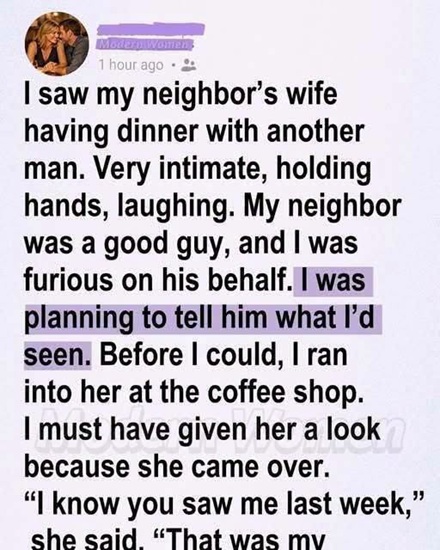
So when I saw Sarah sitting in the corner of the restaurant with another man, my mind immediately began writing the rest of the story.
They Looked Comfortable Together
The man sat close to her.
Their knees were nearly touching beneath the table.
At one point, his hand rested over hers.
Sarah smiled.
Then she leaned toward him while he spoke.
There was nothing loud or theatrical about the scene.
Perhaps that was why it affected me so strongly.
It looked intimate.
Natural.
Familiar.
I remember staring for longer than I should have.
Then a single thought appeared.
How could she do this to Mark?
I Never Asked Whether I Actually Knew What I Was Seeing
That should have been the first question.
Instead, I skipped straight to a conclusion.
The physical closeness became evidence.
The hand on hers became evidence.
The laughter became evidence.
I did not know the man.
I did not know why they were there.
I had no context at all.
But within minutes, I had mentally turned an unexplained dinner into an affair.
And once that story settled into my mind, every detail seemed to confirm it.
Anger Came Faster Than Curiosity
I thought about Mark.
I pictured him at home.
Maybe he believed Sarah was somewhere else.
Maybe he trusted her completely.
Maybe he had no idea.
The more I imagined his position, the angrier I became.
By the time I finished dinner, my reaction no longer felt like speculation.
It felt like moral certainty.
Someone had to tell him.
And I began convincing myself that person should be me.
I Told Myself I Was Protecting Him
That was how I justified it.
I was not gossiping.
I was helping.
At least that was the story I told myself.
Mark deserved the truth.
If I stayed silent, wasn’t I allowing him to be deceived?
The argument felt persuasive.
It also made me feel better about inserting myself into a marriage I knew very little about.
By the time I walked outside, I had already made the decision.
I would tell him.
Just not that night.
For Days, I Rehearsed the Conversation
I imagined knocking on Mark’s door.
I pictured us sitting somewhere private.
I planned the exact tone I would use.
Calm.
Sympathetic.
Reluctant.
I would explain that I had seen something I believed he needed to know.
I would insist I was not trying to hurt him.
I was simply giving him information.
The more I rehearsed it, the more responsible I felt.
That should have worried me.
Instead, it reassured me.
Certainty Can Become Addictive
Once you believe you understand a situation, every new thought begins organizing itself around that belief.
I remembered Sarah’s smile.
I remembered the man’s hand.
I remembered how closely they sat.
Each memory became another brick in the wall I was building.
I never seriously considered that there might be another explanation.
I had seen enough.
Or so I thought.
Then, before I spoke to Mark, I saw Sarah again.
This Time, She Was Alone
It was early morning at a coffee shop.
Rain streaked the windows.
The place was quiet enough that every cup placed on the counter seemed unusually loud.
I was waiting for my order when Sarah walked inside.
At first, I almost looked away.
I suddenly felt uncomfortable standing near someone I had privately judged so harshly.
Then she saw me.
And the expression on her face changed.
Up Close, She Looked Different
At the restaurant, I had noticed only her behavior.
That morning, I noticed her.
She looked thinner than I remembered.
Her skin seemed pale.
There were dark shadows beneath her eyes.
Something about her face looked tired in a way that ordinary lack of sleep did not explain.
For the first time, a small crack appeared in the story I had constructed.
Then Sarah walked toward me.
I had not expected that.
She Knew I Had Seen Her
She did not accuse me.
She did not look angry.
She simply said she knew I had seen her at the restaurant.
My stomach tightened.
Suddenly, every conversation I had rehearsed for Mark became useless.
I opened my mouth.
I was not even sure what I intended to say.
An apology?
A question?
An accusation?
Sarah spoke first.
“That Was My Brother”
For a second, I thought I had misunderstood her.
Her brother.
The man at the restaurant was her brother.
He had traveled from overseas.
The physical closeness I had interpreted as romantic suddenly had another explanation.
The hand over hers.
The quiet conversation.
The familiarity.
Of course they were comfortable together.
They were family.
Embarrassment hit me immediately.
But I had barely begun processing that mistake when Sarah continued.
And the next thing she told me changed everything.
She Said She Was Seriously Ill
Sarah told me she had advanced cancer.
According to her, doctors had given her a very limited prognosis.
The words made the room feel smaller.
Only seconds earlier, I had been ashamed because I had mistaken her brother for a romantic partner.
Now that mistake seemed almost insignificant compared with what she was actually carrying.
She had been living with news that could change her entire family.
And Mark did not know yet.
She Had Not Told Her Husband
That detail was difficult to understand at first.
How could someone keep something so serious from the person closest to them?
But when Sarah explained, it began to make emotional sense.
She was afraid.
Not simply of his reaction.
She was afraid of the moment when their shared future would become something else.
They had plans.
Ordinary plans.
Years they expected to have.
Conversations they assumed they would get to finish.
Telling Mark meant making the future real.
And she was not ready.
Her Brother Already Knew
That was why he had come.
She needed someone she did not have to protect.
Someone who already knew the truth.
Someone she could sit beside without pretending everything was normal.
At the restaurant, what I had interpreted as betrayal was the opposite.
It was refuge.
The man sitting close to Sarah was not helping her deceive her husband.
He was helping his sister survive the emotional weight of knowing something she had not yet found the strength to say aloud at home.
Suddenly, Every Detail Looked Different
His hand over hers was no longer suspicious.
It was comforting.
The laughter no longer seemed secretive.
It felt fragile.
Even the way Sarah had leaned toward him changed meaning.
Nothing about the scene itself had changed.
Only the information surrounding it had.
And that was enough to completely reverse my judgment.
I Had Seen One Moment and Invented Everything Around It
That realization was painful.
I had not lied about what I saw.
Sarah really was sitting close to a man.
He really did place his hand over hers.
She really did smile.
The problem was not the observation.
The problem was what I added to it.
I turned a fact into a conclusion.
Then I turned the conclusion into a moral judgment.
And I almost acted on it.
Sarah Told Me She Kept Trying to Tell Mark
Every morning, she would think that today would be the day.
She would wake up believing she could do it.
Then ordinary life would begin.
Breakfast.
Work.
Small conversations.
Plans for dinner.
Mark might joke about something.
And suddenly she could not bring herself to destroy the normality of the moment.
At night, she would go to bed knowing she had delayed it again.
The next morning, the cycle would repeat.
Fear Does Not Always Look Like Fear
Sometimes it looks like delay.
Sometimes it looks like silence.
Sometimes it looks like going to dinner with your brother because he is the only person around whom you do not have to pretend.
I had looked at one of those moments and called it betrayal.
Sarah was living inside grief.
I had interpreted it as dishonesty.
That difference stayed with me.
I Apologized
There was nothing clever to say.
I told her the truth.
I admitted that I had assumed the worst.
I told her I had even considered speaking to Mark.
The confession made me feel small.
Sarah could have been angry.
She had every reason to be.
Instead, she gave me a tired smile.
That somehow made the shame worse.
Then She Asked Something I Did Not Expect
About a week later, Sarah finally decided she was ready to tell Mark.
But she did not want to do it completely alone.
She asked me to be there.
Not to explain.
Not to defend her.
Not to speak for her.
She only wanted another person in the room in case she lost the courage to finish.
I agreed.
And that evening became one of the hardest experiences I have ever witnessed.
Their Living Room Looked Completely Normal
That was the cruelest part.
Sunlight crossed the floor.
There were ordinary objects exactly where they always were.
Nothing in the room suggested that one sentence was about to divide their lives into a before and an after.
Mark was talking casually.
He complained about work.
He joked about dinner.
I remember thinking how strange it was that a person could be only seconds away from devastating news and have no idea.
Sarah sat quietly.
Then she began.
She Told Him
There was no dramatic speech.
No perfect wording.
She simply found a way to say what she had been unable to say for weeks.
She was sick.
The illness was serious.
Their future might be much shorter than they had believed.
For a moment, Mark seemed unable to understand the words.
Then he did.
I Still Remember His Reaction
He did not respond with a polished sentence.
There was only a sound.
A broken exhale.
Something raw.
Then he moved toward Sarah and held her.
He held her as if physical closeness could somehow change the diagnosis.
I stared at the floor.
And one thought kept repeating in my mind.
I had nearly forced this moment to happen before Sarah was ready.
My “Good Intention” Could Have Caused Real Harm
A week earlier, I believed telling Mark immediately was the morally obvious choice.
Now I understood how little I had known.
Imagine if I had arrived at his door first.
Imagine if I had said I believed Sarah was cheating.
Imagine if Mark had confronted her while she was already struggling with a serious diagnosis.
Imagine adding suspicion and accusation to that moment.
My certainty had come dangerously close to creating pain where there was already more than enough.
Seeing Something Does Not Mean You Understand It
That became the lesson I could not escape.
People often say they trust their own eyes.
But eyes provide fragments.
Context creates meaning.
A hand held across a table can mean romance.
It can also mean comfort.
A secret meeting can mean betrayal.
It can also mean a frightened woman talking to her brother.
Two people sitting closely together tells you almost nothing about why they are there.
I learned that too late for comfort.
But fortunately, not too late to avoid doing more damage.
Judgment Feels Different When You Believe It Is Moral
That may be the most dangerous kind.
I was not judging Sarah because I disliked her.
I believed I was defending Mark.
That made my judgment feel noble.
And because it felt noble, I did not question it enough.
Good intentions can make people reckless.
They can convince us that we have the right to act with incomplete information.
But intentions do not control outcomes.
Privacy Is Not Automatically Deception
Sarah was withholding something enormous from Mark.
That part was true.
But she was not doing it because she wanted to hurt him.
She was terrified.
There is a difference between secrecy used to manipulate someone and silence created by fear.
From outside a relationship, those two things can look similar.
Inside, they may be completely different.
I had never bothered to consider that distinction.
Not Every Truth Belongs to the First Person Who Discovers It
That lesson was harder.
People often assume that if they know something important, they have a duty to share it.
Sometimes that is true.
There are situations involving immediate danger or serious harm where silence would be irresponsible.
But not every private fact creates that obligation.
And not every observer knows enough to decide.
I certainly did not.
Restraint Can Be an Act of Compassion
Before Sarah, I associated compassion with action.
Say something.
Fix something.
Do something.
Afterward, I began understanding another form of compassion.
Wait.
Listen.
Ask.
Recognize the limits of what you know.
Sometimes the most responsible action is refusing to let your first interpretation become someone else’s crisis.
Sarah’s Story Was Never Mine to Control
That is what I had almost forgotten.
I was a neighbor.
I was an observer.
I was not the person with the diagnosis.
I was not her husband.
I was not her doctor.
I was not even the family member sitting across from her in the restaurant.
Yet I had somehow appointed myself the person responsible for deciding what Mark needed to know and when.
That realization was uncomfortable.
It should have been.
Certainty Was the Real Problem
Information alone was not dangerous.
The restaurant scene was simply a scene.
What became dangerous was my certainty about what it meant.
I treated my interpretation as fact.
Once I did that, action seemed justified.
That is how mistakes gain momentum.
First, assumption.
Then certainty.
Then judgment.
Then intervention.
Sometimes only the first step is wrong.
But every step after it can still cause damage.
The Mind Loves Complete Stories
Ambiguity is uncomfortable.
People want explanations.
If we see something confusing, the brain tries to close the gap.
We connect details.
We build motives.
We predict consequences.
That ability is useful.
It is also risky.
Because the story that feels most convincing is not necessarily the story that is true.
I Had Chosen the Most Dramatic Explanation
Sarah was married.
She was sitting with a man.
They were touching.
Therefore, affair.
The story required almost no imagination because it was familiar.
Movies use it.
Television uses it.
Gossip uses it.
Social media rewards it.
But reality had chosen a completely different explanation.
Brother.
Illness.
Fear.
Grief.
Support.
Context Turned the Story Upside Down
That is what I remember most.
The restaurant scene did not become false.
The facts remained the same.
Sarah was there.
The man was there.
His hand was on hers.
She leaned toward him.
But when I learned who he was and what they were discussing, every detail changed emotional meaning.
Facts without context can mislead even when the facts themselves are accurate.
I Started Thinking About How Often We Do This
A coworker seems distracted.
We decide they are rude.
A friend does not answer a message.
We assume they are angry.
A neighbor stops waving.
We decide they dislike us.
A couple sits silently at dinner.
We imagine their relationship is failing.
Most of the time, we know almost nothing about what is happening behind those moments.
People carry illnesses.
Financial problems.
Family conflicts.
Loss.
Anxiety.
Private decisions.
And much of it is invisible.
Sarah Taught Me to Leave Space for What I Cannot See
That does not mean ignoring obvious harm.
It does not mean pretending every concerning situation has an innocent explanation.
It means being careful about the distance between observation and accusation.
There is often more space there than we realize.
And inside that space may be information capable of changing everything.
Sarah’s brother was one piece of information.
Her diagnosis was another.
Together, they dismantled the entire story I had created.
Mark Never Needed My Version of the Truth
He needed Sarah’s.
In her words.
At the moment she could finally say them.
That distinction became painfully clear when I watched them together.
The conversation belonged to them.
I was only there because Sarah asked me to be.
Had I intervened earlier, I would not have protected Mark.
I would have taken control of something that was never mine.
Later, I Thought About the Restaurant Again
I replayed it one final time.
But this time, I imagined the scene knowing the truth.
Sarah was sitting with her brother.
She knew she was seriously ill.
She was afraid to tell her husband.
Her brother had traveled to be with her.
He placed his hand over hers.
She laughed for a moment.
Maybe she needed that laugh.
Maybe it was one of the few moments when she could stop thinking about what came next.
The scene I had judged so harshly suddenly looked incredibly tender.
Nothing About Sarah Had Changed
Only my knowledge had.
That was humbling.
I had been so confident while knowing so little.
And I realized how often confidence can be mistaken for wisdom.
They are not the same thing.
Sometimes the wisest response to uncertainty is admitting that uncertainty exists.
The Lesson Was Not “Never Get Involved”
That would be too simple.
There are moments when speaking up matters.
There are situations where someone is in danger.
There are circumstances where silence can enable harm.
But those situations require evidence and judgment grounded in more than a brief observation across a restaurant.
The lesson was not silence at any cost.
It was humility.
Ask What You Actually Know
That question now comes first for me.
What did I see?
What do I know?
What am I assuming?
Those are different categories.
That evening, I saw Sarah with a man.
That was knowledge.
I assumed they were romantically involved.
That was interpretation.
I believed she was cheating.
That was conclusion.
I nearly told Mark.
That would have been action.
Keeping those steps separate might have prevented days of unnecessary anger.
Good Intentions Need Good Information
Wanting to help does not automatically make an action helpful.
I had good intentions.
I cared about Mark.
I believed he deserved honesty.
But I did not possess enough information to know what honesty actually required.
That is the part people sometimes miss.
You can be sincere and still be wrong.
You can mean well and still cause harm.
Sarah Forgave Me More Easily Than I Forgave Myself
She never made my mistake the center of her situation.
She had much larger things to worry about.
But I kept thinking about how close I had come.
One conversation with Mark could have changed the emotional landscape of his marriage during an already devastating period.
And it would have happened because I felt certain.
That possibility stayed with me.
The Memory Became a Permanent Check on My Judgment
Years later, whenever I feel the impulse to immediately explain someone else’s behavior, I think about Sarah.
Not because every situation hides a tragedy.
Most do not.
But because every situation contains information I cannot see.
That alone is enough reason for caution.
Sometimes Compassion Looks Like Asking Before Accusing
Sometimes it looks like waiting.
Sometimes it looks like admitting you may be wrong.
And sometimes it looks like doing nothing until you know more.
That can feel passive.
It is not always passive.
Self-restraint can require more discipline than confrontation.
The Most Dangerous Thing I Carried Was Not the Secret
For several days, I believed the dangerous information was what I had seen at the restaurant.
I thought I was carrying evidence of betrayal.
I was wrong.
The dangerous thing was certainty.
Certainty told me there was no alternative explanation.
Certainty made judgment feel righteous.
Certainty nearly turned an incomplete observation into a family crisis.
One Scene Is Not a Whole Story
That is the simplest way I know to explain what happened.
I saw one page.
I believed I had read the entire book.
I was wrong.
There were chapters I did not know existed.
A brother.
A diagnosis.
Fear.
A marriage facing an unimaginable conversation.
And a woman trying to find enough courage to say something that would change everything.
I Almost Interrupted That Story Before It Was Ready
That is the part I still struggle with.
Not because I meant harm.
Because I didn’t.
I wanted to do the right thing.
But wanting to do the right thing is not the same as understanding what the right thing is.
Sometimes that understanding requires time.
Sometimes it requires questions.
And sometimes it requires accepting that another person’s private life does not belong to you.
Sarah Changed the Way I Think About Certainty
Before that week, certainty felt strong.
Now it sometimes feels suspicious.
The more confident I become about someone else’s motives, the more I try to ask what information I might be missing.
Not because every judgment is wrong.
Because some judgments are irreversible once expressed.
Words can be apologized for.
Their impact cannot always be withdrawn.
I Never Forgot Mark Holding Her
That image remains clearer than the restaurant.
Not the man beside Sarah.
Not the hand across the table.
Mark holding his wife after she finally told him.
That was the real story.
The other story existed only in my head.
And I came dangerously close to confusing the two.
What Looked Like Betrayal Was Actually Grief
That was the final reversal.
The same closeness that made me suspicious was helping Sarah survive.
The same secrecy I condemned was rooted in fear.
The same dinner I interpreted as romantic betrayal was a sister leaning on her brother while trying to find the courage to face the hardest conversation of her life.
I could not have known all of that from across a restaurant.
That was exactly the point.
I No Longer Trust the First Story My Mind Creates
I notice it.
I acknowledge it.
But I try not to treat it as truth.
Because a first impression is only an interpretation waiting for more information.
Sarah taught me that in the most painful way possible.
And I am grateful I learned it before I knocked on Mark’s door.
The Truth Was Never Mine to Deliver
It was Sarah’s.
She had to choose the words.
She had to choose the moment.
She had to sit across from the person she loved and tell him that the future they had imagined might not happen.
Nothing I could have said would have made that easier.
But I could have made it much worse.
Thankfully, I didn’t.
That Is What I Remember Now
Not the embarrassment.
Not even the mistaken assumption.
I remember how close I came to acting before understanding.
And I remember the lesson that followed.
Restraint can be kindness.
Humility can be wisdom.
Silence can sometimes protect a moment that belongs to someone else.
And certainty, when built on incomplete information, can be one of the most dangerous things we carry.
I thought I had witnessed a betrayal.
What I had really witnessed was a frightened woman sitting beside her brother while preparing to lose the life she thought she had.
The difference between those two stories was everything.
And all I had been missing was the truth.
