It began with the kind of discovery that can make an ordinary room suddenly feel unfamiliar.
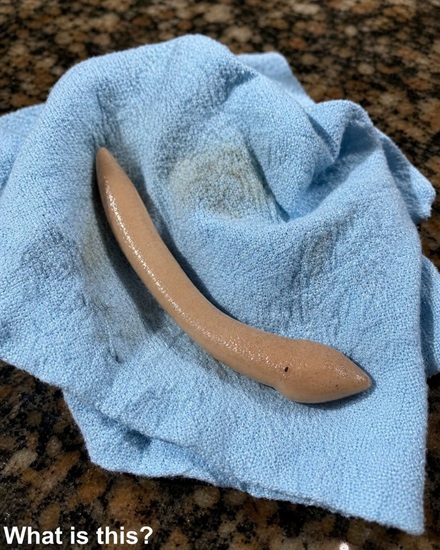
According to the account, a man walked into his girlfriend’s bathroom one evening and noticed something pale and elongated on the floor. It was smooth, wet-looking, and curved in a way that made it difficult to identify at first glance.
For a moment, it did not even seem obvious that it was an animal.
Then it moved.
That small movement immediately changed the situation.
The object no longer looked like a misplaced bathroom item or a piece of soft material. It appeared to be a living creature, but its unusual shape offered few immediate clues about what kind.
The bathroom itself provided no obvious explanation. The sink looked normal. So did the shower and toilet.
That uncertainty was enough to make the discovery seem far more disturbing than it eventually proved to be.
Rather than immediately deciding what the animal was, the person photographed it and began looking for an identification.
That was when the guesses started.
Some people suggested a tapeworm. Others thought it could be a leech or a slug. Still others wondered whether it might not be an animal at all.
The problem was that these possibilities contradicted one another.
And appearances can be particularly misleading when an unfamiliar animal turns up somewhere people do not expect to see wildlife.
A worm-like creature in damp soil may barely attract attention.
Put a similar-looking creature on a bathroom floor, however, and the context changes the way people interpret what they are seeing.
The eventual explanation was considerably less mysterious.
The physical characteristics described in the original account — particularly a broad, flattened body and pointed ends — were consistent with a terrestrial flatworm, commonly called a land planarian.
Land planarians are genuinely unusual-looking animals.
Unlike familiar segmented earthworms, their bodies are soft and flattened. They move by gliding over surfaces on a thin layer of mucus, which helps explain their glossy or wet appearance.
That movement can make them look almost artificial when seen for the first time.
Their biology also explains why moisture matters so much.
Land planarians require humid conditions and generally favor cool, dark and damp places. They can be found beneath rocks, logs, vegetation and other objects that protect them from drying out.
After heavy rainfall, some may become visible on the soil surface.
This is important because it provides a much more ordinary explanation for why a terrestrial flatworm might unexpectedly appear around a home.
There is another well-documented route as well: plants.
Certain land planarians have been spread far beyond their original geographic ranges through horticulture. Soil, rooted plants and potted plants can unintentionally transport these animals from one location to another.
That detail eventually became especially relevant to this particular story.
But first there was a more uncomfortable question to resolve.
Could the strange creature have been a human parasite?
Based on the identification given in the source material, there was no reason to interpret the animal simply as evidence that it had emerged from a person.
A land flatworm is a free-living terrestrial animal.
That distinction matters because visually alarming photographs shared online can quickly generate medical speculation that the image itself does not support.
Calling every unfamiliar worm-like organism a “tapeworm” is not scientifically reliable.
Different groups of worms have very different anatomy, behavior and life cycles.
The location of an animal is not enough to establish what it is.
Neither is a frightened reaction to its appearance.
In this case, the flattened shape, movement and other visible characteristics pointed toward a land planarian rather than providing evidence of a human intestinal parasite.
There was still a practical issue, however.
Finding an unfamiliar flatworm does not mean it should automatically be picked up with bare hands.
There are numerous species of terrestrial flatworms, and identification from a single photograph can be difficult.
Some invasive species produce defensive secretions, and extension specialists recommend avoiding direct skin contact with certain species.
Using gloves or another protective barrier is therefore a sensible precaution when dealing with an unidentified flatworm.
There is another reason not to experiment with it.
Some planarians have impressive regenerative abilities.
For that reason, cutting an unidentified land planarian into pieces is not a sensible method of dealing with it.
The safer approach described in the original account was much simpler.
The animal was handled with gloves and placed in a sealed container.
The surrounding area was then cleaned.
The bathroom was also checked for possible entry points and sources of moisture.
Those steps were more useful than assuming the creature had somehow emerged from the plumbing.
If similar animals repeatedly appear inside a home, looking at environmental conditions can provide useful clues.
Gaps around doors or pipes, damp areas and recently introduced plants are reasonable places to investigate.
Potted plants deserve particular attention because horticultural movement is a documented pathway by which some terrestrial flatworms spread.
And that brings the story back to the detail that finally made the discovery make sense.
According to the original account, the girlfriend had recently taken a potted plant into the bathroom so that its leaves could be washed.
Suddenly, there was a plausible route.
Instead of a mysterious creature originating somewhere inside the bathroom, the flatworm may simply have arrived with the plant or its soil.
The explanation was far less dramatic than the possibilities imagined during the first few minutes.
The girlfriend was reportedly surprised by the discovery too.
The awkward conversation that had been postponed out of embarrassment turned out to be straightforward.
What had initially looked like an alarming bathroom mystery could be explained by the behavior of a moisture-dependent terrestrial animal and a very ordinary household activity involving a plant.
There is a broader lesson in the episode.
Context has enormous influence over how people interpret unfamiliar wildlife.
A land planarian underneath a log looks like part of the natural environment.
The same animal beside a shower can seem inexplicable.
That difference can encourage people online to jump from uncertainty to extreme conclusions.
Photographs alone also have limitations.
There are many terrestrial flatworm species, and color, body shape, markings and head structure can all matter during identification.
A photograph may support identification at a broad level without being sufficient to establish the exact species.
That is why an unidentified animal should not automatically be given a dramatic scientific name simply because it resembles photographs found online.
This distinction is particularly important with land planarians because some introduced species can have ecological consequences.
Several terrestrial flatworms prey on other invertebrates.
For example, the well-known hammerhead flatworm Bipalium kewense feeds on earthworms and other small soil animals.
Other invasive flatworms can prey on snails and slugs.
Their presence therefore can be more than an aesthetic nuisance in places where they have been introduced.
At the same time, those ecological facts should not be turned into unsupported claims about the particular animal in a photograph.
Without a reliable species-level identification and geographic information, it would be misleading to declare that one photographed flatworm is definitely a particular invasive species.
The accurate conclusion is narrower.
The animal described in the source was identified as a land flatworm.
Land planarians are real terrestrial animals that depend strongly on moist environments.
They can occur around homes and gardens.
Some are transported unintentionally with plants and soil.
And seeing one indoors does not, by itself, indicate that someone in the household has a human intestinal parasite.
Those facts are much less sensational than many of the initial online guesses.
They are also much more useful.
The discovery illustrates why identification should come before speculation.
When an unfamiliar animal appears in an unexpected location, photographing it without unnecessary handling can preserve useful identifying details.
If the species may be invasive, a local agricultural, environmental or extension authority can provide guidance appropriate to the region.
That is preferable to relying on contradictory social-media guesses.
It also avoids another common mistake: treating every strange-looking organism as a threat to human health.
Nature contains an enormous variety of animals whose appearance can be surprising when they cross into human spaces.
Bathrooms, basements, garages and kitchens are not isolated from the outdoor environment.
Moisture, open doors, tiny gaps and objects brought indoors can occasionally provide accidental routes for small animals.
A plant pot can be one of those routes.
So can garden equipment or other items that have recently been outdoors.
In the end, the most memorable part of this story may not be the flatworm itself.
It is the gap between what the discovery initially seemed to suggest and what the available evidence actually supported.
For a short time, an unfamiliar shape on a bathroom floor generated increasingly uncomfortable possibilities.
The real explanation required much less imagination.
It was a terrestrial flatworm in a damp indoor environment, with a recently moved potted plant providing a plausible route into the room.
Once that was understood, most of the mystery disappeared.
The photograph may still look unsettling to someone who has never seen a land planarian before.
But unusual does not automatically mean dangerous, parasitic or medically significant.
Sometimes the strangest-looking visitor in a house is simply wildlife that ended up in the wrong place.
And in this case, the smallest household detail — a plant temporarily brought into the bathroom — provided the clue that made the entire episode considerably less mysterious.
