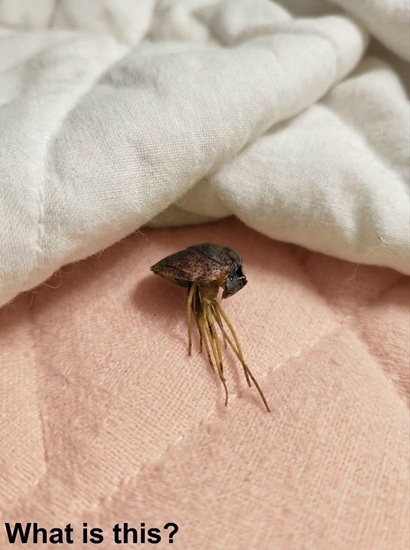
Few things can create instant alarm quite like discovering an unfamiliar object in a place associated with comfort and safety. Imagine pulling back a blanket before going to sleep and noticing a tiny pale object with several thin, root-like projections resting on the bedding. In dim lighting, the unusual shape could easily resemble an insect, spider, or another small creature. Before jumping to conclusions, however, a closer inspection can sometimes reveal a far less frightening explanation.
The first reaction to an unfamiliar object is often emotional rather than analytical. When people encounter something unexpected, particularly late at night or when tired, the brain tries to identify it using familiar patterns. A cluster of thin projections may resemble legs, while a rounded central section might resemble the body of an insect. Shadows can exaggerate these similarities and make an otherwise ordinary object appear surprisingly unsettling.
In a situation like this, the safest response is usually to avoid touching an unidentified object with bare hands until there is a better understanding of what it might be. Turning on additional lights and examining it from a reasonable distance can provide useful information. A phone camera can also help because magnification may reveal details that are difficult to see with the unaided eye.
Once viewed clearly, an object that initially resembles a tiny animal may turn out to be plant material. A germinating seed, for example, can develop a surprisingly strange appearance. When germination begins, the emerging root can extend from the seed and later produce smaller branching structures. Without the familiar green leaves people associate with plants, an early-stage seedling may look completely different from what someone expects.
Germination is the biological process through which a viable seed begins developing into a new plant when environmental conditions are suitable. Water is generally one of the key requirements because the seed absorbs moisture and resumes metabolic activity. Oxygen and an appropriate temperature range are also important, although specific requirements vary considerably among plant species. Some seeds additionally respond to particular light or temperature conditions.
The first structure emerging from many germinating seeds is called the radicle, which develops into the plant’s primary root. This early root typically grows in search of conditions that can support the developing plant. Additional root structures may eventually appear, creating the thin projections that can make a germinating seed look surprisingly similar to a tiny many-legged creature when seen without context.
Young roots are frequently pale rather than green. This is completely normal because roots generally do not contain the same concentrations of chlorophyll responsible for the familiar green appearance of many above-ground plant tissues. When a seed germinates in darkness, the emerging structures may appear particularly pale. Under a blanket or among folds of fabric, this appearance could contribute to an unusual visual impression.
That does not mean every mysterious object found in bedding is a germinating seed. Without clearly identifying a specimen, it would be inaccurate to make that conclusion automatically. Small insects, pieces of dried vegetation, fibers, seed pods, burrs, and other debris can all be carried indoors. The correct identification depends on the object’s actual physical characteristics rather than on how similar it appears to something seen online.
Seeds and other plant materials can reach indoor spaces in ordinary ways. They may attach themselves to clothing, shoes, bags, or animal fur. Open windows and doors can allow lightweight plant material to enter. Flowers, houseplants, dried arrangements, fruit, vegetables, and outdoor activities provide other possible sources. Something found in a bedroom therefore does not necessarily originate there.
Bedding can occasionally provide moisture if fabric has become damp from humidity, condensation, spilled liquid, or another source. Under suitable circumstances, a viable seed exposed to enough moisture and appropriate temperatures may begin germinating. However, it would be misleading to suggest that ordinary dry bedding routinely causes seeds to sprout. Most seeds require sufficiently suitable environmental conditions, and those conditions vary between species.
If an unidentified plant-like object is discovered on a bed, there is generally no reason for panic. It can be removed carefully and the bedding inspected for other material. If the sheets or blankets are damp, they should be washed or thoroughly dried according to their care instructions. Keeping bedding dry is useful for general cleanliness and helps prevent conditions that support unwanted microbial growth.
The surrounding room can also be checked for an obvious source. A nearby houseplant, open window, recently worn outdoor clothing, backpack, pet, or dried flower arrangement might provide a simple explanation. In many cases, the mystery can be resolved by looking at the environment rather than assuming that something unusual has suddenly appeared without a source.
If the object actually appears to move independently, the situation should be treated differently. A living arthropod can often be distinguished from plant material by movement, body segmentation, recognizable legs, antennae, or other anatomical features. Photographs taken in good lighting can assist with identification. When necessary, a qualified pest-control professional or appropriate local expert can help identify suspected household pests.
It is also worth avoiding dramatic conclusions based exclusively on a photograph. Camera angle, magnification, shadows, and image compression can make tiny objects appear very different from how they look in person. A harmless seed casing may resemble an insect, while a piece of fiber may look like a worm when enlarged. Reliable identification requires examining distinctive characteristics rather than relying only on overall shape.
The way people initially interpret unfamiliar shapes has an interesting psychological explanation as well. Human perception constantly searches for recognizable patterns because rapid identification is useful for navigating the environment. When visual information is incomplete, the brain may select the closest familiar interpretation. In a dark bedroom, something with multiple thin projections can therefore be categorized as “bug” before enough information is available to determine what it actually is.
Fear can strengthen this effect. Once someone suspects that an object is an insect, attention becomes focused on features supporting that interpretation. Thin roots begin looking like legs, shadows appear like additional body parts, and ordinary textures can suddenly seem threatening. Better lighting provides more visual information and can quickly change the interpretation.
Fatigue can also influence how confidently people evaluate ambiguous situations. Someone arriving home after a long day may be less inclined to conduct a careful inspection before reacting. This does not mean tired people hallucinate ordinary objects. Rather, when information is ambiguous, circumstances such as darkness, surprise, and expectations can affect the first interpretation that comes to mind.
This is one reason taking a photograph can be helpful. A still image allows someone to inspect the object without remaining extremely close to it. Zooming in may reveal whether apparent “legs” are actually roots, fibers, or genuine anatomical structures. Photographs can also be compared with reliable identification resources if additional assistance is needed.
Suppose closer examination confirms that the mysterious object is a germinating seed. The frightening interpretation immediately becomes unnecessary. What looked like a collection of insect legs may simply be delicate root structures emerging during early plant development. The same physical object remains on the bedding, but understanding what it is completely changes the emotional response.
The discovery can even become an interesting opportunity to observe plant development. If the seed can be identified and remains healthy, it might be transferred carefully to an appropriate growing medium. Whether it survives depends on the plant species, the condition of the developing root, and the environment provided afterward. Not every accidentally germinated seed will successfully become a mature plant.
It is better not to claim that placing any unidentified sprout in a pot will automatically save it. Different species require different amounts of water, light, temperature, and soil conditions. Some seeds found outdoors may belong to plants unsuitable for indoor cultivation. Identification should ideally come before deciding whether to grow an unfamiliar specimen.
The episode also provides a useful lesson about online images with captions such as “What is this?” Such photographs frequently encourage dramatic speculation. Comments may confidently identify an object as a parasite, dangerous insect, or unusual organism without sufficient evidence. Multiple confident comments do not make an identification scientifically reliable.
A more dependable approach is to examine observable characteristics. Does the object move? Are there genuine joints in the apparent limbs? Does it have recognizable insect body segments? Is the central structure clearly a seed coat? Are the projections branching like roots rather than articulated like legs? These questions are considerably more informative than judging whether something simply “looks creepy.”
For insects and other arthropods, accurate identification can sometimes require very specific features that are not visible in a low-resolution photograph. Experts may examine body segmentation, number and arrangement of legs, antennae, wings, mouthparts, or other characteristics. For seeds and seedlings, identification may depend on the seed coat, root structure, emerging shoots, and eventually the leaves.
When certainty is unavailable, the responsible conclusion is simply to say so. “This resembles a germinating seed, but the species cannot be confirmed from the image” is more accurate than inventing a definitive explanation. The same principle applies to claims that an unidentified object is dangerous. Risk should not be exaggerated without evidence.
For household hygiene, ordinary precautions are usually sufficient when plant debris is discovered. Remove the object, inspect the immediate area, wash bedding when appropriate, and ensure that damp fabrics are properly dried. Persistent moisture deserves attention because it can contribute to mold and other household problems, regardless of whether a seed happens to be present.
Repeated discoveries of actual insects would justify a different response. In that situation, checking mattress seams, furniture, cracks, and other relevant locations may be appropriate depending on the suspected species. Professional identification can prevent unnecessary pesticide use and ensure that treatment, if genuinely needed, targets the correct organism.
The broader lesson is that unusual appearances can be deceptive. Nature produces seeds, roots, fungi, insects, and plant fragments in forms that may look completely unfamiliar when removed from their usual surroundings. A structure that would appear perfectly ordinary in soil can seem strange when discovered on a pillow.
Context changes perception. Seeing pale roots beneath a plant would probably cause little concern. Seeing the same root structure unexpectedly beneath a blanket can trigger an entirely different reaction because a bedroom creates different expectations. The object has not changed; the environment surrounding it has changed how it is interpreted.
This principle extends well beyond mysterious objects in bedding. Many viral photographs become popular because familiar things are presented from unusual angles or in unexpected locations. Viewers fill gaps in the available information with assumptions, and those assumptions can quickly become more dramatic than the reality.
Careful observation provides a simple solution. Improve the lighting, keep a reasonable distance from genuinely unidentified organisms, take clear photographs, examine distinguishing features, and consult reliable resources when necessary. These steps replace speculation with evidence while avoiding unnecessary alarm.
If the object ultimately turns out to be nothing more than a germinating seed, the situation can shift from frightening to fascinating. The thin structures that initially looked like threatening legs are actually part of an ordinary biological process occurring in plants around the world every day.
A seed beginning to germinate is not trying to invade someone’s bed. It is simply responding to environmental conditions that permit growth. Moisture activates biological processes within the viable seed, the protective structure opens, and the developing root begins extending outward as the young plant starts its life cycle.
Seen from that perspective, the mysterious bedroom discovery becomes much less like a horror story and much more like an unexpected biology lesson. Something that initially appeared alarming may have a perfectly ordinary explanation once enough information becomes available.
The safest conclusion is therefore not to assume that every strange object is harmless—or dangerous—before it has been identified. Observe first, investigate carefully, and separate what can actually be seen from what imagination adds to the scene.
Sometimes the object beneath the blanket really may require attention. Other times, what appears to be a tiny many-legged creature may simply be plant material or a seed beginning to grow. Either way, accurate identification is far more useful than fear, and a few minutes of careful inspection can turn a mysterious discovery into something completely understandable.
