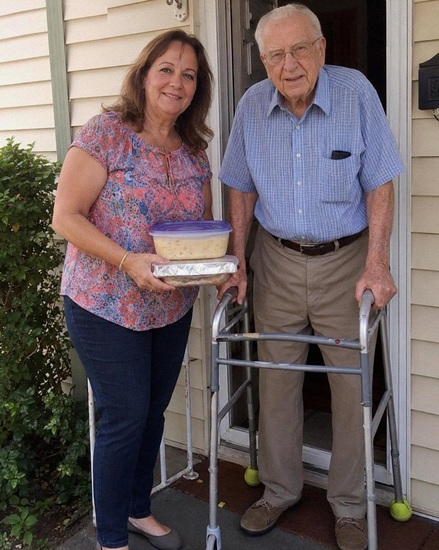
For nine years, Julie had carried bags of groceries across the narrow strip of grass separating her house from Lawrence’s. She had picked up his prescriptions, brought him homemade dinners, driven him to appointments, and checked on him whenever bad weather kept him indoors. None of it had ever seemed extraordinary to her. Lawrence was an elderly neighbor who needed a little help, and Julie was simply the person who happened to be close enough to notice. She never expected those ordinary acts of kindness to become one of the most meaningful relationships of her life.
After Lawrence died peacefully, Julie attended his small funeral with her children, Madison and Matthew. She expected the day to be difficult, but she thought she understood what awaited her: a service, a few memories, quiet conversations, and then the strange experience of returning home knowing the house next door would remain empty. What she did not expect was a lawyer approaching her near the coffee table after the service. Julie was holding a paper cup she had barely touched when the man gently said her name.
“Julie?”
She looked up and nodded.
The lawyer held a sealed envelope toward her. Her name had been written carefully across the front.
“Lawrence asked me to give this to you after the funeral,” he explained.
Before Julie could reach for it, another voice entered the conversation.
“What is that?”
The question came from Peter, Lawrence’s adult son. Julie knew much more about Peter than Peter probably realized. She knew Lawrence had spent years hoping he would call more often. She knew how Lawrence’s expression changed whenever his phone rang unexpectedly. She also knew how quickly he would pretend not to be disappointed when the person calling turned out to be someone else.
The lawyer remained professional.
“It is a private letter addressed to Julie.”
“From my father?” Peter asked.
“Yes.”
Peter’s eyes moved from the envelope to Julie. His expression immediately made her uncomfortable, as though receiving something from Lawrence meant she had taken something that belonged to him.
For a moment, Julie almost stepped away. That had been her habit for much of her adult life. Avoid confrontation. Keep everyone comfortable. Do not become the cause of an argument. Her divorce had only strengthened that instinct.
Then she looked at the envelope again.
Lawrence had written her name.
Julie reached forward and accepted it.
Peter gave a bitter little laugh.
“I didn’t realize bringing casseroles made someone family.”
Julie held the envelope against her chest.
“It doesn’t,” she replied quietly. “But showing up matters.”
Nine years earlier, Julie had known almost nothing about the stubborn man next door.
She had moved into her modest house with Madison and Matthew shortly after her marriage ended. At 48, she was rebuilding a life she had expected to look very different. The divorce papers were finalized, but emotionally she still felt as though she were sorting through the pieces of everything that had changed.
Money was tighter than it had once been. Every purchase mattered. Julie compared grocery prices, postponed repairs when she could, and learned which bills could safely wait a few additional days.
One evening, Matthew looked at the generic cereal box she had placed on the counter.
“Are we poor?” he asked.
The question caught Julie off guard.
She forced herself to smile.
“We’re careful,” she told him. “And being careful means we still have breakfast.”
Madison glanced up from her schoolwork. She did not say anything, but Julie could tell that her daughter understood more than Matthew did.
Those early months were filled with small adjustments. Julie learned how to fix things she had previously left to her husband. She learned how to be both the person comforting the children and the person quietly worrying after they went to sleep.
Lawrence lived next door in another small house with blue shutters.
Whenever Julie waved, he responded with a short nod.
That was about as friendly as Lawrence seemed interested in becoming.
He kept mostly to himself. He collected his mail, maintained his small yard, occasionally sat on the porch, and appeared determined to prove that he needed absolutely nothing from anyone.
Then winter arrived.
One January afternoon, after several days of snow, Julie looked out her kitchen window and noticed something unusual.
Lawrence’s mailbox was overflowing.
There were no fresh footprints leading from his door.
A pharmacy bag had been left between his screen door and the frame and appeared to have remained there long enough to gather frost.
Julie stared through the glass.
“It’s none of my business,” she said quietly.
Madison followed her gaze.
“Lawrence?”
Julie nodded.
She tried returning to what she had been doing.
A few seconds later, she reached for her coat.
“I’m just checking on him.”
Before leaving, she poured some chicken soup into a container.
She crossed the snowy yard and knocked firmly on Lawrence’s door.
“Lawrence? It’s Julie from next door.”
Nothing happened.
She knocked again.
Eventually, the door opened.
Lawrence stood in front of her wearing a robe. His face looked unusually pale, and one hand gripped the doorframe.
“I’m fine,” he said immediately.
Julie raised an eyebrow.
“I didn’t ask.”
For the first time since she had moved next door, Lawrence looked genuinely surprised.
She pointed toward the mailbox.
“Your mail disagrees with you.”
“I can get my own mail.”
“Then why haven’t you?”
Lawrence frowned.
Behind him, Julie noticed medication sitting untouched on a small table.
“Are you sick?”
“I’m old,” he replied. “People confuse the two.”
“You’re shaking.”
“Thank you for the diagnosis.”
Julie held out the soup.
“Eat this.”
“I don’t need charity.”
“It isn’t charity. It’s chicken soup.”
He stared at the container.
Julie extended it farther.
“You can eat it or throw it away. Either way, you’re taking it.”
Lawrence accepted the soup with the expression of a man reluctantly signing a parking ticket.
Julie went home wondering whether she had annoyed him enough that he would never speak to her again.
The following afternoon, someone knocked on her door.
Lawrence stood outside holding the empty container.
“You used too much pepper,” he announced.
Julie looked at the bowl.
It had been scraped completely clean.
“And yet somehow you survived.”
“I didn’t want to waste perfectly good chicken.”
Then Lawrence hesitated.
“My truck won’t start.”
“That sounds inconvenient.”
He remained standing there.
Julie waited.
Finally he said, “My heart prescription is ready.”
She understood immediately.
“Are you going to make me ask?” he grumbled.
“No. I’m headed toward the pharmacy anyway.”
“I’ll pay you back.”
“No, you won’t.”
“Julie.”
“Lawrence.”
He sighed.
That was how their friendship began.
There was no dramatic moment and no promise that they would become important to one another. There was soup, a prescription, a broken truck and two people who were both more lonely than either wanted to admit.
Gradually, a routine developed.
Whenever Julie made stew, roast chicken or another meal large enough for leftovers, a portion often found its way next door.
Whenever she planned to visit the pharmacy, she sent Lawrence a message.
“Need anything?”
His first response was almost always the same.
“No.”
Five minutes later, another message would arrive.
“Maybe milk.”
Then another.
“And those crackers Daisy used to buy.”
Daisy was Lawrence’s late wife.
Over time, Julie began noticing how much of Daisy remained inside the house.
Her favorite mug still sat in the kitchen cabinet. A sweater remained folded over the back of a chair. Her handwritten recipes were stored carefully inside an old metal tin.
Lawrence rarely volunteered stories about her.
Julie learned not to push.
One morning, she found him sitting on his porch with two cups of coffee.
“Expecting somebody?” she asked.
“No.”
He pushed one cup toward the empty chair beside him.
Julie sat down.
For several minutes, neither said much.
Eventually, Lawrence looked toward the yard.
“It’s Daisy’s birthday.”
Julie avoided the automatic words people often use around grief.
Instead she asked, “What kind of cake did she like?”
“Lemon.”
“Store-bought?”
Lawrence looked offended.
“From scratch.”
Julie smiled.
“Of course.”
“She hated shortcuts.”
The following afternoon, Julie arrived carrying a homemade lemon cake.
Unfortunately, the center had collapsed.
Lawrence inspected it carefully.
“Daisy would’ve judged this cake.”
Julie placed it on his table.
“Then Daisy can file a complaint.”
Lawrence laughed.
It was the first time Julie heard him laugh without trying to hide it.
Something between them changed after that.
Months became years.
Julie drove Lawrence to occasional medical appointments.
Lawrence fixed the loose hinge on her garden gate.
Julie picked up his medication.
Lawrence showed Matthew how to repair a broken bicycle chain.
When Madison needed help with a school project that involved building a wooden frame, Lawrence appeared with tools before Julie finished explaining the problem.
He grumbled through the entire project.
Madison adored him anyway.
When Julie’s house became too quiet after the children went out with friends, she sometimes found Lawrence sitting on his porch.
She would sit beside him.
Neither felt obligated to fill every silence.
That was one of the things Julie appreciated most.
After one of Lawrence’s hospital visits, a nurse glanced between them.
“Are you family?”
Julie opened her mouth to answer.
Lawrence spoke first.
“She’s close enough to argue with me.”
Julie laughed.
The nurse smiled and continued filling out the paperwork.
Peter rarely appeared.
Julie had heard his name many times before she properly met him.
Lawrence never openly criticized his son.
“He’s busy,” he would say.
Or, “He has his own life.”
But Julie noticed the details Lawrence pretended were unimportant.
When his phone rang, he checked it quickly.
When his birthday approached, he kept his phone close.
When Father’s Day came, he spent more time than usual looking toward the driveway.
Julie understood that kind of waiting.
Her divorce had taught her that sometimes people stop being present long before the relationship officially ends.
Seven years after Julie first carried soup across the yard, she arrived one evening with groceries and found Lawrence sitting outside.
“You want these inside?” she asked.
“In a minute.”
He looked at her carefully.
“Sit down before you fall down.”
Julie laughed, but Lawrence did not.
She sat.
For several minutes she said nothing.
Then she admitted what day it was.
“The anniversary of my divorce.”
Lawrence waited.
Julie stared toward her house.
“I thought eventually I’d feel completely free.”
“And?”
“Some days I do.”
She paused.
“Other days I just feel tired.”
Madison’s car was parked in the driveway.
Matthew was nearby shooting basketballs into the hoop, one earbud hanging from his ear.
“They still need you,” Lawrence said.
“I know.”
Julie smiled faintly.
“But it’s changing. They’re growing up. Madison has work and school. Matthew has friends and plans. That’s exactly what I wanted for them.”
She rubbed her forehead.
“I just don’t know who I’m supposed to be when nobody needs me anymore.”
Lawrence did not offer an easy answer.
That was another thing Julie valued about him.
He allowed difficult thoughts to remain difficult.
After a while he asked, “What would you do if nobody needed you for one whole day?”
Julie considered the question.
“I’d go somewhere quiet.”
“Where?”
“Some little cabin.”
She smiled.
“Maybe near a lake.”
Lawrence looked amused.
“No television?”
“Maybe one.”
“No children asking where their shoes are?”
“Absolutely not.”
“No dishes?”
“Especially no dishes.”
Lawrence laughed.
Julie leaned back.
“Just one place where no one needs anything from me.”
“That sounds lonely.”
Julie shook her head.
“No. Lonely isn’t being alone.”
She looked toward her house.
“Lonely is spending the entire day taking care of everyone and still feeling like nobody sees you.”
Lawrence became quiet.
Finally, he nodded.
“I understand that.”
Julie assumed he was thinking about Daisy.
She did not realize that he was also thinking about her.
Two weeks before Lawrence died, Julie brought him beef stew.
When she entered the house, a Scrabble board was already waiting on the table.
“You cheat,” she said.
“I win.”
“You invent words.”
“I know words you don’t know.”
That evening, Lawrence defeated her by 23 points.
Julie threatened to stop bringing stew.
“You wouldn’t,” he said.
She smiled.
“No. I wouldn’t.”
It became their final full evening together.
A few days later, Lawrence died peacefully in his sleep.
His funeral was small but not empty.
Several neighbors attended.
The pharmacist who had known him for years came.
Someone from his doctor’s office appeared.
Julie sat with Madison and Matthew.
Then Peter entered.
Julie recognized him immediately.
He had Lawrence’s jaw and familiar eyes, but his expression was harder.
After the service he approached Julie.
“You must be Julie.”
“I am.”
Julie offered her hand.
“I’m sorry for your loss.”
Peter ignored the gesture.
“My father mentioned you.”
“He mentioned you too.”
His expression tightened.
Then came the comment about casseroles and family.
Julie initially tried to ignore it.
But Peter continued.
“My father was elderly. People sometimes take advantage of elderly people.”
Julie felt the room become quiet.
The pharmacist looked toward the floor.
One neighbor visibly frowned.
For nine years, Julie had protected Lawrence’s dignity.
She never told people when he needed help.
She never described him as helpless.
She never used his age to make herself seem generous.
Now someone was transforming that care into something suspicious.
Julie lifted her head.
“I brought him food because one winter his mail stopped moving and I realized he was sick,” she said.
Peter said nothing.
“I picked up medicine because his truck wouldn’t start. I drove him home from appointments because somebody had to. I sat with him when he missed Daisy.”
Her voice remained calm.
“I didn’t do any of it because I expected something.”
That was when the lawyer approached with Lawrence’s letter.
Julie left the funeral without opening it.
She sat inside her car with Madison and Matthew until her breathing settled.
Then she broke the seal.
Lawrence’s handwriting filled the page.
The opening sentence immediately made her eyes burn.
He reminded her of all the meals she had left outside his door.
Then he gave a strange instruction.
Look inside the old freezer in your basement.
Julie knew exactly which freezer he meant.
Years earlier, her refrigerator had stopped working just before Thanksgiving.
She had stood in the driveway close to tears, trying to figure out how to save food she could not afford to replace.
Lawrence had appeared pulling an old chest freezer on a dolly.
“It belonged to Daisy,” he explained.
Julie protested.
“I can’t take your freezer.”
“Then don’t take it.”
He pointed toward her basement.
“Borrow it.”
The freezer remained there for years.
Lawrence had gone into Julie’s basement several times afterward, usually while helping with a fuse, pipe or water heater.
When Julie and the children returned from the funeral, she headed downstairs immediately.
The basement smelled of laundry detergent, old wood and dust.
She lifted the heavy freezer lid.
At first, everything appeared ordinary.
Frozen vegetables.
Bread.
A package of meat.
Then she began moving things.
Near the bottom she noticed a small container wrapped carefully and marked with faded tape.
Julie pulled it out.
The handwriting on the label belonged to Lawrence.
“Julie’s first soup. January 14.”
Julie covered her mouth.
Madison stood behind her.
Matthew remained on the stairs.
“He kept it?” Madison whispered.
Julie shook her head in disbelief.
“It was the first meal I ever brought him.”
Beneath the container was a small brass key attached to another folded note.
Julie sat down on the basement step before opening it.
The message explained why Lawrence had kept the container.
Julie had thought she was giving him soup.
To Lawrence, it represented something much larger.
It was evidence that somebody would notice if he disappeared.
Julie read the next part slowly.
Lawrence wrote that she had given him nine years of ordinary kindness.
Meals.
Medicine.
Bad lemon cake.
Arguments.
Rides home.
Company on Daisy’s birthday.
But then he wrote something Julie had not expected.
He told her that he had been paying attention to her as well.
He remembered the conversation they had shared on the porch.
The one about wanting somewhere quiet.
The brass key belonged to a small cabin near a lake.
Lawrence had owned it for years.
According to the letter, he had legally arranged for Julie to receive it.
He warned her that the porch creaked.
The kitchen window occasionally stuck.
The cabin was not luxurious.
But it was quiet.
Julie struggled to continue reading.
Lawrence explained that she had given him years in which he did not feel forgotten.
He wanted to leave her one place where she could finally rest.
Madison was crying now.
“He listened to you,” she whispered.
Julie stared at the key.
“I only said it once.”
The next morning, Julie met with Lawrence’s lawyer.
Peter was already waiting.
Before Julie had even taken her seat, he questioned whether Lawrence had truly understood the decision he had made.
The lawyer calmly produced the relevant estate documents and explained that Lawrence had confirmed his wishes.
Peter looked toward Julie.
“You were always around.”
Julie nodded.
“I was.”
The implication behind his words became obvious.
He suggested she had influenced his father.
Julie felt anger rise but kept her voice controlled.
“No,” she said. “I cooked for him.”
Peter stared at her.
“I took him home when he needed a ride. I checked on him when storms came through. I sat with him on difficult anniversaries.”
She paused.
“Don’t turn ordinary care into something dishonest because you’re angry about his decision.”
Peter insisted his father had been confused.
Julie almost laughed.
“Two weeks before he died, your father beat me at Scrabble.”
She shook her head.
“He was still arguing about every point.”
The lawyer then explained that Lawrence had left another message specifically for Peter.
Its meaning was simple.
Lawrence had not stopped loving his son.
Leaving the cabin to Julie was not intended as punishment.
He made the decision because Julie had been present during the ordinary days.
Those days mattered to him.
A person’s life, Lawrence believed, consisted mostly of ordinary days.
Julie had shared many of his.
Peter had missed too many.
The words visibly affected him.
At the office door, Peter stopped Julie.
“You got what you wanted.”
Julie touched the brass key inside her pocket.
“No,” she replied.
“I got what Lawrence wanted me to have.”
Two days later, Julie drove to the cabin with Madison and Matthew.
The building was exactly as Lawrence had described it.
The porch sagged slightly.
The paint on the blue door had faded.
One window resisted opening.
Behind the cabin, the lake stretched quietly beneath the sky.
There were no expensive furnishings inside.
No impressive modern kitchen.
No luxury decorations.
It felt simple and lived-in.
And peaceful.
Madison began rinsing several dusty mugs.
Matthew carried their bags from the car.
Julie watched them for a moment.
Then she raised one hand.
“Before we start, this place needs a rule.”
Both children looked toward her.
“If we come here, everybody cooks.”
Madison smiled.
“Fair.”
“Everybody cleans.”
Matthew nodded.
“And everybody sits down together.”
Julie looked at both of them.
“Nobody comes here and turns Mom into the staff.”
Matthew laughed.
“Deal.”
That evening they cooked together.
The meal was ordinary.
Nothing about it would have impressed anyone.
But Julie realized she was not rushing from the stove to the sink and back again.
Matthew cleared the table.
Madison washed dishes.
Julie dried them.
Later, Julie stepped onto the porch carrying coffee in one of the old mugs she had found inside.
The lake was completely still.
For once, nobody called her name from another room.
Nobody needed a prescription picked up.
Nobody needed dinner prepared.
Nobody needed something fixed immediately.
Julie simply sat.
For nearly a decade, she had believed her relationship with Lawrence was built around everything she did for him.
She was the neighbor who noticed the mail.
The woman who carried soup across the snow.
The person who picked up medicine when his truck failed.
The friend who remembered Daisy’s birthday.
Only after Lawrence was gone did Julie understand that care had never traveled in only one direction.
Lawrence had noticed when Julie was exhausted.
He had noticed how hard she worked to hold her family together after the divorce.
He had heard the sadness underneath her jokes.
Most importantly, he had remembered one passing sentence about wanting somewhere quiet.
Julie had forgotten saying it.
Lawrence had not.
The freezer in the basement proved something else too.
The first container of soup had mattered far more than Julie understood.
To her, it had been leftovers given to a sick neighbor.
To Lawrence, it had represented the moment another human being noticed his absence.
Sometimes kindness looks insignificant to the person offering it.
A container of soup.
A pharmacy trip.
A cup of coffee.
A few minutes on a porch.
But the person receiving that kindness may experience it very differently.
Julie had never rescued Lawrence from some dramatic crisis.
She had simply remained present.
Again and again.
Across ordinary days.
Lawrence, in return, had done something similar for her.
He had listened.
He had watched Madison and Matthew grow.
He had repaired things around the house.
He had sat beside Julie when she felt uncertain about the future.
And without telling her, he had remembered the quiet dream she mentioned only once.
Sitting beside the lake, Julie finally understood why Lawrence’s last gift affected her so deeply.
The cabin itself was valuable, but its meaning mattered even more.
It told her that she had been seen.
Not merely as a mother.
Not as a divorced woman struggling to keep everything working.
Not as Lawrence’s helpful neighbor.
As Julie.
A person who occasionally needed somewhere to stop carrying everyone else’s needs.
She raised the coffee mug toward the empty chair beside her.
“Too much pepper,” she whispered with a smile.
For a moment, she could almost imagine Lawrence correcting her from across the porch.
Then she looked out over the water.
For nine years, Julie believed she had been leaving food at Lawrence’s door.
She never realized that, through countless ordinary moments, he had quietly been leaving something for her too.
A friendship.
A reminder that kindness can travel both ways.
And finally, a small place beside a lake where Julie could begin discovering who she was when nobody needed anything from her.
