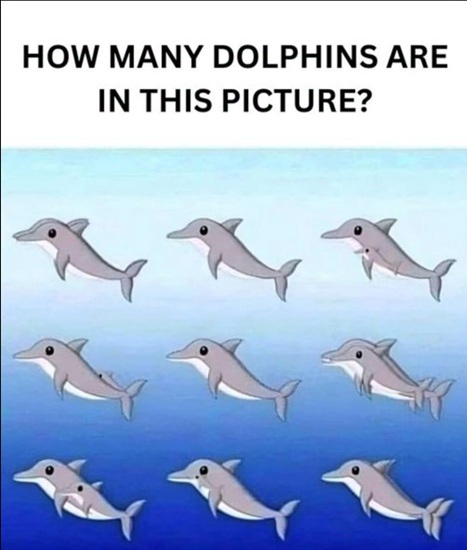
Optical illusions, visual puzzles, and brain teasers have long fascinated people because they combine entertainment with cognitive challenge, encouraging viewers to slow down and observe details that are not immediately obvious. These types of visual challenges are often shared online and in printed media because they engage attention, stimulate curiosity, and encourage problem-solving skills through pattern recognition and careful observation.
Unlike straightforward images, optical illusions are designed to interact with human perception, sometimes causing the brain to interpret shapes, shadows, and patterns in ways that differ from objective reality. One common category of these puzzles involves hidden objects within a larger scene, where the viewer is asked to identify a specific number of animals, shapes, or figures concealed within the composition.

In such illustrations, the difficulty level often varies depending on how elements are blended into the background or integrated into other shapes, requiring careful focus and visual patience from the viewer. A typical example includes marine-themed puzzles where dolphins are camouflaged within ocean waves or overlapping outlines, making it challenging to distinguish individual figures at first glance.
In these dolphin-based visual puzzles, viewers are often asked to count a specific number of dolphins hidden within a single illustration, encouraging repeated scanning and close inspection of details. However, it is important to note that the exact number of hidden figures in such puzzles can vary depending on the version of the image being used, rather than having a universally fixed answer.
Because these images are often digitally shared and edited, different viewers may encounter slightly different arrangements, which can lead to differing interpretations of how many objects are actually present. This variability is part of what makes optical illusion puzzles engaging, as they encourage discussion, comparison, and repeated observation rather than a single definitive outcome.

Another popular variation of visual brain teasers involves jungle or wildlife scenes where animals such as tigers are hidden within foliage, shadows, or overlapping environmental textures. These puzzles rely heavily on camouflage techniques, where outlines and colors are carefully blended to make certain animals difficult to detect without focused attention.
In many cases, the viewer is encouraged to zoom in mentally or physically and slowly examine different sections of the image to identify hidden elements that are not immediately visible. Such exercises are often used informally to demonstrate how human perception can be influenced by expectations, context, and visual grouping principles in cognitive psychology.
A third common type of brain teaser involves geometric puzzles, such as counting the number of squares, triangles, or other shapes formed within a complex diagram. These mathematical visual puzzles are designed to test logical reasoning and spatial awareness, as viewers must consider both small individual shapes and larger combinations formed by overlapping lines.

For example, a square-counting puzzle may initially appear simple, but it often contains multiple layers of shapes formed by intersecting grids, increasing the total count beyond the obvious answer. Solving these puzzles requires systematic thinking, where each section of the image is analyzed methodically to avoid missing smaller or hidden combinations of shapes.
Beyond entertainment, brain teasers and optical illusions are frequently associated with cognitive benefits such as improved attention to detail, enhanced pattern recognition, and mental flexibility. Educators and researchers sometimes use similar visual exercises to study how the brain processes complex images and how individuals interpret ambiguous or layered visual information.
These activities also highlight the difference between perception and reality, showing that what the human eye initially observes may not always represent the complete structure of what is being viewed. Social media has significantly increased the popularity of such puzzles, allowing them to spread rapidly and encouraging users to compare answers, strategies, and interpretations across different communities.
This interactive element adds a social dimension to visual puzzles, turning individual problem-solving into shared experiences that often spark discussion and friendly debate. While some participants focus on finding a definitive answer, others enjoy the process itself, appreciating the challenge of gradually uncovering hidden elements within complex images.
Ultimately, optical illusions and brain teasers serve as reminders that perception is not always straightforward, and that careful observation can reveal details that are easily overlooked at first glance. In conclusion, whether involving dolphins, tigers, or geometric shapes, these visual challenges continue to engage audiences by combining curiosity, creativity, and cognitive skill in an entertaining and thought-provoking way.
