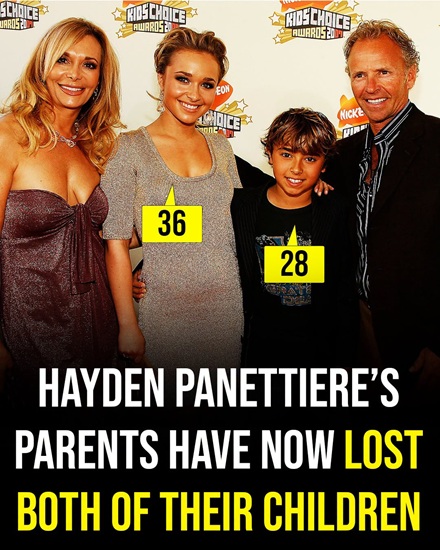
Hayden Panettiere spent much of her life in public, first becoming a professional performer while still a child and eventually reaching international fame through projects including Heroes, Nashville and the Scream franchise. Yet during the final years of her life, some of the subjects she discussed most candidly had little to do with celebrity. She spoke about motherhood, recovery, her relationship with daughter Kaya and the devastating loss of her younger brother, Jansen. Following Panettiere’s death at 36 on August 16, 2026, those reflections have taken on additional significance.
Hayden and Jansen Panettiere grew up sharing an unusually public childhood. Both entered entertainment when they were young, although their careers eventually developed in different directions. Hayden became internationally recognizable through television and film, while Jansen accumulated his own acting credits before increasingly devoting his attention to visual art. The siblings remained connected as adults, and photographs shared publicly offered occasional glimpses of a relationship that existed far beyond their professional careers.
One particularly poignant image appeared shortly before Jansen’s death. In January 2023, he shared a photograph showing Hayden cutting his hair and accompanied it with a playful comment about her previous attempts at giving him haircuts. At the time, there was nothing obviously final about the moment. It looked like an ordinary interaction between siblings comfortable enough with one another to joke publicly.
Only weeks later, everything changed.

Jansen died unexpectedly in February 2023 at the age of 28. His family subsequently announced that his sudden death was connected to cardiomegaly, or an enlarged heart, together with complications involving his aortic valve. In their statement, family members remembered his creativity, warmth, compassion, humor and artistic ability.
For Hayden, losing her younger brother became an enduring source of grief.
She continued speaking about Jansen publicly rather than pretending that time had simply removed the pain. On the second anniversary of his death, she shared a tribute describing how deeply she missed him and expressing hope that he was at peace.
Her later interviews revealed that grief was accompanied by guilt.
While discussing her 2026 memoir This Is Me: A Reckoning, Hayden explained that being Jansen’s older sister affected how she processed his death. She said the guilt remained present and evolved over time because part of her felt that, as the older sibling, she should somehow have been able to protect him.
That feeling was especially complicated by difficulties Jansen had reportedly experienced before his death.
Hayden discussed trying to support him and described efforts to encourage him toward treatment. She eventually acknowledged one of the most painful realities faced by families trying to help an adult loved one: another person’s recovery cannot be controlled entirely from the outside.
Her reflections did not mean she stopped questioning herself.

Instead, they demonstrated how grief can continue changing long after the initial loss. A person may intellectually understand that they could not control another adult’s decisions while emotionally continuing to wonder whether there was one more conversation, intervention or action that might have made a difference.
Jansen’s artwork became particularly meaningful to Hayden.
She described him as an exceptionally talented artist and said his paintings allowed her to continue feeling his presence. Art created something permanent that existed beyond his death, preserving thoughts and emotions he had placed into his work.
For Hayden, those paintings were not simply decorative objects.
They were pieces of her brother.
The loss came during a broader period in which Hayden was publicly reassessing difficult chapters of her own life.
Her memoir, published in May 2026, addressed the enormous pressures of growing up in entertainment as well as her experiences with addiction, mental-health difficulties, relationships and motherhood. Rather than presenting her life as a straightforward celebrity success story, she described periods when the person audiences saw professionally was very different from the person struggling privately.
Motherhood was among the most emotional subjects.
Hayden welcomed daughter Kaya in 2014 with her former fiancé, Ukrainian former heavyweight boxing champion Wladimir Klitschko. She later spoke openly about experiencing postpartum depression and significant mental-health difficulties after becoming a mother.
Those struggles occurred alongside other personal challenges.
Hayden sought professional treatment and later pushed back against the idea that she had simply been forced into getting help. In interviews connected with her memoir, she emphasized that there had been times when she herself recognized that she needed treatment and actively sought it.

Her relationship with Kaya became one of the most publicly misunderstood parts of her life.
Kaya eventually lived primarily with her father in Europe. From the outside, that arrangement sometimes generated harsh assumptions about Hayden’s role as a mother.
Hayden repeatedly rejected the idea that she had simply abandoned her daughter.
She explained that the circumstances developed while she was struggling significantly and trying to become healthier. Initially, the separation was extraordinarily painful, and she described reacting with the fierce instinct of a mother who wanted her child close.
As time passed, however, Hayden said her perspective changed.
Kaya had established a stable life surrounded by family, friends, school and activities. Once Hayden became healthier, she said she had to consider whether disrupting the life her daughter had built would serve Kaya’s interests or primarily satisfy her own desire to have her closer.
Hayden concluded that forcing such a change could have been selfish.
That did not mean disappearing from Kaya’s life.
She described traveling to see her daughter whenever possible and maintaining regular contact through FaceTime. More importantly, she characterized their relationship as emotionally close.
Hayden said mother and daughter could discuss meaningful subjects together.
She described their bond as intense and deeply important to her and was particularly sensitive to suggestions that Kaya might believe her mother had abandoned her.
According to Hayden, she had worked hard to ensure that her daughter felt supported.
The public assumption that she had simply decided to “give away” her child was especially painful to her.
Her comments illustrate why custody arrangements cannot always be understood from a headline.
A child living primarily with one parent does not automatically establish the emotional quality of the relationship with the other parent. Hayden’s own account was that she remained actively connected to Kaya even though they lived apart.
These reflections became part of a broader process of reclaiming her own story.
This Is Me: A Reckoning was published on May 19, 2026, only about three months before Hayden’s death. The memoir traced a life that had unfolded in front of cameras from an extraordinarily young age.
Hayden’s career had begun before she was old enough to understand fame.
She worked in commercials and daytime television before becoming widely known through films such as Remember the Titans. Her breakthrough into international television fame came with Heroes, where she played cheerleader Claire Bennet.
Later, Nashville brought another defining role.
As Juliette Barnes, Hayden portrayed a country singer navigating fame, relationships, motherhood and personal instability. The performance earned her two Golden Globe nominations.
Years later, Hayden explained that parts of Juliette’s storyline became painfully close to difficulties occurring in her own life.
The overlap could make the work emotionally exhausting.
After Nashville ended in 2018, Hayden stepped away from acting for several years before eventually returning to the Scream franchise as Kirby Reed.
Her comeback demonstrated that she still had a substantial audience.
But professionally returning did not erase the experiences she was continuing to process privately.
Jansen’s death in 2023 became one of the most difficult.
When Hayden spoke about him in 2026, three years had passed, yet she made clear that grief had not followed a simple timetable.
She missed him constantly.
She remembered his personality, intelligence and creativity.
And she continued examining her own role as his older sister even when she understood intellectually that responsibility had limits.
That complexity is important when discussing grief.
Surviving family members frequently ask questions that cannot be answered conclusively.
What if I had called?
What if I had recognized something earlier?
What if I had tried one more time?
Those questions can exist even when there is no evidence that a different action would have changed the outcome.
Hayden’s public comments provided a glimpse of that emotional conflict.
She loved Jansen deeply while recognizing that she could not control every aspect of his life.
The paintings he left behind gave her something tangible to hold onto.
Then, in August 2026, tragedy struck the Panettiere family again.
Hayden died on Sunday, August 16, at the age of 36.
Her father, Skip Panettiere, confirmed the death in a family statement describing Hayden as an extraordinary presence who brought love and joy to people who knew her personally and to audiences who watched her work.
Authorities subsequently released additional information about the circumstances.
Police and emergency personnel responded to a residence in Greenville, South Carolina, after Hayden was reported unresponsive.
Paramedics attempted emergency medical treatment.
She was pronounced dead that afternoon.
An autopsy was performed.
Authorities reported that no trauma was discovered that contributed to her death, and police have said that foul play is not suspected.
The official cause and manner of death, however, remain under investigation.
That point is essential.
Dispatch communications and media reports have contained references to a possible overdose, but such references do not constitute an official medical determination.
Until the appropriate authorities complete their investigation and release a cause of death, presenting overdose or another explanation as confirmed would be inaccurate.
Responsible reporting requires leaving the question open.
Hayden’s death produced tributes from colleagues and people who had followed her career for decades.
For audiences who first encountered her as a child performer, the news was particularly difficult because they had effectively watched her grow up.
She had been part of popular culture across several generations of television and film.
But her later public life also demonstrated the limits of what celebrity reveals.
Hayden increasingly spoke about experiences that had once remained hidden behind professional success.
She discussed addiction and recovery.
She discussed postpartum depression.
She discussed complicated relationships.
She discussed motherhood and the painful decisions surrounding Kaya.
And she discussed Jansen.
Perhaps more than any other subject, her brother’s death demonstrated how openly Hayden was willing to acknowledge emotions that did not have simple resolutions.
She never claimed that grief had disappeared.
Instead, she described living alongside it.
The guilt changed.
The memories remained.
The love remained too.
That is why her comments about Jansen now resonate so strongly.
Only months before her own death, Hayden was publicly explaining how difficult it had been to imagine living the rest of her life without her younger brother.
She had expected him to remain part of her future.
Instead, she learned to preserve their relationship through memory, photographs and his artwork.
Her daughter represented another deeply important part of that future.
Hayden repeatedly emphasized that physical distance did not erase their relationship.
She wanted Kaya to know that she remained loved and supported.
Following Hayden’s death, Kaya and the rest of the family now face a loss that belongs to them rather than to the public.
That deserves privacy.
The circumstances of Hayden’s death will continue to receive attention while authorities complete their work, but speculation cannot provide answers that investigators and medical professionals have not yet established.
Her life also should not be reduced to its final day.
Hayden Panettiere spent decades acting.
She created characters remembered by millions.
She survived periods she later described as extraordinarily difficult.
She sought treatment.
She returned to work.
She wrote a memoir in which she attempted to tell her own story rather than allowing public assumptions to tell it for her.
And she continued loving her family through complicated circumstances.
Jansen remained part of that story until the end.
His death changed Hayden, but it did not erase the relationship they had shared.
She preserved his paintings, spoke about his creativity and continued expressing her love for him years after he was gone.
Her own words provide perhaps the clearest way to understand that bond.
She did not describe grief as something she had defeated.
She described it as something that evolved.
That distinction matters.
Some losses do not disappear simply because years pass.
People learn to carry them differently.
Hayden was still learning how to carry Jansen’s absence while simultaneously rebuilding other parts of her life.
Her death at 36 ended that process far earlier than anyone expected.
What remains are her performances, her memoir, the memories shared by family and colleagues, and her own public reflections about the people who mattered most to her.
Among those people were her daughter and her younger brother.
One represented the relationship Hayden was determined to preserve across distance.
The other represented a relationship she was forced to preserve through memory.
Together, those parts of her story reveal something far more complicated than the familiar image of a Hollywood star.
They reveal a daughter, sister and mother attempting to make sense of love, responsibility, regret and recovery while much of her life remained visible to strangers.
As investigations into Hayden Panettiere’s death continue, accuracy matters more than speculation.
Her official cause of death remains pending.
What does not remain uncertain is the importance she placed on her family in the final years of her life.
She spoke openly about missing Jansen.
She spoke forcefully about loving Kaya.
And through her memoir and interviews, she tried to leave behind a more complete account of herself than fame alone had ever provided.
That fuller story—not an unconfirmed theory about her final hours—is the more responsible way to remember her.
