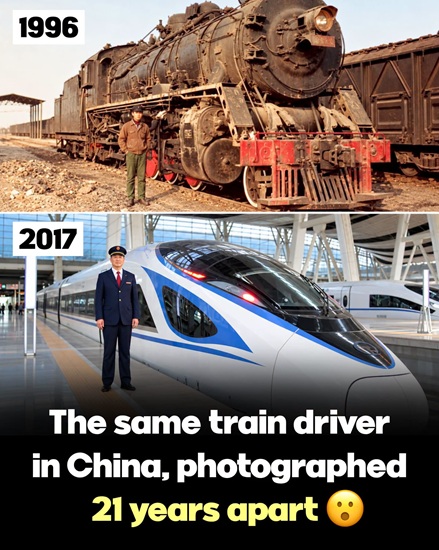
When Han Junjia entered China’s railway industry in 1992, the locomotive in front of him belonged to a very different age.
It burned coal. Its cab could be hot, dirty and uncomfortable.
And the steam locomotives he worked around traveled at only about 50 to 60 kilometers per hour.
Han was 19.
At the time, he could hardly have imagined where his railway career would eventually take him.
Decades later, he would sit inside the cab of a Fuxing high-speed train capable of operating at 350 kilometers per hour — about 217 mph.
The difference between those two machines tells an extraordinary technological story.
But Han did not simply watch that transformation from a distance.
He experienced it from the driver’s cab.
It began with steam
Han joined the railway in Zhangjiakou in 1992.
He initially worked with steam locomotives, beginning as a trainee and fireman before progressing through the profession.
Driving and operating those trains required considerable physical effort.
Steam locomotive crews worked close to the enormous heat generated by the boiler.
The cab could feel intensely hot, yet the side windows also had to remain open so crew members could watch the railway line and signals.
That created an unusual contrast.
Summer meant heat and sweat.
Winter brought freezing air through the open windows while the boiler remained hot nearby.
Coal dust and smoke were simply part of the job.
And there was another major difference from the trains Han would eventually operate.
Technology offered far less assistance.
Drivers and crew members had to depend heavily on their own observation, training and experience.
Han had achieved his childhood ambition of working on trains.
But the railway around him was already beginning to change.
And the first major transformation arrived only a few years later.
From steam to diesel
By the mid-1990s, steam locomotives were disappearing from many Chinese railway operations as diesel and electric locomotives became increasingly important.
In 1996, Han moved into diesel locomotive operation.
Compared with steam, the difference was dramatic.
Diesel locomotives eliminated much of the coal ash and smoke associated with the older machines.
The driver’s working environment also improved.
New equipment included monitoring systems and other features that made operating conditions more manageable.
But comfort was relative.
Han recalled that diesel locomotives could be extremely noisy.
Crew members sometimes had to raise their voices simply to communicate.
Still, they were faster.
Passenger trains hauled by the diesel locomotives Han operated could reach around 120 kilometers per hour.
The young railway worker who had started around steam engines traveling roughly 50 to 60 km/h was already experiencing a very different railway.
But another transformation was underway.
The railway kept getting faster
Between 1997 and 2007, China’s railway system went through six major speed-up campaigns.
Locomotives changed.
Infrastructure improved.
Operating speeds increased.
Han had to change with them.
Every new generation of railway equipment required additional knowledge and training.
He continued qualifying on different types of locomotives rather than remaining attached to a single generation of technology.
Electric locomotives became another important part of his career.
The working environment improved again.
Air conditioning and other equipment made the cab considerably more comfortable than the steam locomotive workplace he had known in the early 1990s.
But Han’s biggest professional leap was still ahead.
It involved a type of train that would redefine railway travel in China.
A difficult career decision
China’s first high-speed railway designed for speeds of 350 km/h, the Beijing-Tianjin intercity line, opened in 2008.
The country’s high-speed era was beginning to accelerate.
Han wanted to be part of it.
In 2010, an opportunity appeared when drivers were being recruited for high-speed EMU operations associated with the Beijing-Shanghai high-speed railway.
Han had moved away from frontline driving into a technical position.
Returning to the driver’s cab required another demanding period of training.
He chose to pursue it.
And the decision came with personal sacrifices.
Railway work had already required long hours away from family, and intensive professional training could make those absences even harder.
But Han completed his training successfully.
The steam-era railwayman was becoming a high-speed train driver.
Even then, there was another goal he still wanted to reach.
Then came the Fuxing
China’s Fuxing trains represented another technological step.
The Fuxing high-speed EMUs were developed for commercial operation at speeds of up to 350 kilometers per hour on appropriate routes.
In September 2017, Fuxing trains began commercial operation at 350 km/h on the Beijing-Shanghai high-speed railway.
Han became one of the drivers entrusted with operating them.
Consider what that meant.
When he entered railway service in 1992, the steam locomotives around him typically reached only about 50 to 60 km/h.
Now he was operating a train at up to 350 km/h.
The top operating speed had increased roughly sixfold.
The driver’s workplace had changed almost beyond recognition too.
Coal and steam had given way to electronics, computers, sophisticated signaling and advanced train-control systems.
Yet the responsibility of the person in the cab remained enormous.
Thousands of passengers depended on railway crews to complete journeys safely and punctually.
Han had spent years preparing for precisely that responsibility.
His licenses tell another version of the story
By 2018, reports about Han’s career noted that he had obtained eight locomotive-driving licenses while progressing through different generations of railway equipment.
He had worked across steam, diesel and electric locomotives before moving into EMUs, including Hexie and Fuxing trains.
Later reports showed that his experience continued expanding.
By 2024, Chinese reporting described Han as having operated dozens of different locomotive and train types, with his collection eventually reaching nine driving licenses.
Those licenses became more than professional qualifications.
Together, they formed a timeline.
Each represented another stage in railway technology and another period when Han had to learn something new.
That willingness to keep learning may be one of the most remarkable parts of his story.
Because the technology never stopped moving.
Speed changed more than the trains
Faster railways also changed everyday life for railway workers.
Han has spoken about how demanding schedules affected time with family.
In earlier periods, longer journeys meant longer stretches away from home.
As trains became faster, some routes required considerably less time.
That did not eliminate the sacrifices of railway work.
But it changed what was possible.
A journey that once consumed a huge portion of a worker’s day could eventually be completed much more quickly.
For Han, technological progress was therefore not something visible only on a speedometer.
It could also be measured in time.
Time on the railway.
And sometimes, time returned to family.
The network around him was transforming too
Han’s career unfolded during a period of enormous expansion in China’s rail system.
When China’s first high-speed services began operating, the network was only at the beginning of its rapid development.
The following years brought thousands of kilometers of new high-speed lines.
By the end of 2025, China’s operational high-speed railway network had reached approximately 50,400 kilometers, according to figures reported by the country’s national railway operator.
That makes it the world’s largest high-speed rail network.
China’s total operational railway mileage had also reached approximately 165,000 kilometers.
Those figures are much larger than the numbers commonly quoted in older accounts of Han’s career.
And that difference itself illustrates how quickly the story continued developing.
More than three decades in one driver’s cab
There is something unusual about Han Junjia’s career.
Many people can look at old photographs of steam locomotives and compare them with today’s high-speed trains.
Han can remember working with both.
He entered railway service when steam locomotives were still part of everyday operations.
He transitioned to diesel.
Then electric locomotives.
Then high-speed EMUs.
Eventually, he operated Fuxing trains at speeds that would have seemed extraordinary when his career began.
In later years, he was also involved with newer high-speed railway operations and testing.
The machines changed repeatedly.
The railway changed around them.
And Han kept qualifying to operate the next generation.
That is what makes his story more than a simple comparison between an old train and a new one.
It is a career measured against technological change.
In 1992, Han Junjia was a 19-year-old railway worker entering the fading world of steam.
Decades later, he could look through the windshield of a Fuxing high-speed train traveling at up to 350 kilometers per hour.
Same profession.
Same fascination with trains.
A completely different railway.
Han did not merely live through that transformation.
For more than three decades, he had one of the best seats from which to watch it happen.
The driver’s seat.
