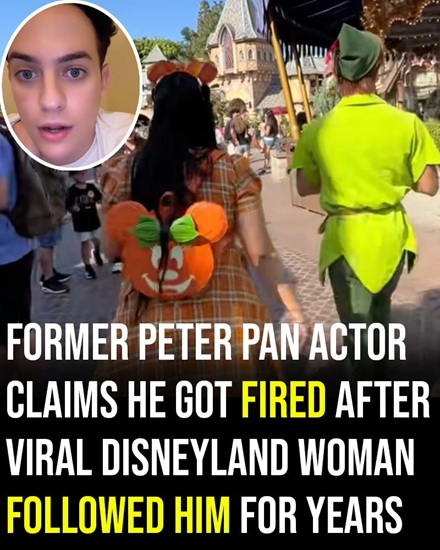
A longtime Disneyland fan has unexpectedly found herself at the center of a major online debate after videos documenting her interactions with performers portraying Peter Pan began circulating widely on social media. Toni Kulusich, a 27-year-old content creator from the Los Angeles area, has shared Disney-related videos for years, including encounters with different cast members portraying the famous character. What she considers a joyful part of visiting Disneyland has recently been interpreted very differently by millions of people online.
Toni’s videos did not suddenly begin with the current controversy. Her social-media history includes Peter Pan interactions stretching back many years, including footage from when she was younger. In various clips, she can be seen talking with the character, walking alongside performers, posing for photographs and occasionally bringing small gifts. Because several different cast members have portrayed Peter Pan over the years, the videos document interactions with the character rather than a single performer throughout the entire period.
One recent video dramatically increased public attention.
As clips spread beyond Toni’s existing audience, viewers who were unfamiliar with the history of her Disney visits began analyzing her interactions. Some interpreted the videos as enthusiastic participation in Disney’s character experience. Others believed certain encounters appeared uncomfortable and questioned whether repeated interactions could place pressure on employees who are expected to remain in character.
Those interpretations quickly became highly polarized.
Some social-media users began describing Toni with terms such as “stalker” and “obsessed.” Those descriptions, however, are allegations and opinions from online commenters rather than established findings about her conduct. There is no basis for presenting such labels as confirmed facts merely because they have become popular on social media.
Toni has publicly defended herself.
In recent reporting, she explained that Disneyland is an important recreational interest for her and rejected the impression that every visit revolves around finding Peter Pan. She said she had encountered Peter Pan during only seven of her previous 30 visits, challenging claims that she continuously spends her time in the park pursuing the character.
That context significantly changes some of the viral framing.
A compilation containing encounters recorded across many years can make interactions appear much more frequent than they occurred in real time. When years of footage are edited together into a short video, viewers may naturally assume the events happened much closer together.
Toni has also indicated that she enjoys many other parts of Disneyland.
Her interest in Peter Pan is highly visible because those videos have attracted attention, but they do not necessarily represent everything she does during visits to the resort.
The controversy became more complicated when people claiming experience as Disney character performers began discussing the situation.
One viral account came from a man identified online as Ryan, who said he previously worked as a Peter Pan performer. In a social-media video, Ryan claimed that he had encountered Toni while working and further claimed that he was eventually dismissed after breaking character during an interaction.
That statement should be carefully attributed.
Ryan’s description is his own account of his employment experience. Without confirmation from Disney or independently verifiable employment documentation, it should not be reported as established fact that Disney terminated him because of Toni.
That distinction is particularly important because viral stories can quickly transform a person’s allegation into an apparent fact.
Ryan said that maintaining character during repeated interactions could become frustrating. Character performers are expected to create an immersive experience for park guests, and remaining consistent with the fictional personality they portray forms an important part of that work.
From a performer’s perspective, that creates an unusual professional dynamic.
A guest is interacting with Peter Pan.
The employee, however, remains a real person performing a job.
The distinction between those two realities has become central to the online conversation.
Guests may develop affection for a fictional character and enjoy returning for new interactions. Character performers, meanwhile, have professional responsibilities and personal boundaries that continue to matter even while they are working.
Another former Peter Pan performer has provided additional context that complicates the most extreme interpretations of Toni’s behavior.
Dylan Gadeke, who has been identified as a former Disneyland Peter Pan performer and appears in older material involving Toni, discussed his own experiences publicly.
His perspective was more nuanced.
Gadeke acknowledged that some interactions with Toni could feel awkward or uncomfortable. At the same time, he reportedly distinguished her behavior from another experience he considered genuine stalking.
In describing that separate situation, Gadeke discussed a guest who allegedly learned personal information about his life outside the character, waited near an employee parking area after shifts and eventually followed members of his family around Disneyland.
That distinction matters.
Repeatedly interacting with a fictional character inside a theme park is not automatically equivalent to pursuing the private individual portraying that character outside the workplace.
This does not mean performers cannot feel uncomfortable during an authorized character interaction.
They can.
Personal boundaries still exist in professional environments.
But evaluating whether behavior crosses a serious line requires more information than slowed-down clips, screenshots or interpretations of facial expressions posted by strangers online.
Body language has become a major focus of the controversy.
Some viewers have repeatedly paused videos and argued that particular Peter Pan performers look uncomfortable. Others have pointed out that Peter Pan is intentionally portrayed with a mischievous, sarcastic and sometimes dismissive personality.
That makes interpretation difficult.
An expression that appears irritated may reflect genuine discomfort.
It may also be part of the performance.
Without testimony from the individual performer, viewers cannot reliably determine someone’s private emotional state from a few seconds of video.
Some clips also show performers initiating portions of the interaction.
Online discussions have highlighted examples in which Peter Pan approaches Toni, walks with her or otherwise participates actively in the character exchange.
Again, that does not prove how every performer felt during every interaction.
It simply demonstrates why sweeping conclusions based on selected clips should be avoided.
The debate has also expanded into a larger argument about adults who enjoy Disney parks.
The term “Disney adult” is frequently used online, sometimes neutrally and sometimes mockingly, to describe adults with a strong interest in Disney characters, theme parks or merchandise.
Toni’s viral videos quickly became incorporated into that broader cultural argument.
Some commenters used the controversy to criticize adults who visit Disney parks without children.
Others defended adult fans and argued that enjoying a theme park or fictional character is not inherently inappropriate.
These are separate questions.
Whether adults should enjoy Disney has little to do with whether a particular interaction respects an employee’s boundaries.
Adults are part of the audience Disney parks serve, and adult enthusiasm alone does not establish misconduct.
The more useful discussion concerns behavior.
Guests interacting with performers should respect physical and conversational boundaries regardless of their age or level of enthusiasm.
Likewise, employees should have workplace systems available when an interaction becomes uncomfortable or unsafe.
That principle applies far beyond Disneyland.
Actors, mascots, musicians, athletes, influencers and other public-facing workers can all experience situations in which audiences feel personally connected to them.
Social media can intensify those connections.
A short interaction that once disappeared when someone left a theme park can now be recorded, uploaded and watched millions of times.
Repeated recordings can also create the impression that viewers personally understand the relationship between two people who may have interacted only briefly in a professional setting.
That is where parasocial assumptions can become complicated.
A guest may know extensive details about a character or performer from watching online content.
The performer may know almost nothing about that guest.
Healthy boundaries require recognizing that difference.
At the same time, the current controversy demonstrates another danger: online audiences can become convinced that they understand a stranger’s motives based on viral compilations.
Toni has experienced significant criticism since the videos began spreading.
Recent reporting has described not only ordinary disagreement but also harassment and exposure of personal information connected with the backlash.
Criticizing publicly posted behavior is different from targeting someone’s private life.
Doxxing, threats and unsupported accusations do not become justified simply because a person has gone viral.
The same standard should protect the performers.
People should not identify private cast members, search for personal information about them or speculate about their lives outside work simply because they recognize them from character videos.
They are employees performing a role.
Their personal identities do not automatically become part of the entertainment experience.
This is one reason the distinction raised by former performers is valuable.
A fan returning to interact with Peter Pan is interacting with a Disney character within the environment where that character is intentionally presented to guests.
Following the employee after work or attempting to obtain private information would represent a fundamentally different type of conduct.
Those situations should not be casually treated as interchangeable.
Toni herself has said that she attempts to respect professional boundaries.
Critics remain free to examine her publicly shared videos and conclude that they personally find certain interactions excessive or uncomfortable.
But opinions should remain opinions.
Without verified evidence, descriptions such as “stalking” should not be converted into factual accusations.
The same caution applies to Ryan’s viral claim.
He has described himself as a former Disney performer and has shared his version of events.
His perspective may contribute to the conversation about what character work can feel like from the employee’s side.
But his claim that a particular interaction resulted in his termination remains his account unless independently confirmed.
Disney’s own perspective would provide important context.
At the time of the recent reporting surrounding the viral controversy, there had not been a public statement establishing that Toni violated park rules or confirming the employment story attributed to Ryan.
That absence does not prove that every interaction was appropriate.
It simply limits what can responsibly be reported as fact.
The controversy therefore contains several different layers.
There is Toni’s documented enthusiasm for Peter Pan.
There are individual performers with their own experiences.
There are millions of viewers interpreting videos without necessarily knowing the full context.
And there is an algorithmic social-media environment that rewards dramatic labels and emotionally charged conclusions.
Those factors can easily become mixed together.
The result is a story that appears simple at first but becomes considerably more complicated under closer examination.
It is reasonable to argue that theme-park employees deserve strong boundaries.
It is also reasonable to say that an adult guest can enjoy interacting with fictional characters.
Neither position requires publicly humiliating a stranger.
The most responsible standard is behavioral rather than personal.
If a guest ignores an employee’s clearly communicated boundaries, that behavior can be addressed.
If an employee needs assistance ending an interaction, workplace procedures should support that person.
But simply being unusual, enthusiastic or socially awkward does not by itself establish harassment.
Likewise, being friendly while working does not necessarily establish personal friendship.
Character performers are paid to create memorable experiences.
A guest should therefore avoid interpreting professional warmth as evidence of a private relationship unless the employee clearly establishes one outside the performance context.
Toni’s situation demonstrates how difficult that distinction can become once years of interactions are publicly archived.
A viewer can watch dozens of encounters consecutively.
The performer experienced each interaction separately, potentially months or years apart.
Context matters.
Frequency matters.
Who initiated an interaction matters.
Whether boundaries were communicated matters.
And evidence matters.
The internet often removes those distinctions because outrage travels faster than nuance.
A dramatic label can reach millions of people before anyone asks whether the underlying claim has actually been verified.
That is why the most accurate description of the current situation is not that a “Peter Pan stalker” has been exposed.
It is that a longtime Disneyland fan has gone viral because of years of Peter Pan interaction videos, prompting disagreement about fan enthusiasm and employee boundaries.
Some former performers have expressed discomfort with aspects of these kinds of interactions.
Others have offered more nuanced descriptions.
Toni has defended her behavior and disputed claims that she spends every visit pursuing Peter Pan.
Those perspectives can coexist without pretending that social media has already delivered a definitive verdict.
Ultimately, the controversy raises a useful question about public-facing entertainment.
How can theme parks preserve the playful interaction that makes character encounters popular while ensuring that employees retain meaningful personal boundaries?
That conversation is worth having.
It can happen without diagnosing Toni, attacking her private life or claiming to know exactly what every performer felt.
It can also happen without dismissing performers who say an interaction made them uncomfortable.
Both guests and employees are real people once the costumes, characters and viral videos are removed.
Respecting that reality is probably the clearest boundary of all.
