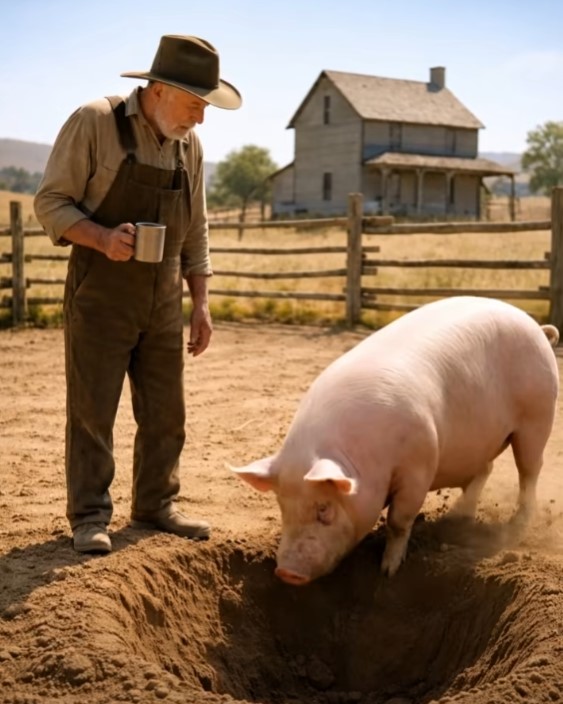
In rural environments, unexpected discoveries sometimes emerge in ways that no one could anticipate. Agricultural land, especially older properties that have changed ownership over decades, can contain hidden layers of history beneath the soil. While the following narrative is not based on a confirmed real-world case, it is inspired by realistic situations in which animal behavior, environmental changes, and routine farming activities can sometimes lead to unforeseen discoveries that require official investigation.
On a quiet countryside farm, daily life typically followed a predictable rhythm. Animals were tended to each morning, fields were maintained, and the landscape remained calm and familiar to those who lived there. Among the animals on the property was a boar, known for its strong physical behavior and natural instinct to dig and explore its surroundings. Under normal circumstances, such behavior was not unusual and was considered part of its natural activity.
However, over a period of several days, the farmer began to notice a pattern that stood out from the animal’s usual behavior. The boar repeatedly returned to a specific area of the yard and began digging with unusual persistence. Instead of moving between different parts of the enclosure, it focused entirely on one location. At first, this was dismissed as routine animal behavior, as livestock often respond to scent, moisture, or underground movement in ways that humans may not immediately understand.
As time passed, the behavior became more consistent and more intense. The same area was disturbed repeatedly, forming a noticeable depression in the soil. Attempts to fill the area did not resolve the behavior, as the animal would return shortly afterward and continue digging. This repetition created a sense of curiosity for the farmer, who began to observe the situation more closely. In agricultural settings, such patterns are sometimes associated with buried objects, water sources, or changes in soil composition.
The surrounding environment remained otherwise peaceful. The farm continued its normal operations, with no visible signs of disruption. However, the contrast between the calm surroundings and the persistent digging behavior created a growing sense of uncertainty. Over time, what began as a minor observation turned into something that required closer attention. The farmer eventually decided that further inspection was necessary to understand what was causing the repeated focus in that area.
Equipped with basic tools, the farmer approached the location and began to carefully remove soil from the disturbed area. The boar remained nearby, continuing to display interest in the activity. In trained observation of animal behavior, such responses can sometimes indicate scent detection or environmental cues that are not immediately obvious. With each layer of soil removed, the ground became harder and more compact, suggesting that something unusual might be beneath the surface.
After some time, the tool made contact with a solid object beneath the soil. The sound immediately changed the atmosphere of the situation. Instead of natural earth or stone, the resistance suggested the presence of something man-made or placed deliberately. The farmer paused and proceeded with caution, carefully removing soil from the area to better understand what had been uncovered.
As more material was cleared away, fragments of fabric-like material began to appear. The texture and condition suggested long-term burial, with significant degradation due to time and environmental exposure. The presence of such material in that location was unexpected and raised serious concern. In agricultural environments, buried human-related materials are not part of normal soil composition and often trigger further caution and investigation.
Recognizing the potential seriousness of the discovery, the farmer stopped digging further and stepped away from the site. In situations involving unknown buried materials, especially those that could be of forensic importance, standard procedure typically involves contacting authorities rather than continuing independent investigation. The farmer followed this approach and reported the findings to local officials.
Law enforcement agencies arrived at the property shortly afterward. The area was secured to ensure that the site remained undisturbed while a formal investigation was conducted. In such cases, forensic teams are usually deployed to carefully examine soil layers, document findings, and determine whether the materials are connected to any historical missing persons reports or unresolved cases.
As the investigation progressed, officials worked methodically to uncover the remains while preserving the integrity of the site. Over time, it became apparent that the materials had been buried for a significant duration. This discovery led investigators to explore historical records associated with the property, including previous ownership and any unresolved incidents reported in the surrounding area.
During the review of historical data, it was noted that the property had changed ownership multiple times over the years. In some cases, rural land can remain unchanged for long periods, allowing earlier events to fade from public awareness. Investigators began to examine whether any unresolved missing persons reports might align with the estimated timeframe of the remains discovered on the property.
As part of standard procedure, authorities reopened older case files that had previously lacked sufficient evidence for resolution. In many investigative systems, cold cases can remain inactive for years until new physical evidence becomes available. The discovery on the farm provided a potential link that required careful analysis, including forensic identification and cross-referencing with historical records.
Throughout the process, the role of environmental and animal behavior became a point of reflection. While animals do not consciously understand forensic significance, their sensitivity to scent, movement, and underground disturbances can sometimes lead to the exposure of hidden materials. In this scenario, the boar’s persistent digging activity unintentionally directed attention toward the buried location.
The presence of such behavior highlights how natural instincts can occasionally intersect with human investigation. In rural and agricultural environments, animals often respond to changes beneath the soil long before humans become aware of them. This can include shifts in temperature, scent, or physical obstruction, all of which may influence digging or movement patterns.
As the investigation continued, the property underwent careful examination to ensure no additional findings were present. Authorities documented all evidence and continued efforts to identify the remains and establish a timeline of events. Such investigations are often complex and require collaboration between forensic specialists, historical researchers, and law enforcement agencies.
Over time, the case remained under active review, with ongoing efforts to match findings with historical records. While some details began to emerge, full conclusions require careful verification and cross-referencing of multiple data sources. Investigations of this nature can take extended periods before final determinations are reached.
Ultimately, the situation serves as a reminder of how unexpected discoveries can occur in even the most ordinary environments. Rural landscapes, despite their calm appearance, can contain layers of history that remain hidden for decades. When combined with careful observation and responsible reporting, even small anomalies can lead to significant investigative developments.
