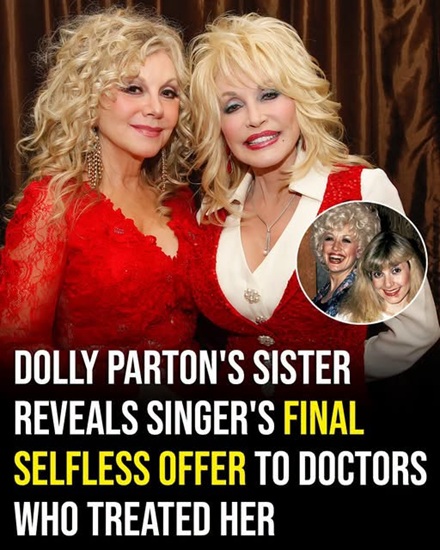
For decades, audiences around the world knew Dolly Parton as one of the most distinctive figures in popular music. Her unmistakable voice, elaborate stage costumes, humor and songwriting made her recognizable far beyond the country genre. Behind the rhinestones and enormous public career, however, family members often described a woman whose private personality was remarkably consistent with the warmth audiences saw onstage.
Her younger sister Stella Parton has now offered another deeply personal glimpse into that side of Dolly. In the days following the singer’s death, Stella remembered her sister not simply as an international superstar but as the person she regularly called before sunrise to talk, laugh and share coffee. Dolly Parton died on Tuesday, August 25, 2026, at the age of 80. Her representatives confirmed that her death followed what they described as a brief battle with cancer, although they did not disclose the specific type.
Her death came after a period in which she had publicly discussed health challenges and had reduced or postponed some professional commitments. Even during that period, reports indicated that she continued working on business, creative and philanthropic projects. The announcement triggered tributes from musicians, actors and admirers around the world who had followed her career for generations. For Stella, however, the loss was something far more personal than the death of a famous artist.
She had lost an older sister with whom she shared a connection extending back to their childhood in Tennessee. Stella, who is also a singer and songwriter, had spoken only months earlier about the importance of her relationship with Dolly and the way the two maintained regular contact despite their busy lives. Their relationship was built not around awards ceremonies or celebrity events but around familiar family routines, humor and conversation. One of those routines was an early-morning telephone call that the sisters treated almost like a weekly coffee date.

Stella said she and Dolly were both early risers and regularly spoke in the morning. They referred to those conversations as their “kaffeeklatsch,” a relaxed opportunity to drink coffee, catch up and talk about whatever was happening in their lives. They might discuss family matters, everyday events or simply gossip the way sisters sometimes do. Those calls reflected a relationship that existed far away from the public version of Dolly Parton. No stage lights were required, and no audience was listening. It was simply two sisters continuing a routine rooted in a lifetime of knowing each other.
After Dolly’s death, Stella wrote about how different Tuesday mornings would now feel. The regular conversation that had become part of her week was suddenly gone. Public grief can be expressed through concerts, memorials and millions of social-media posts, but private grief often emerges through missing routines that outsiders never knew existed. For Stella, one of those routines was coffee and conversation before the sun came up. Her tribute made clear that the absence of those calls represented one of the most immediate ways she felt the loss of her sister.
Stella’s tribute also included a remarkable story about something Dolly had reportedly said during her health struggles. According to Stella, Dolly told her that if doctors eventually reached a point where there was no hope of recovery, she would still be willing to allow her medical team to try experimental drugs. The reason, Stella said, was not that Dolly expected those treatments to save her. Instead, she hoped information gained from trying them might someday help somebody else. The account came from Stella’s recollection of a conversation with her sister rather than from a medical announcement, so it should be understood specifically as Stella’s testimony about what Dolly told her.
That distinction is important. There has been no public confirmation from Dolly’s medical team describing a specific experimental-drug protocol that she actually received. Stella’s story concerns Dolly’s willingness to participate if her own prospects for recovery disappeared. It reveals an intention rather than a documented clinical procedure. Presenting the account carefully does not diminish its emotional impact. In fact, understanding exactly what Stella said makes the story more meaningful because it shows the way Dolly was reportedly thinking about other patients even while confronting her own illness.

For Stella, the conversation perfectly reflected the sister she had known throughout her life. She described Dolly as unusually generous, thoughtful and kind and suggested that the public personality people admired was not a carefully manufactured stage character. According to Stella, the compassion audiences associated with Dolly was genuinely part of the way she treated people privately. That observation helps explain why so many tributes following Dolly’s death focused not only on her music but also on her charitable work. Her reputation for generosity had been built across decades rather than during the final period of her life.
Dolly’s philanthropy became nearly as recognizable as some of her most famous songs. Perhaps the best-known example is her Imagination Library, the book-gifting program created through the Dollywood Foundation in 1995. The initiative began with a focus on children in the area where Dolly grew up before expanding dramatically over the following decades. By the time of her death, the program had distributed hundreds of millions of books and was serving children in several countries. The project was inspired partly by Dolly’s father, Robert Lee Parton, who could not read or write.
The connection with her father gave the literacy program special meaning for Dolly. She repeatedly described him as an intelligent and hardworking man whose lack of literacy limited opportunities available to him. Instead of allowing that family experience to remain only a painful memory, Dolly turned it into a project intended to help young children develop a relationship with books early in life. Over time, the Imagination Library became one of the most significant parts of her philanthropic legacy. It also demonstrated a pattern that appeared repeatedly throughout Dolly’s life: she often tried to transform personal hardship into something useful for someone else.
Her charitable interests extended beyond literacy. Dolly supported disaster relief after devastating fires in East Tennessee, contributed to medical research and assisted a variety of community initiatives. One of her most widely discussed medical donations came in 2020, when she contributed $1 million to Vanderbilt University Medical Center for coronavirus research. Her gift supported work connected with research that contributed to development of the Moderna COVID-19 vaccine. The donation received enormous attention, but Dolly generally spoke about it in a modest way, emphasizing that she was simply glad to help where she could.
Against that background, Stella’s account of the experimental-drug conversation does not appear completely disconnected from Dolly’s earlier behavior. According to her sister, even the possibility that doctors might learn something useful from her own treatment appealed to Dolly because the knowledge could eventually benefit another patient. There is no public evidence establishing whether such experimental treatment ultimately occurred, and that should remain clear. But the willingness Stella described fits with a much larger documented pattern of Dolly supporting causes she believed could improve other people’s lives.
Stella described that generosity as something intrinsic to her sister’s character rather than a public-relations strategy. Dolly’s enormous fame certainly gave her unusual financial resources and influence, but those resources became tools she repeatedly used in charitable projects. She donated money, created programs and attached her name to efforts designed to draw attention toward causes rather than simply herself. The scale of the work changed as her career grew, but the impulse to help was something relatives associated with the personality they knew privately.
The sisters’ childhood helps explain part of that outlook. Dolly and Stella grew up in a family of 12 children in East Tennessee. Their parents, Robert Lee and Avie Lee Parton, raised the family with limited financial resources, and Dolly frequently spoke about the crowded conditions of their childhood home. Yet she also described the household as rich in music, affection, storytelling and family bonds. Those experiences became a central part of her songwriting and public identity even after she became wealthy.
Dolly was the fourth of the 12 Parton children, while Stella was younger. Several members of the family also became involved in music, including Stella and their brother Randy. Growing up with so many siblings meant that family relationships were constantly present in everyday life. Dolly later incorporated memories of that upbringing into songs such as “Coat of Many Colors,” which drew on the family’s poverty while emphasizing the love surrounding them. Her childhood remained one of the strongest emotional foundations of her career.
For Stella, those sibling relationships carried extraordinary emotional weight. In June 2026, months before Dolly’s death, she spoke publicly about the grief she had experienced after losing three brothers: Floyd, Randy and David. Floyd died in 2018, Randy in 2021 and David in 2024. Stella explained that growing up in such a large family had created connections that remained powerful throughout adulthood. The deaths affected her deeply enough that she struggled creatively for years.
Stella described that period as a kind of emotional paralysis. Grief, she said, had interfered with her ability to write, something particularly difficult for a person whose life had been deeply connected to music. Losing siblings was not simply a series of isolated events. Each death changed a family structure built over decades. Stella especially emphasized the closeness she had shared with Floyd and the way those memories eventually found expression in her music.
After seven years without releasing new music, Stella returned in 2026 with a recording of “Stand by Me.” She described music as a form of therapy and a way of processing experiences that had previously left her unable to create. Her decision to return to recording reflected another Parton family trait: difficult emotions often found their way into music. For Dolly and Stella alike, songs could become a place where grief, memory, humor and hope existed together.
Stella had also spoken about how humor helped her and Dolly cope with difficult periods. The sisters came from a family culture in which laughter was frequently used to navigate hardship. Even serious moments could contain jokes or playful observations. Stella said this remained part of her relationship with Dolly as adults. Their early-morning calls could therefore move between grief, gossip and laughter without those emotions seeming contradictory.
That approach became particularly relevant during the difficult final years of Dolly’s life. Her husband, Carl Dean, died in March 2025 after nearly six decades of marriage. Dolly spoke publicly about the profound effect of losing the man who had been part of virtually her entire adult life. She continued working afterward, but her health also became an increasingly visible concern. Plans were postponed or canceled as she dealt with medical problems.
Reports later indicated that Dolly had been dealing with kidney and autoimmune issues before her final hospitalization. She had already acknowledged health challenges publicly and had postponed major performances while continuing to work on other projects. These problems should be distinguished from the cancer diagnosis later confirmed by her representatives. The publicly available information does not establish that the earlier health conditions caused the cancer or directly caused her death. The confirmed statement from her team was simply that she died after a brief battle with cancer.
Even as her health became more difficult, Dolly remained connected to creative and philanthropic work. Reports described her continuing involvement with projects despite reducing certain public commitments. That determination was consistent with a work ethic she had displayed throughout her career. Dolly often described herself as someone who always had another song, business idea or charitable project she wanted to pursue. Retirement never appeared to fit easily with the way she viewed herself.
Her career had already lasted nearly six decades by the time of her death. Dolly wrote thousands of songs and created some of the most recognizable recordings in country music history. “Jolene,” “9 to 5,” “Coat of Many Colors” and “I Will Always Love You” crossed generations and genres. Other artists repeatedly recorded her compositions, helping her songwriting reach audiences far beyond those who listened to her own albums.
“I Will Always Love You” provides perhaps the clearest example. Dolly originally wrote and recorded the song as a farewell to Porter Wagoner when she decided to leave his professional organization. Years later, Whitney Houston recorded an enormously successful version for The Bodyguard. The song’s second life introduced Dolly’s writing to another enormous international audience. It also highlighted something she always considered central to her identity: before almost anything else, Dolly thought of herself as a songwriter.
Her career extended well beyond recording. Dolly became a successful actor, appearing in movies including 9 to 5 and Steel Magnolias. She became a television personality and eventually a major businesswoman through projects such as Dollywood. Her ability to move between entertainment, business and philanthropy helped turn her into a cultural figure whose influence could not easily be contained within a single category.
Yet Stella’s tribute focused on something much smaller than those achievements. It focused on telephone calls. It focused on coffee. It focused on the things sisters said to one another when no audience was present. That contrast is what gives the tribute much of its emotional power. The public remembers millions of records sold; Stella remembers Tuesday mornings.
For family members, that difference is unavoidable after the death of a famous person. The world may mourn a performer, but relatives mourn someone who occupied ordinary spaces in their lives. They remember birthdays, conversations, habits and private jokes. Public memorials can be enormous while grief itself may emerge most strongly in the silence created when a familiar telephone call never comes.
Stella’s statement made that private grief visible without turning it into spectacle. She spoke affectionately about Dolly’s personality and about the routine that connected them. Her words suggested that the sister she knew privately was fundamentally consistent with the woman audiences believed they knew publicly. Dolly’s wit, generosity and concern for others were not switched off when cameras disappeared, according to Stella.
That description was echoed indirectly by many of the tributes released after Dolly’s death. Fellow performers repeatedly remembered moments in which she had encouraged them, offered advice or treated them warmly. Others highlighted her humanitarian work and her unusual ability to remain relatable despite enormous fame. The widespread reaction was therefore not centered exclusively on her musical achievements. Many people specifically remembered the way she made them feel.
Miley Cyrus, Dolly’s goddaughter, also shared an emotional tribute after her death. Their relationship combined family-like affection with a long musical connection. Cyrus remembered private conversations and described one of their final discussions as being about music and transformation. The tribute reinforced the impression that Dolly continued thinking creatively and maintaining close personal relationships even during the later period of her life.
Other entertainers described similar experiences. Reba McEntire, Carrie Underwood, Blake Shelton and numerous country artists spoke publicly about Dolly’s influence following the announcement of her death. Their tributes ranged from professional admiration to intensely personal memories. What connected many of them was the idea that Dolly combined enormous achievement with unusual warmth.
The public response also demonstrated how widely her influence had spread. Dolly began her career within country music, but by the end of her life she had become recognizable to people with little connection to that genre. Her movies reached different audiences. Her charitable work reached families who might never have attended a concert. Her songs crossed into pop and rock culture, and her personality became familiar through decades of television appearances.
Following her death, streaming of Dolly’s music surged dramatically. Reuters reported that her global audio and video streams rose to approximately 35 million on the day of her death, an increase of roughly 1,200 percent from the previous day. Songs such as “Jolene” and “9 to 5” were among those receiving renewed attention. The surge illustrated the way people often return to an artist’s work while processing the loss of that person.
For Stella, however, honoring Dolly meant something more than listening to songs. Her tribute encouraged people to continue the kind of generosity she associated with her sister. Rather than simply mourning Dolly, Stella suggested that admirers could honor her by showing kindness, offering help and using whatever resources they had to support other people. In her view, that would preserve something more important than celebrity.
That message closely matches the documented pattern of Dolly’s philanthropy. Her charitable work often involved practical assistance rather than symbolic gestures. Books were physically delivered to children. Money was provided to families affected by disasters. Research institutions received funding. Dolly’s fame amplified those efforts, but the underlying idea was direct: identify a need and help if possible.
The experimental-treatment story, as Stella described it, represents the same principle in a particularly personal form. Dolly reportedly imagined that even her own illness might produce useful knowledge for someone else. Whether doctors ultimately pursued such treatment has not been publicly documented. The importance of Stella’s recollection lies in the intention she attributes to her sister: even while facing the possibility that treatment could no longer help her personally, Dolly was reportedly thinking about the people who might come afterward.
It is worth being precise about what experimental treatment means in medicine. New therapies generally go through carefully regulated stages of research designed to evaluate safety and effectiveness. Patients may sometimes participate in clinical trials when they meet particular eligibility requirements, but participation is governed by medical and ethical protocols. Stella did not provide details about a specific trial, medication or treatment program. Therefore, the story should not be interpreted as evidence that Dolly became part of a particular clinical experiment.
Nor should the account be used to promote unproven treatments generally. Dolly’s reported willingness to help research is different from claiming that an experimental drug is safe or effective. Medical decisions involving investigational therapies depend on individual circumstances and professional oversight. Stella’s story is primarily about generosity and intention, not a recommendation about cancer treatment.
This distinction is particularly important because Dolly’s specific cancer diagnosis has not been publicly disclosed. Her representatives confirmed a brief battle with cancer but did not announce the type. Without that information, claims about the treatment she received or what medications would have been appropriate would be speculation. Responsible coverage should therefore remain within the boundaries of what her representatives and family actually shared.
The family’s account gives the story emotional context without replacing medical evidence. Stella knew her sister and could report conversations they had. Dolly’s representatives could confirm the broad cause of death. Medical specifics remain private unless the family or treatment team chooses to release them. Those different levels of information should not be mixed together.
The same care applies to descriptions of Dolly’s final days. Reports indicate that she was hospitalized shortly before her death and had been dealing with several health problems. Her team later confirmed cancer as the illness associated with her death. But reconstructing every medical event surrounding her final days would require information that has not been publicly released.
What can be discussed more confidently is the broader trajectory of her life. Dolly grew up with very little money and became one of the most successful entertainers of her generation. Her career provided wealth and influence far beyond anything her childhood circumstances would have suggested. Rather than hiding those origins, she repeatedly incorporated them into her songs and storytelling.
Her family remained central to that identity. She spoke frequently about her parents and siblings, and many of her songs drew directly from childhood memories. Even after becoming internationally famous, Dolly kept returning to the Tennessee mountains and to stories about the household that shaped her. That connection made Stella’s memories of morning coffee particularly fitting. Behind decades of transformation, the sisters still maintained routines that seemed rooted in their earliest years.
Stella’s own experiences with grief also make her latest loss especially difficult. Before Dolly’s death, she had already buried several siblings. Floyd, Randy and David had all died during the years preceding 2026, while another brother, Coy, died in July 2026. The Parton family that had once contained 12 children had therefore experienced repeated losses.
Only months before Dolly died, Stella explained how losing brothers had affected her creativity. She said the grief created a kind of emotional paralysis and contributed to years without releasing new music. The return to recording became part of her attempt to process that pain. Dolly’s death added another profound loss to a period that had already required Stella to confront repeated changes within the family.
The sisters had apparently relied partly on each other during those difficult years. Stella spoke in June about how she and Dolly used humor to cope with hardship. Laughter was something they associated with their mother’s influence and with the Parton family’s approach to difficult circumstances. Humor did not eliminate grief; it simply provided another way of carrying it.
That mixture of humor and resilience was also central to Dolly’s public image. She frequently made jokes about her appearance, her wigs and the exaggerated glamour that became part of her brand. The self-deprecating humor allowed her to participate in the joke rather than simply becoming its target. Audiences could laugh with her because she so clearly understood the theatrical nature of the image she had created.
Beneath the humor was a highly disciplined businessperson and songwriter. Dolly maintained ownership interests in much of her work, made strategic professional decisions and expanded her career into multiple industries. The combination of glamour and practical intelligence became one of the characteristics that made her unusually difficult to categorize.
Her generosity existed alongside that business skill rather than in opposition to it. Dolly understood the value of the fortune and influence she had created. She could use those resources for projects such as Dollywood while also directing money toward philanthropy. The same person who negotiated professionally could donate personally.
This balance helps explain why Stella insisted that the world had essentially seen the real Dolly. The costumes were theatrical, but the underlying personality was not necessarily an invention. According to her sister, generosity and compassion were characteristics Dolly carried into private life.
The public persona certainly exaggerated some visual elements. Dolly openly discussed wigs, makeup and clothes as part of the show. But exaggerating appearance is different from inventing character. Stella’s tribute suggests that the kindness audiences perceived beneath the glamour remained present when the performances ended.
That distinction may help explain Dolly’s unusually broad appeal. Celebrities often become distant as fame increases. Dolly somehow maintained the image of someone approachable even after decades of enormous success. Whether audiences actually knew her personally was irrelevant; they felt that they understood the values she projected.
After her death, many tributes used words such as kindness, generosity and authenticity as often as they mentioned her voice. That is unusual for an artist with such a large catalog of famous songs. It suggests that Dolly’s reputation had expanded beyond artistic achievement into something closer to a cultural identity.
Stella’s tribute therefore fits into a much larger pattern. It is a family member’s account, not independent proof of every private conversation. But it offers insight into how someone who knew Dolly for an entire lifetime interpreted her character.
The detail about experimental drugs is especially memorable because it brings that character into a moment when Dolly herself was vulnerable. Philanthropy is easier when a person is healthy and wealthy. According to Stella, Dolly’s instinct to help remained present even when her own medical prospects were uncertain.
That is the part of the story Stella appeared to want people to remember. Not simply that Dolly faced cancer or that her health deteriorated, but that she continued thinking beyond herself.
For Stella, honoring Dolly meant translating that principle into ordinary life.
Few people have Dolly Parton’s fortune.
Few have her celebrity.
Almost nobody has an audience of the same size.
But generosity does not always require those things.
It can involve time.
Attention.
A conversation.
Helping someone through a difficult period.
Supporting a cause.
Offering resources when possible.
That was the spirit behind Stella’s request that people follow her sister’s example.
The message shifts attention away from the impossible task of reproducing Dolly’s career and toward something much more accessible.
People cannot become Dolly Parton.
They can choose to be kind.
That idea may ultimately be one of the strongest links between Dolly’s private and public legacies.
Her career will remain measurable through recordings, awards and ticket sales.
Her charitable programs will remain measurable through books distributed and money donated.
But the effect of personal kindness is much harder to calculate.
Stella’s memories belong to that less measurable part of the legacy.
The Tuesday calls did not generate headlines while they were happening.
There were no cameras documenting two sisters drinking coffee before dawn.
Yet after Dolly’s death, those conversations became some of the memories Stella valued most.
That is often how grief works.
The enormous achievements remain visible to everyone.
The smallest routines become priceless to the people closest to the person who died.
For Stella, Tuesday morning will now carry an absence no public memorial can fill.
For millions of listeners, Dolly’s absence may be felt differently.
A song may suddenly sound different.
A movie may carry more nostalgia.
A visit to Dollywood may become a reminder of the person whose name it bears.
A book arriving through the Imagination Library may represent another piece of her continuing influence.
Different people will encounter the legacy in different ways.
The sister who shared childhood and morning coffee has a perspective nobody else can have.
That perspective is what makes Stella’s tribute valuable.
It reminds audiences that an icon can still be somebody’s sibling.
It also reminds them that fame does not eliminate ordinary family relationships.
Dolly Parton spent most of her adult life surrounded by extraordinary public attention.
Yet one of the people closest to her remembers something as simple as calling before sunrise with coffee nearby.
In those conversations, there was no Queen of Country Music.
There was Dolly.
A sister.
A confidante.
Someone to laugh with.
Someone to make plans with.
Someone whose absence now changes an ordinary Tuesday morning.
The story about experimental treatment adds another dimension to that memory.
If Stella’s recollection accurately reflects their conversation, Dolly was still imagining how her circumstances might help another person even while discussing the possibility that doctors could no longer help her.
There is no need to exaggerate that account.
There is no need to claim she participated in a particular clinical trial without evidence.
There is no need to invent details about medications or treatment.
The statement itself is powerful enough.
Her sister says Dolly was willing.
That willingness is what Stella wanted people to understand.
It was consistent, in her view, with a lifetime of giving.
That lifetime included books for children.
Support for families recovering from disasters.
Contributions to medical research.
Encouragement offered to younger performers.
Financial assistance delivered without turning every gesture into a publicity campaign.
And countless smaller acts that never entered the public record.
No biography can document all of those moments.
Neither can a tribute.
But Stella’s story provides one small window.
As Dolly’s health failed, according to her sister, the instinct to think about other people remained.
That is why Stella’s account has resonated so strongly after her death.
It does not depend on another award or chart record.
It depends on character.
Dolly Parton’s artistic achievements are already secure.
She wrote songs that will continue being performed.
She created recordings that remain part of country music history.
She crossed successfully into film, television and business.
Her philanthropy created institutions capable of continuing beyond her lifetime.
Those accomplishments need no embellishment.
The final account offered by Stella adds something different.
It suggests that the generosity associated with Dolly’s public life remained present during a deeply private medical struggle.
Because the story comes from Stella, it should remain attributed to her.
Because no clinical details have been released, the medical conclusions should remain limited.
And because Dolly’s representatives disclosed only a brief battle with cancer, speculation about the exact diagnosis should be avoided.
That factual restraint leaves plenty of room for the emotional truth of Stella’s remembrance.
Her sister is gone.
Their weekly call is gone.
A family that has already experienced repeated losses is grieving again.
And millions of people who never met Dolly are also confronting the end of a career that stretched across most of their lives.
The scales of those losses are different.
They should not be confused.
Public grief belongs to admirers.
Private grief belongs most deeply to family and friends.
Stella’s tribute allows a brief glimpse into that private world without claiming to speak for everyone who knew Dolly.
It also offers a simple way of understanding the legacy she hopes will continue.
Not through imitation of the wigs.
Not through copying the stage costumes.
Not even necessarily through music.
Through kindness.
Through generosity.
Through noticing someone else’s need.
Through trying to leave another person’s life slightly better than it was before.
Dolly had extraordinary resources with which to do that.
Most people do not.
But Stella’s message was about the principle rather than the scale.
The same principle appears in the story about the doctors.
According to Stella, Dolly could imagine reaching a point when medicine might no longer save her.
Even then, she apparently asked whether her circumstances could teach doctors something useful.
The exact medical circumstances remain private.
The intention, as Stella remembers it, is clear.
That is why the story provides such a powerful final portrait.
The public knew Dolly Parton through music, laughter, rhinestones and an unmistakable voice.
Her sister knew all of that too.
But Stella also knew the woman on the other end of the phone before sunrise.
The woman drinking coffee.
The woman exchanging family gossip.
The woman carrying years of shared memories.
And, according to Stella, the woman who was still wondering how she might help somebody else even while facing the end of her own life.
That is the Dolly Parton Stella has asked people to remember.
Her music will continue without effort from the public.
The recordings already exist.
Her films remain available.
Her songs will continue to be covered by new artists.
Her charitable institutions can continue their work.
But the part of her legacy centered on kindness requires individual choices.
That is the challenge Stella placed before those mourning her sister.
Remember Dolly.
Listen to the songs.
Celebrate the extraordinary career.
But also notice the person who needs help.
Give when possible.
Be thoughtful.
Use whatever influence or resources are available for something beyond yourself.
For Stella, that was not simply something Dolly preached.
It was who she believed her sister actually was.
The world saw the glitter.
The family saw the same person underneath it.
And in Stella’s telling, even near the end, Dolly Parton’s attention was still capable of turning outward.
That may be one of the simplest and most enduring ways to remember her.
