For many people, popping a pimple feels like the fastest possible solution to an annoying skin problem. A blemish appears, pressure builds beneath the skin, and the temptation to squeeze it can be difficult to resist. In most cases, the result is more likely to be increased redness, irritation, or a scar than a medical emergency. Dermatologists nevertheless recommend leaving pimples alone whenever possible because squeezing can push material deeper into the skin and create a small wound through which bacteria can enter.
One area of the face deserves particular caution because of its anatomy: the region extending approximately from the bridge of the nose to the corners of the mouth. Doctors sometimes refer to it as the facial “danger triangle.” The dramatic nickname can make the risk sound much more common than it actually is. Popping a pimple in this area does not mean that bacteria will automatically travel into the brain, nor does it mean someone is likely to develop a life-threatening condition.
Serious complications are considered rare, especially in the era of modern antibiotics. The reason doctors remain cautious is that veins in the central face have anatomical connections with structures deeper inside the head, including the cavernous sinus behind the eyes. In uncommon circumstances, an infection originating in the nose or central face can spread through these pathways and cause serious illness.
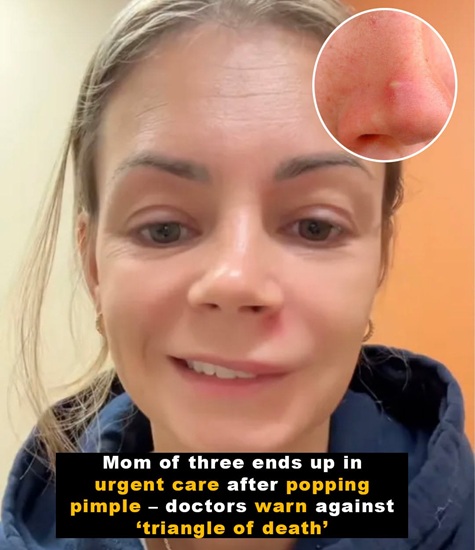
This warning received renewed attention after a woman named Lish Marie shared her experience publicly in 2025. Marie, described in reports as a mother of three, said she noticed what appeared to be a cystic pimple just below one of her nostrils. Like many people facing an uncomfortable blemish, she squeezed it. At first, she apparently did not consider the action particularly significant. Within several hours, however, she said the area became increasingly painful and swollen.

Marie later described noticing an unusual change when she attempted to smile. According to her account, one side of her face moved normally while the swollen side did not move in the same way. She also described substantial facial pain. Concerned by the rapid change, she sought urgent medical attention rather than waiting to see whether the problem disappeared on its own. That decision allowed clinicians to evaluate her quickly.
Reports about the incident said Marie was given four prescription medications, including antibiotics and steroids. She later said she believed she had sought treatment very quickly, within hours of noticing the worsening symptoms. Her condition began improving soon afterward, and accounts of her recovery said she was feeling significantly better the following day and had returned close to normal within several days. Her experience became widely shared as a cautionary example about manipulating inflamed lesions around the nose.
It is important, however, not to turn one person’s experience into a prediction for everyone who has ever squeezed a blemish. Millions of people manipulate acne without developing an intracranial infection. Medical experts quoted in discussions of the facial danger triangle emphasize that severe outcomes are unusual. The useful lesson from Marie’s experience is not that every nose pimple is potentially fatal, but that rapidly worsening swelling, pain, redness, fever, neurological symptoms, or problems involving the eyes deserve medical attention.
To understand the concern, it helps to understand the anatomy behind the nickname. The facial danger triangle is generally described as the region extending from the bridge or upper part of the nose downward toward the corners of the mouth. Definitions vary slightly, but all center on the nose and nearby central face. Veins in this area communicate with deeper venous structures, including the cavernous sinus. The cavernous sinus is a venous channel located behind the eyes near the base of the brain.
Most veins in the body move blood through a network that does not allow a superficial skin infection to reach the brain easily. The central face has anatomical connections that make doctors more cautious about infections in this region. If bacteria cause a significant infection and spread through the surrounding venous system, they can in rare cases contribute to a condition called septic cavernous sinus thrombosis. This means infection is associated with a blood clot forming in the cavernous sinus.
Cavernous sinus thrombosis is a genuine medical emergency, but it remains uncommon. The condition is more typically associated with bacterial infections involving the face, nose, teeth, eye socket, or sinuses rather than simply the existence of an ordinary acne blemish. The MSD Manual notes that facial infections, nasal boils, orbital cellulitis, and certain sinus infections can spread and cause cavernous sinus thrombosis. Staphylococcus aureus is one of the bacteria commonly associated with these infections.
The symptoms of cavernous sinus thrombosis are much more serious than the ordinary redness surrounding a pimple. Early symptoms can include severe or progressively worsening headache and facial pain. Fever is common. As the condition progresses, swelling around the eyes, bulging of the eyes, and difficulty moving the eyes can develop. Neurological symptoms may also occur because several important nerves pass through or close to the cavernous sinus.
Those symptoms help explain why a rapidly worsening infection around the nose or eyes should not simply be ignored. A mildly irritated pimple after squeezing is quite different from severe swelling, fever, escalating pain, visual disturbance, or problems moving the face or eyes. The presence of concerning symptoms should be evaluated by a healthcare professional rather than diagnosed through social media posts or online photographs.
Dermatologists also emphasize that there are much more common reasons to avoid popping pimples, regardless of where they appear on the face. The American Academy of Dermatology explains that squeezing can push pus, dead skin cells, and bacteria deeper into the skin rather than removing everything cleanly. That additional pressure can increase inflammation. The result may be a pimple that becomes larger, more painful, or more noticeable than it was before someone touched it.
Scarring is another important concern. When someone aggressively squeezes or digs into inflamed acne, the additional trauma can damage surrounding tissue. The more inflamed a breakout becomes, the greater the possibility that a persistent mark or scar may remain after the lesion heals. The American Academy of Dermatology specifically recommends avoiding picking, popping, scratching, and squeezing because these behaviors increase the risk of inflammation, discoloration, infection, and acne scarring.
This advice is particularly relevant for deep, painful acne nodules and cysts. These lesions form deeper in the skin than simple superficial whiteheads. Trying to force their contents outward may cause more inflammation without successfully draining the lesion. Dermatologists advise keeping hands away from deep painful pimples because squeezing them can make them more visible and increase the likelihood of infection, discoloration, and scarring.
The natural temptation to pop a pimple usually comes from wanting it to disappear quickly. Unfortunately, squeezing often produces the opposite result. The surrounding skin may become redder and more swollen immediately afterward. A lesion that might otherwise have healed relatively quietly can become irritated for several days. If bacteria enter damaged skin, a localized infection may also develop.
Hands themselves are another potential source of bacteria. People touch keyboards, phones, door handles, clothing, and countless other surfaces throughout the day. Touching an inflamed lesion without washing the hands first can introduce microorganisms into broken skin. Even clean hands cannot eliminate the mechanical damage caused by squeezing too aggressively, but poor hygiene increases another avoidable source of risk.
The skin normally serves as an effective physical barrier. When intact, it helps prevent many microorganisms from entering deeper tissue. Popping or picking at acne deliberately disrupts that barrier. The opening may be tiny, but it is still a wound. Most such wounds heal without serious consequences, yet avoiding unnecessary damage is generally safer than creating it in the first place.
Dermatologist Dr. Mark Strom has drawn attention to the danger triangle in public educational videos. He has explained that the central face contains venous connections to the cavernous sinus and therefore recommends avoiding at-home extraction of pimples in this area. His warning is consistent with broader medical guidance that infections in the nose and central facial region can, in rare cases, spread to deeper structures.
The wording used in some viral stories about this anatomy can nevertheless be misleading. Statements suggesting that veins run “directly to the brain” can sound as though bacteria from every squeezed pimple immediately enter brain tissue. That is not what usually happens. The medically relevant point is that venous connections create a possible route by which an established infection could spread. That possibility is unusual but serious enough to justify caution.
The cavernous sinus itself is not simply a pipe carrying bacteria into the brain. It is a complex venous structure located near important nerves and blood vessels. When infection reaches the area, inflammation and clot formation can damage surrounding structures. That is why cavernous sinus thrombosis can affect eye movement, vision, facial sensation, and other neurological functions.
Before antibiotics were widely available, infections involving the cavernous sinus were especially dangerous. Modern antibiotics have greatly improved treatment, but the condition can still be life-threatening and therefore requires urgent medical care. Cleveland Clinic describes cavernous sinus thrombosis as rare but serious and notes that it can develop in response to infection involving the face or head.
This does not mean people should become frightened every time they notice acne around the nose. Most pimples are not medical emergencies. Acne is extremely common, and routine breakouts can usually be managed with ordinary skin-care measures or appropriate acne treatments. The goal of understanding the danger triangle is sensible caution rather than fear.
Someone who has already squeezed a pimple in this region also does not need to assume a severe infection will follow. The most appropriate response is to leave the area alone afterward, keep it clean, and watch for worsening symptoms. Repeatedly squeezing the same lesion usually causes additional irritation rather than helping it heal faster. The absence of severe or progressive symptoms is reassuring, although individual medical concerns should always be discussed with a qualified healthcare professional.
Signs that deserve greater attention include redness or swelling that spreads rapidly instead of gradually improving. Increasing warmth, worsening pain, drainage, or fever can suggest infection. Significant swelling around the nose or eyes is also more concerning than ordinary pimple inflammation. If symptoms are severe, rapidly worsening, or associated with feeling systemically ill, medical assessment is appropriate.
Eye symptoms are especially important because of the anatomy of the central face and cavernous sinus. New difficulty moving an eye, swelling around the eye, bulging of an eye, double vision, visual changes, or intense pain around or behind the eye requires prompt evaluation. These symptoms can occur with serious conditions such as orbital cellulitis or cavernous sinus thrombosis and should not be managed through home pimple treatments.
A severe headache accompanied by fever and rapidly worsening facial or eye symptoms is another situation where urgent medical assessment is warranted. These symptoms do not automatically mean that an infection has reached the cavernous sinus, but they are outside the range of an ordinary uncomplicated blemish. Early treatment of serious bacterial infections generally provides a better opportunity to prevent complications.
For ordinary pimples, dermatologists offer much less dramatic alternatives to squeezing. Acne treatments containing ingredients such as benzoyl peroxide or salicylic acid can be helpful for some types of breakouts. Hydrocolloid patches are another popular option for certain superficial lesions because they cover the area and may reduce the temptation to repeatedly touch it. Treatment depends on the type of acne, and deep cystic or recurring acne may require professional evaluation.
Warm compresses may sometimes be used to help soothe a painful lesion without traumatizing the skin. A clean cloth with comfortably warm water can be applied gently rather than squeezing the pimple between the fingers. The goal is not to force material out but to reduce discomfort while allowing the lesion to heal.
For deep nodules or cysts that repeatedly occur, a dermatologist can offer treatments that are safer and more effective than home extraction. Prescription topical medications, oral treatments, and in-office procedures are available depending on the severity and type of acne. Severe acne deserves treatment not only because it can be uncomfortable but also because controlling inflammation reduces the chance of permanent scarring.
Professional extraction is also different from casually squeezing a blemish in front of a bathroom mirror. Dermatologists work with sterile equipment and can determine which lesions are appropriate to drain. They also understand how much pressure can safely be applied and when a lesion should be left alone. The American Academy of Dermatology specifically notes that acne extraction is safest when performed by a dermatologist.
Some online dermatologists have demonstrated methods intended to reduce damage if a person insists on extracting a superficial whitehead. Dr. Mamina Turegano, for example, has discussed cleaning the hands and skin, creating a very small opening with a sterile lancet, and applying extremely gentle pressure with cotton swabs rather than fingernails. She has also warned that excessive pressure increases inflammation and scarring.
That kind of demonstration should not be interpreted as encouragement to perform minor skin procedures at home, particularly around the nose. A technique that may reduce damage does not eliminate infection risk, and not every bump that looks like a pimple is actually acne. Cysts, boils, ingrown hairs, cold sores, and other skin conditions can resemble one another. A painful or unusual lesion that persists is better assessed professionally than repeatedly manipulated.
Nostril lesions deserve additional caution because some are related to bacterial infections rather than typical acne. Nasal vestibulitis, for example, is an infection near the entrance to the nostril and can sometimes produce painful sores or boils. Cleveland Clinic notes that complications involving this region can become serious when infection spreads, although that is uncommon with appropriate treatment.
This is another reason the advice “just pop it carefully” is too simplistic. A person may not know whether a bump is a whitehead, inflamed follicle, cyst, boil, or another condition. Manipulating an infected boil can potentially worsen inflammation and spread bacteria into nearby tissue.
Marie’s widely shared experience illustrates this uncertainty. She reportedly believed she was dealing with an ordinary cyst-like pimple. Only after swelling and pain developed did she realize that the situation required medical attention. Her decision to seek care promptly appears to have been important to her rapid recovery.
Her story also demonstrates one of the benefits and risks of health information spreading through social media. A personal account can alert people to a genuine medical concept they had never heard about. At the same time, dramatic terminology such as “triangle of death” can encourage exaggerated interpretations. The safest approach is to use personal stories as prompts to learn from reliable medical sources rather than treating a viral video as a substitute for medical guidance.
The central scientific point is straightforward. Infections in the middle portion of the face have anatomical pathways that, very rarely, can allow infection to spread toward the cavernous sinus. That is why physicians traditionally pay special attention to significant infections involving the nose and upper lip.
The practical point is even simpler. There is little benefit to aggressively squeezing a pimple and several possible disadvantages. It can increase inflammation, push material deeper, prolong healing, increase discoloration, create scars, and sometimes introduce or spread infection.
For pimples inside the danger triangle, the balance favors leaving them alone even more strongly. The possibility of a severe complication is low, but there is no reason to take an unnecessary risk simply to make a blemish disappear a little faster. A temporary pimple is generally easier to deal with than an infection or permanent scar.
It is also useful to separate genuine warning signs from normal post-pimple irritation. A small amount of temporary redness immediately after touching a blemish is not equivalent to cavernous sinus thrombosis. Likewise, mild tenderness does not mean an infection has reached deeper structures. Serious infections usually involve symptoms that worsen rather than settle and may produce significant pain, fever, swelling, or eye-related symptoms.
Anyone worried about a rapidly changing facial infection should avoid trying to diagnose the condition by comparing photographs online. Skin tone, lighting, camera quality, and individual anatomy can make infections appear very different. Clinicians can assess the extent of swelling, temperature, pain, eye function, neurological signs, and other features that a photograph cannot reliably provide.
For people who frequently feel compelled to pick or squeeze their skin, the issue can also go beyond acne itself. Repetitive skin picking may become a difficult habit and can lead to recurring wounds and scarring. Covering blemishes with patches, keeping nails short, avoiding magnifying mirrors, and following a consistent acne treatment routine may help reduce the temptation.
A successful acne routine generally works gradually rather than instantly. Pimples form through processes occurring within hair follicles, including oil production, buildup of dead skin cells, inflammation, and bacterial activity. No amount of squeezing can reliably eliminate the underlying tendency to develop acne.
This is why people with frequent breakouts often benefit more from prevention than extraction. Depending on the individual, dermatologists may recommend topical retinoids, benzoyl peroxide, salicylic acid, or prescription therapies. Treatment choices depend on skin type, acne severity, medical history, pregnancy status, medications, and other individual factors, so professional guidance may be useful when acne is persistent.
The same principle applies to acne scarring. Preventing repeated inflammation is generally easier than treating scars after they form. Once deeper acne scars develop, they can be difficult to eliminate completely, although dermatologists have procedures that can improve their appearance. Avoiding unnecessary squeezing is one simple way to reduce additional trauma.
The phrase “danger triangle” has existed for many years because physicians recognized that central facial infections could occasionally cause severe complications. It was not invented by TikTok or recent viral stories. Social media has simply brought the concept to a much larger audience.
Modern medicine has also changed the level of risk. Effective antibiotics mean that infections capable of spreading toward the cavernous sinus can often be treated before catastrophic complications develop. Medical experts continue to warn about the condition because delayed treatment can still be dangerous, not because severe outcomes are common among people with acne.
That nuance matters when presenting health information responsibly. Saying “popping a pimple can send bacteria straight to your brain” may attract attention, but it leaves out important context. A more accurate statement is that damaging infected skin in the central face can, in rare circumstances, allow a serious infection to spread through venous pathways toward the cavernous sinus.
Similarly, blindness, stroke, neurological injury, and life-threatening infection are possible complications of severe cavernous sinus infection or thrombosis, not typical outcomes of squeezing a pimple. Presenting those outcomes without explaining their rarity can create unnecessary fear.
Marie’s case fortunately ended with recovery rather than one of those extreme complications. Her swelling and pain reportedly improved after medical treatment, and within several days she said she felt normal again. Her experience can therefore be understood as a warning about recognizing worsening symptoms and seeking timely care rather than as evidence that pimple popping routinely produces neurological emergencies.
For most people, the simplest advice remains the best: try not to pop pimples at all. Keep the skin clean without scrubbing aggressively, use appropriate acne treatment, and allow the lesion time to resolve. If a blemish is particularly painful, deep, recurrent, or located inside the nose, seek medical or dermatological advice rather than repeatedly squeezing it.
If someone does touch or accidentally open a pimple, basic hygiene becomes important. Wash the hands, avoid continued manipulation, and keep the area gently clean. Do not repeatedly dig at the lesion in an attempt to remove every visible trace of material, because that often produces more tissue injury.
Most importantly, pay attention to the overall direction of symptoms. A blemish that becomes gradually less painful and less red is different from one producing rapidly expanding swelling or worsening pain. Fever, significant facial swelling, severe headache, eye symptoms, or feeling seriously unwell should move the situation out of the category of routine acne care and into medical evaluation.
The lesson behind the so-called facial danger triangle is therefore not that people should become frightened of their own skin. It is that seemingly minor actions can sometimes create unnecessary problems, and the anatomy around the nose deserves additional respect. Serious complications remain rare, but avoiding a preventable wound in this region is easy.
A pimple may feel urgent when someone sees it in the mirror, particularly before work, school, a photograph, or an important event. From a medical perspective, however, a few days of visible acne is usually far less concerning than inflammation, infection, or a scar caused by forceful squeezing.
Marie’s experience gained attention because an ordinary habit suddenly led to a frightening medical situation. Her recovery also shows why noticing unusual symptoms and seeking appropriate care matters. She did not wait for severe symptoms to progress for days before asking for help.
For everyone else, there is an even easier option: avoid creating the problem in the first place. Dermatologists have good reason to recommend leaving pimples alone, particularly those around the nose and central face.
The “danger triangle” may have an alarming nickname, but the most useful message behind it is calm and practical. Do not panic over ordinary acne. Do not assume every facial blemish is dangerous. But avoid aggressive squeezing, recognize when a skin problem is worsening rather than healing, and seek professional care when symptoms become significant.
Most pimples will eventually heal. Giving them time, treating them appropriately, and resisting the temptation to squeeze may not provide the instant satisfaction of popping one in front of a mirror, but it is generally kinder to the skin—and in the central face, it also avoids a small but real medical risk.
