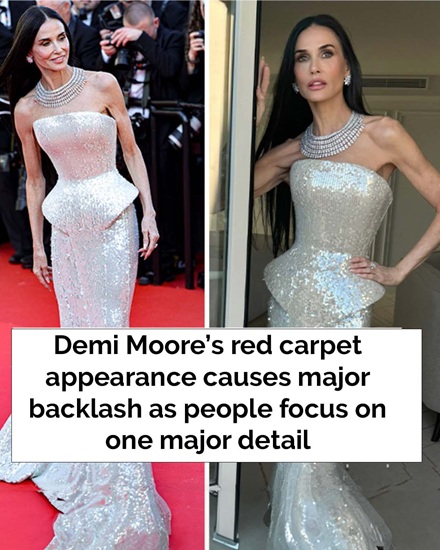
Demi Moore’s appearance at the 79th Cannes Film Festival quickly became one of the most discussed moments of the event, but the conversation that followed had less to do with fashion or cinema and more to do with body image, language, and how celebrities are discussed in the media. She attended the opening ceremony on May 12 as one of the nine jury members, arriving in a strapless sequined Jacquemus gown paired with Chopard jewelry.
On the surface, it was a classic Cannes red carpet moment, but attention online shifted almost immediately toward her visibly slim physique, particularly her arms. While some outlets described her look as “toned,” social media users strongly disagreed, sparking a heated debate about whether that description was accurate or misleading. The discussion escalated rapidly after headlines used the word “toned,” which many critics argued was being used to soften or reframe extreme thinness.
On platforms like X and Instagram, users expressed contrasting opinions, with some arguing that the media was promoting unhealthy beauty standards, while others defended Moore by pointing out that aging naturally changes body composition. The divide highlighted how subjective and emotionally charged conversations about appearance can become, especially when they involve well-known public figures.

As the debate spread, it evolved beyond Demi Moore herself and turned into a broader discussion about Hollywood’s long-standing beauty standards. Many users began comparing her appearance with other actresses known for visibly athletic builds, such as Angela Bassett, Jennifer Aniston, and Cameron Diaz, arguing that there is a clear difference between having visible muscle tone and simply having very low body fat. The conversation revealed how differently people interpret the same visual cues depending on personal expectations and cultural influence.
Age also became a key factor in the conversation, since Moore is 63 years old. Some commenters suggested that expectations for body shape naturally shift with age, while others rejected that idea and pointed to examples of women in the same age group who maintain muscular physiques through regular strength training. This part of the debate exposed how age, fitness, and appearance are often unfairly bundled together in public discourse, even though they are influenced by many different lifestyle and biological factors.

A significant portion of the conversation also focused on the actual meaning of the word “toned.” Fitness professionals and medical experts often emphasize that “tone” is not a separate physical state but rather the visible result of muscle combined with a certain level of body fat. In simple terms, visible definition comes from maintaining muscle through resistance training while managing overall body composition, not from thinness alone. This distinction became central to the discussion as people questioned whether the term was being misused in celebrity media coverage.
Fitness specialists explain that muscle tone refers to the ability of muscles to maintain tension even at rest, which contributes to posture, strength, and movement efficiency. It is not purely a visual concept, even though it is often treated that way in popular culture. Experts also note that rapid weight loss without strength training can reduce both fat and muscle mass, sometimes leading to a more fragile or angular appearance rather than a defined or athletic look.

Exercise physiologists have also pointed out that a healthy body composition requires a balance between muscle and fat, particularly for women, where certain levels of body fat are biologically essential. This perspective added another layer to the conversation, reminding audiences that health cannot be judged solely by appearance or celebrity red carpet photos.
Celebrity trainers also weighed in on the discussion, explaining that most clients who seek “toned” arms are actually looking for visible definition through resistance training, not extreme thinness. They emphasized that exercises like weight training, bodyweight movements, and consistent fitness routines are what create muscle shape over time, rather than focusing on isolating fat loss in specific areas of the body.
Medical professionals reinforced this point by explaining that spot reduction is largely a myth. According to plastic surgeons and fitness experts, the body loses fat in a general pattern influenced by genetics, lifestyle, and overall activity levels. As a result, achieving visible arm definition requires a combination of overall fitness, hydration, nutrition, and consistent training rather than targeting a single area.
As the online debate continued, it became clear that the reaction to Demi Moore’s appearance was not just about one red carpet moment, but about how society interprets beauty, aging, and health in public figures. Some saw her look as elegant and natural for her age, while others felt the media’s language contributed to unrealistic or harmful expectations.
In the end, the discussion highlighted a larger cultural issue: how quickly visual impressions can turn into judgment, and how terms like “toned” can carry very different meanings depending on context. What began as a Cannes fashion moment ultimately evolved into a wider reflection on body image, language, and the responsibility of media in shaping public perception.
