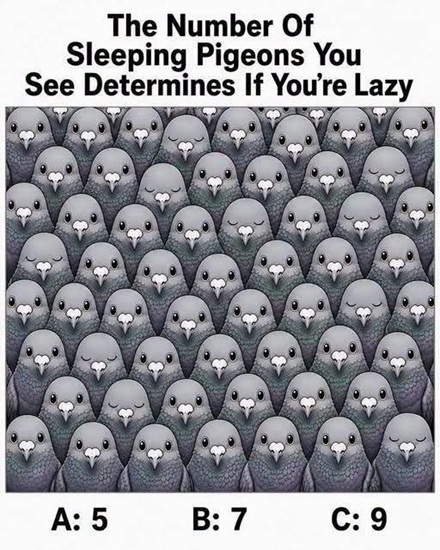
How Many Pigeons Did You Notice First? This Simple Visual Puzzle May Make You Look Twice
At first glance, the challenge seems almost too simple. Look at the picture.
Count the pigeons. Give your answer. Done.
But then someone else looks at exactly the same image and gives you a different number.
You look again.
Suddenly, you notice something you missed the first time.
That is what makes simple visual puzzles like this one entertaining.
The interesting part is not necessarily getting the “right” answer immediately.
It is discovering how easily your first impression can change when you give the same image a second look.
And before attaching any deeper meaning to your answer, there is something important to understand.
This Is a Visual Puzzle, Not a Psychological Test
Online observation challenges are often presented as though a single answer can reveal someone’s personality, intelligence or hidden psychological traits.
There is no scientific basis for making that conclusion from this pigeon puzzle.
Seeing five, seven or nine pigeons first does not diagnose a personality type.
It does not measure intelligence.
And it cannot predict how successful, creative or analytical someone is.
What it can do is give you a quick demonstration of something much more ordinary.
People do not always examine the same image in exactly the same way.
And your first count can depend on surprisingly simple factors.
Take One Quick Look Before Counting Carefully
If you have the image in front of you, try not to study it immediately.
Look briefly.
Then decide how many pigeons you think you saw.
Was your first answer five?
Seven?
Nine?
Remember that first number.
Now look again, but this time take longer.
Scan the entire picture.
Check the edges.
Look for shapes you may initially have treated as part of the background.
Did your answer change?
If it did, that does not mean your first attempt was a failure.
It demonstrates exactly why visual puzzles can be deceptive.
Your Brain Has a Lot to Process
Vision feels effortless because it happens constantly.
But seeing is not simply a matter of the eyes recording everything in front of them with equal importance.
Attention matters too.
When viewing a busy scene, people may focus on the most prominent shapes first.
Smaller or less obvious elements may receive less attention during the initial glance.
Give yourself additional time and you may begin noticing details that were present all along.
That is why the first answer and the second answer can differ.
But there is another reason two people can get different results.
They may not even be seeing the puzzle under the same conditions.
Your Screen Can Change the Experience
Imagine one person viewing the image on a large computer monitor.
Another sees it on a small phone.
A third has low screen brightness.
Someone else is standing farther away.
The underlying image may be identical, but the viewing conditions are not.
Image resolution can matter.
Screen size can matter.
Brightness and contrast can matter.
Viewing distance can matter.
Even the amount of time someone spends looking before answering can influence what they notice.
So if your friend immediately sees something you missed, there is no reason to conclude that one of you has a “better brain.”
You may simply have looked differently.
Still, comparing the first answers can be fun.
If You Saw 5 Pigeons First
Suppose your immediate answer was five.
One possible explanation is simply that those were the most visually prominent birds to you.
Perhaps you registered the main shapes quickly and answered before scanning every smaller part of the scene.
In everyday language, people sometimes describe this as looking at the “big picture.”
It can be tempting to go further and declare that anyone who sees five must therefore be a visionary, leader or creative thinker.
The puzzle cannot establish any of those things.
But it can raise an interesting question about your approach to the image.
Did you understand the overall scene first and inspect the details afterward?
If so, try another look.
There may be more waiting for you.
What If Your First Answer Was 7?
Seven sits between the other commonly suggested answers in this version of the puzzle.
If you noticed seven first, perhaps your eyes picked up the most obvious birds plus several less prominent ones.
Again, that does not scientifically establish that you have a “balanced personality.”
But your viewing process may have combined a quick overall impression with some additional scanning.
Now compare your first attempt with your second.
Did seven remain your answer?
Or did another shape suddenly begin looking like a pigeon?
That second look is where the puzzle becomes more interesting.
Because some viewers report noticing even more.
If You Counted 9
If nine was your first answer, you may simply have spent more attention on individual elements before deciding on your count.
Perhaps you scanned from one side of the image to the other.
Maybe you naturally took slightly longer before answering.
Or perhaps the smaller details were simply easier for you to see on your particular screen.
It can be fun to call this “detail-oriented.”
But the puzzle alone cannot prove that someone consistently behaves that way in real life.
A person who carefully counts pigeons in one image may rush through a completely different task five minutes later.
Human attention changes with context.
And that is part of what makes this puzzle more interesting than the personality labels often attached to it.
Try Looking at the Image Differently
There is another experiment you can perform.
Instead of asking how many pigeons you see, change the way you scan the picture.
Start at the upper-left corner and move slowly across.
Then scan downward.
Count each bird only after you have visually separated it from the surrounding shapes.
Now compare that result with your first answer.
The difference can demonstrate how a deliberate search differs from an immediate impression.
Your eyes did not necessarily improve in the space of a few seconds.
Your strategy changed.
And strategy can affect what you notice.
Why We Enjoy Comparing Answers
Puzzles like this often become social because disagreement makes them more entertaining.
One person says five.
Someone else insists there are seven.
Another person immediately announces nine.
Then everyone goes back to the image.
People begin pointing out shapes to one another.
Someone discovers a bird they had overlooked.
Someone else realizes they counted the same shape twice.
The puzzle becomes less about pigeons and more about comparing perception.
That is harmless fun as long as the interpretation stays proportionate to what the exercise can actually show.
What Your Answer Does Not Tell You
Seeing a particular number of pigeons does not establish your IQ.
It does not diagnose ADHD, autism, anxiety or another condition.
It does not reveal whether you are an introvert or extrovert.
It cannot determine whether you are a good leader.
And it cannot reliably predict your future behavior.
Those claims require evidence that a casual online visual puzzle does not provide.
That does not make the puzzle pointless.
It simply means the interesting lesson is somewhere else.
The Real Surprise Comes With the Second Look
Remember your original answer?
Now return to the image.
Do not rush.
Look at every section carefully.
Count again.
If you still see exactly the same number, compare your result with someone else’s.
If your answer changed, ask yourself what you missed initially.
Was one pigeon smaller?
Was part of another shape easy to overlook?
Did you focus so strongly on the center that you ignored the edges?
Those questions tell you more about the experience than a dramatic personality label ever could.
And that brings us to the real payoff.
The Puzzle Is Not Really About Whether You Saw 5, 7 or 9
The number makes the challenge entertaining.
But the more interesting part is what happens between your first and second look.
Your first impression feels certain.
Then you inspect the same information more carefully.
Something that was invisible to your attention suddenly becomes obvious.
Nothing in the image necessarily changed.
What changed was the way you looked at it.
That is a useful reminder far beyond a pigeon puzzle.
First impressions can be quick and useful.
They are not always complete.
Sometimes a second look confirms exactly what we thought we saw.
Sometimes it reveals something we completely missed.
So if you counted five, seven or nine pigeons, enjoy the result.
Compare it with someone else’s answer.
Then look again.
The most interesting question may not be how many pigeons you counted.
It may be how many were there all along that you simply did not notice the first time.
