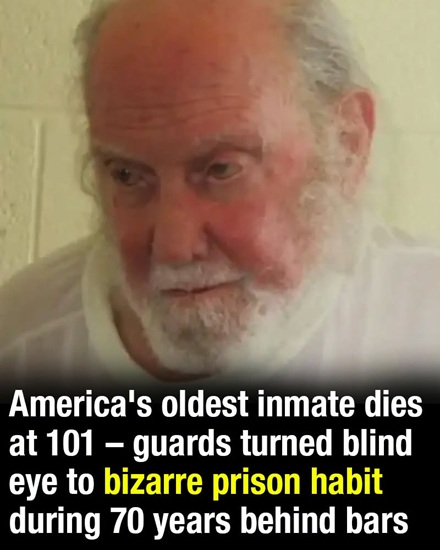
Francis Clifford Smith, believed to have been one of the longest-serving prisoners in the United States, died on June 25, 2026, at the age of 101. His life had been shaped for more than seven decades by a murder conviction, repeated legal appeals, a commuted death sentence, an escape, brief periods of parole, and eventually supervised release to a nursing facility. Smith spent the overwhelming majority of his adult life in the custody of the state of Connecticut.
By the time of his death, his case had become notable not only because of its extraordinary length but also because of the questions that had surrounded his conviction for decades. Smith was born on September 1, 1924, in Stamford, Connecticut, and later lived in the Noroton area of nearby Darien. He was 25 years old when he was charged in connection with the killing of Grover S. Hart, a night watchman at the Indian Harbor Yacht Club in Greenwich.
Hart was shot and killed in the early morning hours of July 23, 1949, during what authorities determined was a robbery at the club. Smith was later convicted of first-degree murder. The case would go on to follow him for the rest of his life. Court records from the case show that Hart was killed by a bullet fired from a .22-caliber Smith & Wesson revolver. Investigators also found another bullet and four cartridge cases that had been fired from a .22-caliber Colt automatic pistol.
That evidence suggested that at least two people were involved in the crime. George F. Lowden was also connected to the killing and later pleaded guilty to second-degree murder. Smith, however, was convicted of first-degree murder and sentenced to death. The evidence against Smith was largely circumstantial, and doubts about the case emerged both during and after his legal proceedings.
Among the evidence discussed in court were a gray Cadillac later found in Brewster, New York, items taken from the yacht club, witness testimony placing Smith near the vehicle, and other circumstances linking him to the events. Smith maintained his innocence throughout his life. Later developments in the case would raise additional questions about whether the original verdict had been correct.
One particularly important development came when another man, Charles Blumetti, later claimed that he had been involved in the crime instead of Smith. That new information became part of Smith’s effort to obtain another trial. His legal team argued that the newly discovered evidence created serious doubt about his guilt. The Connecticut Supreme Court considered the matter in 1954 but ultimately upheld the denial of a new trial. One justice dissented, reflecting the fact that the case was not viewed as completely straightforward even within the judiciary.
Smith’s death sentence brought him extremely close to execution on multiple occasions. Recent reporting has described him as having been scheduled for execution eight times before each execution was stopped or postponed. Some accounts also state that he received what was intended to be his final meal on repeated occasions. The experience placed him in an extraordinary position in the history of the Connecticut correctional system. For several years, he lived with the possibility that one of those scheduled executions would finally be carried out.
The most important change came in June 1954. Smith was again scheduled to be executed, and historical reporting says that preparations had progressed to the point that part of his head had been shaved in anticipation of the electric chair. Only hours before the scheduled execution, Connecticut’s Board of Pardons intervened. His death sentence was commuted to a prison term of 25 years to life. That decision meant Smith would remain incarcerated, but it ended the immediate threat of execution that had followed him for years.
The commutation did not bring freedom. Smith remained in the Connecticut correctional system for decades afterward. His life became defined by the routines of incarceration as years turned into decades. The United States changed dramatically around him. Presidents came and went, technology transformed daily life, and entire generations grew up while Smith remained under state supervision. His unusually long confinement eventually became one of the main reasons his name resurfaced in media coverage many years later.
Smith did not spend every moment of those decades inside a prison cell. In 1967, he escaped from custody. Reports indicate that the escape lasted approximately 12 days before authorities recaptured him. The episode briefly removed him from the confinement that had dominated his adult life, but it ultimately resulted in his return to prison.
He was also released on parole in the 1970s. According to later reporting, a 1975 parole lasted for roughly ten months before Smith was returned to custody for violating the conditions of his release. After that, he again spent many years inside the correctional system. Those short interruptions were exceptions to a life otherwise characterized by confinement.
During his years at the Osborn Correctional Institution, Smith became known for an unusual routine involving birds. Correctional officials recalled that he would collect bread and hide it in his clothing so that he could feed birds around the prison grounds. Staff apparently knew what he was doing and often chose not to interfere. The habit eventually earned him the nickname “The Birdman of Osborn.”
The nickname became one of the more human details associated with a man whose public story was otherwise dominated by legal proceedings and imprisonment. Feeding birds may have been a small act, but within the narrow structure of prison life it offered Smith a routine that belonged to him. Accounts from correctional officials suggest that the behavior was familiar enough that staff understood why he was carrying extra bread. Rather than treating it as a major disciplinary concern, they often allowed him to continue.
As Smith became older, the physical realities of aging created new questions about where and how he should be housed. The United States prison population has aged significantly in recent decades, creating challenges for correctional systems that were not designed to function as long-term geriatric care facilities. Smith became an extreme example of that issue because he had entered custody as a young man and remained under correctional supervision into his late nineties.
In 2020, Smith accepted placement at 60 West, a nursing facility in Rocky Hill, Connecticut. He lived there under supervised parole rather than returning to ordinary community life. Although he was no longer housed in a conventional prison, he remained under state supervision. The facility provides care for people who may be difficult to place in traditional nursing homes, including some individuals with correctional histories.
His move to 60 West represented one of the most significant changes in his life after decades inside prison institutions. By that time, Smith was in his mid-nineties. He needed a level of care more appropriate for an elderly person than what a normal correctional facility could easily provide. Even then, his release remained structured and supervised rather than unconditional.
In interviews late in life, Smith spoke about incarceration with a striking sense of resignation. He told the Boston Globe in 2023 that he had been locked up for nearly his entire life and that he simply moved from one day to the next as circumstances came. The statement reflected a life in which ordinary ideas about retirement, career, travel, or independent adulthood had very little meaning. His adulthood had largely unfolded within institutions controlled by the state.
Smith continued to maintain that he had not committed the murder for which he was convicted. That claim remained part of the discussion surrounding his case until the end of his life. Supporters and some legal observers pointed to inconsistencies, later testimony, and questions about the original evidence. At the same time, his conviction was never formally overturned. Legally, he died as a man who had been convicted of Grover Hart’s murder.
That distinction is important when discussing the case accurately. There were documented doubts about the conviction, and at least one other person later claimed responsibility for involvement in the crime. But Smith was not formally exonerated. His legal status remained defined by the conviction entered against him in 1950. Responsible reporting therefore needs to acknowledge both the doubts and the fact that the conviction itself remained in place.
Grover Hart, the victim at the center of the case, should also not disappear from the story. Hart was working as a night watchman at the Indian Harbor Yacht Club when he was killed during the robbery. Court records establish that he was shot inside the clubhouse. Whatever later controversy surrounded Smith’s conviction, the underlying crime involved the death of a real person whose family also lived with the consequences.
Members of Hart’s family supported Smith’s execution during the early years of the case. Historical reporting shows that at least one of Hart’s daughters publicly argued that Smith should face the death penalty. Their perspective reflected the enormous anger and grief surrounding the killing. The later questions about Smith’s conviction do not erase the loss suffered by Hart’s family, just as the family’s desire for punishment does not resolve the doubts that emerged in the legal record.
Smith’s case therefore sits at the intersection of several difficult issues: violent crime, capital punishment, the reliability of convictions, parole, aging prisoners, and the meaning of punishment over an entire lifetime. None of those subjects can be reduced to a simple conclusion. His story can be discussed without romanticizing his conviction or ignoring the doubts that existed around it.
The fact that he was scheduled for execution multiple times is especially striking because Connecticut ultimately moved away from capital punishment altogether. Smith’s sentence had already been commuted decades earlier, but the state later abolished the death penalty. That broader change in law means the punishment he originally faced no longer exists in Connecticut in the same way it did when he was sentenced.
The repeated execution dates also highlight how psychologically unusual Smith’s early years in custody must have been. A person scheduled to die does not simply experience one legal decision; they may live through prolonged uncertainty while appeals, hearings, and administrative actions unfold. Smith’s case is particularly unusual because this process reportedly happened again and again. The eventual commutation in 1954 finally removed the death sentence but replaced it with a term that effectively consumed most of his life.
After the commutation, decades passed with much less national attention. Smith became one of many prisoners serving extraordinarily long sentences. Over time, however, the sheer length of his confinement began attracting renewed interest. By the time journalists returned to his story in later years, almost no one else in the country appeared to have spent such a long continuous period under correctional supervision.
Even here, some caution is necessary. Recent reports frequently describe Smith as the longest-serving prisoner in U.S. history or the country’s longest-serving inmate. However, it is difficult to verify a definitive national record because the United States does not maintain one simple historical database covering every prisoner and every jurisdiction. Some experts have therefore described him as believed to be the longest-serving inmate rather than stating the claim as an unquestionable record.
What is certain is that Smith spent more than 70 years in custody and approximately 76 years under some form of state correctional supervision if his final period at 60 West is included. That is an extraordinary span by any standard. It covered nearly three quarters of a century and most of his entire lifetime.
Smith died on June 25, 2026, while living at 60 West. Connecticut Department of Correction spokesperson Andrius Banevicius confirmed the death. Smith was 101 years old. Reports described his death as peaceful and attributed it essentially to old age rather than to a specific dramatic medical event.
David Skoczulek, a spokesperson connected with 60 West, said Smith had very limited family involvement near the end of his life. The facility nevertheless worked to ensure that his final arrangements were handled with dignity and in accordance with his wishes. He had lived far longer than many people expected, particularly given the extraordinary circumstances of his life.
Reports also indicate that there was no formal funeral after his death. Smith’s body was cremated. The quiet nature of those arrangements contrasted sharply with the enormous legal attention surrounding his case in the early 1950s. A man whose scheduled executions once generated headlines died more than seven decades later in a nursing facility with little ceremony.
The contrast between those two moments is one of the most remarkable aspects of the story. As a young man, Smith lived under the immediate possibility of execution by the state. As an elderly man, he lived in a nursing facility under supervised parole until his body simply reached the end of its natural life. The punishment originally designed to end his life quickly instead became a lifetime of incarceration and supervision.
His longevity added another layer to the case. Smith was already an adult when World War II ended and entered prison before television became common in American households. He remained under state authority through the civil rights era, the Vietnam War, the rise of personal computers, the internet, smartphones, and major changes in criminal justice policy. Few individual prison sentences have stretched across such a broad portion of modern American history.
That historical span can make it tempting to describe his story in sensational terms, but the underlying facts are significant enough without exaggeration. He was convicted in 1950 for a 1949 murder. He was sentenced to death, scheduled for execution repeatedly, had the sentence commuted in 1954, escaped briefly in 1967, experienced unsuccessful parole in the 1970s, and eventually moved to supervised nursing care in 2020. He died there in 2026 at 101. Those facts alone make his case extraordinary.
His legal history also demonstrates how final a criminal conviction can become even when doubts continue. Courts reviewed Smith’s claims, including the later evidence involving another potential participant, but his conviction remained intact. Once years became decades, the question shifted from whether he would be executed to whether he would ever leave institutional custody at all.
By the time he entered 60 West, the practical meaning of freedom was very different from what it would have meant at age 25. He was an elderly man who had spent nearly his entire adult life inside controlled environments. Supervised parole to a nursing facility offered a different setting, but it was not a conventional return to independent life.
That raises broader questions about prisoners who reach advanced age after serving extremely long sentences. Correctional systems must decide how to provide medical care, mobility assistance, memory care, and other services associated with old age. Nursing homes may also face complicated questions when accepting residents with long criminal histories. Smith’s placement at 60 West was one example of how Connecticut tried to address those realities.
His case does not provide one simple answer to those policy questions. Some people view decades-long imprisonment as necessary punishment for serious crimes. Others question the purpose of keeping extremely elderly people in conventional prison settings when they pose little physical risk and require extensive medical care. Smith’s story became part of that wider debate because very few people had remained in the system for as long as he had.
The doubts surrounding his conviction make the discussion even more complicated. If the original verdict was correct, Smith spent more than seven decades serving punishment for a murder. If the doubts raised by later evidence were justified, then the human cost of the case becomes something very different. Because the conviction was never overturned, history does not provide a definitive legal resolution to that question.
Smith himself never abandoned his claim of innocence. That position remained consistent across the decades. He did not publicly transform the claim into a dramatic campaign late in life, but it remained an important part of how journalists and legal observers discussed his case.
His co-defendant’s history added to those questions. George Lowden accepted responsibility for his role and pleaded guilty to second-degree murder. He was ultimately released decades before Smith. The different outcomes experienced by the two men became another unusual element of the case. Smith, who maintained his innocence, remained confined far longer.
The case also demonstrates how plea agreements can produce very different outcomes for defendants connected to the same crime. One person may accept guilt for a lesser charge and eventually become eligible for release, while another person who contests the charge may face a much harsher sentence after trial. That does not prove anything about Smith’s guilt or innocence by itself, but it helps explain why the contrast between the two men continued to draw attention.
Despite all of this, much of Smith’s later life appears to have been quiet. His bird-feeding habit became one of the few personal details regularly mentioned by correctional staff and journalists. He did not become a famous prison author or public activist. He largely remained a man whose world was defined by institutions, routines, and the passage of time.
The “Birdman of Osborn” nickname therefore carries a certain symbolic weight. Birds could leave the prison grounds while Smith could not. There is no need to romanticize that detail, but it helps explain why the story stayed with people who worked around him. Feeding the birds offered a small act of continuity in a life that otherwise changed very little from one day to the next.
His own statement about living “day to day” captures that reality more effectively than dramatic language. After so many years, there may have been little reason to think about long-term plans in the ordinary sense. His life was structured by what the institution allowed, what his health permitted, and what happened next inside a very limited environment.
By the time he reached his final years, many of the people originally connected to the 1949 case had already died. Witnesses, lawyers, investigators, relatives, and officials who had once debated his fate belonged to another generation. Smith outlived much of the world that had sentenced him.
That longevity is part of why his death attracted renewed international attention in August 2026, even though he had actually died several weeks earlier in June. Reports revisited the murder, execution dates, doubts surrounding the conviction, and his unusual prison habits. The delay between his death and widespread coverage reflected how quietly his final years had been spent.
The attention also produced some exaggerated descriptions. Headlines sometimes referred to Smith unequivocally as America’s longest-serving prisoner. A more precise formulation is that he was widely believed to be one of the longest-serving and possibly the longest-serving prisoner in modern U.S. history. That wording reflects the difficulty of proving an absolute national record across every prison system.
Another point requiring care involves the phrase “served 76 years behind bars.” Smith did not literally spend every day of those 76 years inside a conventional prison. He had a short escape, a period on parole, and later lived at 60 West on supervised parole. Describing his entire period as “under correctional supervision” is therefore more precise than suggesting every year was physically spent in a prison cell.
Even with those qualifications, the scale of his confinement remains extraordinary. A sentence that began when he was 25 continued until he was more than four times that age. His entire middle age and old age unfolded within a system that controlled where he could live and how much freedom he had.
The story is also a reminder of how punishment can change meaning over time. At 25, Smith was sentenced with the expectation that the state would execute him. By 101, no execution was necessary. Time itself had become the punishment.
His death did not resolve the historical argument surrounding his conviction. People who believe the evidence was sufficient will continue to view the case one way. Those who focus on the circumstantial evidence, later confession, and judicial dissent may view it very differently. Both perspectives are part of the documented history.
What should remain undisputed is that Grover Hart was killed, Smith was convicted, the death sentence was commuted, and he spent the overwhelming majority of his adult life under state control. Those are the central facts around which every interpretation must be built.
Francis Clifford Smith’s life therefore cannot be reduced simply to the label of “oldest prisoner” or “Birdman of Osborn.” His case involved a real murder victim, contested evidence, a death sentence, eight reported execution dates, a commutation, an escape, parole violations, and decades of imprisonment. It later became a case study in what happens when a sentence stretches far beyond the ordinary human timeline.
When Smith died at 101, there was no dramatic final reversal, no last appeal, and no late exoneration. He died quietly at the nursing facility where he had spent his final years. His body was cremated, and reports indicate that no funeral was held.
That quiet ending stood in sharp contrast to the intense legal drama that surrounded him as a young man. He had once been prepared repeatedly for execution. Instead, he lived long enough to die of old age.
For more than seven decades, the state of Connecticut controlled nearly every major aspect of Francis Clifford Smith’s life. Whether history ultimately remembers him primarily as a convicted murderer, a man whose conviction carried unresolved doubts, or an example of the extraordinary length of American prison sentences, his case remains unusual. What is certain is that very few people in the United States have ever spent such a large proportion of a century under correctional supervision.
