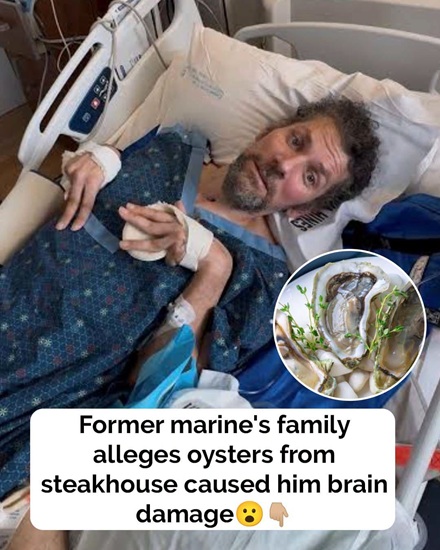
A family dinner at a well-known Illinois steakhouse has become the center of a serious legal dispute after a retired firefighter and Marine veteran suffered catastrophic medical complications days after the meal. Joe Belgio, 44, visited Gibsons Bar & Steakhouse in Oak Brook, Illinois, with his fiancée, Melanie Stayer, and relatives on June 30, 2025. According to a lawsuit filed on his behalf in August 2026, Belgio ate raw oysters during the dinner.
Three days later, on July 3, he experienced a severe cardiac event that ultimately left him with a permanent brain injury. The lawsuit alleges that contaminated oysters caused the illness, but Gibsons has denied responsibility, and that allegation has not yet been established in court. Belgio had built much of his adult life around public service before the medical emergency occurred. He served in the U.S. Marine Corps and later worked as a firefighter with the Cicero Fire Department in Illinois. Friends and relatives have also described him as a father and a Little League coach who remained active in his community after leaving the fire service.
His fiancée told reporters that the June 2025 dinner was simply intended as an opportunity for the family to spend time together and celebrate. Nothing about the evening suggested that a life-changing medical crisis would begin only days later. According to the complaint, Belgio became critically ill after the restaurant visit and suffered cardiac arrest on July 3. His legal team says the cardiac arrest deprived his brain of oxygen, causing what is described in the lawsuit as an anoxic brain injury.
An anoxic brain injury occurs when the brain is deprived of oxygen for a significant period, and the consequences can be severe and permanent. Belgio required intensive medical treatment after the cardiac event and remained in a coma for months, according to his attorneys. More than a year later, reports in August 2026 said he remained hospitalized and required extensive medical support.
The lawsuit attributes Belgio’s condition to foodborne pathogens that his attorneys say were associated with the oysters he consumed at Gibsons. Court filings allege exposure to Enteropathogenic E. coli, commonly abbreviated as EPEC, Plesiomonas shigelloides and Vibrio cholerae. The complaint claims that Belgio’s treating physicians connected his illness and subsequent cardiac arrest to the oysters to a reasonable degree of medical certainty. Those statements are part of the plaintiff’s allegations and medical theory presented in the lawsuit, rather than a final judicial determination of what caused his condition.
That distinction is especially important because the case remains unresolved. Belgio and his attorneys are alleging that the oysters were contaminated and that the contamination initiated the chain of events leading to his permanent injuries. Gibsons Restaurant Group disputes that conclusion. The restaurant has stated that its own review found no evidence showing that the establishment caused Belgio’s medical condition and has emphasized that no other illnesses were reported in connection with the oysters. Until the evidence is evaluated through the legal process, responsibility cannot accurately be described as established fact.
Gibsons has also expressed sympathy for Belgio while firmly denying liability. In a statement reported by CBS Chicago, the restaurant described the consequences of his cardiac event as tragic and said it wished him a full recovery. The company added that it takes food safety seriously and considers providing a safe dining experience a priority. It further said that, based on the information available from its internal investigation, it had found no evidence that the restaurant caused Belgio’s condition. The company said it expects the legal process to examine the allegations fully.
The lawsuit does not name only the restaurant. Court records show that seafood suppliers, including Supreme Lobster and Seafood Company and Taylor Shellfish Company, are among the defendants, along with other potentially involved entities in the supply chain. Belgio’s lawyers argue that the oysters reached him in a condition that exposed him to dangerous pathogens. The defendants will have opportunities to contest those allegations, present their own evidence and challenge the claimed chain of causation as the case proceeds.
Belgio’s medical condition has reportedly changed nearly every aspect of his life. His attorneys have described him as having severe cognitive impairments and requiring specialized brain-injury rehabilitation, therapy and continuing support. One of his lawyers said publicly that he is expected to need around-the-clock assistance for the rest of his life. Reporting in August 2026 placed him at Edward Hines Jr. VA Hospital, where he was continuing to receive care more than a year after the original cardiac event.
The injuries have also had profound consequences for Belgio’s family. He and Stayer have a young daughter, Carmela, who was still an infant when her father became critically ill. Stayer has spoken publicly about the emotional impact of seeing an ordinary family outing followed by such an unexpected medical emergency. She has emphasized how rapidly life can change, while describing Belgio as someone who had spent years helping other people through his work in the military and fire service.
The family has also faced major financial pressures connected to Belgio’s continuing medical needs. Attorneys said in August 2026 that his medical expenses had already reached seven figures and would continue accumulating because of rehabilitation, therapy and long-term care requirements. Friends, relatives, firefighters and community members have organized fundraising efforts aimed at helping the family manage those costs. The financial claims are part of the broader damages Belgio is seeking through the lawsuit.
A GoFundMe campaign was established shortly after Belgio’s July 2025 cardiac event. The fundraiser described him as a former Marine, firefighter, father, fiancé, son and brother and said that the unexpected medical crisis had created substantial emotional and financial challenges for his family. At the time the campaign was created, organizers said the precise cause of his cardiac event remained unknown. The fundraiser has continued to collect donations as the family seeks support for his medical care and recovery needs.
That early fundraising description is another reason the timeline must be presented carefully. Immediately after Belgio became critically ill, his family did not publicly claim that oysters had definitively caused the cardiac event. The legal allegations connecting his illness to the restaurant meal emerged after medical testing and investigation, according to the later lawsuit. A responsible account of the case therefore needs to distinguish between what was known in July 2025 and what Belgio’s attorneys alleged when they filed the complaint in August 2026.
Raw oysters do carry recognized food-safety risks in general. The U.S. Centers for Disease Control and Prevention states that most cases of vibriosis are associated with eating raw or undercooked shellfish, particularly oysters. Raw shellfish can contain harmful microorganisms even when the food looks, smells and tastes normal. Those general public-health facts help explain why raw-oyster consumption is treated as a potential risk, but they do not independently establish that the oysters Belgio ate were contaminated or that they caused his specific medical emergency.
The U.S. Food and Drug Administration likewise warns that raw shellfish can cause foodborne illness, particularly for people at increased risk of serious complications. FDA guidance lists raw oysters, clams, mussels and scallops among foods that higher-risk individuals are advised to avoid. The agency has also issued numerous targeted warnings and recalls over the years when particular batches of oysters were linked to suspected contamination. Again, those warnings describe the general safety issue surrounding raw shellfish and should not be treated as proof regarding the oysters involved in Belgio’s case.
The pathogens mentioned in Belgio’s lawsuit also require careful wording. His attorneys allege that testing identified multiple organisms and that the resulting illness triggered the cardiac arrest and brain injury. However, determining precisely how a person contracted a foodborne pathogen can involve several factors, including the food consumed, handling practices, possible environmental exposure and other potential sources. That is one of the central factual questions that the legal proceedings will have to address rather than something that can responsibly be decided from headlines alone.
The complaint also challenges the warning language that appeared on the Gibsons menu. According to reporting on the filing, the restaurant used a general consumer advisory of the type required for raw or undercooked foods. Belgio’s lawyers argue that the warning was not sufficiently specific about the potential consequences associated with raw oysters and particular foodborne pathogens. Whether the warning was legally adequate and whether any alleged deficiency contributed to Belgio’s injuries are questions for the court to consider.
For its part, Gibsons maintains that the absence of other reported illnesses is significant. The restaurant says it investigated what happened and found nothing connecting its food to Belgio’s condition. That position directly conflicts with the allegations made by Belgio’s legal team, which says his physicians linked the infection and resulting medical crisis to the oysters. The disagreement illustrates why the story should be described as an active lawsuit rather than as a resolved case of restaurant-caused food poisoning.
Belgio’s attorneys are seeking compensation for a wide range of alleged damages. The complaint says he has experienced permanent physical impairment, loss of normal life, emotional distress, lost income and continuing medical, rehabilitation and therapy expenses. It also describes his brain injury as severe, permanent and debilitating. The filing seeks damages exceeding the jurisdictional minimum specified in the complaint, while the ultimate amount, if any, would depend on the legal process and findings in the case.
His former colleagues have been among those publicly supporting him. Firefighters, police officers, Marines and members of the Little League community participated in events surrounding the announcement of the lawsuit and fundraising campaign. Their involvement reflects the many parts of Belgio’s life before his medical emergency. He had previously served in occupations where responding to emergencies was part of his daily work, whereas he now depends on medical professionals and caregivers for his own continuing needs.
The situation has been particularly difficult for his immediate family because Belgio’s daughter has experienced much of her early childhood while her father has been hospitalized. Public accounts from his family describe milestones that occurred while he was unable to participate in family life as he once had. Those details underscore the extent of the disruption created by his injury without changing the central legal question of what caused the illness in the first place.
More than a year after the June 2025 dinner, Belgio’s condition remains a story of both medical uncertainty and a developing legal case. There is no dispute that he suffered a devastating cardiac event and serious brain injury. There is also no dispute that he requires extensive continuing care. What remains contested is whether contaminated oysters served by Gibsons were responsible for setting that chain of events in motion.
That unresolved question is important because accusations involving restaurants, food suppliers and severe illness can have significant consequences. The lawsuit provides one side’s detailed account, while Gibsons has publicly rejected responsibility. The seafood suppliers named in the case are also defendants whose legal positions will form part of the proceedings. Until a settlement, court ruling or other authoritative resolution establishes responsibility, phrases such as “the lawsuit alleges” and “according to Belgio’s attorneys” are necessary for accuracy.
The broader food-safety lesson is less disputed. Eating raw oysters involves a recognized risk because oysters filter water and can accumulate microorganisms from their environment. Cooking shellfish thoroughly reduces the risk posed by many pathogens. The CDC specifically recommends avoiding raw or undercooked oysters and notes that contaminated oysters can appear completely normal. Those recommendations apply generally and are not dependent on the outcome of Belgio’s lawsuit.
Public-health agencies also stress that some people face greater risks of severe illness from contaminated foods than others. The FDA advises people in certain higher-risk groups to avoid raw shellfish altogether. These recommendations are intended as general safety guidance rather than commentary on any specific restaurant or seafood supplier. They also demonstrate why consumers should understand that visually inspecting a raw oyster cannot reliably determine whether it contains harmful microorganisms.
For Belgio’s family, however, the case is far more personal than a general discussion about food safety. They are dealing with the continuing reality of a loved one who once lived an active life and now requires intensive support. His military service, firefighting career and role as a father have featured prominently in the way relatives and colleagues describe him, but the family’s immediate concern is his continuing medical care and quality of life.
The family’s legal team says Belgio will likely require specialized assistance indefinitely. That can include rehabilitation, therapeutic services and support for everyday activities, depending on his condition and medical recommendations. His long-term prognosis has been described in serious terms by his attorneys, although precise medical outcomes can be difficult to predict and should ultimately be left to the professionals directly involved in his treatment.
Melanie Stayer has also used the attention surrounding the case to describe how unexpectedly the family’s circumstances changed. Their dinner in Oak Brook was not planned as a risky event or an unusual outing. According to her public comments, it was simply time spent celebrating with relatives. The contrast between that ordinary evening and the medical emergency days later is one reason the case has attracted such widespread attention.
Still, the emotional force of the story should not replace factual precision. It would be inaccurate at this stage to state as proven fact that Gibsons served contaminated oysters that caused Belgio’s brain injury. It is accurate to say that Belgio’s lawsuit makes that allegation, that his lawyers say medical findings support it, and that the restaurant disputes the claim. Those three facts can exist simultaneously while the litigation remains unresolved.
It would also be misleading to imply that every person who eats raw oysters faces an outcome like Belgio’s. Severe complications of the type alleged in his case are not the inevitable consequence of eating shellfish. Public-health agencies nevertheless acknowledge that raw oysters can transmit dangerous pathogens and recommend appropriate precautions, particularly for people who may be vulnerable to severe foodborne disease.
As of August 2026, the lawsuit is still at an early stage. The allegations have been filed, the defendants have been identified, and Gibsons has issued a public response rejecting responsibility. Evidence concerning the source of the pathogens, the restaurant’s food-handling practices, the seafood supply chain, Belgio’s medical records and the causal relationship between his infection and cardiac event may all become relevant as the case proceeds. No final judgment establishing liability has been reported.
Meanwhile, Belgio remains at the center of a medical struggle that began more than a year earlier. His family continues to seek support for the cost of care, and the fundraiser created after his cardiac event remains active. The GoFundMe campaign reflects the family’s need for help with medical and household expenses but does not itself establish the cause of his illness. It was originally created before the later lawsuit publicly advanced the oyster-related theory.
What can be stated with certainty is that Joe Belgio experienced a catastrophic health crisis shortly after the June 30, 2025 family dinner. He suffered cardiac arrest, survived, and was left with severe brain injuries that have required prolonged hospitalization and specialized care. The consequences for him, his fiancée and their young daughter have been profound.
What cannot yet be stated with the same certainty is exactly who, if anyone, bears legal responsibility for those injuries. Belgio’s attorneys maintain that contaminated raw oysters caused the infection that led to his cardiac arrest. Gibsons says its investigation found no evidence connecting the restaurant to his condition and notes that no other illnesses were reported. That dispute is now for the legal process to examine.
Until that happens, the most accurate account is also the simplest one. A Marine veteran, retired firefighter and father became critically ill days after eating raw oysters during a family meal. His lawsuit alleges the oysters contained dangerous pathogens and caused the medical crisis that left him permanently disabled. The restaurant strongly denies that conclusion. His family, meanwhile, continues dealing with the consequences of an injury that has fundamentally changed their lives.
For them, the events are not merely a legal argument or a food-safety headline. They involve a father who requires continuing care, a fiancée navigating an entirely different future and a young child growing up while her father remains seriously impaired. Whatever the court eventually determines about the source of Belgio’s illness, the medical consequences he and his family are facing are already very real.
The case also serves as a reminder of why factual distinctions matter when reporting on unresolved lawsuits. Allegations should not be presented as verdicts, and a defendant’s denial should not be ignored. At the same time, the documented severity of Belgio’s condition should not be minimized. Both sides of that distinction are necessary to describe this story responsibly.
As the lawsuit moves forward, additional evidence may provide a clearer answer about what happened after that June 2025 meal. For now, Belgio’s attorneys are seeking accountability and financial support for his continuing care, while Gibsons maintains that it did not cause his condition. The ultimate question of responsibility remains unresolved.
Behind those competing legal positions is a family whose life changed in a matter of days. Joe Belgio once served as a Marine, responded to emergencies as a firefighter and spent time coaching children in his community. Today, according to his lawyers and family, he requires continuous assistance because of a severe brain injury.
That is the part of the story that is not disputed: a devastating medical event occurred, its effects have lasted for more than a year, and Belgio’s future now involves extensive care. The question of whether raw oysters served at Gibsons caused that outcome remains an allegation being tested in court, and any responsible account of the case should continue to make that distinction clear.
