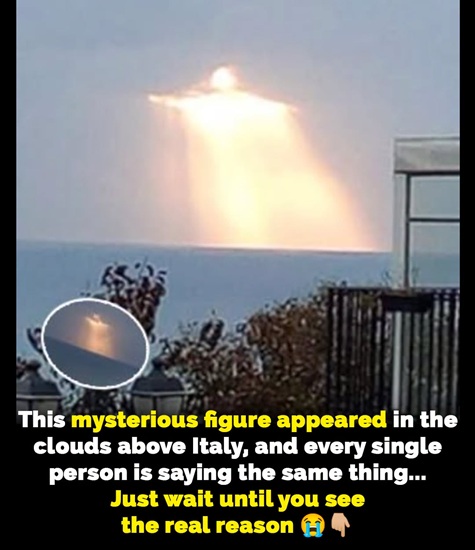
Throughout history, people have looked toward the sky and found shapes, patterns, and images that seem strangely familiar. Clouds illuminated by sunlight can sometimes create extraordinary scenes, and photographs of these moments frequently inspire different interpretations. One particularly striking example attracted international attention after a man in southern Italy photographed an unusual formation above the sea. To some viewers, the illuminated shape appeared remarkably similar to a human figure with outstretched arms.
Others saw it simply as a beautiful combination of clouds, sunlight, and perspective. The photograph was taken by Alfredo Lo Brutto, who was reported to be from Agropoli, a coastal town in the Campania region of southern Italy. According to media reports published in 2019, Lo Brutto captured the scene while looking toward the Tyrrhenian Sea. Bright sunlight was breaking through clouds near the horizon, creating dramatic beams of light above the water. In the middle of those rays, the darker cloud formation produced a silhouette that some observers interpreted as resembling a large standing figure.
The image became especially notable because viewers compared the apparent silhouette with Christ the Redeemer, the famous statue overlooking Rio de Janeiro in Brazil. Christ the Redeemer depicts Jesus Christ standing with both arms extended outward and is one of Rio’s best-known landmarks. The shape visible in Lo Brutto’s photograph appeared, from a distance, to have a similarly upright form and broad horizontal features resembling extended arms.
That visual similarity was enough for the photograph to attract widespread interest after it circulated online. Lo Brutto himself described being impressed by the beauty of what he witnessed rather than claiming that he had photographed a supernatural event. Speaking to the Daily Mail at the time, he said he had been enchanted by the view. He also explained that he did not normally share many photographs on social media but felt that this particular image was something other people should see. His comments focused primarily on the remarkable appearance of the scene and the emotional impact it had on him.

Once the photograph reached a larger audience, however, interpretations naturally began to differ. Some viewers regarded the image through a religious or spiritual lens and felt that the resemblance to a Christ-like figure was meaningful. For people of faith, unusual natural scenes can carry personal or symbolic significance even when there is no scientific evidence that they have a supernatural origin. Such interpretations are ultimately matters of individual belief and cannot be established as objective conclusions from a photograph alone.
Other observers offered a much simpler explanation. Clouds constantly change shape as air currents, moisture, temperature, and wind interact in the atmosphere. When sunlight passes through gaps between clouds, the resulting rays can dramatically emphasize particular shapes. The position of the photographer can further affect how those clouds appear against the horizon. Together, these ordinary atmospheric and visual effects can produce formations that resemble people, animals, objects, or other familiar images.
There is also a well-known psychological phenomenon that helps explain why people recognize familiar forms in otherwise random patterns. It is commonly known as pareidolia. A classic example occurs when someone sees a face in a cloud, a rock formation, the surface of the Moon, or even the front of a building. The human brain is exceptionally good at identifying recognizable patterns, particularly faces and human forms, even when those patterns were not intentionally created.
Pareidolia does not make the experience of seeing such an image any less interesting. In fact, it helps explain why a single photograph can generate so many different reactions. One person might immediately see the outline of Christ with outstretched arms, while another might see nothing more than clouds illuminated by the setting sun. Both people are looking at the same photograph, but their experiences, expectations, beliefs, and attention can influence what they perceive within it.
The setting also contributed significantly to the photograph’s dramatic appearance. Agropoli sits along the coast of the Tyrrhenian Sea, providing broad views of the horizon. When the sun is low and partly obscured by clouds, light can stream through openings and create visible shafts extending toward the sea. These rays are sometimes called crepuscular rays. They can make an otherwise ordinary cloud formation look far more dramatic, particularly when photographed at exactly the right moment.
What the photograph does not provide is evidence that an actual human or supernatural figure was physically present in the sky. The safest factual description is that Lo Brutto photographed clouds and sunlight that created an appearance some viewers compared with Christ the Redeemer. Whether someone assigns a religious meaning to that resemblance is a matter of personal interpretation. There is no reliable evidence establishing the scene as a miracle or other supernatural event.
This distinction is important because remarkable photographs can easily acquire exaggerated descriptions as they spread across social media. A compelling image may be reposted thousands of times, sometimes with captions that gradually become more dramatic than the original account. Separating what is visible from what is interpreted allows people to appreciate an unusual photograph without presenting speculation as established fact. In this case, the photograph itself is real, while claims about supernatural significance remain matters of belief.
The original image dates back to 2019 rather than being a newly captured photograph. Contemporary reports identified Lo Brutto as the photographer and described the scene as occurring over the sea near Agropoli. His own public comments emphasized how beautiful he found the view and why he decided to share it. The subsequent discussion about whether the shape looked like Jesus developed largely from the reactions of people who encountered the photograph online.
Christ the Redeemer provides an understandable point of comparison because its silhouette is recognized around the world. The monumental statue stands on Mount Corcovado overlooking Rio de Janeiro and depicts Christ with arms stretched widely to either side. When viewers saw a roughly vertical shape surrounded by bright rays in the Italian photograph, the resemblance became an immediate talking point. Nevertheless, resemblance by itself does not demonstrate a connection between the natural formation and the Brazilian monument.
Images like this also illustrate how quickly humans attach meaning to unusual natural events. A rainbow, unusual cloud, dramatic sunset, meteor, or beam of sunlight can have profound personal meaning to someone who witnesses it. Science can explain many of the physical processes involved while leaving room for individuals to decide what emotional or spiritual meaning they personally associate with the experience. Those two perspectives do not necessarily have to be presented as competing factual claims.
For Lo Brutto, the most clearly documented reaction was admiration for the scene itself. He saw something sufficiently beautiful that he wanted other people to experience it through his photograph. That simple explanation remains central to the story. Whatever interpretation viewers choose afterward, the photograph captured a brief alignment of sunlight, cloud cover, perspective, and the coastal horizon that produced an unusually memorable image.
Years after it was first shared, the picture remains an interesting example of how nature can create scenes that seem almost deliberately arranged. The shape may remind some people strongly of Christ the Redeemer, while others may immediately recognize it as an example of clouds producing a familiar-looking silhouette. Neither reaction changes the underlying visual spectacle captured above the Tyrrhenian Sea.
The photograph can therefore be appreciated without making unsupported claims about what caused the formation. What is documented is that Alfredo Lo Brutto photographed the striking scene near Agropoli, that sunlight and clouds created the unusual silhouette, and that viewers compared its appearance with Christ the Redeemer. Claims that the image represents a divine sign go beyond what can be verified and belong to the realm of personal faith and interpretation.
Perhaps that uncertainty is precisely what has kept the image interesting. People can look at the same sky and come away with completely different impressions. For some, the photograph may carry spiritual symbolism. For others, it is an impressive demonstration of atmospheric conditions and the human tendency to recognize familiar shapes. And for many viewers, it may simply be a beautiful photograph captured at an unusually fortunate moment.
Whatever interpretation a person prefers, the scene demonstrates how extraordinary the natural world can appear when light, weather, and perspective come together. A fleeting formation that may have lasted only a short time was preserved in a photograph and subsequently seen by people far beyond the Italian coastline where it was captured. Rather than requiring a definitive supernatural explanation, the image can stand on its own as an unusual and visually powerful moment above the sea.
Ultimately, there is no verified evidence proving that the formation was a message or manifestation from a higher power. There is, however, a genuine photograph that prompted many people to discuss faith, perception, nature, and coincidence. Viewers are free to interpret its personal significance for themselves while recognizing the distinction between belief and verifiable fact. Whether seen as spiritually meaningful or simply as an extraordinary cloud formation illuminated by sunlight, the photograph remains a fascinating example of how a single moment in nature can capture worldwide attention.
