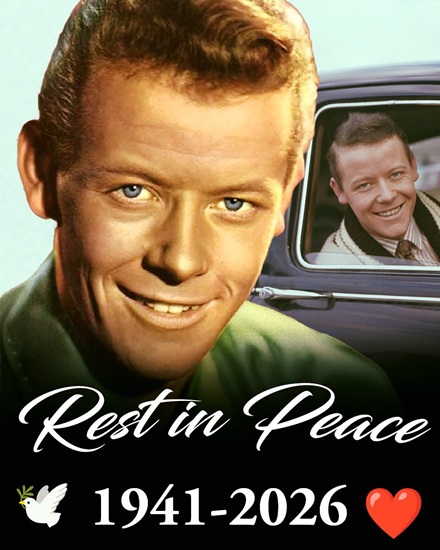
For millions of music fans, certain songs never really grow old.
They become attached to first dances, old radios, family gatherings and moments that seemed ordinary at the time but eventually became treasured memories.
For many listeners in Britain, one of those voices belonged to Craig Douglas.
Now, that voice has fallen silent.
Craig Douglas, the British pop singer who became famous during the late 1950s and early 1960s and scored a No. 1 hit with “Only Sixteen,” has died at the age of 85.
His death on September 4, 2026, marked the end of a remarkable life that began far away from recording studios and national television.
Long before millions knew his stage name, he was Terence Perkins, a young man from the Isle of Wight.
And his journey into show business began in an unlikely way.
Before the fame
Douglas was born into a large family in Newport on the Isle of Wight in 1941.

He was a twin and grew up as one of nine children.
Before becoming a professional entertainer, he worked around farms and also spent time delivering milk.
That part of his early life would eventually give him one of the nicknames that followed him throughout his career: the “Singing Milkman.”
At the time, however, international success must have seemed a distant possibility.
Music changed that.
As a teenager, Douglas entered a talent competition and demonstrated that his voice could take him somewhere very different from the life he had known.
Before long, opportunities began appearing.
Then came another important change.
Terence Perkins became Craig Douglas.
His manager, Bunny Lewis, gave him the stage name after reportedly seeing the name Craig Douglas outside a house in Scotland.
The reasoning was simple: there were plenty of performers named Terry, but Craig was less common.
It proved to be a name that British music fans would soon recognize.

But Douglas still needed the song that would transform him from a promising young performer into a star.
It arrived in 1959.
The song that changed everything
Sam Cooke had released “Only Sixteen” in the United States in 1959.
Douglas recorded his own version in Britain at EMI’s Abbey Road Studios.
His interpretation connected with British audiences almost immediately.
The single climbed through the UK chart until it reached No. 1 in September 1959.
And it stayed there for four weeks.
Remarkably, Douglas’s recording became more successful in Britain than Cooke’s original version.
For a young singer who had been delivering milk only a short time earlier, life had changed dramatically.
Suddenly, Craig Douglas was one of Britain’s most recognizable young pop performers.
That same year brought another important honor.
NME readers voted him Best New Singer of 1959.
But “Only Sixteen” was not his only success.
More than one memorable record
Douglas built a substantial run of chart appearances during an era when British popular music was changing quickly.
He ultimately accumulated nine UK Top 40 singles.
Among his other successful recordings were “A Teenager in Love,” “Pretty Blue Eyes,” “The Heart of a Teenage Girl” and “When My Little Girl Is Smiling.”
There was even an unusual chart coincidence.
Four of his singles in succession peaked at exactly the same position — No. 9.
Douglas also entered Britain’s 1961 selection competition for the Eurovision Song Contest with “The Girl Next Door,” although he was not chosen to represent the country.
His final UK chart entry came with “Town Crier” in 1963.
By then, something much bigger was happening in British popular music.
A new generation was arriving.
And among the groups changing everything were four young musicians from Liverpool.
A connection to the Beatles
Douglas’s career overlapped with the period immediately before Beatlemania transformed popular culture.
In fact, he topped the bill at an important early Beatles stage appearance, a fascinating reminder of just how established Douglas already was while the future superstars were still building their reputation.

The musical landscape soon changed dramatically.
Groups such as the Beatles helped move British pop in a new direction, and the style of clean-cut solo singers who had dominated only a few years earlier began facing intense competition.
Douglas’s days as a regular chart star gradually came to an end.
But his career did not.
Not even close.
Life after the charts
Many performers disappear from public view once their biggest hits are behind them.
Douglas took another path.
He continued entertaining audiences for decades.
His career expanded beyond hit records into stage performances, television appearances and live entertainment.
He also appeared on the big screen, including in the 1962 musical film “It’s Trad, Dad!”
As the decades passed, audiences continued wanting to hear the songs that had first made him famous.
Douglas performed in clubs, theatres and other venues and remained associated with the music of Britain’s pre-Beatles pop era.
Even when health problems made performing more difficult later in life, his connection with music remained.
His story had become about something larger than maintaining a place on the charts.
It was about longevity.
Returning home
In later life, Douglas remained closely associated with the Isle of Wight, the place where his extraordinary journey had begun.
The teenager who once delivered milk had experienced a life that few could have predicted.
He had recorded at Abbey Road.
He had reached No. 1.
He had appeared in films.
He had performed during a transformative period in British popular music.
And his signature recording survived long after its original chart run ended.
Following his death, his family said he had passed away peacefully after a short illness and asked for privacy.
For listeners who remember Britain’s early pop era, the news represents the loss of another performer whose music helped define those years.
But records have a peculiar way of preserving voices.
The song remains
More than six decades have passed since “Only Sixteen” first reached the top of the British chart.
The world in which Douglas recorded it has changed almost beyond recognition.
Records gave way to CDs.
CDs gave way to downloads and streaming.
The teenagers who first heard Douglas on the radio grew older, raised families and watched new generations discover completely different kinds of music.
Yet press play on that old recording and something remarkable happens.
His voice is young again.
The year might as well be 1959.
That may ultimately be the lasting power of performers such as Craig Douglas.
Their careers belong to history, but their voices do not have to disappear with them.
Craig Douglas died at 85 after a career stretching far beyond the brief period when his name regularly appeared near the top of the charts.
He began as Terence Perkins, a young Isle of Wight milkman with a talent for singing.
He became Craig Douglas, a chart-topping recording artist whose biggest hit spent four weeks at No. 1.
And somewhere between those two lives, the “Singing Milkman” became part of British pop history.
The man is gone.
But whenever the opening moments of “Only Sixteen” play again, a small piece of that era returns with him.
