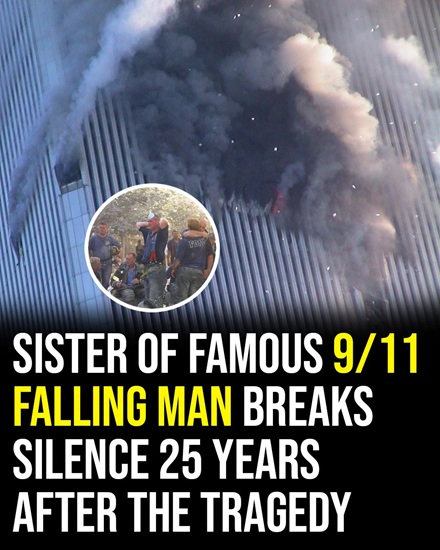
Twenty-five years after the September 11 attacks, one photograph remains among the most difficult images from that morning to confront.
It does not show an airplane striking a building or a tower collapsing into Lower Manhattan. Instead, it captures a single person falling from the North Tower of the World Trade Center.
The photograph became known as “The Falling Man.”
Content note: This article discusses the September 11 attacks and deaths at the World Trade Center. Some readers may find the subject distressing.
On September 11, 2001, Associated Press photographer Richard Drew was working in New York when he was sent to cover the unfolding disaster at the World Trade Center.
As smoke and fire consumed the upper floors, Drew began photographing people who could be seen falling from the towers.
His camera captured a sequence of images.
One frame, taken at approximately 9:41 a.m., was different.

For a fraction of a second, the person in the photograph appeared almost perfectly aligned with the vertical lines of the North Tower behind him. The terrible circumstances surrounding the image seemed momentarily suspended.
Drew did not immediately realize that he had created what would become one of the defining photographs of September 11.
That realization came later.
When the image appeared in newspapers after the attacks, the reaction was intense. Some readers believed such a private and terrifying final moment should never have been published.
The photograph largely disappeared from widespread publication for a time.
But the questions surrounding it did not.
Who was the man in the photograph?
And what could his story tell us about the people trapped high above the impact zone that morning?
A mystery without a definitive answer
The identity of the person photographed by Drew has never been officially established.
One possibility initially discussed was Norberto Hernandez, who worked as a pastry chef at Windows on the World, the restaurant complex near the top of the North Tower.
Members of Hernandez’s family challenged that identification, particularly after examining details of the man’s clothing.
The search continued.
Journalist Tom Junod later investigated the photograph extensively for an Esquire article published in 2003. Rather than examining only the famous frame, the reporting considered additional photographs from Drew’s sequence.
Another name eventually emerged.
Jonathan Briley.
Briley was 43 years old and worked as an audio technician at Windows on the World.

People who knew him saw similarities between Briley and the man visible in the photographs. Details involving his build and clothing also contributed to the theory that he could have been the person Drew photographed.
But there was a crucial limitation.
There was no definitive proof.
More than two decades later, that distinction remains essential: Jonathan Briley is widely considered a possible identity of the Falling Man, but the identification has never been conclusively confirmed.
For Briley’s family, however, the photograph became connected to something much larger than a question of identification.
It became connected to memory.
A brother remembered 25 years later
As the 25th anniversary of September 11 approaches, Briley’s sister, Gwen Briley-Strand, has again spoken publicly about her brother and the grief that followed his death.
Jonathan was remembered by his family as a man of strong religious faith.
Shortly before September 11, Gwen and her husband took an unexpected trip to Florida, and Jonathan joined them.
No one knew how significant that trip would become.
It was the last time Gwen would see her brother.
Twenty-five years can sound like an enormous distance on a calendar. Grief, however, does not necessarily follow a calendar.
Gwen has described the experience as coming in waves. At certain moments the attacks feel decades away.
At others, the memories can feel remarkably close.
Her faith has also shaped the way she thinks about those who were trapped in impossible conditions inside the towers.
That point matters because the people seen falling from the World Trade Center have sometimes been described using language that suggests they simply chose to die.
The reality was far more complicated.
People were trapped above the impact zones amid extreme heat, fire and smoke, with normal escape routes unavailable to many of them. New York City’s medical examiner did not classify those who fell from the towers as suicides. The deaths resulting from the September 11 attacks were classified as homicides.
They were victims of the attacks.
For Gwen, faith eventually provided another way of understanding the photograph.
Years ago, she explained that she had become at peace with the possibility that the person in the picture might not be Jonathan at all.
The image, she suggested, had grown beyond the identity of one individual.
The man could represent many.
The photographer behind the frame
Richard Drew has also spent decades discussing the photograph and the responsibility that came with making it.
Drew was not waiting for one perfectly composed image.
He was documenting what was happening.
Looking through a telephoto lens created a narrow view of an enormous catastrophe, and his camera recorded multiple frames as people fell.
Only afterward did the extraordinary geometry of one particular photograph become apparent.
Against the straight architectural lines of the tower, the person appears almost motionless.
Of course, he was not.
That contrast is part of what has made the photograph so unsettling.
Musician and photography collector Elton John later acquired a print of “The Falling Man” for his collection. John has spoken about the extraordinary tension within the image: a photograph that can be visually powerful while depicting something profoundly painful.
That contradiction remains difficult even 25 years later.
Perhaps it should.
One person among thousands
The September 11 attacks killed 2,977 victims in New York, at the Pentagon and aboard the four hijacked aircraft, excluding the 19 hijackers.
Behind that number were thousands of individual lives, families, friendships and unfinished plans.
Jonathan Briley was one of those lives.
Whether he was also the person captured in Richard Drew’s photograph remains unresolved.
And keeping that uncertainty clear is important.
The photograph does not need a confirmed name to communicate what happened to people trapped inside the towers that morning.
Nor does it need to turn an unknown victim into a symbol at the expense of his humanity.
Twenty-five years later, “The Falling Man” remains difficult precisely because it reduces an event of almost unimaginable scale to one human being.
One person.
One moment.
One life caught in a fraction of a second.
The towers are no longer part of New York’s skyline, and an entire generation has now grown up knowing September 11 primarily through history, photographs and the memories of others.
Richard Drew’s photograph remains among those records.
Its central mystery may never be solved.
But perhaps the question that has survived for 25 years is no longer simply, “Who was he?”
It is also how we choose to remember him — and every person whose ordinary morning on September 11, 2001, became their last.
