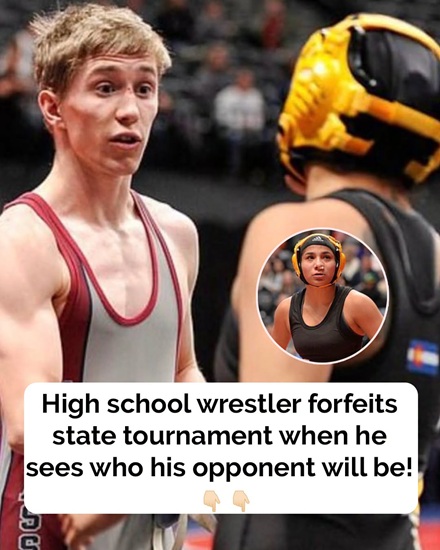
For most high school athletes, reaching a state tournament represents years of work.
There are early mornings. Long practices. Weight management.
Injuries. Losses. And countless hours spent repeating the same movements until they become instinct.
For senior wrestler Brendan Johnston, the 2019 Colorado state championships were supposed to be the final opportunity to turn all that work into a state title.
He was 18 years old.
He attended The Classical Academy in Colorado Springs.
And he had put together a strong senior season.
Then the tournament bracket presented him with a decision he had already thought about before.
His first-round opponent was Jaslynn Gallegos of Skyview High School.
Gallegos was also a senior.
And she was a girl competing in the boys’ Class 3A 106-pound division.
Johnston had a choice.
Step onto the mat.
Or forfeit.
He chose the second option.
That decision immediately drew attention.
But the story was not finished.
Later in the tournament, Johnston reached another match.
This time his opponent was Angel Rios, a junior from Valley High School.
Again, he chose not to wrestle.
Again, he forfeited.
The second decision effectively brought his high school wrestling career to an end.
For an athlete who had spent years competing, the consequences were real.
Johnston knew that refusing the matches would hurt his chances of placing as high as he wanted.
Winning the state tournament had been a goal.
But he had decided before stepping onto the mat that another consideration mattered more to him.
His personal and religious beliefs.
Johnston identified as Christian.
In interviews after the tournament, he explained that his objection was connected partly to the physical nature of wrestling.
Wrestling is not a distant-contact sport.
Opponents grip one another.
They fight for position.
They use leverage and body pressure.
The sport demands aggressive physical contact.
Johnston said that this type of physical contact with a young woman made him uncomfortable.
His explanation was not that Gallegos or Rios lacked athletic ability.
He specifically rejected the idea that he considered women less valuable than men.
Instead, he said he believed men and women were different while still being equal in value.
For him, that distinction shaped the decision.
He also connected it to the way he had been raised to treat women.
Some people viewed the forfeits as an example of someone accepting a real personal cost for a belief.
Others saw the situation very differently.
And that is where the story became more complicated.
From Gallegos’s perspective, she had not entered the tournament primarily as “a girl wrestler.”
She had entered as a wrestler.
She had trained.
She had qualified.
And she wanted the same opportunity to compete that other wrestlers received.
When an opponent declined to wrestle her because of her gender, it touched on a frustration she had experienced before.
Gallegos had been wrestling since childhood.
Like many girls who entered a sport traditionally dominated by boys, she was familiar with people noticing her gender before noticing her ability.
She said her goal had always been straightforward.
She wanted to be seen as a wrestler.
Not as a novelty.
That made Johnston’s decision frustrating.
Yet her response was also measured.
She said she respected his decision.
Both ideas could exist at once.
She could respect his right to make the choice.
And she could still dislike what the choice meant for her as an athlete.
Rios responded in a similar way.
She said the decision belonged to Johnston.
If his religion prevented him from wrestling her, she could not control that.
But the tournament continued.
And something historic happened.
Rios went on to finish fourth in the Class 3A 106-pound division.
Gallegos finished fifth.
Those results made them the first girls to place at Colorado’s state wrestling tournament.
That achievement mattered beyond one forfeited match.
Girls had participated in wrestling for years.
But at that point, girls’ wrestling was still developing as a separate competitive structure in Colorado.
Female athletes who wanted the highest level of state competition could find themselves wrestling boys.
That created situations that schools, athletes, families, coaches and governing bodies were still learning how to navigate.
Johnston’s decision therefore became part of a much larger conversation.
Some people focused on religious freedom.
Others focused on equal treatment in athletics.
Some emphasized the physical differences between male and female athletes.
Others emphasized that Gallegos and Rios had earned their places in the tournament under the rules that existed.
Those arguments can easily become heated.
But the actual events are less dramatic than many later social-media versions make them sound.
Johnston did not demand that the girls be removed.
He did not prevent them from competing.
He made an individual decision not to participate in those particular matches.
And he accepted the competitive consequences.
Gallegos and Rios continued competing.
Neither athlete lost her tournament opportunity because of his decision.
In fact, Rios advanced through Johnston’s forfeit.
The disagreement therefore was not simply about whether women belonged in wrestling.
It was about what happens when one athlete’s personal convictions collide with another athlete’s expectation of equal competition under the rules.
That is a much harder question.
Johnston had faced similar circumstances before.
During his wrestling career, he had previously forfeited rather than face female opponents.
According to reporting at the time, several of the losses on his senior-season record came from forfeits connected to his refusal to wrestle girls.
That detail matters because it shows the state tournament decision was not something invented at the last minute for publicity.
He had applied the same position earlier.
The state tournament simply made the consequences much larger.
This time, a championship opportunity was involved.
That changed the scale of the choice.
It did not change the choice itself.
For Johnston, wrestling was important.
But it was not the most important thing in his life.
That was how he described the situation afterward.
Sports could matter deeply without becoming the ultimate measure of who he was.
For many athletes, that perspective is difficult to reach.
Competition encourages athletes to keep going.
To push through discomfort.
To take every opportunity.
To avoid forfeiting whenever possible.
A state tournament intensifies all of that.
There may never be another chance.
For a senior, there definitely will not be another high school season.
That was the position Johnston faced.
If he competed, he could preserve his path through the bracket.
If he refused, that opportunity could disappear.
He refused.
Whether someone agrees with that choice depends heavily on how they interpret the competing principles involved.
Some saw consistency.
Johnston believed wrestling a girl was incompatible with his religious and personal boundaries, and he was willing to lose rather than abandon them.
Others saw inequality.
Gallegos and Rios had qualified under the same competitive system as the boys, yet one opponent treated them differently solely because they were female.
Both reactions came from genuine concerns.
That is why reducing the event to a simple hero-versus-villain story misses much of what actually happened.
Gallegos herself did not portray Johnston as an enemy.
She expressed frustration.
But she also said she respected his decision.
That nuance often disappears when old stories are recycled online.
A headline may say a wrestler “refused to fight a girl.”
Another may describe him as sacrificing his career for his faith.
Another may focus entirely on discrimination.
Each framing emphasizes one part of the event.
None captures everything.
The tournament itself tells a broader story.
Girls’ participation in wrestling was growing.
Gallegos and Rios were not simply symbolic entrants.
They were competitive athletes.
Gallegos earned victories against male opponents during the tournament.
Rios had also put together a strong season.
Their eventual fourth- and fifth-place finishes gave girls’ wrestling in Colorado a historic moment.
That accomplishment deserves to stand on its own.
Johnston’s forfeits were part of how the tournament unfolded.
They were not the sole reason those athletes had reached that level.
Gallegos had been wrestling since she was five.
Years of training came before the state tournament.
Rios had spent a season building her own record.
Both athletes entered because they had earned competitive opportunities.
That context matters.
Otherwise the story can accidentally make it sound as if two girls became historically significant only because one boy stepped aside.
That would not accurately reflect the broader tournament.
They were already serious wrestlers.
And they proved it through competition.
At the same time, Johnston’s own athletic record should not be erased because of controversy surrounding the forfeits.
He had won dozens of matches during his senior year.
Reaching the state tournament itself required success.
He was not a competitor avoiding difficult matches simply because he expected to lose.
The issue was specific.
He did not want to wrestle female opponents.
That boundary ultimately cost him.
Then came one of the more interesting details.
After everything was over, Johnston said he would make the same decision again.
That is important because regret often changes the meaning of a sacrifice.
If someone gives something up impulsively and later wishes they had chosen differently, the story becomes one of uncertainty.
Johnston did not describe it that way.
His ending was not the ending he had originally wanted.
But he still believed the decision was consistent with his priorities.
Gallegos also continued to explain her side.
She wanted opponents to see the athlete first.
She had encountered boys who underestimated her because she was a girl.
Then some of them discovered during competition that she was much more capable than expected.
For her, wrestling offered a direct way to challenge assumptions.
The mat did not care about the prediction.
Someone still had to wrestle.
That is why a forfeit could feel especially frustrating.
She wanted the chance to compete.
Without a match, there was nothing to prove in that particular moment.
Still, she accepted the result.
And moved forward.
This is where the delayed payoff of the story begins to appear.
The event is often framed as being entirely about Brendan Johnston.
But the tournament produced two very different examples of conviction.
Johnston was willing to accept a loss rather than violate a personal boundary.
Gallegos and Rios were willing to compete in a field dominated by boys and be judged by their wrestling.
All three athletes accepted uncomfortable situations.
They simply approached those situations from different directions.
Johnston valued his religious and personal beliefs above tournament advancement.
Gallegos valued being treated as a wrestler regardless of gender.
Rios wanted to compete under the rules available to her.
Those positions were never going to fit together perfectly.
Someone was going to leave dissatisfied.
That is often what makes questions involving conscience and equal participation difficult.
A rule can determine who is allowed to compete.
It cannot make every athlete feel comfortable with every matchup.
A personal belief can determine what one person chooses to do.
It cannot prevent another person from feeling disappointed by that decision.
And respect does not require pretending disagreement disappeared.
Gallegos could respect Johnston while still wishing he had wrestled her.
Johnston could recognize her effort while still refusing the match.
That tension is part of the real story.
There is also a broader sports lesson.
Athletic competition constantly brings people with different backgrounds into the same space.
Religious beliefs differ.
Cultural expectations differ.
Views about gender differ.
Personal boundaries differ.
Sports organizations have to create rules that are predictable enough for competition to function.
Athletes then have to decide whether they can participate under those rules.
Sometimes they cannot.
Forfeiture is one mechanism that allows a competitor to decline while preserving the tournament structure.
But forfeiting has consequences.
The opponent receives the win.
The athlete who refuses may lose advancement opportunities.
That is exactly what happened here.
Johnston made his choice.
The bracket moved on.
Eventually, Gallegos stood fifth.
Rios stood fourth.
And Colorado wrestling had its first female state placers.
That may be the detail with the longest athletic significance.
A controversy about one wrestler’s forfeits became attached to a milestone for two others.
Years later, people can still debate whether Johnston’s decision was admirable, unfair, understandable, or some combination of those things.
But the documented facts do not require anyone to invent motives beyond what the athletes themselves said.
Johnston described the decision as rooted partly in Christian belief, his discomfort with the physical aggression involved, and the way he believed women should be treated.
Gallegos described the frustration of being viewed through gender rather than simply as a wrestler.
Rios acknowledged that the choice was his to make.
The tournament accepted the forfeits.
Competition continued.
That is the story without turning it into a culture-war slogan.
No athlete needs to be made into a villain.
No athlete needs to be stripped of agency.
And no side requires fictional details to make its position seem stronger.
The documented choices are already compelling.
An 18-year-old senior arrived at the final state tournament of his high school career with hopes of winning.
He discovered that following his stated beliefs would likely cost him that opportunity.
He accepted the cost.
Two female wrestlers arrived wanting to compete on the same stage as everyone else.
They encountered an opponent who would not wrestle them because they were female.
They continued anyway.
By the end of the tournament, they had made history.
That is why the final lesson is larger than one forfeit.
Conviction can have a cost.
So can breaking barriers.
Johnston left without the ending he had originally hoped for.
Gallegos and Rios left having achieved something no girls had previously done at that Colorado state tournament.
And all three became part of a conversation about belief, gender and sport that was never as simple as the headline made it seem.
