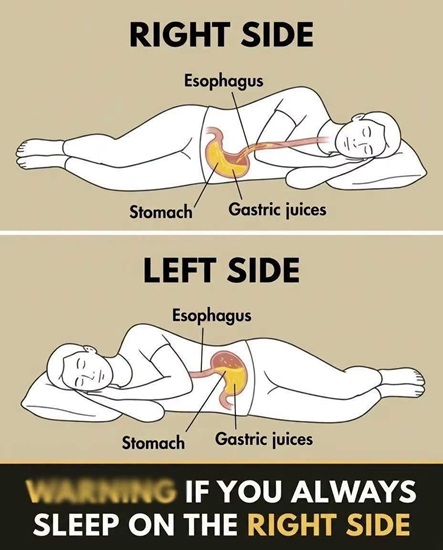
Sleeping on Your Left Side May Help in Certain Situations — But Not for the Reasons You Often Hear Online
A good night’s sleep affects far more than how energetic you feel the next morning.
Sleep supports concentration, mood, immune function and many other aspects of health.
But there is another question people often ask.
Does the position you sleep in matter too?
Sometimes, yes.
Yet the real answer is more nuanced than many viral health posts suggest.
Sleeping on the left side may be useful for certain people, particularly those who experience nighttime acid reflux.
It can also be comfortable during pregnancy.
But claims that the position somehow “detoxifies” the liver or dramatically improves every major organ go well beyond what medical evidence currently shows.
The most interesting benefits are actually simpler.
And much better supported.
1. Left-Side Sleeping May Reduce Nighttime Acid Reflux
This is the strongest evidence-backed reason to consider sleeping on the left side.
Gastroesophageal reflux happens when stomach contents move upward into the esophagus.
That can cause burning discomfort, a sour taste, coughing or disturbed sleep.
Body position can influence how easily this happens.
Studies comparing sleep positions have found that people with GERD tend to have less nighttime acid exposure and faster acid clearance while lying on the left side than while lying on the right side or flat on the back.
Why?
The anatomy of the stomach and esophagus changes relative to gravity depending on which side is down.
When someone lies on the left, the junction between the stomach and esophagus can sit in a position that makes reflux less likely.
The difference is not merely theoretical.
A randomized trial involving people with nighttime reflux found that encouraging more left-side sleeping improved symptoms and increased the number of reflux-free nights compared with a sham intervention.
That makes left-side sleeping a reasonable lifestyle strategy for some people with nighttime GERD.
But it is not the only one.
Elevating the Upper Body Can Help Too
Sleep position works best as one part of a larger reflux strategy.
Evidence-based guidance also supports elevating the head of the bed for some people with nighttime reflux.
Leaving several hours between the evening meal and bedtime may help as well.
A consensus review recommends left-side sleeping, head-of-bed elevation and avoiding lying down soon after eating for people with nighttime reflux-like symptoms.
So someone struggling with heartburn may benefit more from combining several habits rather than relying on one position alone.
And there is an important point here.
If heartburn happens frequently, is severe, causes difficulty swallowing or keeps returning despite lifestyle changes, it deserves medical evaluation.
Sleep position can help symptoms.
It does not diagnose or cure every cause of reflux.
2. Side Sleeping Can Be Helpful During Pregnancy
Pregnancy is another situation in which sleeping position becomes more important.
As pregnancy progresses, lying flat on the back can allow the weight of the uterus to compress major blood vessels.
That may reduce venous return and can make the pregnant person feel dizzy.
For this reason, major medical guidance recommends side sleeping later in pregnancy.
But here is where a common online claim needs correcting.
It does not have to be the left side every night.
ACOG specifically notes that people can sleep on either the left or right side during pregnancy.
The important distinction later in pregnancy is side versus back, not left versus right.
NHS guidance similarly advises going to sleep on either side after 28 weeks rather than on the back.
So left-side sleeping is an option.
It is not a universal requirement.
What If Someone Wakes Up on Their Back?
This is another area where unnecessary anxiety can develop.
People move naturally while sleeping.
Someone who goes to sleep on their side may wake up in another position.
Medical guidance does not suggest panicking if this happens.
The recommendation is simply to turn back onto the side and go back to sleep.
Pregnancy pillows or ordinary pillows between the knees and beneath the abdomen can also make side sleeping more comfortable.
The goal is sustainable sleep.
Not trying to remain completely motionless all night.
3. Left-Side Sleeping Is Not Automatically Better for the Heart
One of the most common claims online is that sleeping on the left side somehow “takes pressure off the heart.”
That statement is too simplistic.
For healthy people, there is no good evidence that everyone needs to sleep on the left side to make the heart pump more efficiently.
In fact, the situation can be different for people with heart failure.
Research has found that some patients with congestive heart failure naturally spend less time on their left side.
The left-side position may increase awareness of the heartbeat or contribute to discomfort in some people with enlarged hearts or impaired cardiac function.
Another small study found that lateral positions could worsen discomfort and some measurements of lung function in people with chronic heart failure.
That does not mean left-side sleeping is dangerous for everyone with heart disease.
It means the sweeping claim that it universally “rests the heart” is not supported.
People with significant heart or breathing conditions should prioritize comfort and individualized medical guidance.
4. Your Liver Does Not Need a Particular Sleep Side to “Detox”
The liver really does process and remove many substances from the bloodstream.
But that does not mean sleeping on the left side makes it detoxify the body more effectively.
There is no established clinical evidence that right-side sleeping “congests” the liver in healthy people or that lying on the left meaningfully improves its toxin-processing ability overnight.
The liver works continuously.
Its function depends on blood flow, metabolism, overall health and many other biological processes.
It is not switched into a better detoxification mode simply because someone turns onto one side.
This is an important example of how a real biological fact can become an unsupported health claim.
Yes, the liver detoxifies.
No, that does not prove that left-side sleeping enhances the process.
5. The Same Caution Applies to the Lymphatic System
The lymphatic system helps return fluid to the bloodstream and plays important roles in immune function.
The thoracic duct does drain into the venous circulation on the left side of the body.
That anatomical fact is sometimes used to claim that sleeping on the left dramatically improves “toxin drainage.”
But anatomy alone does not establish a clinical benefit.
There is no strong evidence showing that healthy people need to sleep on their left side to make the lymphatic system work properly.
The body does not rely on one nightly posture to perform lymphatic circulation.
Movement, muscle contractions, breathing and normal physiology all contribute.
So the phrase “detox while you sleep by lying on the left” sounds appealing.
It is not a proven medical recommendation.
6. The Spleen Claim Is Also Overstated
The spleen is located primarily in the upper left side of the abdomen.
From that fact, some articles conclude that lying on the left improves blood flow to the spleen and helps it function more effectively.
Again, there is a gap between anatomy and evidence.
There is no established recommendation telling healthy people to sleep on their left side to improve spleen function.
The spleen filters blood, participates in immune responses and helps manage certain blood cells regardless of ordinary sleep position.
Being located on the left does not automatically mean lying on that side improves its performance.
If anything, this illustrates a useful rule when reading health advice online.
An organ’s location is not proof that sleeping on top of it improves its function.
7. Left-Side Sleeping Has Not Been Proven to Move Waste Through the Bowel
Another popular explanation focuses on digestion.
It is sometimes claimed that because parts of the large intestine and the ileocecal valve occupy particular locations, gravity makes waste move more easily when someone sleeps on the left.
This sounds mechanically plausible.
But clinical evidence has not established left-side sleeping as a reliable treatment for constipation or as a method of improving bowel movements in healthy people.
The digestive tract moves contents primarily through coordinated muscular contractions known as peristalsis.
Gravity can influence certain gastrointestinal processes.
But the digestive system does not simply operate like a straight pipe in which everything falls toward one side.
For constipation, factors such as fiber intake, fluid intake, physical activity, medication use and underlying health conditions are generally more important.
So Is Sleeping on the Left Actually “Better”?
For some people, yes.
For everyone, no.
That distinction is the real takeaway.
If someone has nighttime GERD, the evidence supporting left-side sleeping is meaningful.
If someone is pregnant, side sleeping later in pregnancy is recommended — but either side can generally be used.
For many healthy adults without reflux or pregnancy-related considerations, there is no medical rule saying the left side must be used.
Comfort matters too.
And different conditions can change the answer.
The Right Side Is Not Automatically “Bad”
Health claims often become overly simple.
Left equals good.
Right equals bad.
Human physiology rarely works that way.
A healthy person who sleeps comfortably on the right side does not need to assume they are harming their liver, spleen, lymphatic system or heart.
For someone with GERD, right-side sleeping may increase nighttime reflux compared with the left.
That is a specific physiological effect.
It should not be transformed into a general statement that right-side sleeping is unhealthy.
Different questions require different answers.
Back Sleeping Has Its Own Advantages and Drawbacks
Sleeping on the back can be comfortable for some people.
It may help keep the spine in a neutral position when the head and neck are properly supported.
But back sleeping can worsen snoring or obstructive sleep apnea in susceptible people.
It is also generally discouraged later in pregnancy.
Someone’s ideal sleep position therefore depends on far more than one organ.
Breathing matters.
Pain matters.
Pregnancy matters.
Reflux matters.
Comfort matters.
Stomach Sleeping Is Another Trade-Off
Some people naturally sleep face down.
This can reduce snoring in certain cases.
But it often requires turning the head to one side for long periods.
That can become uncomfortable for the neck or back depending on the mattress and pillow.
Again, there is no single position that wins every category.
Sleep quality depends partly on finding a posture that allows the body to remain comfortable enough to stay asleep.
A theoretically “healthy” position is not very helpful if it keeps someone awake all night.
Good Sleep Usually Matters More Than Chasing a Perfect Position
This is the payoff often lost in discussions about sleeping sides.
Sleep position can matter.
But total sleep quality matters much more broadly.
Consistent sleep schedules.
Enough sleep duration.
A dark and quiet sleeping environment.
Managing sleep apnea when present.
Treating pain.
Limiting factors that repeatedly disturb sleep.
Those issues often have a greater impact on health than whether someone spends another hour on the left or right shoulder.
The goal should not be perfection.
It should be restorative sleep.
How to Make Side Sleeping More Comfortable
People who want to try left-side sleeping can make small adjustments.
A pillow that keeps the head aligned with the spine may reduce neck strain.
A pillow between the knees can help support the hips and lower back.
People with reflux may benefit from elevating the upper torso rather than simply stacking several soft pillows under the head.
Pregnant people can use pillows beneath the abdomen or between the knees for additional support.
Comfort often determines whether a position is sustainable.
When Sleep Position Is Not Enough
Persistent nighttime symptoms should not always be solved by experimenting with pillows.
Repeated heartburn deserves attention.
So does choking or gasping during sleep.
Loud snoring combined with daytime sleepiness can be a sign of sleep apnea.
Chest pain, significant shortness of breath or symptoms of heart disease require appropriate medical assessment.
Similarly, persistent pain that prevents comfortable sleeping may have an underlying cause.
A different sleeping side can sometimes reduce symptoms.
It should not delay evaluation of something more serious.
The Most Evidence-Based Conclusion Is Surprisingly Modest
Sleeping on the left side is not a secret detox method.
It does not have proven magical effects on every organ.
But it is not meaningless either.
For people with nighttime acid reflux, evidence suggests that the left-side position can reduce acid exposure and help the esophagus clear reflux more quickly.
During later pregnancy, sleeping on the side is generally recommended, although the left and right sides are both acceptable.
Beyond those situations, the best sleeping position often depends on comfort and individual health conditions.
So if sleeping on the left feels good, there is usually no reason to stop.
If another position feels better, there may be no reason to force a change either.
The real benefit is not hidden in one “perfect” side.
It is finding a position that supports comfortable, uninterrupted sleep — while using evidence rather than internet myths to decide when position genuinely matters.
