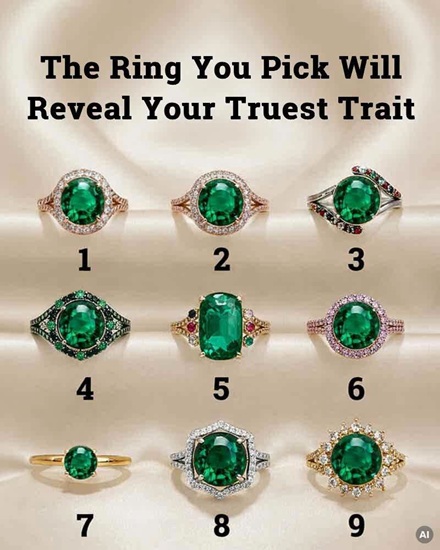
Take a moment to look carefully at nine different purple gemstone rings and notice which design attracts your attention first. You do not need to study every detail or search for a hidden meaning before making a choice. Simply observe the shapes, settings, shades of purple, and overall appearance of the rings. One design may immediately feel more appealing than the others, while another may stand out because of its simplicity or elegance. Once you have selected the ring that catches your eye, you can read the personality description associated with that choice.
The activity is designed for entertainment and reflection rather than scientific personality assessment. Purple gemstones have long been appreciated for their striking appearance and wide range of shades. Some stones can appear pale lavender, while others display deep violet or rich purple tones. Jewelry designers can also create very different impressions by changing the cut, setting, surrounding metal, and decorative details of a ring. Because people have different visual preferences, it is natural for one person to prefer a simple design while another is drawn toward something bold and elaborate.
These differences in taste can make a visual personality quiz enjoyable. They should not, however, be interpreted as proof of fixed psychological characteristics. The basic idea behind this activity is simple. Instead of asking a long series of questions, the quiz asks you to make one visual choice. You look at the nine rings and decide which one you would most naturally select if all of them were available. The description connected to the ring then offers a positive personality theme for you to consider. Some choices focus on reliability and calmness, while others emphasize confidence, ambition, independence, leadership, or balance. The descriptions are intentionally broad enough to encourage self-reflection.

For the most enjoyable experience, try to notice your first reaction before analyzing every ring. The first design that catches your attention may reflect something about your immediate aesthetic preference. Perhaps you are drawn to symmetry, bright colors, unusual shapes, large stones, or understated designs. That preference can be interesting to think about even though it cannot scientifically determine your personality. Visual choices are influenced by many things, including personal taste, fashion experience, memories, cultural influences, mood, and simple curiosity. There is therefore no correct or incorrect ring to choose.
If Ring One is the design that immediately attracts you, its entertainment description can represent dependability. This result suggests the image of someone who values consistency and prefers to be someone other people can rely upon. Dependable personalities are often associated with keeping promises, completing responsibilities, and trying to remain steady when circumstances become difficult. They may prefer thoughtful decisions instead of unnecessary risks. Friends or relatives may appreciate having someone who listens carefully and follows through on commitments. In this quiz, the first ring represents the idea of being a stable and trustworthy presence.
Dependability does not mean that a person must always have every answer. Someone can be reliable while still needing help, making mistakes, or changing plans when circumstances require it. Reliability is more closely connected with honesty about what can realistically be done. A dependable person may tell someone when they cannot complete a task rather than making a promise they cannot keep. They may also value routines because routines create predictability. If this description feels familiar, the result may simply highlight a quality you already value in yourself or other people.
If Ring Two attracts you most, the associated theme can be peace and harmony. This description represents someone who appreciates calm environments and generally dislikes unnecessary conflict. Such a person may prefer discussion and compromise rather than arguments that become increasingly hostile. They may enjoy helping people find common ground when disagreements arise. They can also value emotional balance and relationships in which people feel respected. Within this playful quiz, the second ring symbolizes a preference for cooperation and peaceful interaction.
Wanting peace should not be confused with avoiding every disagreement. Healthy relationships sometimes require people to express uncomfortable opinions or establish clear boundaries. A person who values harmony can still speak firmly when something matters. The difference may be that they prefer solving a disagreement constructively rather than creating additional tension. They may think carefully about their words and try to understand several perspectives. If the second ring appeals to you, the description invites you to consider how important balance and cooperation are in your own life.
Ring Three can be connected with confidence. Someone who chooses this design may enjoy the description of a person who is comfortable expressing ideas and making decisions. Confidence can involve trusting one’s abilities while also recognizing that nobody is perfect. A confident individual does not necessarily need to dominate conversations or constantly attract attention. Quiet confidence can be just as meaningful as an outgoing personality. In this quiz, the third ring symbolizes the willingness to move forward even when complete certainty is impossible.
Healthy confidence is different from believing that you are always right. Truly confident people can admit when they need more information and can change their opinions when better evidence becomes available. They can learn from mistakes without allowing one failure to define their entire identity. Confidence also develops over time through experience, practice, and learning. Someone may feel highly confident in one part of life and uncertain in another. If Ring Three is your choice, the description may resonate because self-belief is something you appreciate or want to strengthen.
Ring Four can represent leadership. The associated description suggests someone who feels comfortable organizing activities, making decisions, or helping a group move toward a goal. Leadership can appear in many forms and does not require holding an official title. A person can demonstrate leadership within a family, friendship group, workplace, classroom, or community project. Effective leaders often need to listen as much as they speak. The fourth ring therefore symbolizes responsibility, direction, and the ability to encourage cooperation.
Leadership is also much broader than simply telling other people what to do. Strong leadership can involve recognizing people’s abilities, sharing responsibility, and helping others contribute ideas. Good leaders may also accept responsibility when plans do not work as expected. They often need patience because groups contain people with different personalities and opinions. Leadership can therefore require empathy and flexibility as well as decisiveness. Choosing Ring Four does not prove that someone is naturally a leader, but the description may appeal to people who admire those characteristics.
If Ring Five stands out immediately, its entertainment result can represent independence. This personality theme describes someone who values making personal decisions and having enough freedom to follow their own direction. Independent people may enjoy solving problems themselves before asking others for assistance. They can also appreciate having time alone to think, work, or explore personal interests. Independence can create a strong sense of responsibility because choices belong to the person making them. The fifth ring symbolizes self-direction and personal freedom.
Independence does not mean rejecting help or avoiding relationships. Everyone depends on other people in countless ways throughout life. Healthy independence is compatible with cooperation, friendship, family connections, and teamwork. A self-directed person can still recognize when someone else has greater knowledge or experience. Asking for help can sometimes be the most responsible decision. If Ring Five attracts you, its description may simply reflect your appreciation for autonomy and the ability to make choices for yourself.
Ring Six can be associated with ambition. The description represents someone who enjoys setting goals and working steadily toward them. Ambitious people may feel energized when they have something meaningful to pursue. Goals can involve education, career development, creative projects, personal improvement, business, sport, or almost any area of life. Ambition can encourage persistence when progress takes longer than expected. In this lighthearted quiz, Ring Six symbolizes motivation and a desire to keep moving forward.
Ambition can be healthy when it is balanced with realistic expectations and attention to well-being. Constantly comparing yourself with everyone else can turn motivation into unnecessary pressure. People can pursue significant goals without treating every part of life as a competition. Rest, relationships, health, and personal satisfaction can remain important alongside achievement. Successful goals may also change as a person’s circumstances or priorities evolve. Choosing the sixth ring may resonate if growth and accomplishment are particularly meaningful ideas for you.
Ring Seven can symbolize courage and boldness. This result describes a personality that may be attracted to new experiences, challenges, or situations requiring decisive action. Courage does not mean never experiencing fear. In many circumstances, courage actually means acting thoughtfully despite uncertainty or nervousness. Bold individuals may be comfortable trying something unfamiliar when others hesitate. The seventh ring therefore represents willingness to move beyond familiar routines.
Being bold also benefits from judgment. Not every risk is worthwhile, and courage should not be confused with reckless behavior. A thoughtful person can consider potential consequences before deciding whether an opportunity is worth pursuing. Sometimes the courageous choice is to move forward, while at other times it is to step away from a harmful situation. Boldness can therefore work together with caution. If Ring Seven attracts you, the description invites reflection on how you normally respond when facing uncertainty.
Ring Eight can represent determination. This personality theme focuses on persistence and the ability to continue working when progress becomes difficult. Determined people often understand that meaningful achievements may require repeated attempts. They can experience disappointment without immediately abandoning a goal. Persistence can be particularly useful when learning a difficult skill or completing a long project. The eighth ring symbolizes endurance and commitment.
Determination is most effective when combined with flexibility. Continuing the same unsuccessful approach forever is not always useful. Persistent people can change strategies while keeping the larger goal in mind. They can ask for advice, learn from previous attempts, and adjust expectations when new information becomes available. Knowing when to change direction can be just as important as refusing to quit. If Ring Eight appeals to you, persistence may be a quality you strongly value.
Ring Nine can be associated with creativity and individuality. This result represents someone who enjoys approaching ideas from a personal perspective rather than always following the most common option. Creative people may express themselves through art, writing, design, music, problem-solving, fashion, cooking, technology, or many other activities. Creativity is not limited to people working professionally in artistic fields. Everyday problem-solving can require considerable imagination. In this quiz, the ninth ring symbolizes originality and an appreciation for individual expression.
Individuality does not require someone to be different simply for the sake of being different. It can mean understanding personal preferences while still respecting the choices of other people. Someone with a strong sense of individuality may feel comfortable enjoying something even when it is not currently fashionable. They may also be willing to experiment and discover what works for them. Creative thinking often benefits from curiosity and openness to unfamiliar ideas. Choosing Ring Nine may resonate if personal expression is particularly important to you.
Although each ring has been connected with a different theme, most people possess several of these characteristics at the same time. Someone can be ambitious and peaceful, independent and dependable, or creative and highly organized. Human personalities are far too complex to fit perfectly into nine categories. Behavior can also change depending on the situation. A person may naturally take leadership at work while preferring someone else to organize social activities.
Personality can also develop throughout life. Experiences, relationships, education, responsibilities, and changing circumstances can influence how people think and behave. Someone who lacked confidence as a teenager may become much more comfortable making decisions later in adulthood. A highly independent person may learn to enjoy teamwork. Someone who once avoided leadership may discover that they are good at guiding others. This is another reason the ring descriptions should be treated as entertainment rather than permanent labels.
The visual preference itself can still be interesting. People genuinely do differ in the kinds of shapes, colors, and decorative styles they find attractive. One person may prefer a large central gemstone surrounded by elaborate details. Another may choose the smallest and simplest ring. Someone else may be drawn mainly to the precise shade of purple. These preferences can say something about what currently looks appealing to the viewer, but they do not create a scientifically validated personality profile.
Mood can influence a choice as well. A person might choose a dramatic ring one day and a more understated design at another time. Seeing a similar piece of jewelry associated with a positive memory may affect the decision without the viewer consciously realizing it. Familiarity can also make one style appear more attractive. Fashion trends and cultural experiences may shape preferences over many years. The choice therefore comes from a combination of influences rather than a hidden psychological code inside the gemstone.
That uncertainty is part of what makes quizzes like this enjoyable. The purpose is not to produce a medical, psychological, or professional evaluation. It is to provide a simple opportunity for entertainment and self-reflection. Reading a description may encourage someone to consider which qualities they recognize in themselves. Another person may notice that the result describes a trait they admire but do not believe they currently possess. Both reactions are completely reasonable.
Sometimes a description may seem surprisingly accurate. This can happen because broad positive descriptions apply to many people in at least some situations. Most individuals have experienced moments of confidence, determination, independence, kindness, ambition, or creativity. A description may therefore feel personally meaningful without proving that the original visual choice scientifically revealed the characteristic. Enjoying that feeling is perfectly fine as long as the limitations of the quiz remain clear.
A result may also feel completely inaccurate. That does not mean the person selected the wrong ring or misunderstood the activity. There is no wrong selection because there is no objective personality score being calculated. If your chosen ring is connected to leadership but you do not consider yourself a leader, you can simply enjoy the contrast. Perhaps leadership is something you admire, or perhaps you selected the ring solely because you liked its design.
You can also compare your result with friends or family members for entertainment. Two people may select the same ring for completely different reasons. One may appreciate the gemstone shape while another prefers the setting. Their personalities may also be very different despite making the same choice. This is another reminder that the exercise should not be used to make judgments about other people. It works best as a conversation starter rather than a method of categorizing anyone.
If several rings attract you equally, you do not need to force a decision immediately. You can choose the one you noticed first or simply select the design you would most enjoy wearing. Another option is to read several descriptions and consider which qualities feel most relevant. The quiz is intended to be flexible and entertaining. There is no scoring system that requires one precise answer.
People should also avoid making important decisions based on a visual personality quiz. A ring choice cannot determine whether someone is suitable for a relationship, job, financial decision, or leadership position. Those judgments require meaningful information about behavior, skills, experience, communication, and circumstances. Entertainment quizzes are not substitutes for validated psychological assessments. Keeping that distinction clear prevents a playful activity from being mistaken for expert guidance.
Psychologists use carefully developed methods when they need to assess personality for research or professional purposes. Validated assessments usually involve multiple questions and statistical testing rather than a single aesthetic choice. Even professional personality measures have limitations and must be interpreted appropriately. A photograph containing nine rings does not provide that level of evidence. Its purpose is fundamentally different.
That does not mean an entertainment quiz has no value at all. Reflection itself can be useful. If a description makes you think about whether you are dependable, ambitious, peaceful, or confident, the activity has encouraged a moment of self-consideration. The insight comes from your reflection rather than from the gemstone predicting your personality. This distinction allows the quiz to remain fun without making unsupported scientific claims.
Purple is also a visually striking choice for this kind of activity because it can appear very different depending on lighting and design. A pale lavender stone can create a soft impression, while a darker violet gemstone may appear much more dramatic. The surrounding metal can also change the overall effect. Silver-colored settings, yellow gold, rose gold, and darker metals can all make the same purple tone appear different. These visual differences naturally affect preference.
Gemstone cuts also influence what people notice first. Round, oval, square, pear-shaped, and other cuts reflect light differently and produce distinct visual impressions. A ring with many small decorative stones may feel more elaborate than a simple solitaire design. Neither style is objectively better. Personal taste determines which appearance feels most appealing.
Some viewers may focus on practicality rather than visual drama. They might select a ring that appears comfortable or easy to wear every day. Others may deliberately choose the most elaborate design because they see jewelry as an opportunity for bold expression. These decisions are genuine preferences even though they do not reveal fixed personality categories. Thinking about why a particular design appealed to you can sometimes be more interesting than the assigned result itself.
For example, someone who chose the simplest design might realize that they generally prefer minimal decoration in clothing and home design as well. Another person may notice that they repeatedly choose symmetrical patterns. Someone attracted to a very unusual ring may recognize that novelty often catches their attention. These are observations about preferences rather than diagnoses. They can change over time.
The descriptions associated with the rings have deliberately positive themes. Dependability, peace, confidence, leadership, independence, ambition, courage, determination, and creativity can all be valuable qualities in suitable circumstances. None is intended to rank above the others. Different situations require different strengths. A peaceful negotiator may be particularly valuable during conflict, while a determined organizer may be useful when a difficult project needs to be completed.
Even desirable traits can become less useful when taken to extremes. Independence can turn into reluctance to accept necessary help. Determination can become stubbornness if someone refuses to reconsider a poor decision. Confidence without humility can make communication difficult. A desire for peace can become avoidance when an important issue genuinely needs to be addressed. Healthy personality development often involves balance rather than maximizing one characteristic.
Leadership provides another example of that balance. Taking charge can be useful when a group needs direction, but effective leaders also know when another person has more expertise. Creativity can generate innovative ideas, while organization helps turn those ideas into practical results. Ambition can inspire progress, while patience prevents every delay from becoming a crisis. Different traits frequently work best together.
This is why no single ring can represent the complete personality of a real person. Every individual contains a complicated combination of habits, preferences, abilities, emotional responses, and experiences. Those characteristics may even appear contradictory from one situation to another. Someone can enjoy being alone while also loving social gatherings with close friends. A quiet person can still become extremely assertive when defending something important.
Context has a powerful effect on behavior. A person may appear confident among friends but become nervous during a formal presentation. Someone who avoids leadership in a workplace may naturally organize activities within their family. A competitive athlete may be extremely cooperative in another area of life. Human behavior cannot be accurately summarized by one visual choice.
The ring activity works better when that complexity is acknowledged. Instead of saying, “This ring proves you are ambitious,” a more responsible interpretation is, “This ring is associated with ambition in this entertainment quiz.” The difference is significant. One statement makes an unsupported psychological claim, while the other clearly explains the rules of a game.
The same principle applies if the result seems accurate. You can enjoy recognizing yourself in the description without believing that the gemstone detected something hidden about your mind. The ring did not perform an assessment. You selected an image, and then you read an assigned interpretation. Your reaction to that interpretation is the meaningful part of the experience.
Some people enjoy repeating these quizzes after several months to see whether their choices change. A different selection would not mean that their entire personality transformed. Their visual preference, mood, recent experiences, or attention may simply have shifted. The same person can legitimately appreciate several styles. Changing preferences are normal.
The activity can also be used as a light conversation with friends. Each person can select a ring independently before revealing their choice. The group can then read the descriptions and discuss which parts feel accurate or inaccurate. This can lead to amusing conversations about how people see themselves compared with how friends see them. It should remain respectful rather than being used to criticize or label anyone.
For younger audiences especially, it is helpful to emphasize that personality quizzes should not determine self-worth. A result saying “leader” does not make someone superior to a result saying “peaceful.” Someone choosing an independence-themed ring is not automatically more capable than another person. The categories exist only to make the activity entertaining. Every individual has qualities that cannot be captured by the quiz.
The same caution applies to appearance and jewelry preferences. Choosing an elaborate ring does not mean someone is superficial or attention-seeking. Preferring a simple ring does not mean someone lacks confidence. Those would be stereotypes rather than reasonable conclusions. People can enjoy specific designs for countless reasons.
Visual quizzes become misleading only when entertainment claims are presented as established psychological facts. Clear labeling solves much of that problem. Readers should know from the beginning that the activity is playful. They can then participate without confusing the descriptions with medical or psychological advice. Transparency makes the content both more responsible and more enjoyable.
So look at all nine purple gemstone rings one more time. Notice which stone, shape, or setting attracts your attention before you start comparing every detail. Select the design that feels most appealing at this particular moment. Then read the corresponding description and decide for yourself whether any part of it resonates with you. You may immediately recognize the trait, or you may find the connection amusingly inaccurate.
If your ring represents dependability, consider whether being trusted by others is important to you. If it represents peace, think about how you approach disagreements. A confidence result may encourage reflection on situations where you trust your judgment. Leadership may remind you of times when you have organized or guided other people. Independence can raise questions about how much personal freedom matters to you.
An ambition result can encourage you to consider the goals that currently motivate you. Courage may make you think about how you respond to unfamiliar situations. Determination can remind you of challenges you continued working through despite frustration. Creativity may highlight the ways you enjoy expressing original ideas. None of these reflections requires the quiz to be scientifically predictive.
You may also discover that the description connected with another ring feels more accurate than the one you selected. That is perfectly normal. Personality traits overlap, and most people identify with several positive characteristics. You do not need to change your selection or search for an explanation. The activity has no official answer key.
What matters is the experience of choosing, reading, and reflecting. A simple visual exercise can become a fun way to think about qualities that people value in themselves and others. It can also demonstrate how quickly humans look for meaning in visual preferences. Our minds naturally make associations, even when those associations are part of a game.
Enjoying those associations does not require treating them as scientific evidence. Entertainment and accuracy can exist together when the limitations are stated clearly. The ring descriptions can be playful while acknowledging that psychology is far more complicated. This approach prevents exaggeration without removing the enjoyable part of the activity.
Most importantly, there is no bad result among the nine rings. Each description highlights a potentially positive characteristic, and every person can demonstrate different qualities at different moments in life. Your choice does not place you into a permanent category. It does not predict your future or determine how other people should see you.
The nine-ring challenge is simply an invitation to pause for a moment and notice what attracts you visually. Perhaps your selection will match a trait you strongly recognize in yourself. Perhaps it will describe something you would like to develop. Or perhaps you will simply decide that you chose the ring because you liked the gemstone.
All three outcomes are perfectly valid. The activity succeeds if it provides a little entertainment and perhaps sparks an interesting thought about your preferences. No psychological diagnosis is being made, and no important conclusion should be based on the result. Your personality is shaped by far more than a jewelry choice.
So choose whichever purple gemstone ring catches your attention first and enjoy the description connected to it. Compare it with how you actually see yourself rather than assuming the result must be correct. Share the activity with others if you enjoy it, while remembering that their selections should not be used to judge them. Treat the descriptions as playful prompts rather than scientific labels.
In the end, the most interesting result may not be whether the description appears accurate. It may be discovering why one particular design attracted you while the others did not. Personal taste is interesting in its own right. The ring you choose today can simply represent what you find beautiful, appealing, or intriguing at this moment.
That is enough to make the quiz enjoyable. Choose your favorite, read the corresponding personality theme, and decide whether it resonates with you. There is no right answer, no wrong answer, and no hidden scientific score. It is simply a lighthearted personality-style activity built around nine beautiful purple gemstone rings and nine positive qualities.
