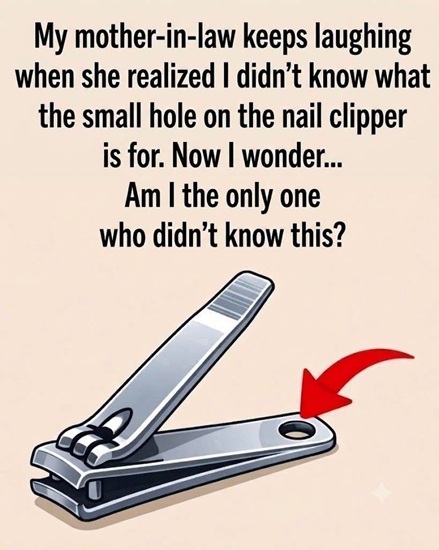
A nail clipper is one of those everyday tools that seems almost too simple to deserve much thought. It fits easily into a bathroom drawer, travel bag, grooming kit, or pocket, and most people learn how to use one without ever considering how its individual pieces work together. Yet a closer look reveals that even a basic metal nail clipper contains several carefully designed mechanical features. One of the details that often attracts attention is a small opening or hole near the lever or at the rear of the clipper.
Online posts sometimes assign dramatic or unusual purposes to this feature, but the real explanation depends on exactly which opening and which clipper design is being examined. The first thing to understand is that nail clippers are not all constructed in exactly the same way. Manufacturers use different shapes, lever arrangements, attachment holes, files, pins and retaining systems. On many traditional lever-style clippers, a central pivot pin or post passes through aligned openings in the metal jaws.
The operating lever then connects to that post and uses it as part of the mechanism that converts thumb pressure into cutting force. Other clippers also have a separate hole toward the blunt end that can accept a key ring, chain or lanyard. Treating every visible opening as though it serves one universal purpose can therefore be misleading. The basic cutting mechanism, however, is remarkably elegant.
Most familiar metal nail clippers use two spring-like metal members that form opposing jaws. Their cutting edges meet at one end, while the rest of the body remains slightly separated when the clipper is not being pressed. A lever sits above the upper jaw and provides mechanical advantage. When the user pushes down on the broad end of the lever, that force is transferred through the clipper’s pivot and contact points, causing the cutting edges to move together.
This system is a compact example of leverage. The user applies force over a relatively large and comfortable surface with the thumb. The lever then concentrates that input into a much smaller movement at the cutting jaws. Because the cutting edges are sharpened and aligned, that concentrated force is enough to shear through a fingernail without requiring the user to squeeze the metal body directly with excessive effort.
Historical patents for nail clippers show how carefully engineers have developed this apparently simple arrangement. One design describes a joint pin passing through corresponding holes in the upper and lower portions of the clipper body, allowing the components to remain assembled while the lever operates. The patent describes the joint pin as a structural part of the mechanism and explains how the cutting edges and resilient metal sections work together. This provides strong evidence that holes associated with the pivot area can be essential mechanical features rather than decorative marks.
Another nail-clipper patent describes a cam lever connected with flexible jaw members through a pivot pin. The pin passes through aligned openings in the upper and lower members, while the lever works against the natural spring pressure of the metal jaws. When pressure is released, the resilience of the clipper body helps the cutting edges return to their open position. This basic interaction between lever, pin and spring-like metal explains why such a small tool can repeatedly cut nails with relatively little thumb pressure.
The lever itself must also be able to change position. Anyone who has used a conventional nail clipper has probably noticed that the handle is normally folded down for storage. Before trimming a nail, the user lifts the lever and rotates it into its working orientation. Once positioned correctly, pressing the lever downward forces the upper part of the clipper toward the lower jaw.
This folding arrangement serves several purposes at once. It makes the clipper compact when stored, protects the lever from protruding unnecessarily and allows the same component to become an efficient handle when needed. The design uses very few moving parts, which is one reason traditional nail clippers can remain functional for years.
The small openings and shaped portions around the lever and pin help make that movement possible, but their exact appearance differs by model. Some designs use a notch or transverse bar in the lever that engages with a specially shaped pivot post. Others use openings directly associated with the pivoting components. Because of those differences, it is safer to explain the feature in terms of the specific clipper rather than claiming that every round hole performs exactly the same job.
There is also another kind of hole commonly found on nail clippers: a dedicated attachment point. This is usually located closer to the rear or blunt end of the tool rather than at the cutting mechanism itself. Its purpose can be much simpler. A key ring, chain or cord can pass through it so the clipper can be carried or secured.
This is not merely an internet theory. A published U.S. patent application specifically describes a nail clipper designed with a hole intended to receive a key chain. The design emphasizes keeping the key-ring hole exposed so that the operating lever does not block access to it. The patent even discusses earlier nail-clipper designs that included holes capable of receiving a key chain.
That evidence is important because it shows why two apparently similar holes can have different purposes. One opening may be fundamental to the mechanical connection between jaws, lever and pivot pin. Another may exist primarily as a carrying feature. In some products, a hollow eyelet or attachment feature may even serve more than one structural or practical purpose.
A 1962 nail-clipper patent provides an especially interesting example. It describes a hollow eyelet used in the clipper assembly and explicitly notes that the hollow construction allows the tool to be attached to a key ring or chain. This demonstrates how designers sometimes combine mechanical construction with portability rather than treating those as completely separate concerns.
The ability to attach a nail clipper to another object can be genuinely useful. Small grooming tools are easy to misplace because they disappear into drawers, travel bags and toiletry cases. Connecting one to a key ring or small chain can make it easier to locate.
Travel kits are another obvious use. A short cord or ring can keep a clipper attached to a pouch so it does not fall loose among other items. Some people also attach small clippers to compact grooming sets where scissors, tweezers and other tools are grouped together.
That does not mean every circular opening should automatically have something threaded through it. If the hole is part of the lever or pivot mechanism rather than a dedicated attachment point, adding a thick ring or cord could interfere with the movement of the lever. The safest approach is to look at how the specific clipper operates before attaching anything.
The same principle applies to the idea of using a loop as a grip aid. If a clipper includes a true attachment hole that does not interfere with the mechanism, a small cord loop may provide an additional place to hold or secure it. However, that is an optional user adaptation rather than the fundamental reason all nail-clipper openings exist.
A loop should also never obstruct the lever. The handle needs enough clearance to rotate into position and move through its full pressing range. Anything wrapped around the clipper that restricts that motion can make cutting awkward or potentially cause the tool to slip.
The engineering becomes even more interesting when considering the jaws themselves. They are usually formed from resilient metal so that they naturally tend to separate after pressure is released. This spring action eliminates the need for a separate coil spring in many traditional designs.
When the thumb presses the lever, the jaws flex toward each other. When the pressure is removed, the material’s resilience helps restore the original spacing. That repeated flexing is central to the clipper’s operation.
The cutting edges are shaped to meet precisely. Fingernail clippers usually have a curved cutting profile intended to match the general curve of a fingernail, while larger toenail clippers may use a different curvature or wider jaw.
The effectiveness of the tool depends on alignment. If the upper and lower cutting edges do not meet correctly, the clipper may crush, tear or bend the nail instead of making a clean cut.
That is another reason the pivot and lever system matters so much. The components must remain positioned correctly relative to one another even after repeated use.
The central pin provides an important structural relationship between the parts. In some designs, it also forms the point around which the lever is turned from storage position into working position.
The lever then uses contact with the upper jaw to create the force needed to close the cutting edges.
Although this sounds mechanically complicated when described in detail, the user experiences almost none of that complexity.
A person simply rotates the handle, places the nail between the blades and presses.
That simplicity is evidence of good tool design.
A well-designed everyday object hides most of its engineering from the person using it.
Nail clippers are an excellent example.
Very few separate components are needed.
The body provides both structure and spring action.
The sharpened ends provide the cut.
The pivot holds critical pieces in alignment.
The lever supplies mechanical advantage.
And depending on the model, an additional hole or eyelet can provide a convenient attachment point.
This efficient use of parts helps explain why the basic form has remained recognizable for generations.
Manufacturers have changed materials, coatings, sizes and accessories, but the basic principle remains highly effective.
Modern versions can include textured handles, built-in files, clipping catchers, rotating heads or larger ergonomic grips.
Some are designed specifically for babies.
Others are made for thick toenails.
Some are small enough to attach directly to a key ring.
Despite those variations, the familiar lever-operated metal clipper remains extremely common.
Another detail worth noticing is the nail file sometimes attached to the clipper.
On many models, a narrow metal file folds along the body when not in use.
It may share a pivot or attachment area with other parts of the clipper.
Some files include a pointed tip traditionally used for cleaning beneath nails, although care is advisable because aggressive cleaning beneath the nail can irritate sensitive tissue.
The presence of these additional components can make the purpose of a particular hole less obvious.
A user might see several openings, pins or folded parts in the same small area.
That is why generalizations based on photographs alone can easily become inaccurate.
Internet posts often simplify the explanation by claiming that “the hole on every nail clipper” exists for one surprising hidden purpose.
That style of explanation may attract attention, but manufacturing designs rarely work so universally.
The more accurate approach is to identify the specific hole.
If it surrounds or aligns with the main pivot assembly, it is likely related to the mechanism.
If it is positioned at the blunt end with clear space around it, it may be intended for a key ring or chain.
If a file or another accessory shares the area, the opening may be involved in securing that accessory.
Some designs intentionally combine these functions.
Patent documents show that designers have experimented with nail-clipper mechanisms for well over a century.
An early twentieth-century patent describes levers and cutter blades mounted around a pivot pin, with perforated components receiving the pin and allowing the cutting elements to move. Although that design is not identical to every clipper sold today, it demonstrates how long pivot-based engineering has been central to nail-cutting tools.
Later designs refined the mechanism to improve stability, leverage and user control.
One patent describes structures intended to prevent unwanted sideways movement of the operating lever around the pivot pin.
That may sound like a small improvement, but stability matters when sharp edges are being positioned close to fingertips.
If the lever wobbles excessively, the pressure delivered to the jaws can become less predictable.
The goal is therefore not merely to make the blades move.
They must move together in a controlled and repeatable way.
This is why a tiny opening, notch or pin can be mechanically important.
Small components determine how force travels through the tool.
A few millimeters of metal can determine whether the lever stays aligned or shifts sideways.
That is the kind of engineering people rarely notice until a clipper becomes loose or damaged.
Anyone who has used an old worn-out clipper may recognize the symptoms.
The lever may begin to wobble.
The jaws may not meet evenly.
More thumb pressure may be required.
The blades may bend the nail instead of cutting it cleanly.
Those problems illustrate how much the performance depends on proper alignment.
Regular cleaning can also help maintain the tool.
Small fragments of nail can become trapped around the cutting edges or inside the body.
After use, loose clippings can be removed and the surfaces wiped clean.
If the clipper becomes wet, drying it before storage can help reduce the chance of corrosion, especially on inexpensive metal models or areas where protective finishes have worn away.
Sharing nail clippers also deserves some caution.
The tool comes into close contact with nails and surrounding skin.
A clipper that has been contaminated should be appropriately cleaned before another person uses it.
People with conditions that make foot or nail care medically sensitive may require advice from an appropriate healthcare professional rather than relying only on ordinary home trimming.
It is also important to use the right size tool.
A small fingernail clipper is designed for relatively thin fingernails.
Trying to force very thick material between small jaws can place unnecessary stress on the lever and cutting edges.
A larger toenail clipper is generally better suited to thicker nails.
Forcing the handle harder does not necessarily produce a better cut.
It can instead distort the mechanism or cause the clipper to slip.
Sharp, properly aligned blades require less effort.
A severely dull or damaged clipper is often better replaced than forced.
The attachment hole, when present, should also be kept free of anything that changes the operation of the clipper.
A small key ring at the rear of a model designed for one normally causes no problem.
A bulky chain near a lever that needs to rotate may be different.
The key is to observe the actual geometry of the tool.
If the lever can open, rotate and press normally, the attachment is unlikely to interfere.
If anything catches or restricts movement, it should be removed.
That practical observation also provides a useful way to evaluate online claims.
Instead of assuming a viral “hidden feature” is correct, look at the surrounding parts.
Ask what moves.
Ask what the pin connects.
Ask whether the opening is directly involved when the lever changes position.
Ask whether the hole remains completely separate from the operating mechanism.
Those questions often reveal the real answer without requiring any dramatic explanation.
For example, if a pin physically passes through aligned holes in the clipper body, those openings clearly have a structural purpose.
If a hole sits unused at the far end of the clipper and a ring passes easily through it, its role as an attachment point is equally straightforward.
Engineering should be explained through what the parts actually do.
That approach is more reliable than assigning a purpose because it sounds clever.
The popularity of nail-clipper “secret hole” stories probably comes from the fact that people enjoy discovering overlooked functions in familiar objects.
There is nothing wrong with that curiosity.
Ordinary products often contain thoughtful design decisions that users never consciously notice.
But the real design can be more interesting than an invented hack.
The nail clipper demonstrates how engineers can make several mechanical functions fit into an extremely small object.
The jaws have to remain aligned.
The body needs enough elasticity to reopen.
The lever needs to multiply thumb force.
The pivot needs to keep components connected.
The handle needs to rotate for storage.
And the entire tool must remain small enough to fit easily into a grooming kit.
Some models then add another requirement: a convenient way to attach the clipper to something else.
That is where a dedicated key-ring hole becomes useful.
A patent published in 2011 specifically focused on improving access to such a hole.
The design moved or exposed the hole so that the pivot arm would not obstruct a key ring.
That is particularly strong evidence that key-ring functionality is intentional on at least some clipper designs, not merely something users invented afterward.
At the same time, that patent also proves why saying “the hole is only for a key ring” would be too broad.
The patent describes the attachment hole as a particular feature added to or improved on the clipper.
Other holes elsewhere in the tool serve the mechanical assembly.
Both explanations can therefore be correct depending on which opening is being discussed.
That is the most accurate answer to the common question.
There is no mysterious universal hidden function.
There are several legitimate engineering features that can look similar.
A hole associated with a pivot can help connect and position moving parts.
A separate rear hole can be intended for carrying the tool on a ring or chain.
A hollow eyelet may sometimes provide both assembly and attachment functionality.
The exact design must be examined before deciding which explanation applies.
This distinction also makes the nail clipper a useful reminder about everyday engineering.
Simple objects are rarely truly simple.
They are often the result of many years of small improvements.
A tool becomes successful when the user no longer has to think about its mechanism.
The nail clipper achieves that remarkably well.
Most people can pick one up, rotate the lever and begin using it immediately.
No instructions are needed.
No batteries are needed.
There are very few parts to break.
The same tool can remain functional for years with basic care.
That simplicity is not the absence of engineering.
It is the result of effective engineering.
The next time a small circular opening on a nail clipper catches the eye, the best question is therefore not, “What secret trick is this for?”
A better question is, “Which part of the design am I looking at?”
If the opening belongs to the pivot assembly, it helps make the cutting mechanism possible.
If it is an exposed hole near the rear of the clipper, it may provide a deliberate attachment point for a key ring, chain or lanyard.
If another accessory occupies the same area, the design may serve additional purposes.
The answer depends on the clipper.
What does not change is the basic mechanical idea.
Pressure on the lever is transferred through a carefully arranged pivot system.
The resilient jaws move.
The sharpened cutting edges meet.
The nail is trimmed.
Then the jaws spring apart again when the pressure is released.
That sequence happens in a fraction of a second.
It feels effortless because the clipper’s components have already done the mechanical work.
That is why the small hole, pin and lever deserve more credit than they usually receive.
They are parts of a compact mechanism that turns a small movement of the thumb into useful cutting force.
And on models with an additional attachment opening, the designer has managed to add portability without making the tool significantly larger.
So the most accurate conclusion is also the least sensational.
A nail clipper may contain more than one hole, and those openings do not necessarily serve the same purpose.
Mechanical openings around the pivot help assemble and operate the clipper.
Dedicated holes at the rear can be designed for key rings or chains.
Some constructions combine structural and carrying functions through eyelets or similar components.
There is no need to invent another purpose.
The genuine engineering is interesting enough.
A handful of metal parts, a carefully positioned pivot, a folding lever and two sharpened edges create a tool that millions of people use without giving the mechanism a second thought.
That is the real hidden detail of the nail clipper.
Not a viral trick.
Just clever, compact mechanical design.
