For years, I tried to be the kind of neighbor who was easy to live beside. If someone needed a ladder, a cooler, a roasting pan, or a kitchen appliance, I usually said yes without thinking too much about it. My neighbor Denise had borrowed several things from me over the course of the year, beginning with my ladder in the spring and eventually moving on to items from my kitchen. At first, I treated each request as a normal part of having a friendly relationship with someone who lived next door.
The problem was not that Denise failed to return my belongings entirely. She usually returned them eventually, but they often came back later than promised, dirty, scratched, dented, or missing a small piece. My ladder once came home covered in dried mud, my cooler smelled strongly of fruit punch, and my roasting pan developed a dent in one corner. Whenever I mentioned the condition of something, there seemed to be an explanation. I kept accepting those explanations because I did not want a disagreement over household objects to damage a six-year relationship between neighbors.
Looking back, I realize that I had gradually taught myself to ignore behavior that bothered me. I disliked confrontation, and saying no always felt more uncomfortable than simply handing something over. That changed when Denise asked to borrow my cream-colored stand mixer. It was not simply another appliance sitting in my kitchen. My mother had bought it in 1989, used it regularly for years, and left it behind after she died. The mixer had scratches, a small chip in the enamel, and decades of family memories attached to it.
When Denise asked for it, I initially refused. I explained that it had belonged to my mother and that I preferred not to lend it out. She assured me that she would be careful and said she needed it only to make one cake. After some hesitation, I changed my mind. I handed it over while reminding her to clean it before bringing it back. Almost immediately, I regretted agreeing, but I told myself that nothing serious was likely to happen during a single afternoon of baking.
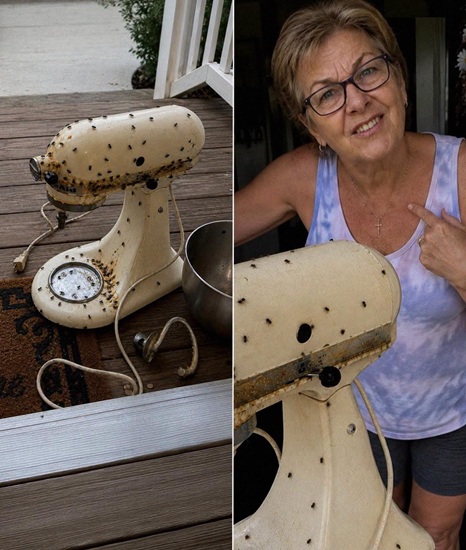
On Saturday morning, I discovered the mixer sitting outside on my porch instead of being returned to me personally. Dried cream had collected around the body, something sticky was on the cord, and the whisk attachment still had hardened icing on it. I spent a considerable amount of time cleaning everything before plugging it in. When I switched the machine on, the familiar sound was gone. The motor produced a grinding noise, the head jerked, and then the machine stopped.
I went next door to ask Denise what had happened. I expected an apology or at least an explanation, but our conversation went very differently. She told me the mixer had begun making a terrible noise while she was preparing frosting and eventually stopped turning. When I asked whether she had continued using it after it began struggling, her answer suggested that she had been trying to finish what she was making. She also pointed repeatedly to the mixer’s age, arguing that an appliance more than three decades old was bound to stop working eventually.
What upset me most was not only the possibility that she had damaged it. It was the lack of concern. The mixer had been returned dirty, left unattended on my porch, and treated as though its sentimental importance did not matter because it was old. My daughter Sophie could immediately see how disappointed I was. Instead of continuing the argument, I decided to find out what had actually happened to the machine before deciding what to do next.
I took the mixer to an appliance repair shop. According to the technician who examined it, the motor showed signs consistent with overheating under a heavy load and continuing to run while it was straining. He explained that age could affect any appliance, but he did not consider what he saw to be ordinary wear alone. The repair estimate was $347. I sent Denise a photograph of the estimate and asked her to cover the cost because the mixer had been working when I lent it to her.
She refused. Her response was that she was not going to spend $347 repairing an appliance from the 1980s and that I should replace it instead. At that point, I realized that repeatedly arguing about responsibility was unlikely to accomplish anything. I paid for the repair myself, but I also decided that the way I lent my belongings was going to change. I did not want revenge. I simply wanted borrowing something from me to come with the same level of responsibility that I had always expected but never clearly enforced.
A few days later, Denise was preparing for a large graduation gathering and came over asking to borrow my cooler, crock pot, and two folding tables. This time, instead of immediately opening the garage, I brought out a simple lending agreement. I had written down each item, an approximate replacement value, the required return time, and three basic conditions: everything had to be returned clean, dry, on time, and in the same condition. I also included a refundable security deposit of $350 and listed the unresolved $347 mixer repair separately.
Denise initially thought I was joking. When she realized I was serious, she called the agreement unnecessary and complained that she had borrowed things from me for years without signing paperwork. I agreed with that part. She had borrowed from me for years, and that was exactly why I had finally created the agreement. I told her she was completely free not to borrow anything. She decided to rent equipment elsewhere and walked back home frustrated.
On the morning of the party, however, she returned. The rental company had apparently failed to provide everything she expected, and she urgently needed the tables and cooler. I brought out the same agreement. After another uncomfortable discussion, she signed it and provided the money we had discussed. I helped her carry the items because my goal was never to interfere with her family celebration. I simply wanted my belongings treated carefully and the mixer repair resolved.
The difference was remarkable. The following afternoon, Denise returned everything well before the deadline. The tables were properly folded, the cooler had been washed and dried, the crock pot was spotless, and even the drink dispenser she had later added to the agreement looked exceptionally clean. Once I inspected everything, I returned the refundable portion of her deposit. The $347 related to the mixer repair was not returned because that money covered the expense that had already been incurred.
That conversation finally became more productive. I explained that the damaged mixer itself was only part of what had hurt me. If Denise had knocked on my door, admitted that something had gone wrong, apologized, and offered to help, I would have viewed the entire situation differently. What bothered me was finding an important family possession dirty and abandoned on the porch, followed by being told that its age made the damage unimportant.
For the first time, Denise acknowledged that she should not have handled the situation that way. She admitted that she had been stressed while hosting people and that she should not have blamed me. Then she apologized. It was not a dramatic moment, and it did not erase everything that had happened, but it mattered because it finally recognized something I had failed to communicate clearly for years: borrowing another person’s property also means accepting responsibility for it.
A short time later, the repair shop called to say my mixer was ready. When the technician switched it on, the motor once again sounded smooth and steady. That weekend, Sophie and I used it to make the kind of simple chocolate cake my mother used to prepare. Hearing the machine running normally again brought back memories of Sundays in my parents’ kitchen, which reminded me why I had cared so deeply about an appliance that someone else might have considered replaceable.
The experience also changed my relationship with Denise in a practical way. She stopped borrowing things for several months. Later, when she eventually asked for my pressure washer, she jokingly asked whether I still had my lending forms. I did. She signed one, borrowed the machine, and returned it clean, on time, and with the fuel tank full. There was no argument and no damaged equipment.
I still believe that sharing things with neighbors can be generous and helpful. What I learned, however, is that generosity does not require ignoring repeated carelessness. Setting boundaries did not make me less neighborly. It simply made the expectations clear for both of us. Once Denise had something of her own at stake, she treated borrowed items differently, and once I stopped being afraid to say no, I stopped feeling resentful every time someone asked for something.
The old mixer is still part of my kitchen. It still has the small chip in its enamel and the scratches it collected over decades of use. To another person, it might be nothing more than an outdated appliance that could easily be replaced by a newer model. To me, it carries memories that cannot be purchased in a store. That was the lesson I should have understood from the beginning: the value of someone else’s belongings is not ours to decide, and respecting those belongings is part of respecting the person who trusted us with them.
