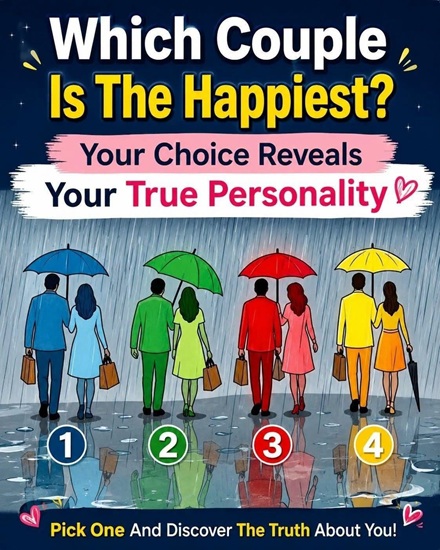
A colorful illustration showing four couples walking through the rain asks viewers a deceptively simple question: which couple appears happiest? Each pair is represented by a different color—blue, green, red, or yellow—and popular versions of the puzzle connect those colors with different ideas about relationships. Some people may immediately notice one couple, while others may spend time comparing all four before making a choice.
The exercise can be entertaining because it encourages people to think about what happiness in a relationship looks like to them. However, the result should not be treated as a scientifically validated personality assessment. A preference for one illustration cannot reliably determine someone’s personality, compatibility, or the quality of their real relationships. The interesting part of the puzzle is therefore not whether it can reveal a hidden psychological truth. Its value comes from the conversation it can create about love, companionship, trust, independence, passion, and personal expectations.
Different people naturally prioritize different qualities in relationships, and those priorities may also change throughout life. Someone who currently wants stability may respond differently from someone who is excited about a new relationship or recovering from a difficult one. Even the viewer’s mood at the moment of seeing the picture can affect which couple attracts attention first. The four choices are best understood as symbolic prompts rather than fixed categories.
The first couple is represented in blue, a color commonly associated in this particular puzzle with calmness, loyalty, security, and emotional stability. The pair appears close without relying on especially dramatic gestures, creating an impression of comfortable companionship. For someone attracted to this scene, happiness may be associated with knowing that another person will remain dependable when circumstances become difficult. The umbrella can be interpreted symbolically as two people facing unpleasant conditions together rather than allowing the rain to separate them. That interpretation emphasizes partnership over spectacle. It presents love as something demonstrated consistently rather than only during exciting moments.

People who choose the blue couple may therefore identify with the idea of a peaceful relationship. They may appreciate patient conversations, predictable support, reliability, and the feeling of being emotionally safe with another person. A quiet evening together might feel every bit as meaningful as an elaborate romantic gesture. Trust may be built through ordinary actions repeated over months and years rather than through dramatic promises. In this interpretation, love does not need to be constantly exciting in order to feel strong. Stability itself becomes an important expression of affection.
There is an understandable appeal to that kind of partnership. Relationships inevitably encounter periods when life is less exciting, whether because of work, responsibilities, family concerns, financial pressure, illness, or ordinary daily routines. A relationship built on reliability can provide a sense of continuity during those periods. Partners may know that disagreement does not automatically mean abandonment and that temporary difficulties do not erase their commitment. The blue interpretation therefore places considerable importance on trust developed over time. It treats emotional security as something valuable rather than boring.
Yet even positive qualities can become complicated when taken too far. Loyalty does not mean someone should tolerate repeated disrespect, manipulation, abuse, or serious boundary violations. A person who places enormous value on keeping relationships together may sometimes find it difficult to recognize when staying is causing more harm than leaving. Commitment works best when it exists alongside mutual respect and safety. Remaining in an unhealthy situation simply because ending it feels like failure is not the same thing as building a stable partnership. The blue interpretation can therefore encourage reflection on the difference between healthy commitment and unhealthy endurance.
Emotional safety also does not require avoiding every disagreement. Healthy couples can disagree, become frustrated, and occasionally need space from each other. The important question is how those disagreements are handled. Partners can communicate honestly without humiliation, threats, intimidation, or deliberate cruelty. A calm relationship is not necessarily one without conflict; it may instead be one where conflict can occur without destroying the basic sense of respect. That distinction gives the blue symbolism more depth than simply describing someone as peaceful.
The second couple is represented in green. Within the puzzle, green is associated with growth, renewal, compassion, adaptability, and the idea that relationships can evolve over time. Someone drawn to this pair may see happiness as two people encouraging each other to develop rather than expecting each other to remain exactly the same forever. People change as they gain experience, pursue goals, encounter challenges, and discover new priorities. A relationship capable of adapting to those changes may feel particularly attractive to someone choosing green. Love, in this interpretation, involves growing beside another person rather than freezing both partners at the moment they first met.
This perspective can place considerable importance on encouragement. A supportive partner may celebrate another person’s education, career ambitions, creative interests, friendships, or personal development. Instead of feeling threatened by change, the relationship can create room for both people to become more fully themselves. Partners do not need identical goals in order to support one another. What matters is the willingness to take each other’s aspirations seriously. Green therefore symbolizes a relationship where development is treated as something to share rather than something to fear.
Adaptability can also become especially valuable during major life transitions. Moving, changing careers, becoming parents, caring for relatives, dealing with health problems, or entering a different stage of adulthood can alter the routines of a relationship substantially. Couples may need to renegotiate responsibilities and expectations as circumstances change. A partnership that worked perfectly at one stage may require adjustments at another. The green interpretation acknowledges that healthy relationships are rarely completely static. Maintaining connection can require both people to learn and adapt.
Compassion is another quality associated with this choice. Someone attracted to green may instinctively want to understand what another person is experiencing and provide support during difficult periods. Empathy can strengthen relationships because partners feel heard rather than dismissed. It can also make disagreements less adversarial when both people are willing to consider perspectives beyond their own. However, empathy works best when it exists in both directions. One person should not be expected to provide endless understanding while receiving little consideration in return.
This leads to the potential weakness associated with the green interpretation. People who strongly identify with helping and supporting others can sometimes neglect their own needs. They may repeatedly excuse harmful behavior because they believe the other person is still “growing” or needs more time. Forgiveness can be valuable, but forgiveness without meaningful change can become a repeating cycle. Supporting someone’s development does not require accepting unlimited mistreatment. Healthy growth requires responsibility from both partners.
The idea of changing someone can also become problematic. Encouraging a partner is different from treating that person as a project that needs to be repaired. A relationship should not depend entirely on the hope that someone will eventually become a fundamentally different person. Green works best as a symbol of mutual development, where both individuals are capable of reflection and adjustment. Growth should expand the relationship rather than become an excuse for permanent dissatisfaction. The strongest version of this interpretation involves two people taking responsibility for themselves while supporting one another.
The third couple is represented in red, visually one of the strongest colors in the illustration. The puzzle associates red with passion, romance, intensity, desire, and openly expressed affection. Someone whose attention immediately moves toward this pair may appreciate relationships where feelings are communicated clearly and enthusiastically. Love may feel most meaningful when it is visible rather than implied. Romantic gestures, physical affection, emotional conversations, and a strong sense of attraction may all be especially important. The red interpretation presents relationships as experiences that should feel vivid and emotionally engaging.
There is nothing inherently unhealthy about wanting passion. Attraction and affection can contribute meaningfully to romantic relationships, and many people enjoy partners who communicate feelings openly. Enthusiasm can make another person feel appreciated rather than taken for granted. Celebrating anniversaries, expressing affection, planning surprises, or simply saying how much someone matters can strengthen a sense of connection. For people drawn to red, emotional expression may feel like an essential part of maintaining closeness. Silence may sometimes be interpreted as distance even when that was not the partner’s intention.
People also differ considerably in how they express affection. One person may communicate love through words and physical closeness, while another demonstrates it through reliability, practical help, or spending time together. These differences do not necessarily indicate different levels of commitment. A quieter person can feel deeply attached without expressing emotion dramatically. Conversely, highly romantic gestures do not automatically prove that a relationship is stable or respectful. The red interpretation becomes more useful when it acknowledges this distinction.
Intensity can occasionally create challenges when someone expects another person to communicate at exactly the same emotional level. One partner may want immediate discussion after a disagreement, while the other needs time to think. One may enjoy frequent messages and reassurance, while another feels comfortable with more independence. Neither preference automatically makes someone more loving. Problems can arise when differences are interpreted as rejection instead of being discussed openly. Passion works best alongside respect for another person’s emotional style.
The same caution applies to conflict. Strong emotional chemistry can make positive moments feel extraordinary, but it can also make disagreements feel overwhelming if both partners react intensely. Healthy passion should not be confused with constant volatility. Repeated cycles of extreme conflict followed by dramatic reconciliation are not automatically evidence of deep love. Stability, boundaries, and respectful communication remain important even in highly passionate relationships. Emotional intensity is one ingredient rather than a complete measure of relationship quality.
Someone choosing red might therefore use the puzzle as an opportunity to ask what passion actually means personally. Does it mean affection, attraction, excitement, honesty, adventure, or constant reassurance? Which forms of intensity strengthen a relationship, and which become exhausting? Those questions are more useful than assuming that selecting a red illustration proves someone has a particular personality type. The image can begin reflection without providing a psychological diagnosis. Personal meaning comes from the viewer’s own answers.
The fourth couple is represented in yellow, which the puzzle connects with optimism, confidence, creativity, humor, and independence. This pair appears bright against the gray atmosphere created by the rainy scene. Someone drawn to yellow may imagine happiness as a relationship where two individuals can enjoy each other’s company without losing their separate identities. Love does not have to require constant closeness or complete agreement. Instead, the relationship can provide companionship while leaving room for personal interests and independence. Freedom and commitment are treated as compatible rather than contradictory.
This interpretation may appeal especially to people who value individuality. They may want a partner who supports friendships, hobbies, career goals, and time spent independently. They may also be comfortable allowing their partner the same freedom. Trust reduces the need to control every activity or demand constant reassurance. Both individuals remain complete people while choosing to share part of their lives. The relationship becomes an addition to identity rather than a replacement for it.
Humor can be another important element of the yellow interpretation. Being able to laugh together can help couples enjoy ordinary moments and reduce tension when life becomes stressful. Shared jokes and playful interactions can create a sense of friendship alongside romance. Optimistic partners may also help each other maintain perspective when difficulties arise. A rainy day does not necessarily ruin everything if the couple can still find something enjoyable within it. That symbolic contrast explains why yellow fits naturally into the illustration.
However, optimism also has limits. Positive thinking should not become a way of refusing to acknowledge real problems. Someone who dislikes conflict may use humor to change the subject whenever serious issues arise. Another person may insist that everything is fine because discussing disappointment feels uncomfortable. Avoiding difficult conversations can create temporary peace while allowing unresolved problems to accumulate. Healthy optimism makes problems feel manageable; it does not require pretending they do not exist.
Independence can similarly become unhealthy when it turns into emotional distance. Maintaining individual interests is different from refusing vulnerability or never allowing a partner to provide support. Relationships generally require some degree of interdependence, where both people can remain individuals while also relying on each other appropriately. The yellow interpretation is therefore strongest when freedom exists alongside emotional availability. Independence should create breathing room rather than permanent separation.
Some viewers may look at the four couples and find themselves unable to choose. That response does not mean the puzzle has failed. It may simply indicate that several qualities feel equally important or that the viewer does not believe happiness can be judged from a single illustration. Both reactions are reasonable. A healthy relationship can contain stability, growth, passion, and independence simultaneously. Real people rarely fit neatly into one color category.
Someone may also question whether any of the illustrated couples can genuinely be described as happy based solely on body language. That skepticism is justified. A frozen image cannot reveal what happens when two people disagree, whether they respect each other’s boundaries, or whether either person feels emotionally safe. Clothing, posture, physical proximity, and facial expressions provide limited information. They cannot reveal an entire relationship. The couple that appears most affectionate in a drawing is not automatically the healthiest one.
This is an important limitation whenever casual personality tests use photographs or illustrations. Human relationships are complex and unfold over time. Trust is demonstrated through behavior across many situations, not through one pose. Respect becomes visible in decisions, communication, boundaries, and everyday treatment. Emotional safety cannot be measured by how closely two illustrated people stand beneath an umbrella. A visual puzzle can symbolize these ideas but cannot evaluate them scientifically.
Current mood may also influence the choice more than people realize. Someone who has recently experienced conflict may find the peaceful blue couple especially appealing because calm is what feels missing. A person excited about a new romance may notice red first because passion matches their current emotional state. Someone starting a new stage of life may identify with green and the idea of growth. A viewer who has recently felt restricted might be especially attracted to the freedom represented by yellow.
This means the answer can potentially change from one day to another. If someone completed the same exercise months later, a different couple might attract attention. That would not mean their personality had completely transformed. Their circumstances, needs, memories, or mood may simply have changed. Human preferences are often more flexible than online personality categories suggest. Treating the result as temporary reflection rather than permanent identity is therefore more realistic.
Color itself can also influence attention independently of any relationship meaning. Red naturally stands out strongly in many visual compositions, while yellow can appear especially bright against darker surroundings. Blue and green may create different levels of visual contrast depending on the illustration. Someone might choose a couple partly because the color caught their eye first rather than because of a deep emotional preference. This is another reason the result cannot be treated as a validated psychological measurement. Visual design affects choice.
Previous experiences can matter as well. Someone who grew up around stable long-term relationships may associate happiness with quiet companionship. Another person may value independence strongly after experiencing a controlling relationship. Someone whose previous partnerships lacked affection might place greater importance on visible romance. These reactions can be meaningful to the individual without being predictable from the illustration alone. Personal history gives symbols their significance.
Culture also influences how people think relationships should look. Public displays of affection are normal in some communities and less common in others. Expectations surrounding independence, marriage, family responsibilities, gender roles, and emotional communication can differ widely. A single illustration cannot account for those differences. The same pose may communicate affection to one viewer and excessive dependence to another. Interpretation is shaped by context.
Age and life stage can influence priorities too. A teenager imagining an ideal romance may focus on excitement and emotional intensity. Someone balancing work and family responsibilities may place greater value on dependability and shared responsibility. A person rebuilding life after a major transition may prioritize independence or personal growth. None of these preferences is automatically superior. Different qualities can become important at different times.
The exercise becomes more useful when the question changes from “What does my choice prove about me?” to “Why did this particular couple appeal to me?” That second question encourages reflection without pretending the image has diagnostic power. Someone choosing blue might realize they are currently craving stability. A green choice could reveal that personal development feels especially important. Red may prompt thoughts about affection, while yellow may raise questions about freedom and individuality.
A second useful question is whether those preferred qualities actually appear in someone’s real relationships. Wanting stability is different from practicing reliable communication. Valuing growth is different from supporting a partner’s goals when those goals require compromise. Enjoying passion is different from maintaining respectful behavior during conflict. Celebrating independence is different from respecting another person’s boundaries. Ideals become meaningful when they are connected with behavior.
The four colors can therefore function as conversation starters. Two partners could independently choose a couple and explain their reasoning. Their answers might reveal different expectations about what makes a relationship feel satisfying. One person may emphasize security while another emphasizes affection. Discovering that difference does not necessarily signal incompatibility. It can provide an opportunity to understand what each person values.
Partners may even choose different colors while wanting many of the same things. Someone selecting blue may appreciate stability but still enjoy passion. A red choice does not mean the person rejects loyalty. Someone attracted to green may also need independence, while a yellow choice does not exclude emotional closeness. The categories overlap because real relationships contain multiple dimensions. Treating them as mutually exclusive would oversimplify human behavior.
There is also no objectively correct couple to choose. The illustration may ask which one appears happiest, but happiness cannot actually be established from the available information. Every answer reflects interpretation. The puzzle works precisely because different viewers can construct different stories around the same images. That ambiguity creates discussion.
A person who immediately identifies one pair may simply be responding to visual composition. Someone who spends several minutes comparing the couples may be more interested in analyzing the symbolism. Neither response indicates superior emotional intelligence. Speed has no validated meaning here. The exercise is recreational rather than diagnostic.
The same caution applies to claims about relationship compatibility. Two people choosing the same color are not necessarily better matched than people choosing different colors. Compatibility involves communication, values, expectations, boundaries, attraction, practical circumstances, and many other factors. No single visual preference can capture all of that information. A matching answer may create an interesting conversation, but it should not be treated as evidence about the future of a relationship.
What research on relationships can support more broadly is the importance of factors such as respectful communication, trust, emotional responsiveness, constructive approaches to conflict, and mutual support. Healthy relationships also allow boundaries and individual autonomy. Those qualities develop through repeated behavior rather than symbolic color choices. An illustration can represent them metaphorically, but it cannot measure whether they are actually present. That distinction keeps the puzzle entertaining without turning it into misinformation.
The umbrella in the image provides a useful metaphor for this broader idea. Rain can represent difficulties that inevitably appear during life, while sharing shelter can symbolize support. Yet real partnership requires more than standing under the same umbrella. Sometimes one person needs to hold it while the other handles something else. Sometimes both need to decide where they are going. Cooperation involves practical behavior rather than appearance alone.
The blue interpretation highlights the importance of having someone dependable when difficulties arrive. Green emphasizes adjusting together when circumstances change. Red focuses on keeping affection and emotional connection alive. Yellow emphasizes preserving optimism and individuality. None of these qualities needs to defeat the others. A strong relationship can potentially contain elements of all four.
