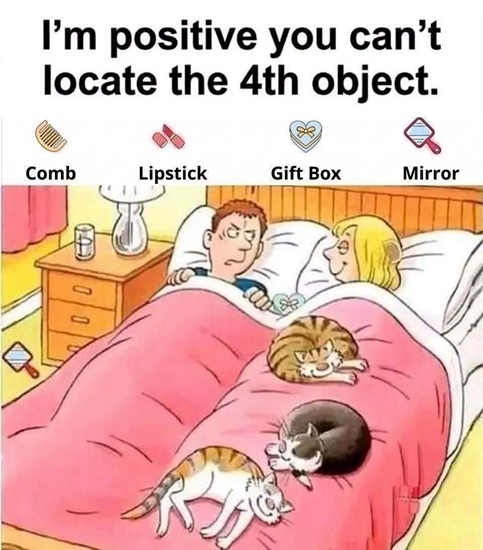
At first glance, the bedroom illustration looks simple enough. A couple is shown together in bed, surrounded by ordinary furniture, bedding, walls, and a visible section of floor. Nothing immediately appears unusual, which is exactly what makes the puzzle effective. Four everyday objects have been hidden inside the scene, but none of them appears in the place where someone would normally expect to find it. The challenge is to locate a comb, a small gift box, a mirror, and a tube of lipstick.
Each object has been carefully blended into another part of the drawing so that the surrounding shapes distract the viewer from recognizing it. The puzzle becomes difficult because the human eye does not inspect every detail with equal attention. Most people immediately look at the faces of the two people, the center of the bed, and the larger objects in the room. Small lines and shapes around those areas can easily be ignored because the brain quickly decides what it thinks it is seeing.
A dark line in someone’s hair becomes part of the hairstyle, while a rectangular shape on a blanket may be interpreted as a fold. The objects are therefore not invisible in a literal sense. They are visible from the beginning, but their placement makes them easy to misclassify. One of the hidden objects is the comb. Instead of appearing on a dresser, nightstand, or bathroom surface, it has been worked into the woman’s hair. The teeth of the comb follow the lines and texture of the hairstyle closely enough that they can initially look like ordinary strands.
Someone searching only for a separate object is likely to overlook it. The best clue is to look for a series of evenly spaced parallel lines that seem slightly more regular than natural hair. Once the comb is recognized, its outline becomes much easier to see. The placement of the comb demonstrates one of the most common techniques used in hidden-object illustrations. An artist can conceal an object by matching its defining feature with something already present in the scene.
A comb naturally contains a row of repeated teeth, and hair can also contain many narrow lines. By placing those two visual patterns together, the artist allows one shape to disguise another. The viewer’s expectation does the rest of the work. Because no one expects a comb to be physically hidden inside a hairstyle, the brain tends to interpret the lines as hair first.
The second hidden item is a small gift box. It is located between the couple on the bed, an area that already contains several overlapping shapes and folds. The rectangular edges of the box can merge with the pillows, blanket, and the space created by the two people. Since the center of the illustration contains so much visual information, a small geometric object can disappear surprisingly well. A viewer may look directly at it several times without recognizing it. Searching specifically for straight edges or a small box-like outline can make the object easier to detect.
The gift box is a useful example of how clutter affects visual attention. When several shapes overlap, the brain tends to group them into one larger scene rather than process each outline individually. Bedding naturally creates folds, corners, shadows, and blocks of color, which gives the artist many opportunities to hide a rectangular object. The box does not need to be completely covered in order to remain difficult to see. It only needs to resemble the shapes surrounding it closely enough. Once the viewer stops seeing “bed” and begins searching for geometry instead, the hidden object often becomes obvious.
The third missing object is the mirror. Unlike the comb and gift box, the mirror is not hidden in the most visually dominant part of the illustration. It appears closer to the floor, meaning people who keep staring at the bed may never notice it. Its shape blends into the lower portion of the room and may initially look like part of the furniture, flooring, or another decorative feature. This placement encourages viewers to expand their search beyond the central figures. Looking deliberately at the bottom section of the illustration can reveal details that attention initially skipped.
A mirror can also be difficult to identify because it does not have only one universal shape. Some mirrors are round, others oval, rectangular, or handheld, and their frames can vary widely. For this puzzle, looking for an outline that resembles a frame or reflective surface is more useful than expecting a specific household mirror. If the hidden item includes a handle, that narrow extension may be easier to notice than the reflective section itself. Searching by components rather than complete objects is one of the best strategies for this type of challenge. The mirror becomes easier once the viewer knows which visual features to isolate.
The final item is the lipstick. It is positioned along the lower right portion of the comforter close to the floor. Its long, narrow form follows the edge and pattern of the bedding, allowing it to look more like a decorative line than a separate cosmetic item. A tube of lipstick normally belongs on a dresser, in a handbag, or near a mirror, so the unusual location works against the viewer’s expectations. The brain sees fabric before it sees makeup. Looking for a slim cylindrical outline can help reveal the lipstick.
The lipstick demonstrates another effective method used by puzzle artists: placing an object where it makes very little logical sense. Familiar objects are often recognized partly because of context. A toothbrush beside a sink is easy to identify because both its shape and location are expected. The same toothbrush hidden in tree branches would take longer to notice because the context contradicts what the brain expects. In this illustration, the lipstick is visible, but its placement along the comforter encourages the viewer to classify it as part of the blanket. Context becomes part of the camouflage.
These four hiding places explain why the puzzle can remain challenging even when someone knows exactly which objects to search for. The problem is not simply identifying a comb, gift box, mirror, and lipstick. The real challenge is separating each object from the visual structure that surrounds it. People naturally use context to understand complicated scenes quickly. That ability is extremely useful in everyday life, but puzzle designers can turn the same mental shortcut against the viewer. Familiar shapes become surprisingly difficult to recognize when they appear in unfamiliar locations.
A useful way to solve the image is to divide it into smaller areas rather than repeatedly scanning the entire picture. Start with the people and inspect clothing, hair, hands, and nearby shapes carefully. Then move to the bed, examining the pillows, sheets, comforter, and the space between the figures. After that, inspect the furniture, walls, floor, and outer edges. This method reduces the amount of information the brain has to process at one time. It also decreases the chance that the same visually dominant areas will keep attracting attention.
Another strategy is to search for each object’s defining feature. For the comb, look for repeated parallel teeth rather than the entire silhouette of a grooming tool. For the gift box, search for straight sides, square corners, or something resembling a ribbon or lid. For the mirror, look for a frame, reflective shape, or narrow handle. For the lipstick, search for a small cylinder or tube. Breaking familiar objects into their basic components can make them much easier to identify when camouflage hides the complete form.
Viewing distance can also affect performance. Looking closely at the screen helps reveal tiny lines, but staring from extremely close range can sometimes make the overall shape harder to recognize. Moving slightly farther away may allow separate lines to combine into a recognizable object. Zooming in and out can therefore be useful. A change in viewing angle or image size can sometimes reveal an edge that previously blended into the background. The illustration itself does not change, but the way the visual information is processed can.
Some people also find it helpful to cover part of the image while searching another section. This prevents the faces or other prominent details from repeatedly pulling attention back toward the center. Another technique is to scan slowly from left to right and then from top to bottom. A systematic search can be more effective than jumping randomly between interesting areas. The goal is not speed alone. A careful scan increases the probability of noticing unusual lines and shapes.
It is important to remember that puzzles like this are designed primarily for entertainment. They are not scientific measures of intelligence, cognitive ability, or overall observational skill. Someone who finds all four objects quickly is not necessarily more intelligent than someone who takes several minutes. Performance can be affected by eyesight, screen resolution, image size, previous experience with hidden-object puzzles, and even whether the person already knows common hiding techniques. Familiarity often creates a major advantage.
A person who frequently completes these puzzles may automatically inspect hairstyles, blanket folds, picture frames, shadows, and corners because those locations are commonly used by illustrators. A first-time solver may search only obvious places such as tables and drawers. That difference reflects strategy and experience rather than a meaningful difference in intelligence. Once someone learns how artists disguise objects, future puzzles often become easier. The brain begins searching for inconsistencies instead of simply recognizing the overall scene.
The puzzle also illustrates how strongly expectations influence visual perception. People have learned that combs are associated with hair care, but they normally expect the comb itself to sit beside the person rather than become part of the hairstyle. Gift boxes are expected to be separate objects, not shapes embedded within blankets. Mirrors belong on walls or furniture, while lipstick normally appears among personal belongings. When those expectations are deliberately violated, familiar objects can become surprisingly difficult to notice. The eye sees the lines, but the brain gives them another explanation.
This phenomenon is not unique to puzzles. Everyday perception depends heavily on context because processing every detail independently would be slow and inefficient. People recognize objects by combining shape, color, position, previous knowledge, and surrounding information. Hidden-object puzzles manipulate that efficient system by creating conflicting clues. An outline may say “comb,” while its position and color say “hair.” The viewer usually accepts the explanation provided by the larger scene until careful attention reveals the contradiction.
That is also why the objects become almost impossible to ignore after the solution is revealed. Before finding the comb, the viewer may stare directly at it without recognizing anything unusual. After identifying it, the teeth stand out immediately. The same effect happens with the gift box, mirror, and lipstick. The physical image has not changed at all. What changes is the viewer’s interpretation of the lines.
Once a hidden object has been correctly categorized, the brain begins treating its separate lines as one meaningful shape. What previously looked like random details suddenly becomes a coherent object. This explains the familiar reaction of wondering how something so obvious could have been missed. It was visible all along, but visibility and recognition are not exactly the same thing. Recognition depends on how the brain organizes what the eyes provide. Hidden-object puzzles make that difference entertainingly clear.
The puzzle can also work well as a group activity. Friends or family members can view the same image and compare how long it takes each person to find the four objects. For a fairer comparison, everyone should ideally use the same image size and have approximately the same amount of time. Revealing the locations too quickly removes much of the challenge. A better approach is to provide increasingly specific hints only when someone becomes stuck.
The first hint might simply state that none of the four objects is placed where it would normally belong. If that is not enough, a second hint could explain that some items have been blended into the people or bedding. Another hint could identify general zones such as hair, bed, and floor without naming the precise locations. This keeps the solver actively searching rather than simply pointing directly at the answer. Good hints narrow the field without completely removing the challenge.
For children, hidden-object puzzles can become an opportunity to practice descriptive language. Instead of asking only whether they found an item, an adult can ask what feature helped them recognize it. A child might explain that the comb was noticeable because of its repeated teeth or that the gift box had straight edges unlike the surrounding folds. Describing visual evidence encourages careful observation. It also turns the activity into more than a race to announce the correct answer.
Adults can use the same approach when comparing strategies. One person may begin with the center because that is where the main characters are located. Another may immediately inspect the corners because puzzle designers often hide objects away from the focal point. Someone else may search for shapes instead of locations. Comparing those methods can be more interesting than simply recording who finished first. Different search strategies reveal how people organize visual information.
The puzzle can become especially frustrating when only one object remains. After finding three items, people often repeatedly inspect the same areas where they already succeeded. At that stage, it is helpful to deliberately change strategy. If the first objects were found around the people and bed, focus exclusively on the floor or edges. If searching by location has failed, search by geometric features. Changing the question from “Where is the lipstick?” to “Where is there a narrow cylindrical shape?” can make a significant difference.
Another useful tactic is to ignore color. Hidden objects are often shaded to match their backgrounds, which makes color an unreliable clue. Shape and line direction can provide more useful information. A series of perfectly parallel lines among irregular hair strands may reveal the comb. Straight corners in an area dominated by soft fabric can reveal the gift box. A narrow rigid-looking form along a curved blanket can reveal the lipstick.
The four objects also differ in how much context works against them. The comb is connected conceptually with hair, but physically placing it inside the hairstyle creates confusion. The gift box has no strong visual relationship with bedding, yet its geometric edges blend with folds. The mirror is hidden partly through location because attention is focused higher in the scene. The lipstick combines an unexpected location with a shape that can easily resemble part of the comforter. Each hiding method exploits perception slightly differently.
Knowing those techniques can make future hidden-object puzzles easier. Look for lines that seem too regular, shapes that are slightly more geometric than their surroundings, and objects whose outlines have been incorporated into clothing, hair, architecture, or furniture. Pay special attention to boundaries where two visual areas meet. Artists can hide objects effectively along those edges because part of the outline can disappear into one region while another part blends into the next. Corners and overlapping shapes are especially useful for camouflage.
The bedroom scene is therefore more carefully designed than it may initially appear. The people and furniture provide recognizable content that captures attention, while the small hidden objects occupy less obvious visual roles. The composition encourages viewers to understand the overall story before studying individual lines. That natural reading of the image creates the puzzle. Only after someone deliberately slows down does the second layer become visible.
There is no need to worry if the objects take a long time to find. Some illustrations are easier to examine on a large computer monitor than on a small phone screen. Compression, brightness, and image quality can make thin outlines more difficult to see. People with different levels of visual acuity may also experience the challenge differently. These practical factors are another reason the puzzle should not be treated as a meaningful intelligence test. It is simply a visual game built around attention and expectation.
For anyone who wants to attempt the challenge without immediately seeing the solution, the best approach is to remember the four targets: a comb, a gift box, a mirror, and lipstick. Search slowly and resist the temptation to look only where those objects would logically belong. Examine the hair, bedding, lower portions of the room, and edges of the illustration. Look for defining shapes rather than colors. Give the image a little time before checking the answers.
If the search is over, the locations can be summarized clearly. The comb is hidden within the woman’s hair, where its teeth resemble strands. The gift box is positioned between the couple on the bed and blends into the surrounding bedding. The mirror is located down near the floor, outside the area that attracts most initial attention. The lipstick is concealed along the lower right edge of the comforter near the floor. Once those locations are known, each item becomes substantially easier to recognize.
That final transformation is what makes the puzzle satisfying. During the search, the four objects seem almost absent. After they are found, they appear so clearly that it becomes difficult to understand why they were overlooked. The image demonstrates how perception depends on more than simply having something directly in front of the eyes. Expectations, context, attention, and previous experience all influence what people recognize. The hidden objects were present from the very beginning; the challenge was persuading the brain to see them differently.
Ultimately, this bedroom puzzle is best enjoyed as a light visual challenge rather than a judgment of anyone’s intelligence. Some people will spot all four objects quickly, while others will need hints or several careful scans. Both experiences are completely normal. The interesting part is noticing how cleverly ordinary shapes can disappear when they are placed in unexpected surroundings. A comb, gift box, mirror, and lipstick become surprisingly difficult to find simply because the illustration convinces the viewer to see hair, bedding, furniture, and decoration instead.
